
Letters to the Editor
All letters will be carefully considered; those of general interest will be used. Send to Model Aviation, 1810 Samuel Morse Dr., Reston, VA 22090.
Martin China Clipper
What a magnificent model—the China Clipper by Bud Chappell (December 1983 issue). It is the sort of model I dream about. Knowing my limitations, I have never attempted to build one.
I appreciate the history of the full-size plane which often is incorporated in MA articles. In regard to the China Clipper article, I am wondering if there were only the three Martin M-130s mentioned in the article. During WWII, while I was in the Navy helping out Nimitz, Spruance, Halsey, et al., I was stationed at NAS Alameda from around March to July 1945. I was with FAETU-Pac, Det. 2. We had aboard the station a Clipper on beaching gear that was on a concrete apron. It was a four-engine job, a creamy beige in color (I think), and it had a name painted on the bow as does the Clipper in Chappell's article. I no longer remember the exact name, but I do remember that it was (something) Clipper. Could it have been a fourth of the China Clipper type? Could it have been a Boeing 314 Clipper? I just don't know.
The Martin Mars was also there at the time, berthed directly across from our building. The tail was toward us, and what a mess it made of our building every time it left the area; it blew salt spray, muck, etc., all over whenever it was revved up. The Mars was being used to carry wounded servicemen from the Pacific area. A long line of ambulances would meet the Mars every time she returned. I wonder what has happened to her.
Once again—Chappell's Clipper—fantastic!
Ed Lowe Holdingford, MN
We thought that Bud Chappell might be knowledgeable on some of these questions. His response follows.
Mr. Lowe is correct in his belief that there were more Clippers, for Pan Am still names its planes "clippers" to this day, even though they are now landplanes. I think that the Clipper referred to was a Boeing 314 Clipper; these were produced in larger quantity than the Martin Clippers. Martin built just three of the M-130 machines, and a fourth one, the M-156, was the little-known Russian Clipper.
In 1936 Russia ordered a larger version of the China Clipper, which had a 157-ft. wingspan and was 90 ft. 7 in. long. The engines were larger, and top speed was 190 mph. The plane had dual rudders placed outboard on the stabilizer, similar to the arrangement of the Martin Mariner PBM.
The one-of-a-kind aircraft was completed in 1937. It was test flown in the Baltimore area, then dismantled for delivery to Russia by ship. No further information regarding its history has ever been revealed.
Bud Chappell Portland, CT
He Will Succeed
An award for Best Article of the Year should go to Walt Seaborg for his piece on the young handicapped RC flier Steve Massey, his parents, and his mentor, Bill McFarland (December 1983 issue, page 44).
Great pictures, skillful writing, and an extraordinary sensitivity on the part of the author combine here in a story that fills the reader with heartwarming pride for all concerned. First rate!
Dave Ritchie Hatfield, PA
First RC Glider
Just a bit of correction. On page 10 of the January issue (Letters to the Editor) Roger Schroeder wrote that the Thermic 100 was the first RC glider. This is not the case. There were others, including those by DeSoto.
The actual fact is that the Thermic 100 was the first RC glider kit. And it was a bit before its time. When RC gliders became popular, the kit had been discontinued. However, I have the rib dies and a small stock of the ribs.
Frank Zaic Northridge, CA
Max Bassett and Bill Brown
I have been following the articles about Max Bassett and his gas models in the September, October, and November issues. Max's experiences in the early '30s and beyond are fascinating. He and Bill Brown were the pioneers in the early gas days.
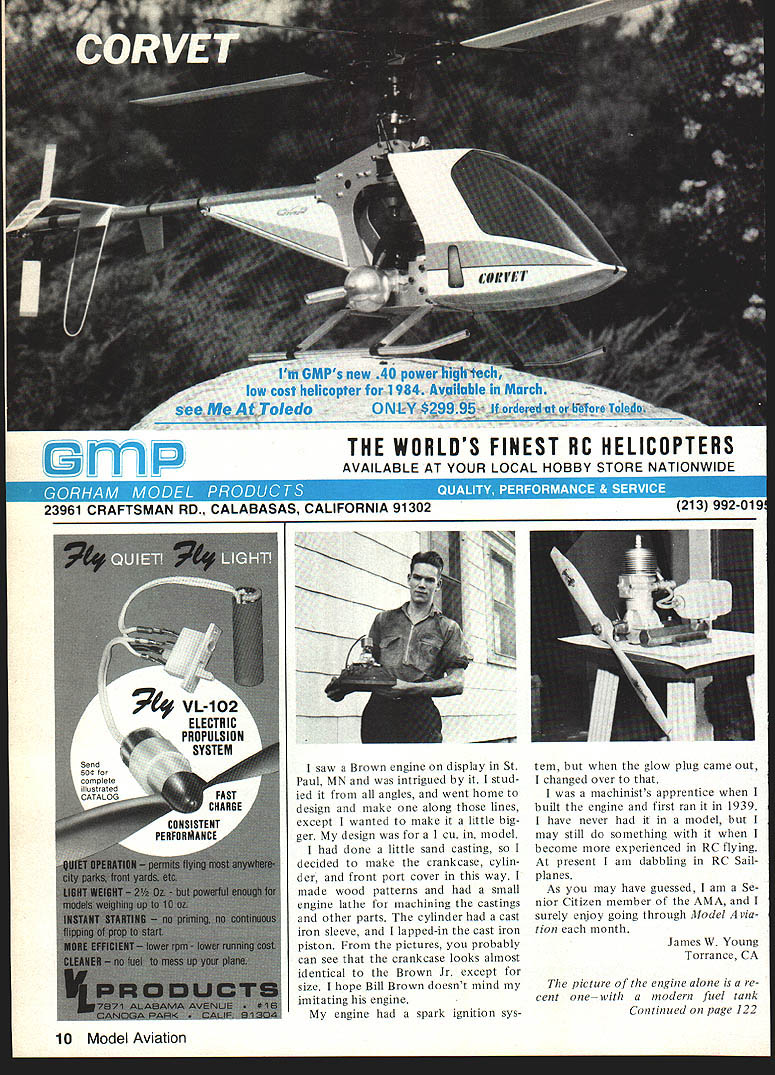
The reason I'm writing, besides commenting on the fine article, is to send a few words and pictures about the experiments I did in the late '30s with small engines. I saw a Brown engine on display in St. Paul, MN and was intrigued by it. I studied it from all angles and went home to design and make one along those lines, except I wanted to make it a little bigger. My design was for a 1 cu. in. model.
I had done a little sand casting, so I decided to make the crankcase, cylinder, and front port cover in this way. I made wood patterns and had a small engine lathe for machining the castings and other parts. The cylinder had a cast iron sleeve, and I lapped in the cast iron piston. From the pictures, you probably can see that the crankcase looks almost identical to the Brown Jr., except for size. I hope Bill Brown doesn't mind my imitating his engine.
My engine had a spark-ignition system, but when the glow plug came out I changed over to that.
I was a machinist's apprentice when I built the engine and first ran it in 1939. I have never had it in a model, but I may still do something with it when I become more experienced in RC flying. At present I am dabbling in RC sailplanes.
As you may have guessed, I am a Senior Citizen member of the AMA, and I surely enjoy going through Model Aviation each month.
James W. Young Torrance, CA
The picture of the engine alone is a recent one — with a modern fuel tank instead of the original aluminum tank that sat beneath the intake and needle valve. The plug looks like a spark-ignition type, but it's really a large-size Champion glow plug. The other picture is dated 1940. Yes, he was running the engine on spark ignition then.
Updated Over-EZ
I read with some interest the article in the January 1984 issue and feel compelled to write and supply a few comments and observations. Joe Johnson did a reasonable job of research in preparing the article, but in all fairness, and from the viewpoint of one who was there (and saw it all happen and participated meaningfully in the development of the hobby), the research was sketchy and incomplete.
First off, Ed Alexander was a good friend, an able competitor, and one of the nicest guys I had the pleasure of knowing during those years. I lost contact with him since moving to Colorado in May 1948 to take a job as a crop duster pilot, but my memories of the guy are still fresh and pleasant.
I also well remember the Over Easy, as I flew against it many times in contests in the Ft. Worth area as well as all over Texas and Oklahoma, and Ed will be the first to admit that it had some "bugs" to overcome. For one thing, it had very little, if any, glide angle. The plane was light, and it had a great deal of drag. When the Super Cyke quit, the pilot did well to get a quarter of a lap before it landed. It was a fierce competitor under power, and it would almost bite its tail in a tight loop!
Bill Skipper Greeley, CO
Transcribed from original scans by AI. Minor OCR errors may remain.

