
Letters to the Editor
All letters will be carefully considered; those of general interest will be used. Send to Model Aviation, 1810 Samuel Morse Dr., Reston, VA 22090.
Frequency Flag Query
I was wondering if you could tell me why it is, just because some of us have the new frequencies out, that we have to tolerate those big frequency flags hanging off the ends of our antennas.
I have Channel 50, and my husband also has a new channel. I have also made our own set of ribbons for our four frequencies which are just like the old ones except with the channel number stamped on the ribbon.
I wonder how many people have bent antennas because of these cumbersome things, not to mention the fact that when it's windy, these flags blow much worse than the ribbons did—to the point of moving the antenna. Also, my set only lasted two weeks. I don't understand why 72.080 is a plain set of brown-and-white ribbons and why Channel 50 can't be just a set of green-and-black ribbons. Can you shed some light on this subject for me?
Thank you for your time. We enjoy MA very much.
Ruth E. Carlson, Treasurer Chandler Sport Flyers Chandler, AZ
We responded to Mrs. Carlson that the numerical system was instituted for the new RC channels because it was thought that fliers would have a difficult time remembering so many ribbon combinations—not to mention the lack of uniformity of colors, the effect of fading, and the fact that some people simply are color blind. We sent a copy of Mrs. Carlson's letter and our response to George M. Myers, our Radio Technique man (and also chairman of the AMA Frequency Committee) for verification and additional response if desired. George stated that the reasons we gave were correct and added the following with respect to the Frequency Committee's thinking.
There was an obvious need to specify the new flags in a better way. At first, consensus of the committee was to use "European" number boards, which were already available and a proven method of identification. One member of the committee held out for some form of colored wind streamer. The resulting design was a compromise that met all of our needs. Flag colors were specified in terms of printers' color standards known nationwide (but through an error on my part the ink color standards were left out of the 1984–85 rule book; nobody on the committee, including the man who worked so hard to find and list the colors, caught the oversight).
As soon as the design was ratified, I began making and using samples. I manufactured and tested several implementations before publishing the construction method which appeared in the October 1983 issue of Model Aviation, starting on page 81. You should understand that my friends and I have used them for 18 months in all kinds of flyable weather on Long Island, NY, without encountering the problems you describe. None of them have failed yet. Since I had difficulty in finding all colors in 1-in. ribbon, many of mine were constructed using 1/2-in. ribbon, which was available. That may explain part of the difference between my experience and yours.
Perhaps you should mount your frequency flag at the base of the antenna instead of at the tip. That is the safety position I recommend to all helicopter fliers to keep the flag out of the rotors (don't laugh, it happened to me!). In spite of the way the flags are sketched in the 1984–85 AMA rule book (pp. 128–129), only a twit would try to protest out of a winning contest position on the basis of the frequency flag location. I'm confident that any intelligent Contest Director would disallow the protest. I am a CD, and I know I would.
George M. Myers, Chairman AMA Frequency Committee Hicksville, NY
A follow-on letter from Mrs. Carlson indicated that she thought she might have been misunderstood. "We have nothing against the new numerical system," she said, "in fact we're thrilled with all the new frequencies. We are just wondering if the new frequency flags have to be quite so large. Color blindness, fading, etc., were all things existing even before the numerical system came into being." Mrs. Carlson included a sketch of the frequency ribbons she would like to see used—two 1-in. ribbons (the same as authorized for CB channels), the old PBS frequencies, and the AMA flier frequencies—with a number stamped on the ribbon near the antenna end. "I am sorry if my point was misunderstood," she said.
George Myers' response to this letter:
The reason for the use of number boards was concern for possible misunderstandings when we move to use all 50 channels. People have more experience with numbers than with colored flags, hence we expect them to be more accurate in their recognition of numbers, given appropriate sizes.
By jury test, using a grass-and-trees background lighted by sunlight from a sky with less than 25% cover and at times of two hours either side of local noon, we find that clean, 1-in.-wide colored ribbons can be distinguished at 150 feet (oriental pastels excepted). Half-inch-wide ribbons can be distinguished at 50 to 75 feet, providing that they aren't too long. White numbers 1 in. high (as supplied by certain manufacturers today) can be read at 5 to 30 ft. depending on their colored backgrounds, while 1-1/2-in.-high black numbers with a 1/4-in. stroke, presented against a white background, are discernible at 100 to 150 ft.
Given that AMA suggests that flying stations should be separated by 25 ft., and recognizing that the practical limit of five co-located flying stations seems to have been implanted in the minds of the "average powered-RC club," it would seem that we should specify number boards large enough to be distinguished at 100 ft. (the distance between the end stations in a group of five).
The red 2-in. ribbon specified for SRF radios is visible at 300 ft. The number boards specified are white, 1-1/2 x 1-1/2 in., with 1/4-in. black letters, using a 1/4-in. stroke. (See the AMA rule book for 1984–85, pp. 128–129.) I believe that when enough of these ribbons have been used in service, they will become the standard for the future. These do put a strain on the tip of the antenna in wind, so provisions to mount them at the base of the antenna, when necessary, should be part of the basic design.
Since you have taken enough interest in the subject to make some flags and write some letters, perhaps you would be good enough to make some further specimens as described above, then contact us. If so, could you report your results to us? It would be nice to hear the opinions of someone who has tested the alternatives.
(Continued on page 10)
Lazy Duck
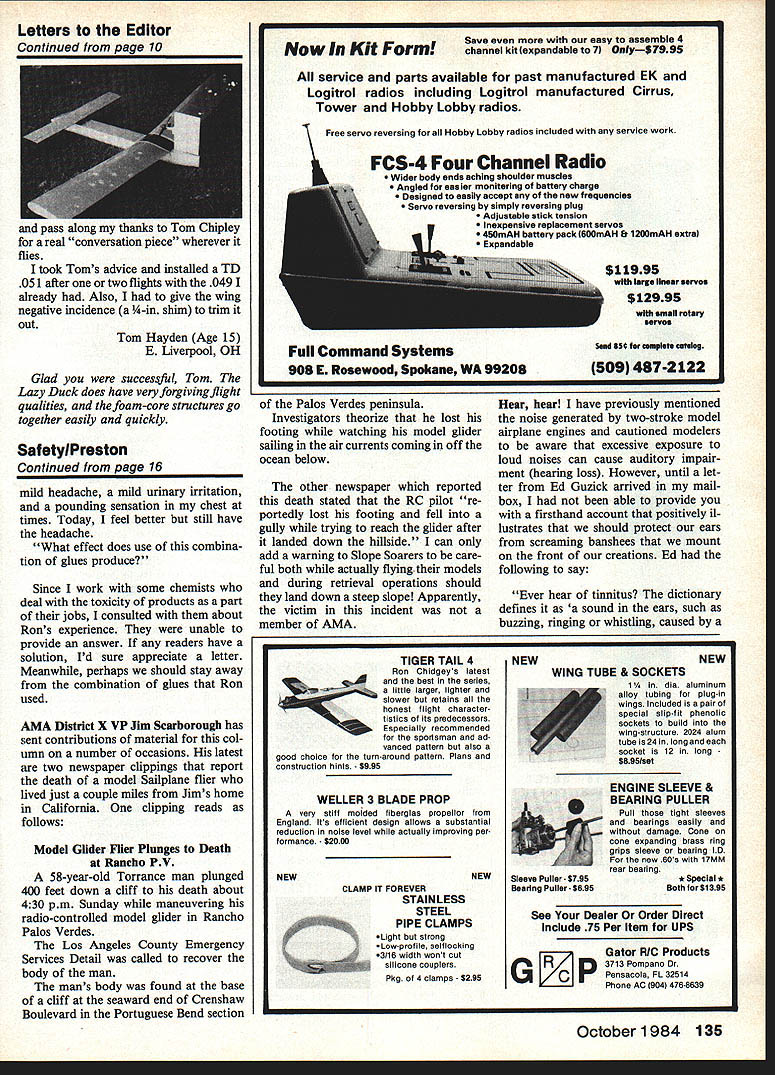
I viewed Tom Chipley's article on his Lazy Duck in the May issue with such interest and intrigue that I sent for the plans and built one. For some time I have wanted to build a canard and see it fly "backwards." This model just seemed to appeal to me as a good beginning point and pass along my thanks to Tom Chipley for a real "conversation piece" wherever it flies.
I took Tom's advice and installed a TD .051 after one or two flights with the .049 I already had. Also, I had to give the wing negative incidence (a 1/4-in. shim) to trim it out.
Tom Hayden (Age 15) E. Liverpool, OH
Glad you were successful, Tom. The Lazy Duck does have very forgiving flight qualities, and the foam-core structure goes together easily and quickly.
Transcribed from original scans by AI. Minor OCR errors may remain.

