
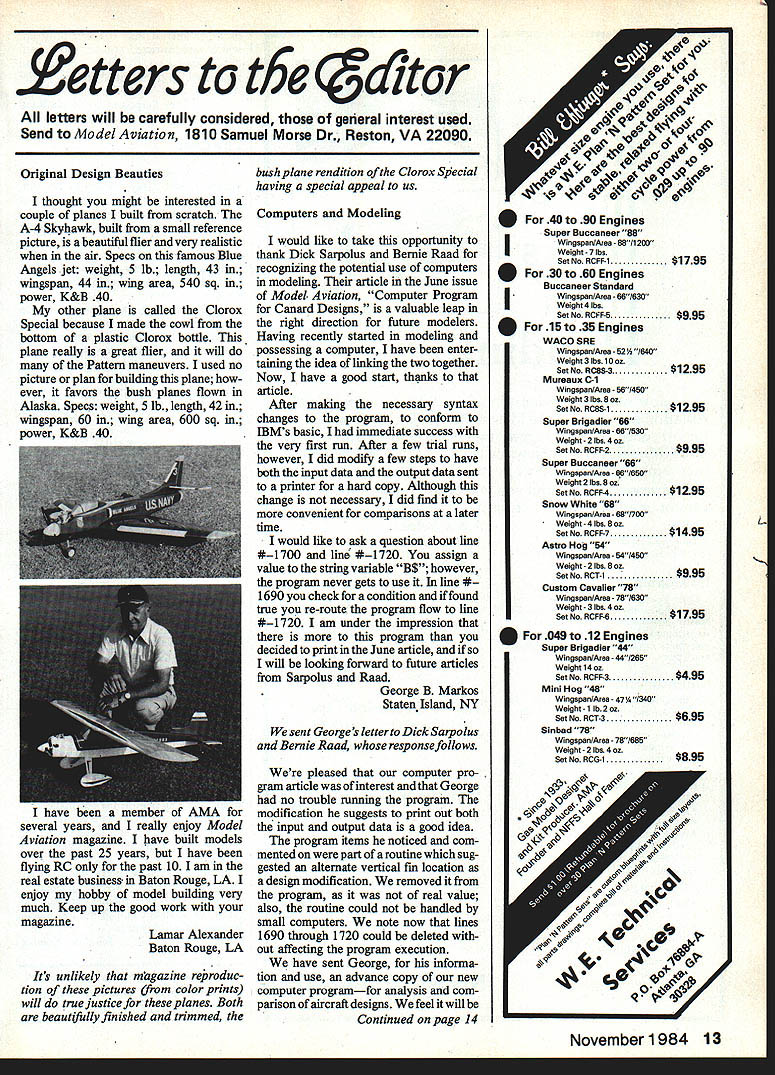
Letters to the Editor
All letters will be carefully considered; those of general interest will be used. Send to Model Aviation, 1810 Samuel Morse Dr., Reston, VA 22090.
Original Design Beauties
I thought you might be interested in a couple of planes I built from scratch. The A-4 Skyhawk, built from a small reference picture, is a beautiful flier and very realistic when in the air. Specs on this famous Blue Angels jet: weight, 5 lb.; length, 43 in.; wingspan, 44 in.; wing area, 540 sq. in.; power, K&B .40.
My other plane is called the Clorox Special because I made the cowl from the bottom of a plastic Clorox bottle. This plane really is a great flier, and it will do many of the Pattern maneuvers. I used no picture or plan for building this plane; however, it favors the bush planes flown in Alaska. Specs: weight, 5 lb.; length, 42 in.; wingspan, 60 in.; wing area, 600 sq. in.; power, K&B .40.
I have been a member of the AMA for several years, and I really enjoy Model Aviation magazine. I have built models over the past 25 years, but I have been flying RC only for the past 10. I am in the real estate business in Baton Rouge, La. I enjoy my hobby of model building very much. Keep up the good work with your magazine.
Lamar Alexander Baton Rouge, LA
It's unlikely that magazine reproduction of these pictures (from color prints) will do true justice to these planes. Both are beautifully finished and trimmed, the bush-plane rendition of the Clorox Special having a special appeal to us.
Computers and Modeling
I would like to take this opportunity to thank Dick Sarpolus and Bernie Raad for recognizing the potential use of computers in modeling. Their article in the June issue of Model Aviation, "Computer Program for Canard Designs," is a valuable leap in the right direction for future modelers.
Having recently started in modeling and possessing a computer, I have been entertaining the idea of linking the two together. Now, I have a good start, thanks to that article.
After making the necessary syntax changes to the program to conform to IBM's BASIC, I had immediate success with the very first run. After a few trial runs, however, I did modify a few steps to have both the input data and the output data sent to a printer for a hard copy. Although this change is not necessary, I did find it to be more convenient for comparisons at a later time.
I would like to ask a question about line #1700 and line #1720. You assign a value to the string variable "B$"; however, the program never gets to use it. In line #1690 you check for a condition and, if found true, you re-route the program flow to line #1720. I am under the impression that there is more to this program than you decided to print in the June article, and if so I will be looking forward to future articles from Sarpolus and Raad.
George B. Markos Staten Island, NY
We sent George's letter to Dick Sarpolus and Bernie Raad, whose response follows.
We're pleased that our computer program article was of interest and that George had no trouble running the program as modified. His suggestion to print out both the input and output data is a good idea.
The program items he noticed and commented on were part of a routine that suggested an alternate vertical fin location as a design modification. We removed it from the program, as it was not of real value; also, the routine could not be handled by small computers. We note now that lines 1690 through 1720 could be deleted without affecting program execution.
We have sent George, for his information and use, an advance copy of our new computer program for analysis and comparison of aircraft designs. We feel it will be of wider interest than our first program, which was restricted primarily to canard design assistance. The new program and article will be published shortly in Model Aviation.
Dick Sarpolus and Bernie Raad Shrewsbury, NJ
First Crash
I thought you might like to publish the enclosed short essay, written by my son, age 12, for a school exercise about his first crash—which took place in 1982! Judging by the well-remembered details, this early training flight of Jonathan's impressed him greatly (as do all our own early flights). Reading his words reminded me of my first RC flights some 30 years ago. They are still vivid to me today.
Incidentally, we learned a few months later that Jonathan needed eyeglasses. At the time of the accident, he was unable to properly judge the distance that the model was from him (a One-Step from the September 1981 MA, photo enclosed). A warning in there somewhere.
James Kemble Madison, CT
My Flying Accident
It was a bright summer morning without a cloud in the sky. The sun was shining down on my father's station wagon as we approached the field. In the back was a radio-controlled airplane. It was painted in Army colors. My father took a long time to do it.
My father parked the car, and we brought the plane and equipment out. Since I'm not very good at making the plane take off, my father taxied it out to the runway and took off.
After a while he gave me the transmitter and let me fly it for a while. It was quite easy to control because there wasn't any wind, and pretty soon I could hear the people behind me praising my good flying.
Just then I heard my father yelling frantically, "Right! Turn right!" and an instant later there was a big crash. I found out I had just made it hit a tree, then it fell into the stream on the other side of the runway.
I couldn't believe what had just happened to me. After a while everybody started walking over to the crash site.
After the plane was recovered — in about three pieces — I thought my dad was going to kill me. He didn't say much. We packed up and left.
Nothing much happened to me, and after the plane was fixed, I was flying again.
I learned that even though I crashed the plane, he wouldn't punish me too much, because he still loved me.
Jonathan Kemble
Transcribed from original scans by AI. Minor OCR errors may remain.

