
Letters to the Editor
All letters will be carefully considered; those of general interest will be used. Send to Model Aviation, 1810 Samuel Morse Dr., Reston, VA 22090.
Frequency Control Board
As the wife of a radio-control helicopter buff, I can't help but leaf through the Model Aviation magazine my husband subscribes to.
I find your articles most informative and enjoy the photos of the different models. Also, your cartoons are reminders of some of the mistakes I have seen take place wherever there is model flying.
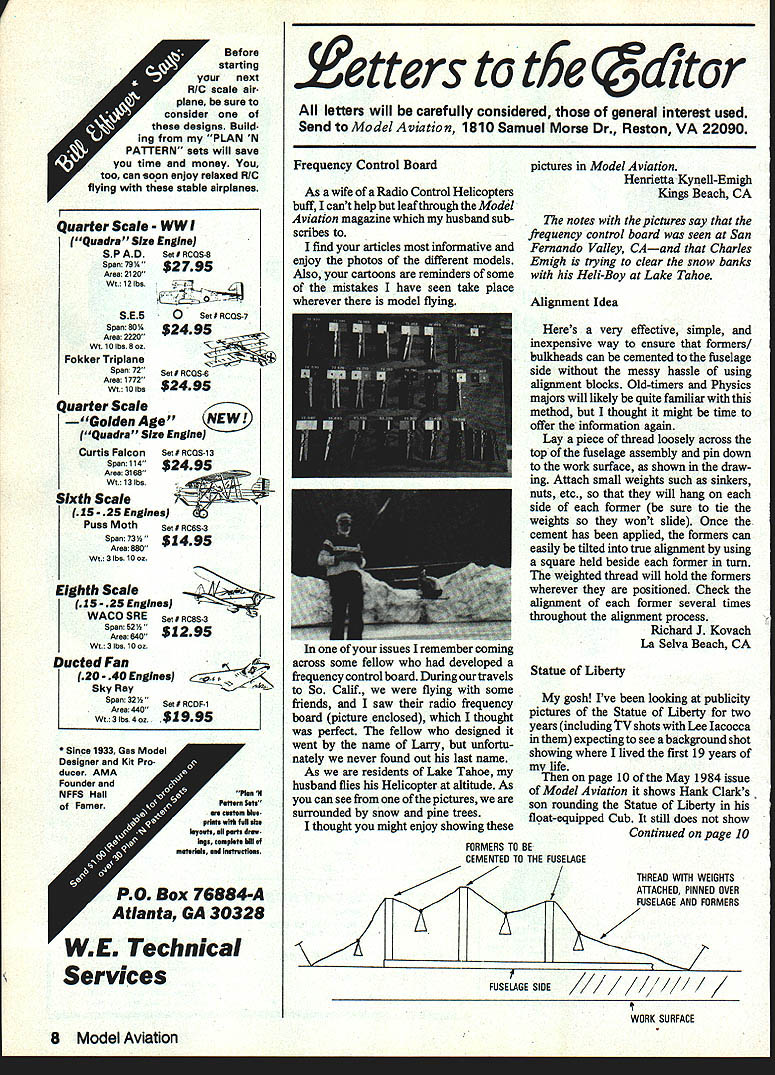
In one of your issues I remember coming across a fellow who had developed a frequency control board. During our travels to Southern California, we were flying with some friends, and I saw their radio-frequency board (picture enclosed), which I thought was perfect. The fellow who designed it went by the name of Larry, but unfortunately we never found out his last name. As we are residents of Lake Tahoe, my husband flies his helicopter at altitude. As you can see from one of the pictures, we are surrounded by snow and pine trees. I thought you might enjoy showing these pictures.
Henrietta Kynell-Emigh Kings Beach, CA
Alignment Idea
Here's a very effective, simple, and inexpensive way to ensure that formers/bulkheads can be cemented to the fuselage side without the messy hassle of using alignment blocks. Old-timers and physics majors will likely be quite familiar with this method, but I thought it might be time to offer the information again.
Lay a piece of thread loosely across the top of the fuselage assembly and pin it down to the work surface, as shown in the drawing. Attach small weights such as sinkers, nuts, etc., so that the weight will hang on each side of each former (be sure to tie the weights so they won't slide). Once the cement has been applied, the formers can easily be tilted into true alignment by using a square held beside each former in turn. The weighted thread will hold the formers wherever they are positioned. Check the alignment of each former several times throughout the alignment process.
Richard J. Kovach La Selva Beach, CA
Statue of Liberty
My gosh! I've been looking at publicity pictures of the Statue of Liberty for two years (including TV shots with Lee Iacocca in them) expecting to see a background shot showing where I lived the first 19 years of my life.
Then on page 10 of the May 1984 issue of Model Aviation it shows Hank Clark's son rounding the Statue of Liberty in his float-equipped Cub. It still does not show where I lived, but that line going through the maiden's arm is the Jersey City sewer pipe that empties into the Hudson River. When a kid, I attempted to walk out on that concrete viaduct, but did not get very far because there was a hole in the top—and one whiff of the fumes sent me running home.
An earlier issue of Model Aviation (February 1984) shows the picture I've been looking for. You'll need a magnifying glass; just above the bridge shown just to the left of the torch is where I lived. The waterfront shown was "Bare Ass Beach," and in back is Black Tom. The Black Tom Explosion took place in June 1916. My house was split in half with me in it (at not quite one year old). TNT was being shipped to France from there during World War I, and it all exploded... the worst explosion prior to the atomic bomb. The explosion damaged the Statue of Liberty severely, and that is one reason why it is now being repaired.
Not many years after I took the "sewer walk," Hank Clark began sending me airplane photos for my articles in Model Airplane News. It's the same famous Hank Clark who took the picture of the Statue of Liberty on page 10 of the May issue! It looks like some of his work.
As one of the few survivors of the Black Tom Explosion, I'm sending a contribution for the statue's restoration. I wonder why France does not contribute more money. We did a lot for them in two World Wars.
Robert C. Morrison Vida, OR
We didn't check with our Hank Clark, but we're certain he's the one who sent Bob pictures those many years ago. Hank's the guy who does our fabulous monthly cutaways and other Wood cartoon strips. Morrison, by the way, operates Replica-Tech International, the company that supplies drawings and other goodies so useful to the scale modeling fraternity.
A FF Sorta Kanary
Since I get dizzy going around in circles, I converted the Control Line Sorta Kanary (July 1984 Model Aviation) to a free flight—which I call Tweedle Bird. Changes include using a Pee Wee .020 engine in place of the .049 and adding down- and left-thrust (as with the Dakota). Wings originally were 3/32" sheet, but they turned out to be too vulnerable. I went to 1/8" soft sheet with sanded ends and warped-in camber.
The lower wing is set at 2° positive, the upper wing and stabilizer at 0°. Tail feathers were made from 3/32" balsa. Wingspan was increased to 18 in. A little right-rudder tab was needed for adjustment.
Bud Overm Santa Ana, CA
Transcribed from original scans by AI. Minor OCR errors may remain.

