
Letters to the Editor
All letters will be carefully considered, those of general interest used. Send to Model Aviation, 815 15th St., N.W., Washington, D.C. 20005.
The Size of It
The article "About the Size of It," Jan. '78, was very interesting and enlightening. However, I did notice a minor error in the Q & A position at the beginning. #10, HO scale is 1/87 not 1/96. The answer is correct to be more accurate 1.095 ft./sec.
Dick Gleason Austin, MN
We can quote author Brad Powers: "I had always thought that 'O' gauge trains were quarter-scale (1/4 to the foot) and that 'HO' was 'Half O.' I called the model train man and he said that Dick Gleason is correct. My apologies to the train gang. Sacre Bleu!"
He Begs to Differ
Since I've been addicted to World War I scale models for a number of years, Bob Wischer's remarks concerning RC scale in the December '77 issue of Model Aviation disturb me. While he is correct in his assessment that Sport Scale is becoming a pattern event for WW II fighters, he is dead wrong in implying that lightly loaded models cannot be competitive in strong winds—they definitely are, if flight judges will only follow existing AMA rules. Unfortunately, in my experience, most are familiar with pattern events where maneuvers are judged, and rightly so, only in comparison to absolute geometric perfection. Many have apparently not read the scale rules which clearly call for judging maneuvers on the basis of realism; i.e. in relation to how it would be performed by the real aircraft. For example, few (if any) WW I aircraft could do a slow (aileron) roll without loss of considerable altitude. Similarly, the modern Immelmann turn bears little resemblance to maneuvers performed by Lt. Immelmann. Clearly, realism also calls for lightly loaded aircraft to respond to wind gusts.
Since his remarks were also observations on the '77 Nats, they are even less understandable. Here the judges were obviously well briefed by C.D. Monty Groves who would not allow contestants to elect maneuvers foreign to the aircraft modeled. As a result, the model (a Brandenburg W. 18 flying boat) scoring the highest in AMA scale flight had about 1480 sq. in. of wing and weighed slightly over 7 lbs. or some 11 oz. per sq. ft. Furthermore, this flight was made during the windy part of the day—in fact the model almost took off during proto taxi.
Bob's remarks also support the commonly held belief that light models are very difficult to fly in a breeze. While it is obviously not easier, if the model is well trimmed and has reasonable stability and control characteristics, it is not particularly difficult to fly safely in any wind less than its flying speed. True, doing geometrically perfect and smooth maneuvers under such conditions is next to impossible with light aircraft, but scale judges should take scale conditions into account in their scoring.
This myth that light models are most difficult to fly in a wind has been generated by observation rather than personal experience. The rank novice is invariably attracted to the light, usually under-powered model. Hence most models of this type are not flown well, and this observation grows into the conclusion that they cannot be flown well. To observe what even average pilots can do with light wing loadings, one has only to watch slope soaring sites. Here loadings run as low as 8 or 10 oz. per sq. ft., and it's always windy. Yet average flyers will perform precision maneuvers such as touch-and-goes on the cliff's edge and frequently fly when wind speed exceeds the model's minimum speed. I'm convinced that, within the limits of practical construction, the lighter the scale model, the easier it is to fly safely under all conditions. The heavy model easily gets out of hand at low speeds—occasionally terminating flight with an involuntary snap roll—and ground handling is much more difficult with taildraggers.
Today's scale rules are excellent if all their implications are followed. They permit the modeler a wide choice of subject and the resulting diversity attracts large numbers of spectators to scale meets and hence popularizes our hobby. On the other hand, pattern meets currently hold little spectator interest simply because "when you've seen one, you've seen them all." Uniformity is repetition, and that spells boring.
For the health of the sport, I sincerely hope that the '78-'79 rule book and judges' guide reinforce the principles of flight realism with more specific instructions. If it is abandoned, the most popular and rapidly growing branch of our hobby will soon stagnate into a specialized event for a few experts similar to control-line racing.
Joe Tschirgi Santa Ana, CA
This letter should be carefully reread. While Joe seems to be disagreeing with Bob Wischer, the main thrust of his reasoning concerns perception of the rules (especially the judges') and the rules themselves. Our considered opinion is that neither of these highly qualified gentlemen is wrong, and that additional comment will be significant when it appears in Model Aviation.
Small World
Maybe one year ago a friend in the Army showed me a model aviation magazine with a construction article in it about a pattern plane named "Sequel." Please let me know the name and address of the designer or where I can get the plans for the airplane (I have only the October issue '77 of your magazine and couldn't find the plans in the list on page 96). Please tell me also if a back issue with the article about this airplane is available.
Karlheinz Schmid Augsburg, W. Germany
The Sequel was published in the last issue of the American Aircraft Modeler. That magazine was replaced by R/C Sportsman which has continued the plan service. Readers interested in plans from AAM—who keep writing us in error—should try: R/C Sportsman, P.O. Box 11247, Reno, NV 89520. On the same day we received Mr. Schmid's letter, MA also heard from Bud Weber who designed the Sequel, and we hope to publish one of his ideas.
Wants in
I am interested in joining the A.M.A., could you please tell me the procedure and cost. I am interested in control line flying and in the process of starting a C/L club in Ft. Worth, there is a R/C club here but not a C/L.
Would you please give me some information (Rules, Regulations, etc.) regarding all phases of C/L airplanes. I am en-
Letters to the Editor
closing a dollar to cover postage etc. I am a 34 year old veteran of the United States Air Force and have been building and flying models since the age of 13.
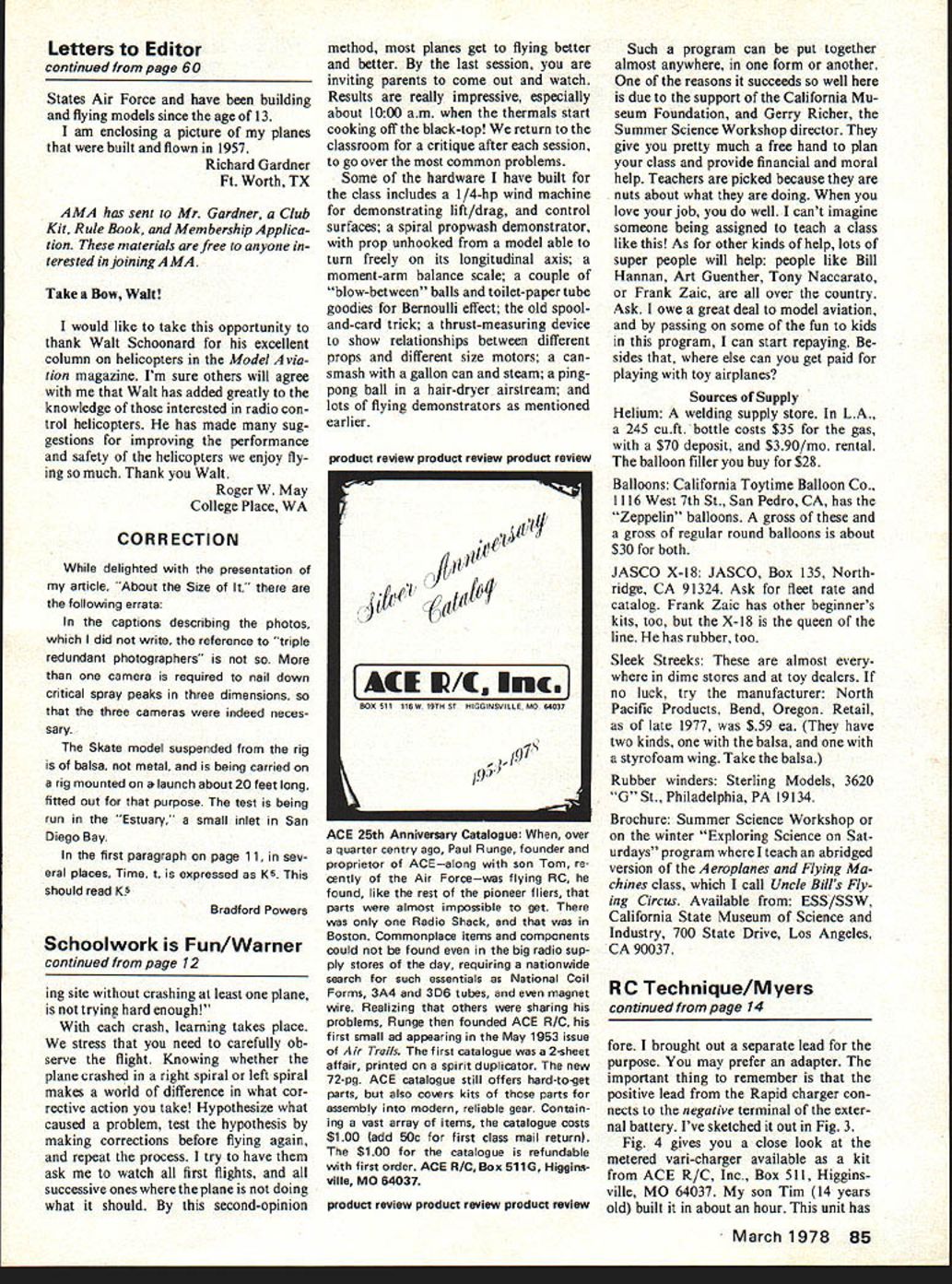
I am enclosing a picture of my planes that were built and flown in 1957.
Richard Gardner Ft. Worth, TX
AMA has sent to Mr. Gardner, a Club Kit, Rule Book, and Membership Application. These materials are free to anyone interested in joining AMA.
Take a Bow, Walt!
I would like to take this opportunity to thank Walt Schoonard for his excellent column on helicopters in the Model Aviation magazine. I'm sure others will agree with me that Walt has added greatly to the knowledge of those interested in radio control helicopters. He has made many suggestions for improving the performance and safety of the helicopters we enjoy flying so much. Thank you Walt.
Roger W. May College Place, WA
CORRECTION
While delighted with the presentation of my article, "About the Size of It," there are the following errata:
In the captions describing the photos, which I did not write, the reference to "triple redundant photographers" is not so. More than one camera is required to nail down critical spray peaks in three dimensions, so that the three cameras were indeed necessary.
The Skate model suspended from the rig is of balsa, not metal, and is being carried on a rig mounted on a launch about 20 feet long, fitted out for that purpose. The test is being run in the "Estuary," a small inlet in San Diego Bay.
In the first paragraph on page 11, in several places, Time, t, is expressed as kS. This should read ks.
Bradford Powers
Transcribed from original scans by AI. Minor OCR errors may remain.

