

Letters To The Editor
All letters will be carefully considered; those of general interest will be used. Send to Model Aviation, 1810 Samuel Morse Dr., Reston, VA 22090.
Airfoils and Moments
Why does a wing with a cambered airfoil have a negative moment? This question headlined an article in the October 1985 issue. I feel the diagrams and discussion in that article failed to answer the question. Since there appears to be interest in this topic, the following excerpt from a text should be of interest.
"We may explain the existence of a pitching moment at zero lift by considering the type of pressure distribution that exists under this condition. For a symmetrical section, the pressure distribution over the upper and lower surfaces must be the same at zero lift and no couple or pitching moment can be produced; however, because of the lack of symmetry of a cambered airfoil, the distribution of pressure over the upper and lower surfaces is not the same at zero lift. This means that although any up-load on the upper surface is balanced by a down-load on the lower surface, the resultants of the pressure forces on the upper and lower surfaces are not colinear, and an unbalanced couple exists. It is this couple which produces a moment at zero lift for a cambered airfoil."
The problem with the "Let's Talk About Airplane Design" article seems to arise from an incorrect definition of center of pressure (c.p.). Correctly, it is the point along the chord where the moment is zero. The forces about this point can be denoted by lift and drag alone; but do the forces physically act there? There are two easy ways to recognize that they do not.
First, by definition: some positive moment must cancel the negative moment due to shape. This is the lift vector, acting at the aerodynamic center (a.c.), times the distance between the a.c. and c.p. Since, at constant speed, the moment about the a.c. is constant, the c.p. must "travel" as angle of attack changes.
Second, the c.p. can "travel" completely outside the wing's boundaries. It is physically impossible that the resultant pressure force developed by the wing can act there. The c.p. concept is archaic; whatever merit it had years ago is not incorporated in modern aerodynamic theory.
The author also stated: "A cambered wing alone exhibits a negative moment, but when attached to a fuselage having no tail, the combination generally produces a positive moment." Later it was pointed out that the success of a plane without a tail required a net positive moment and a forward (of the a.c.) center of gravity (c.g.) location. If that analysis were valid, it should be possible to construct a successful tailless glider with no movable surfaces by simply adding a fuselage to, say, a Clark Y wing and locating the c.g. properly. (Editor: We don't mean to be picking nits, but our reading of the article didn't convey to us that this would be possible.)
I think that if the author actually tried to construct such a configuration, he would fail utterly and wish he had said either nothing on the subject or something other than what he did.
John Brownlee Decatur, AL
Movies from Models
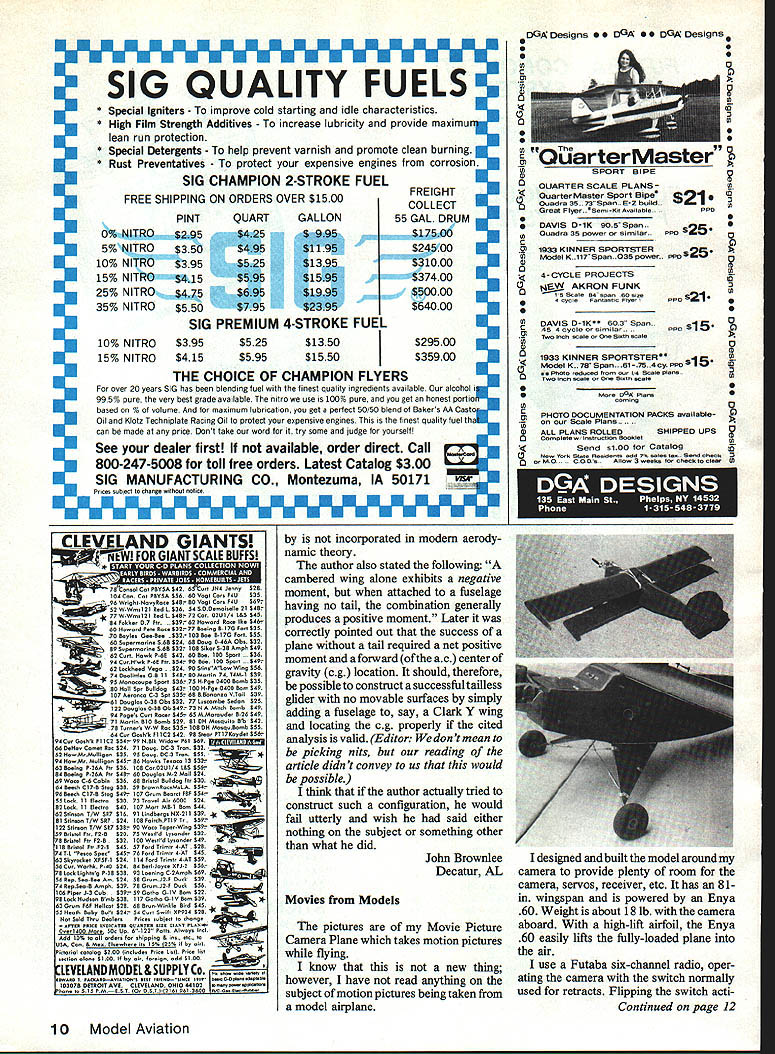
The pictures are of my Movie Picture Camera Plane, which takes motion pictures while flying. I know this is not new, but I have not read anything recently on taking motion pictures from a model airplane.
I designed and built the model around my camera to provide plenty of room for the camera, servos, receiver, etc. It has an 81-inch wingspan and is powered by an Enya .60. Weight is about 18 lb with the camera aboard. With a high-lift airfoil, the Enya .60 easily lifts the fully loaded plane into the air.
I use a Futaba six-channel radio, operating the camera with the switch normally used for retracts.
Nice CAP
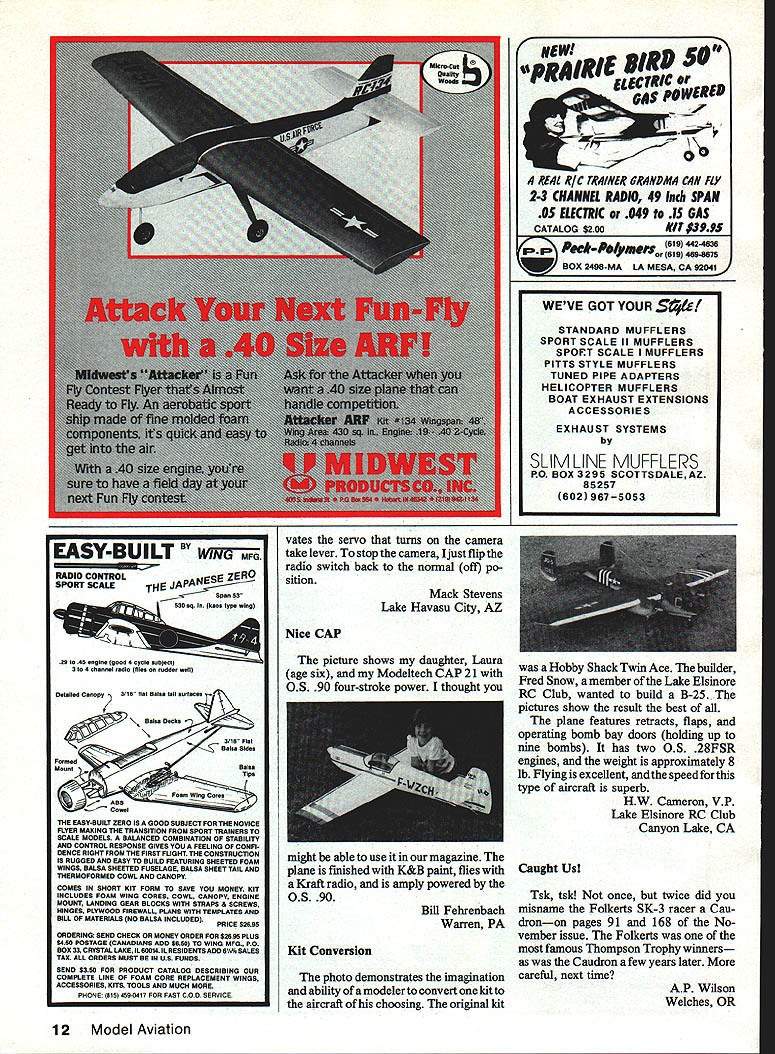
The picture shows my daughter, Laura (age six), and my Modeletech CAP 21 with O.S. .90 four-stroke power. The plane is finished with K&B paint, flies with a Kraft radio, and is amply powered by the O.S. .90. I thought you might be able to use it in your magazine.
Bill Fehrenbach Warren, PA
Kit Conversion
The photo demonstrates the imagination and ability of a modeler to convert one kit to the aircraft of his choosing. The original kit was a Hobby Shack Twin Ace. The builder, Fred Snow, a member of the Lake Elsinore RC Club, wanted to build a B-25. The pictures show the result — the best of all.
The plane features retracts, flaps, and operating bomb-bay doors (holding up to nine bombs). It has two O.S. .28 FSR engines, and the weight is approximately 8 lb. Flying is excellent, and the speed for this type of aircraft is superb.
H. W. Cameron, V.P. Lake Elsinore RC Club Canyon Lake, CA
Caught Us!
Tsk, tsk! Not once, but twice you misnamed the Folkerts SK-3 racer as a Caudron — on pages 91 and 168 of the November issue. The Folkerts was one of the most famous Thompson Trophy winners — as was the Caudron a few years later. More careful next time?
A. P. Wilson Welches, OR
Transcribed from original scans by AI. Minor OCR errors may remain.

