
Letters to the Editor: Thanks for Your Help
Ken Rusnok — MOTOR Program
In the September 1992 issue of Model Aviation, I requested motor/propeller data from interested modelers to evaluate a computer program for electrics. That evaluation has been completed, and the program is now available. My thanks to all those who wrote.
The MOTOR program evaluates the performance of electric motor/propeller combinations and runs on IBM-compatible machines. For a copy, please send a formatted disk (3½" or 5¼") along with an SASE to Ken Rusnok, P.O. Box 4643, Fayetteville, AR 72702.
Along with the program, a text file will be included that contains the equations that were used.
Last, I was informed of the availability of commercial software to evaluate electrics. The product name is Aero*Comp. For more information, please contact USR&D Corporation, P.O. Box 561, Denville, NJ 07834-0561.
Thank you.
Ken Rusnok Fayetteville, Arkansas
RC Flyers Net — Fred Lomax and Contacts
There are people all over who know the equipment and have no financial interest in what you finally purchase. The RC Flyers Net is now on the air every morning. Join in and join the fun.
Fred Lomax — N4KYG 204 South Claiborne St. Goldsboro, NC 27530 (919) 736-2116
David Rose 817 Hawthorne Rd. Shelby, NC 28150 (704) 487-5654 (home), (704) 482-2491 (work)
Search for Vacation Flying Sites
Does anybody know of any stretches of highway in the U.S. where plentiful casual flying sites can be found?
I am hoping to combine a scenic family vacation with opportunities to get out of the car and fly R/C, control line, or rockets along the way.
I was disappointed in a recent trip to the Las Vegas area to find almost all otherwise suitable roadside land to be heavily fenced.
Here in Orlando, it is difficult to even find a parking lot or ball field to fly 1/2A control line (without driving 40 minutes each way to the official club flying site), because schoolyards are either fenced or have live-in custodians who chase people away.
Is the whole country like this?
Walter A. Legan 8014 Nashua Lane Orlando, FL 32817
Instructions Needed — P-51B Top-Flite Kit
I'm the proud owner of an old P-51B Top-Flite kit. The problem is that it came with no plans or instructions.
I called Top-Flite, which was purchased by Great Planes. The company explained that when it was sold, the kit was discontinued, and all old inventory and plans were sold to a company called Slots and Wings.
I talked to Mark Thompson there, and he had four or five of those kits on hand, all without plans and instructions. Sounds like the end of the line.
Do you suppose any of your readers might have built one and could furnish me with a set of plans? I would be happy to pay for reproduction costs of the plans and mailing.
Terry Ankeny 420 Oak Knoll Court Blue Earth, MN 56013
One More Request
I'm a recent entrant into R/C flying and have completed two Eagle II models, one with an O.S. .40 and one with an O.S. .61 4C. I am still in the training stages and haven't soloed.
As a naval aviator, WWII vintage, I loved flying the Stearman, which the Navy graciously allowed us to do in our off time. I'd like to visit the Naval Air Museum in Pensacola, Florida, and I'd also like to build an R/C Stearman, so I would appreciate any suggestions, comments, and/or recommendations regarding those two activities or kits by anyone seeing this.
Bruce R. Pratt 7296 Monticello Way Ravenna, OH 44266
Thank You, Wayne Lehman
As a result of the article by Wayne Lehman in the February issue of Model Aviation, I just had to write this letter. On page 127, in the last paragraph, it is suggested that it would be nice to hear from one of the youths affected by Wayne's building program 20 or 30 years from now.
Well, it has been over 30 years since I benefited from the dedication of a gentleman in the little town of Greenville, Pennsylvania. It must have been sometime in 1955 or 1956 that I got my first U-Control model and joined a group of youngsters who flew indoors at the town's civic center. We had a building room located under the stage, where we were able to work on our projects two nights a week and on Saturdays. We were supervised and helped by two men, who I remember as being in their 30s. Over the years, I have forgotten their names, but certainly not their efforts!
After moving from Greenville in 1960, I gave up the flying models since I did not have an indoor place to fly, and had never seen a model flown outdoors.
It was only after finishing school and getting married that my interests once again returned to the challenges of model flight.
In 1967, I built a Goldberg Jumpin' Bean, and learned to fly it outdoors. When I returned from Vietnam in 1970, I bought my first R/C equipment, and have been active since then.
During the past 22 years, I have built over 140 R/C planes and logged over 2,700 flights. My main interest since 1984 has been pattern competition, and I am currently flying in Advanced.
After serving my local club as president twice, vice president once, secretary for nine years, and newsletter editor for two years, I was appointed to the position of AVP last February by our newly elected VP, Joe Beshar.
My only reason for including the above information is to let those two men, who so generously gave of their time to a youngster that they have probably forgotten, know that they are having their investment returned. This is my way of saying thank you. Thank you for all your efforts, and thanks for building a solid foundation that supports all of my activity, even now.
If either of these two men are still active, or someone reading this knows who they are, I would very much like to hear from you.
Terry Terroneire, AVP Endicott, New York
Letters to the Editor
Air Molecules Identified
I really enjoyed Nick Stevens's article on lift in the May '92 Model Aviation and would like to provide some additional data.
Nick mentioned that the Wright brothers had invented air molecules. Until last week that was widely accepted, but we now know that it was Wilbur alone who was responsible.
For some reason, he never shared the secret with Orville, and when Wilbur died in 1912, so did air molecule production.
The sad fact is that we have been without air molecules for at least 80 years.
The stuff that passes for air these days is a simple mixture of discrete gases, mainly nitrogen and oxygen, but with traces of others thrown in for flavor.
Here in southern California, we add car exhaust for body and aroma, but I am told that in some places the air is so bland that you can see right through it.
Ralph Geele Hawthorne, California
What Is Legal?
Recently, I reread the story "The Murder of a Starship" in the January issue, and a couple of thoughts came to mind. I can certainly empathize with the persons involved on the loss of their superb project and "labor of love." The experience does support our (perhaps unconscious) knowledge that any aircraft that is flown can self-destruct at any moment, even through circumstances that are no fault of our own.
Even expertise is no guarantee of immunity against this, as shown by the demise of the magnificent Byron B-29 flown by a very experienced team with virtually unlimited technical and financial backing.
I tell people who are interested in the hobby that they must be mentally and financially prepared to experience up to 100% loss of an aircraft. They don't have to like it, just be able eventually to rationalize and accept it and then go on.
In addition to expressing my sympathy, this letter is to ask an opinion from any "legal types" out there on the subject.
Presume that you were able to identify absolutely, by some means, the remains from a model that was lost or left in a tree. This would probably be the radio components, the engine(s), wheels, and similar reusable parts.
Just what recourse would the owner have, and what could he expect to recover? The culprit (?) did not exactly steal the items (or did he?). Did you abandon the plane when you left it in a tree overnight or longer? Would you recover anything more than those items I just named, and in what condition?
Very possibly the engines would be rusted from lack of proper maintenance, and the radio would have some physical damage by being pulled out of the plane without due care. Almost certainly you would not expect to recover any of the time and labor spent on construction (or would you?). Considering the time, frustration, and anguish involved in even small claims court (I have been there!), would it be better psychologically just to write off the whole incident and get on with your life a little sadder and wiser?
I suspect the latter is true. This hobby has a tremendous potential for feelings of accomplishment and self-satisfaction since Mother Nature—as well as the laws of physics and aerodynamics—gives the final exam.
Nobody has to tell you when you get it all just right. You will know it yourself! The exhilaration after that flight when everything is finally perfect will make it all worthwhile.
John Arbogast Hamilton, Ohio
"They Really Fly!" — Catapult Canards
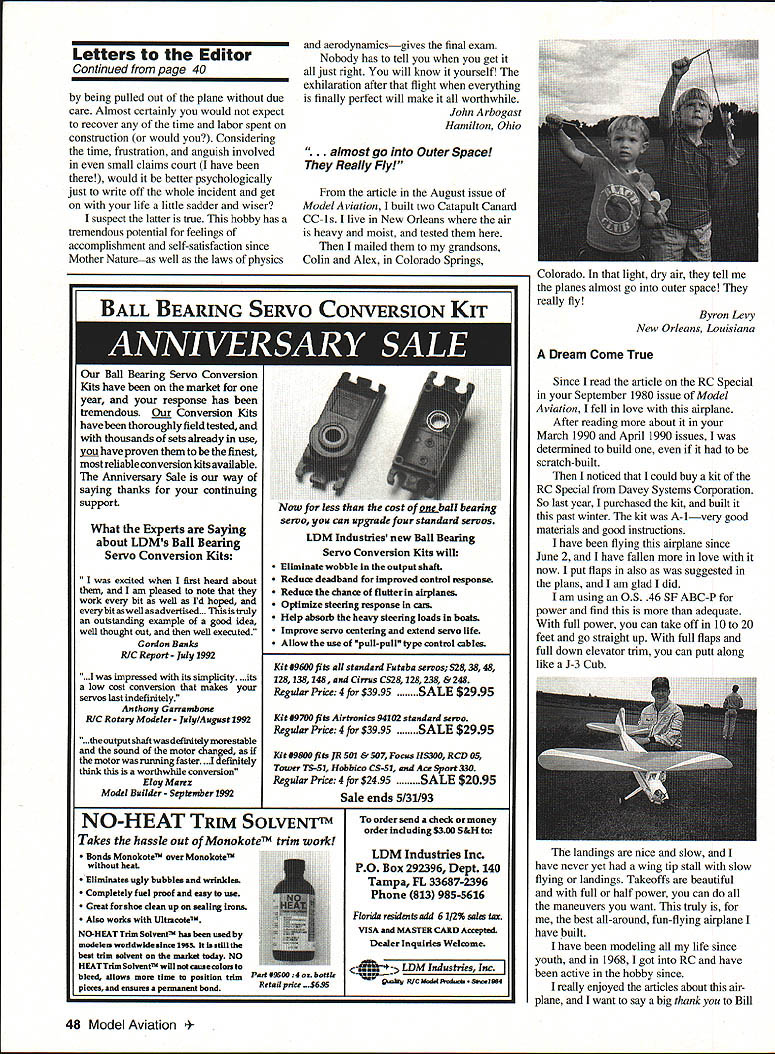
From the article in the August issue of Model Aviation, I built two Catapult Canard CC-1s. I live in New Orleans where the air is heavy and moist, and tested them here.
Then I mailed them to my grandsons, Colin and Alex, in Colorado Springs, Colorado. In that light, dry air, they tell me the planes almost go into outer space! They really fly!
Byron Levy New Orleans, Louisiana
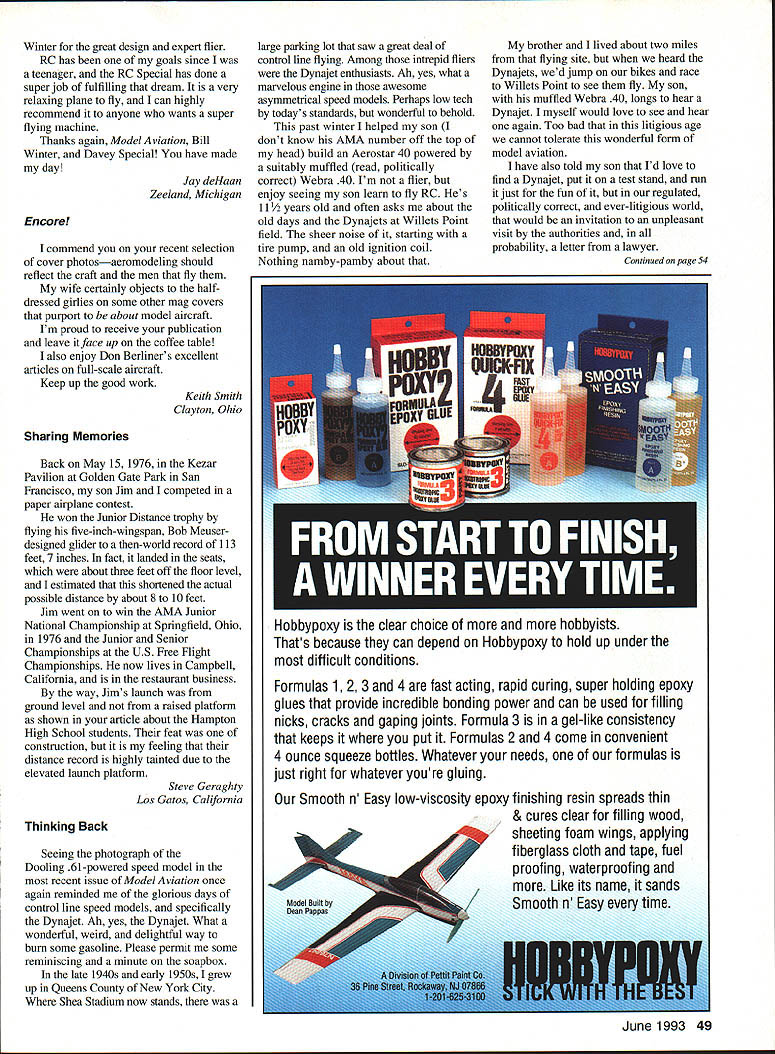
A Dream Come True — RC Special
Since I read the article on the RC Special in your September 1980 issue of Model Aviation, I fell in love with this airplane.
After reading more about it in your March 1990 and April 1990 issues, I was determined to build one, even if it had to be scratch-built.
Then I noticed that I could buy a kit of the RC Special from Davey Systems Corporation. So last year, I purchased the kit, and built it this past winter. The kit was A-1—very good materials and good instructions.
I have been flying this airplane since June 2, and I have fallen more in love with it now. I put flaps in, as was suggested in the plans, and I am glad I did.
I am using an O.S. .46 SF ABC-P for power and find this is more than adequate. With full power, you can take off in 10 to 20 feet and go straight up. With full flaps and full down elevator trim, you can put along like a J-3 Cub.
The landings are nice and slow, and I have never yet had a wing-tip stall with slow flying or landings. Takeoffs are beautiful and with full or half power, you can do all the maneuvers you want. This truly is, for me, the best all-around, fun-flying airplane I have built.
I have been modeling all my life since youth, and in 1968 I got into R/C and have been active in the hobby since.
I really enjoyed the articles about this airplane, and I want to say a big thank you to Bill Winter, and Davey Special! You have made my day!
Jay deHaan Zeeland, Michigan
Encore!
I commend you on your recent selection of cover photos—aeromodeling should reflect the craft and the men that fly them. My wife certainly objects to the half-dressed girls on some other mag covers that purport to be about model aircraft.
I'm proud to receive your publication and leave it face up on the coffee table! I also enjoy Don Berliner's excellent articles on full-scale aircraft. Keep up the good work.
Keith Smith Clayton, Ohio
Sharing Memories — Paper Airplane Contest
Back on May 15, 1976, in the Kezar Pavilion at Golden Gate Park in San Francisco, my son Jim and I competed in a paper airplane contest.
He won the Junior Distance trophy by flying his five-inch-wingspan, Bob Meuser–designed glider to a then-world record of 113 feet, 7 inches. In fact, it landed in the seats, which were about three feet off the floor level, and I estimated that this shortened the actual possible distance by about 8 to 10 feet.
Jim went on to win the AMA Junior National Championship at Springfield, Ohio, in 1976 and the Junior and Senior Championships at the U.S. Free Flight Championships. He now lives in Campbell, California, and is in the restaurant business. By the way, Jim's launch was from the ground level and not from a raised platform as shown in your article about the Hampton High School students. Their feat was one of construction, but it is my feeling that their distance record is highly tainted due to the elevated launch platform.
Steve Geraghty Los Gatos, California
Thinking Back — Dynajets and Memories
Seeing the photograph of the Dooling .61-powered speed model in the most recent issue of Model Aviation once again reminded me of the glorious days of control line speed models, and specifically the Dynajet. Ah, yes, the Dynajet. What a wonderful, weird, and delightful way to burn some gasoline. Please permit me some reminiscing and a minute on the soapbox.
In the late 1940s and early 1950s, I grew up in Queens County of New York City. Where Shea Stadium now stands, there was a large parking lot that saw a great deal of control line flying. Among those intrepid fliers were the Dynajet enthusiasts. Ah, yes, what a marvelous engine in those awesome asymmetrical speed models. Perhaps low tech by today's standards, but wonderful to behold.
This past winter I helped my son build an Aerostar 40 powered by a suitably muffled (read: politically correct) Webra .40. I'm not a flier, but enjoy seeing my son learn to fly R/C. He's 11½ years old and often asks me about the old days and the Dynajets at Willets Point field. The sheer noise of it, starting with a tire pump and an old ignition coil—nothing namby-pamby about that.
My brother and I lived about two miles from that flying site, but when we heard the Dynajets, we'd jump on our bikes and race to Willets Point to see them fly. My son, with his muffled Webra .40, longs to hear a Dynajet. I myself would love to see and hear one again. Too bad that in this litigious age we cannot tolerate this wonderful form of model aviation.
I have also told my son that I'd love to find a Dynajet, put it on a test stand, and run it just for the fun of it, but in our regulated, politically correct, and ever-litigious world, that would be an invitation to an unpleasant visit by the authorities and, in all probability, a letter from a lawyer.
Things have got to the point where our flying field here in Scio Township has had to post a notice that there cannot be any flying of jet-powered models without proper permission. Mind you, we live in the country, yet even the muffled two-strokes could face banishment, as they have at one field about seven miles further south.
Don't get me wrong. I'm most certainly not against R/C and model aviation. A great deal of skill is involved. There are some wonderful models out there, and the technology is more sophisticated than anyone in the Dynajet era could ever have imagined. It's just that I miss the more rough-and-tumble atmosphere of those years.
Thanks for taking a few minutes to read my thoughts and reminiscences about an era gone by, a less regulated era, a time of individualism.
Long live the Dynajet, the Dooling, etc.
Kurt H. Miska Ann Arbor, Michigan
"The End" — Excerpt and Commentary
"... enough to make a left turn. Don't try one to the right.
'6. The landing: The landing is made in accordance with the law of gravity. The landing gear doesn't collapse on the first bounce, it will on the second. After you have extracted yourself from the cockpit, light a cigarette and walk away (DON'T RUN).
'The End by Melvin Way'"
Morris L. Coville Corvallis, Oregon
Now We Know
Ed White, editor of our McDonnell Douglas R/C club paper, asked a question in an issue of the club paper. He asked if anyone knew what "10 dynes-centimeter-seconds squared per coulomb squared" is. He gave a hint that a dyne is a unit of force in the metric CGS (centimeter-gram-second) system.
In a later issue of the club paper he explained that "10 dynes-centimeter-seconds squared per coulomb squared" is one millionth of a henry (the basic unit of electrical inductance) or one microhenry.
Carl Brandenberg St. Louis, Missouri
Ute RC Association Has Grand Opening
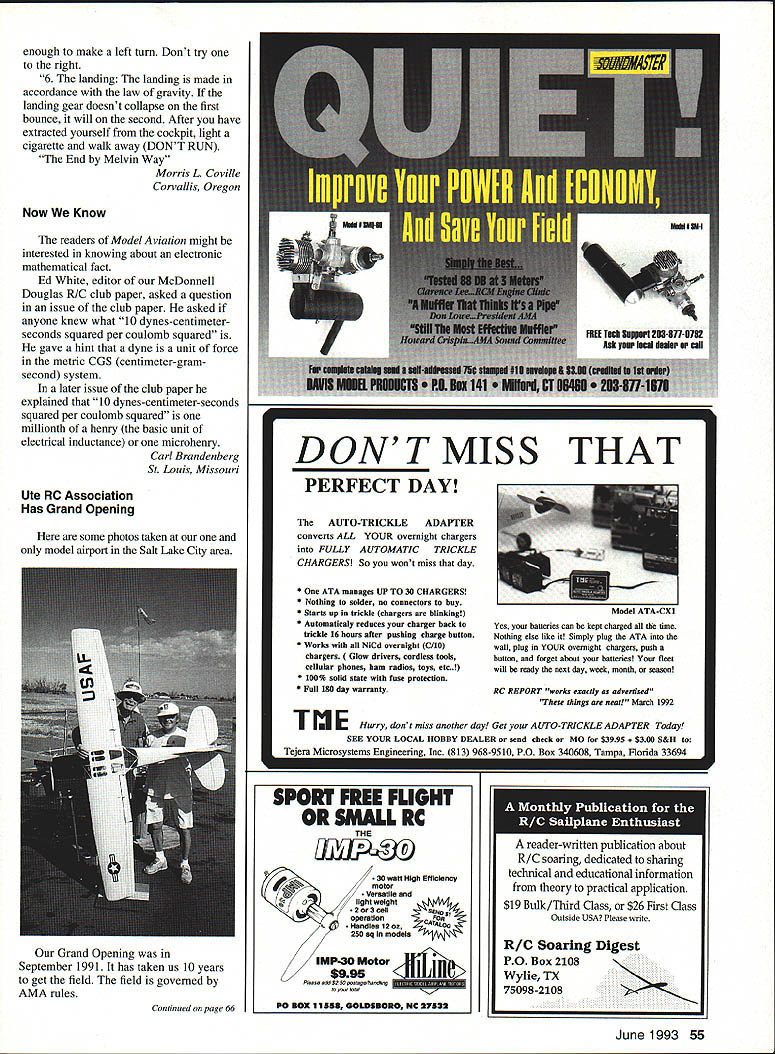
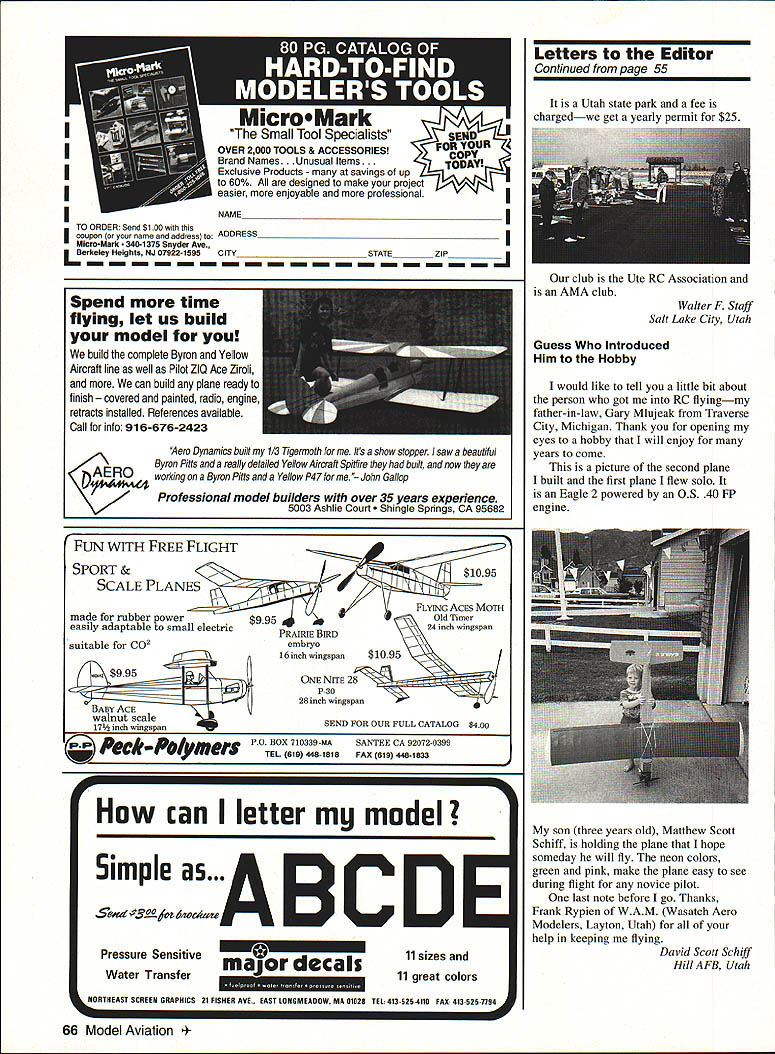
Our Grand Opening was in September 1991. It has taken us 10 years to get the field. The field is governed by AMA rules. It is a Utah state park and a fee is charged—we get a yearly permit for $25.
Our club is the Ute RC Association and is an AMA club.
Walter F. Staff Salt Lake City, Utah
Guess Who Introduced Him to the Hobby
I would like to tell you a little bit about the person who got me into R/C flying—my father-in-law, Gary Miljuak from Traverse City, Michigan. Thank you for opening my eyes to a hobby that I will enjoy for many years to come.
This is a picture of the second plane I built and the first plane I flew solo. It is an Eagle II powered by an O.S. .40 FP engine.
My son (three years old), Matthew Scott Schiff, is holding the plane that I hope someday he will fly. The neon colors, green and pink, make the plane easy to see during flight for any novice pilot.
One last note before I go. Thanks, Frank Rypien of W.A.M. (Wasatch Aero Modelers, Layton, Utah) for all of your help in keeping me flying.
David Scott Schiff Hill AFB, Utah
Transcribed from original scans by AI. Minor OCR errors may remain.

