

Liama Conquers the Atlantic: From Newfoundland to Scotland in 26 hours
Rick Allison
Overview
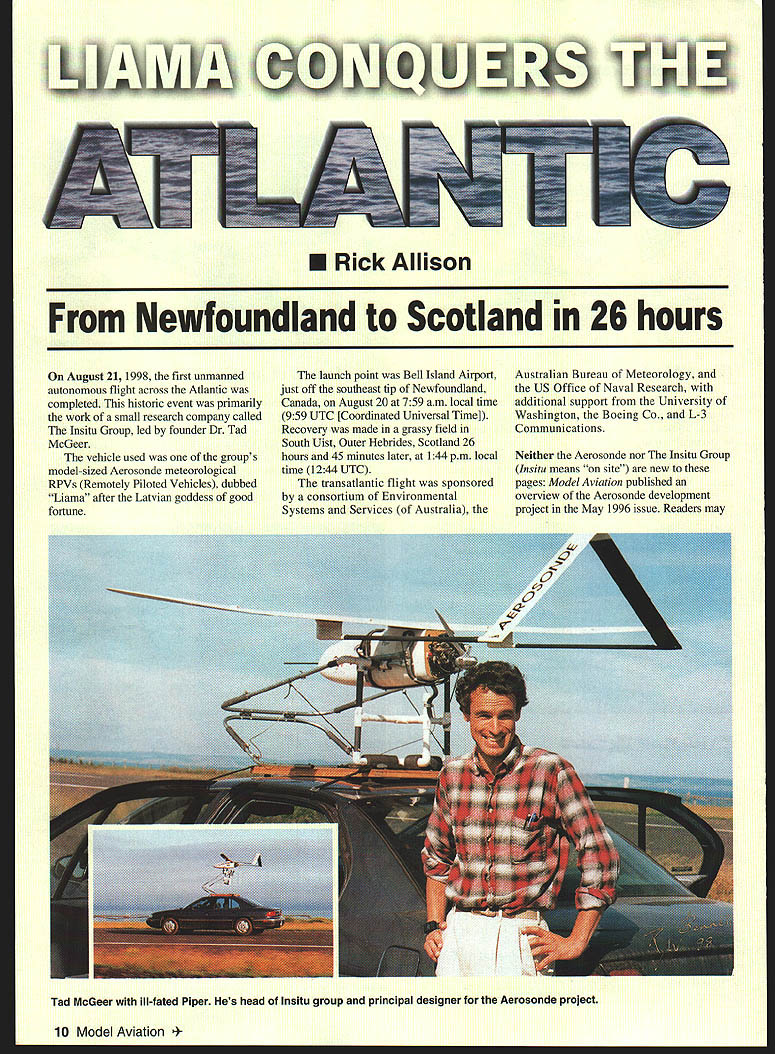
On August 21, 1998, the first unmanned autonomous flight across the Atlantic was completed. The flight was primarily the work of a small research company, The Insitu Group, led by founder Dr. Tad McGeer. The vehicle used was one of the group's model-sized Aerosonde meteorological RPVs (Remotely Piloted Vehicles), dubbed "Liama."
Liama was launched from Bell Island Airport, off the southeast tip of Newfoundland, Canada, on August 20 at 7:59 a.m. local time (9:59 UTC). Recovery was made in a grassy field on South Uist, Outer Hebrides, Scotland, 26 hours and 45 minutes later at 1:44 p.m. local time (12:44 UTC).
The transatlantic flight was conceived as a demonstration of the Aerosonde's operational capability and capped an impressive list of recent accomplishments for the program.
Sponsors and Support
- Environmental Systems and Services (Australia)
- Australian Bureau of Meteorology
- U.S. Office of Naval Research
- Additional support: University of Washington, Boeing Co., L-3 Communications
Design and Construction
Airframe
- Wing: box-stock 900-square-inch Genesis thermal-duration glider wing with a Selig 7037 airfoil (RnR Products, Milpitas, California).
- Remaining airframe: designed by The Insitu Group and produced by RnR.
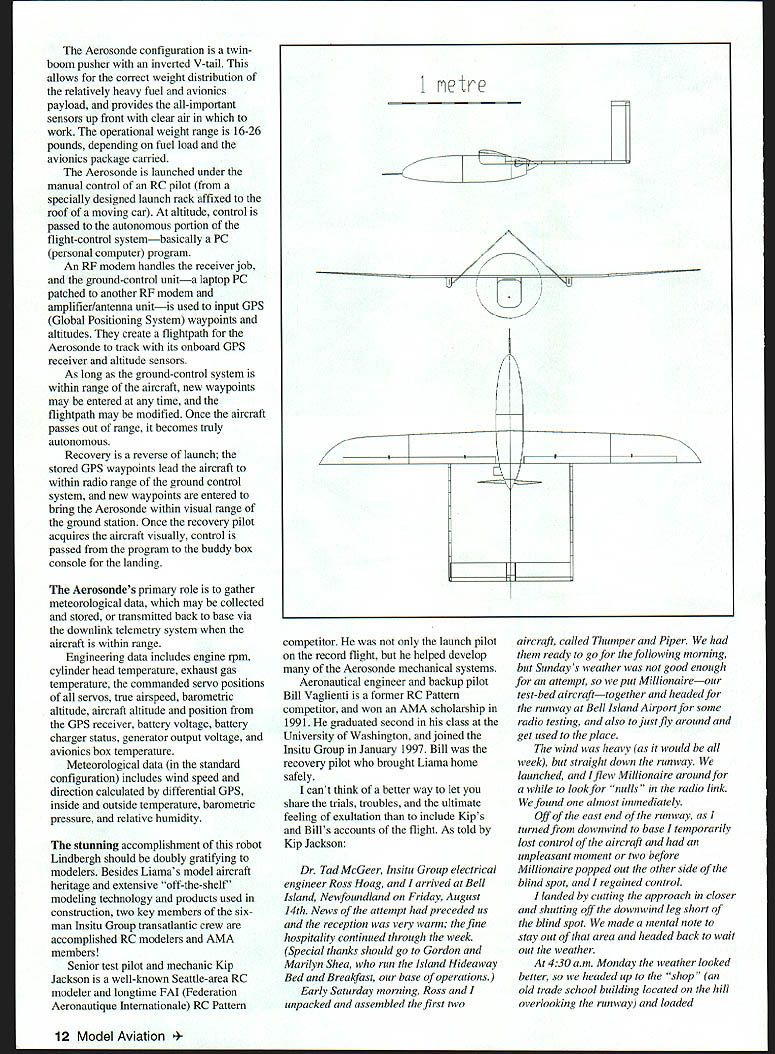
- Configuration: twin-boom pusher with an inverted V-tail to allow correct weight distribution for fuel and avionics and to place sensors in clear air.
- Operational weight range: 16–26 pounds (depending on fuel load and avionics package).
Propulsion
- Engine: substantially modified Enya 1.20R running on 100 low-lead avgas.
- Propeller: regular tractor-style APC 20 x 8 used in a pusher configuration by reversing engine rotation.
- Carburetor: Walbro WT332 with a custom intake manifold and custom in-flight mixture control.
Electrical and Ignition
- Generator: small 30-volt brushless generator modified from an electric RC "can" motor, belt-and-pulley driven from the engine.
- Ignition: capacitive-discharge ignition system from C&H Electronics paired with a custom ignition-timing system.
Flight Controls and Servos
- Flight-control surfaces actuated by stock Futaba and JR servos and hookups.
- Onboard flight-control system: essentially a PC program handling autonomous control once launched.
Autonomy, Launch and Recovery
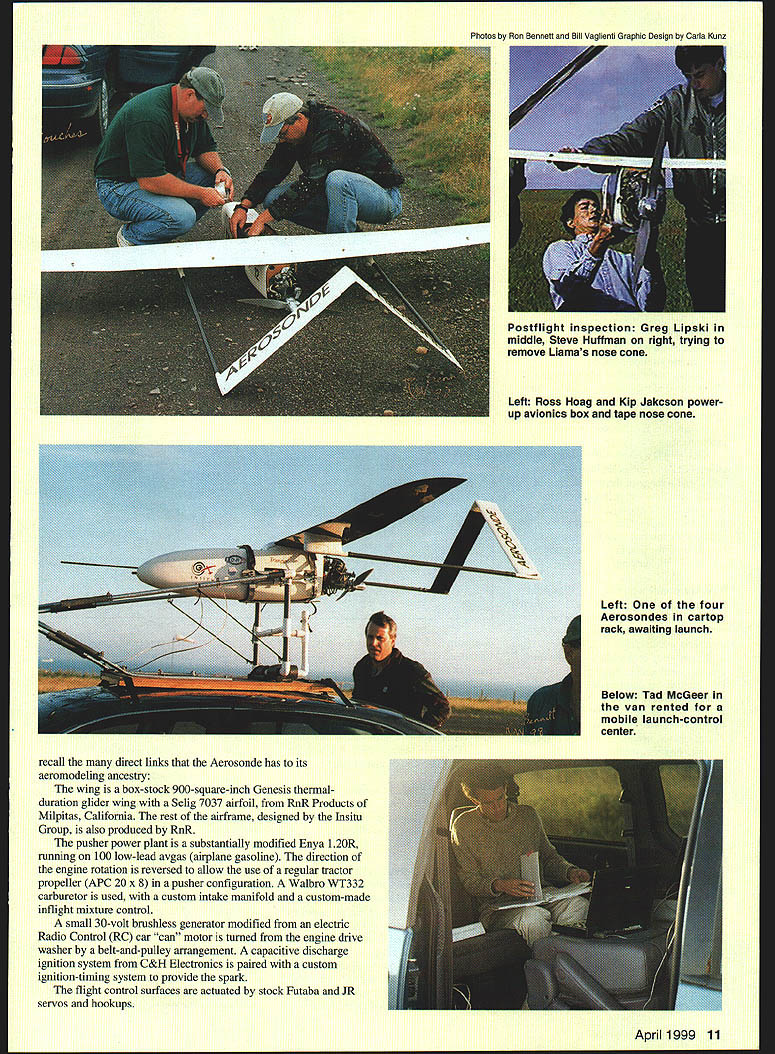
- Launch: manual control by an RC pilot from a specially designed launch rack affixed to the roof of a moving car.
- Transition to autonomy: at altitude control is handed to the onboard autopilot program.
- Ground-control: laptop PC patched to an RF modem/amplifier/antenna used to upload GPS waypoints and altitudes to create a flightpath. An RF modem on the aircraft handles reception.
- In-range operation: as long as the ground-control system is within radio range, operators may upload new waypoints and modify the flightpath.
- Out-of-range operation: aircraft becomes fully autonomous.
- Recovery: stored GPS waypoints bring the aircraft back within radio range; operators then guide the Aerosonde into visual range, hand control to a recovery pilot via a buddy-box console, and land manually.
Data Collection
- Primary role: gather meteorological data for collection, storage, and telemetry when within range.
- Engineering telemetry (examples): engine RPM, cylinder head temperature, exhaust gas temperature, commanded servo positions, true airspeed, barometric altitude, GPS position and attitude, battery voltage, battery charger status, generator output voltage, avionics-box temperature.
- Meteorological sensors (standard config): wind speed and direction (calculated, including differential GPS), inside and outside temperature, barometric pressure, and relative humidity.
The Flight Crew and Accounts
The Insitu Group transatlantic crew numbered six. Two key members with RC-modeling backgrounds were senior test pilot and mechanic Kip Jackson and aeronautical engineer and recovery pilot Bill Vaglienti. Both had long histories in RC competition and model aviation.
Kip Jackson — Launch and Early Operations (as told by Kip Jackson)
Dr. Tad McGeer, electrical engineer Ross Hoag, and I arrived at Bell Island on Friday, August 14. Local reception and hospitality were excellent. We assembled two aircraft, Thumper and Piper, and prepared them for launch. Poor weather delayed initial attempts, so we used a test-bed aircraft, Millionaire, for radio testing and familiarization flights.
During one test flight we discovered a radio "null" off the east end of the runway where control was temporarily lost; we adjusted our procedures to avoid that area. On Monday morning we launched Thumper, checked the autopilot (speed sweeps and gains), activated the autonomous program, and sent her out to sea.
A few hours later we launched Piper as a second attempt to maximize our weather window. Piper experienced a software bug during the transition from manual to automatic control and crashed into the sea shortly after takeoff. It was an embarrassing loss in front of press and onlookers, but part of experimental RPV work.
After weather delays on Tuesday and Wednesday, we prepared Liama and Millionaire for another attempt. On Thursday we launched both (with Millionaire modified for balance). With Liama headed out to sea I left to begin a vacation. Early the next morning, Ross called to say Liama had made it across the ocean.
Bill Vaglienti — Recovery and Landing (as told by Bill Vaglienti)
The long crossing put Liama out of communications range for much of the flight. We had to trust the Aerosonde's autonomous navigation, which used a preprogrammed course designed to take advantage of prevailing North Atlantic winds. Our simulations predicted a midday arrival, but weather variations could shift timing.
On recovery day the forecast predicted poor conditions (25-knot winds and a low cloud base), but the skies proved CAVU (clear and visibility unlimited). About 1 p.m. local our ground station beeped; telemetry showed Liama was healthy. Greg (on the ground station) used the autopilot to set Liama up for an open-field landing while Steve (Huffman) moved the mobile ground station toward the site to pick her up visually.
Once the radio link was transferred to the mobile station, a few computer commands brought Liama "feet dry" and over land after 26 hours. We visually acquired the aircraft, switched to manual control on a standard Futaba transmitter, and flew a conservative pattern. A short downwind pass and a smooth final were enough. I shut the engine down and landed on a wide grass field; Liama slid to a stop on her belly with barely a scratch. There was much celebration and relief.
Liama flew the overwhelming majority of the trip alone and unassisted, guided only by programming and sensors. Postflight analysis indicated 8–10 hours of the journey were spent in heavy rain.
Results and Aftermath
- Liama was the first unmanned aircraft and the smallest aircraft of any type to cross the Atlantic.
- The flight demonstrated Aerosonde operational capability and helped validate autonomy and long-range mission concepts.
- Concept testing was complete; the project moved toward developing a more flexible, robust aircraft for routine commercial use, with planned initial operation in the near term.
- Reliability improvements were identified as a major goal: of four aircraft launched on the attempt, only one completed the crossing. Piper crashed due to a software bug during transition from manual to automatic control; reasons for the loss of Thumper and Millionaire (presumed lost) are unknown without enroute telemetry, though low-reliability parts are suspected as possible causes.
- Future routine oceanic crossings may become practical as long-range satellite communications and telemetry become available.
Quick Facts from Liama's Journey
- Flight duration: 26 hours 45 minutes
- Distance traveled: 2,031 miles
- Average speed: 75 mph
- Fuel burned: 3.9 kilos (about 1.5 gallons)
- Oil used: 30 cc
- Estimated fuel efficiency: about 1,350 miles per gallon
Dr. Tad McGeer, The Insitu Group, and all individuals and organizations involved — including Kip Jackson and Bill Vaglienti — can be proud of their accomplishment. For the Aerosonde, future skies look CAVU indeed.
Rick Allison 26405 SE 160th St. Issaquah, WA 98027
Transcribed from original scans by AI. Minor OCR errors may remain.

