
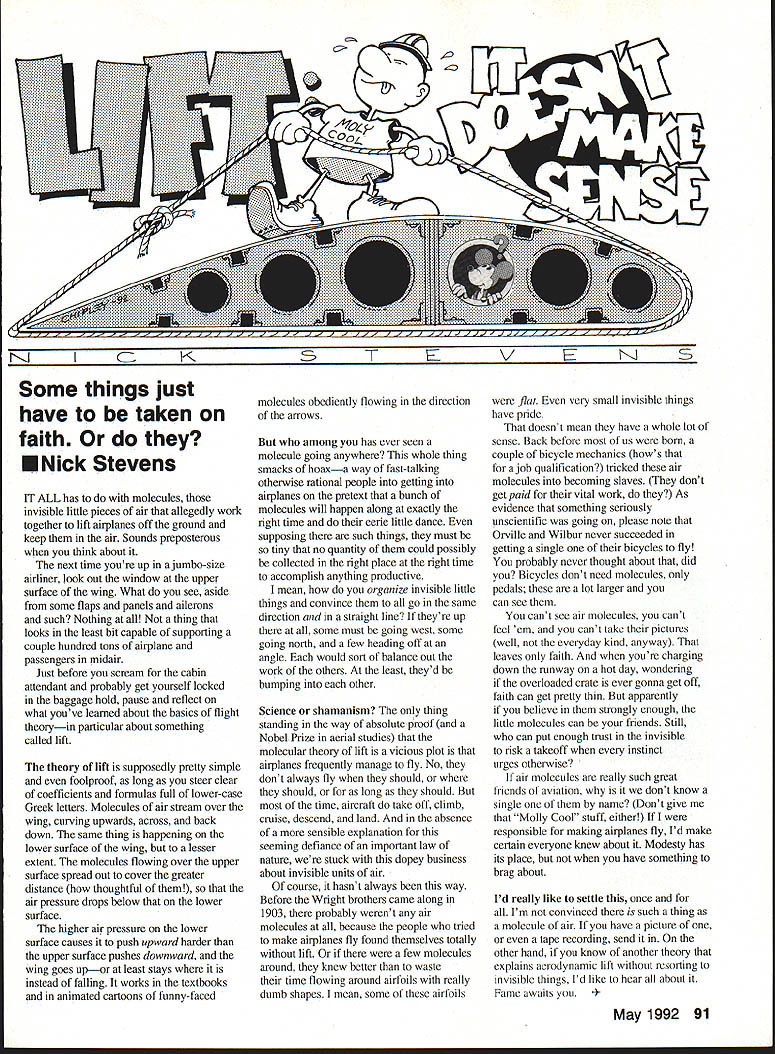
Lift: It Doesn't Make Sense
By Nick Stevens
Some things just have to be taken on faith. Or do they?
It all has to do with molecules, those invisible little pieces of air that allegedly work together to lift airplanes off the ground and keep them in the air. Sounds preposterous when you think about it.
The next time you're up in a jumbo-size airliner, look out the window at the upper surface of the wing. What do you see, aside from some flaps and panels and ailerons and such? Nothing at all—nothing that looks in the least bit capable of supporting a couple hundred tons of airplane and passengers in midair.
Just before you scream for the cabin attendant and probably get yourself locked in the baggage hold, pause and reflect on what you've learned about the basics of flight theory—in particular about something called lift.
The theory of lift is supposedly pretty simple and even foolproof, as long as you steer clear of coefficients and formulas full of lower-case Greek letters. Molecules of air stream over the wing, curving upwards, across, and back down. The same thing is happening on the lower surface of the wing, but to a lesser extent. The molecules flowing over the upper surface spread out to cover the greater distance (how thoughtful of them!), so that the air pressure drops below that on the lower surface.
The higher air pressure on the lower surface causes it to push upward harder than the upper surface pushes downward, and the wing goes up—or at least stays where it is instead of falling. It works in the textbooks and in animated cartoons of funny-faced molecules obediently flowing in the direction of the arrows.
But who among you has ever seen a molecule going anywhere? This whole thing smacks of a hoax—a way of fast-talking otherwise rational people into getting in airplanes on the pretext that a bunch of molecules will happen along at exactly the right time and do their eerie little dance. Even supposing there are such things, they must be so tiny that no quantity of them could possibly be collected in the right place at the right time to accomplish anything productive.
I mean, how do you organize invisible little things and convince them to all go in the same direction and in a straight line? If they're up there at all, some must be going west, some going north, and a few heading off at an angle. Each would sort of balance out the work of the others. At the least, they'd be bumping into each other.
Science or shamanism? The only thing standing in the way of absolute proof (and a Nobel Prize in aerial studies) that the molecular theory of lift is a vicious plot is that airplanes frequently manage to fly. No, they don't always fly when they should, or where they should, or for as long as they should. But most of the time, aircraft do take off, climb, cruise, descend, and land. And in the absence of a more sensible explanation for this seeming defiance of an important law of nature, we're stuck with this dopey business about invisible units of air.
Of course, it hasn't always been this way. Before the Wright brothers came along in 1903, there probably weren't any air molecules at all, because the people who tried to make airplanes fly found themselves totally without lift. Or if there were a few molecules around, they knew better than to waste their time flowing around airfoils with really dumb shapes. I mean, some of these airfoils were flat. Even very small invisible things have pride.
That doesn't mean they have a whole lot of sense. Back before most of us were born, a couple of bicycle mechanics (how's that for a job qualification?) tricked these air molecules into becoming slaves. (They don't get paid for their vital work, do they?) As evidence that something seriously unscientific was going on, please note that Orville and Wilbur never succeeded in getting a single one of their bicycles to fly! You probably never thought about that, did you? Bicycles don't need molecules, only pedals; these are a lot larger and you can see them.
You can't see air molecules, you can't feel 'em, and you can't take their pictures (well, not the everyday kind, anyway). That leaves only faith. And when you're charging down the runway on a hot day, wondering if an overloaded crate is ever gonna get off, faith can get pretty thin. Apparently, if you believe in them strongly enough, the little molecules can be your friends. Still, who can put enough trust in invisible things to risk a takeoff when every instinct urges otherwise?
If air molecules are really such great friends of aviation, why is it we don't know a single one of them by name? (Don't give me that "Molly Cool" stuff, either!) If I were responsible for making airplanes fly, I'd make certain everyone knew about it. Modesty has its place, but not when you have something to brag about.
I'd really like to settle this, once and for all. I'm not convinced there is such a thing as a molecule of air. If you have a picture of one, or even a tape recording, send it in. On the other hand, if you know of another theory that explains aerodynamic lift without resorting to invisible things, I'd like to hear about it. Fame awaits you.
Transcribed from original scans by AI. Minor OCR errors may remain.

