
Lightweight Tail Surfaces
"Build the tail structure as light as possible." This is necessary to prevent a tail‑heavy airplane that may be unstable, or at least difficult to control.
Methods
There are several methods to build tails:
- Flat sheet
- Stick construction
- Laminated edges for curved outlines
- Foam core sheeted
- Complete built‑up with ribs and spars
Lightweight core-with-doublers method
Another method I have used is strong and light, and is adaptable to models of varying sizes. It uses thin balsa sheet as a core, on which false ribs and doublers are glued. It can be used for any tail shape, and is fast to build. This example is for a .25‑size model and used 1/16" sheet balsa for the core and doublers.
Construction example (.25-size model)
Materials and dimensions used in this example:
- Core and doublers: 1/16" sheet balsa
- Leading edge and false ribs: 1/8" square balsa
- Optional center reinforcement: 1/64" plywood (or thin carbon fiber)
Steps:
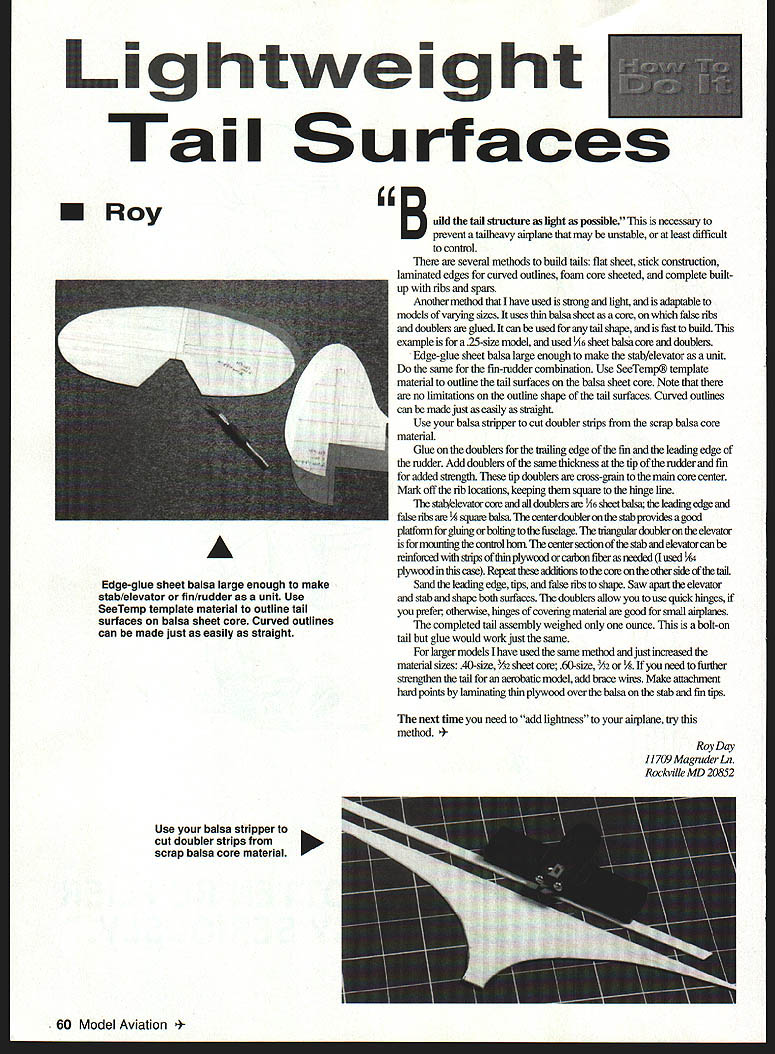
- Edge‑glue sheet balsa large enough to make the stabilizer/elevator as a unit. Do the same for the fin/rudder combination.
- Use template material to outline the tail surfaces on the balsa sheet core. There are no limitations on the outline shape; curved outlines are as easy as straight.
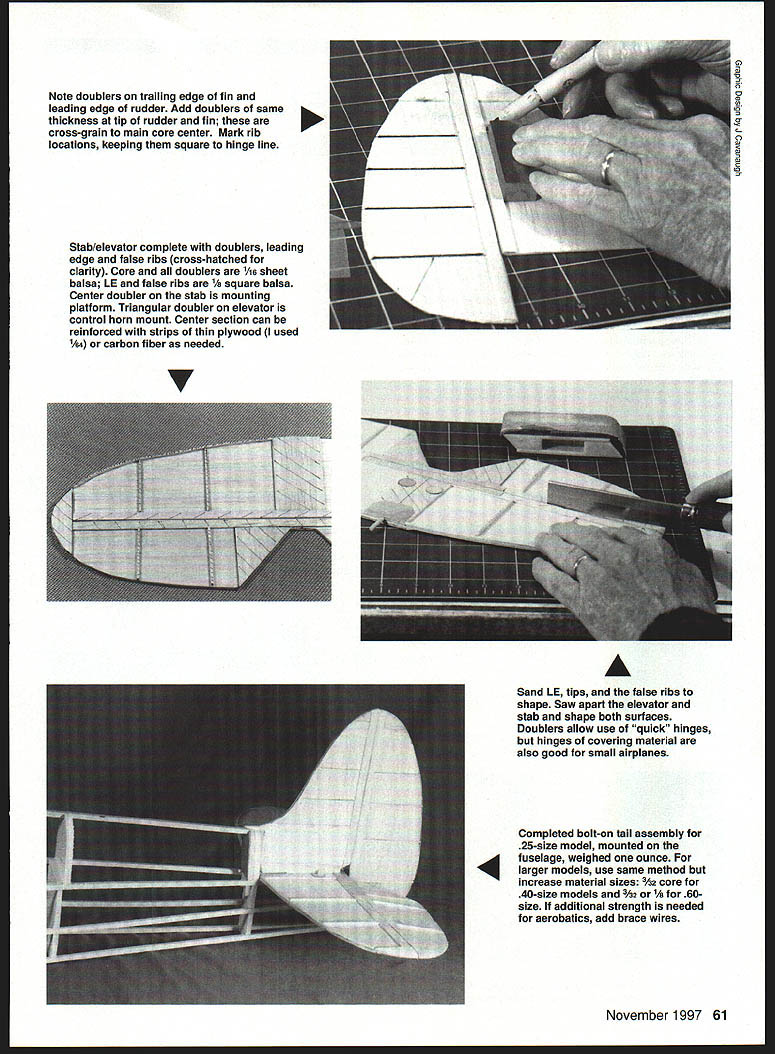
- Use a balsa stripper to cut doubler strips from scrap balsa core material.
- Glue on doublers for the trailing edge of the fin and the leading edge of the rudder.
- Add doublers of the same thickness at the tips of the rudder and fin for added strength. These tip doublers should be laminated cross‑grain to the main core center.
- Mark off the false rib locations, keeping them square to the hinge line.
- Add a center doubler on the stabilizer to provide a good platform for gluing or bolting to the fuselage.
- Add a triangular doubler on the elevator for mounting the control horn.
- Reinforce the center section of the stabilizer and elevator as needed with strips of thin plywood or carbon fiber (1/64" plywood was used in this case).
- Repeat the additions to the core on the other side of the tail.
- Sand the leading edge, tips, and false ribs to shape.
- Saw apart the elevator and stabilizer and shape both surfaces.
- Install hinges: the doublers allow the use of quick hinges if preferred; otherwise, hinges of covering material are suitable for small airplanes.
- Mount the tail: this example produced a completed tail assembly that weighed only one ounce. It was built as a bolt‑on tail, but glue would work just as well.
Scaling and strengthening for larger or aerobatic models
- For larger models, increase material sizes:
- .40‑size: 3/32" sheet core
- .60‑size: 3/32" or 3/16" sheet core
- For aerobatic models, add brace wires as needed.
- Make attachment hard points by laminating thin plywood over the balsa on the stabilizer and fin tips.
Notes
- Doublers are placed on the trailing edge of the fin and the leading edge of the rudder.
- Add tip doublers of the same thickness at the tips of the rudder and fin; these tip doublers should be cross‑grain to the main core center.
- Always mark rib locations square to the hinge line.
The next time you need to "add lightness" to your airplane, try this method.
Roy Day 11709 Magruder Ln. Rockville, MD 20852
Transcribed from original scans by AI. Minor OCR errors may remain.

