
Lil'Quickie
John Ballard
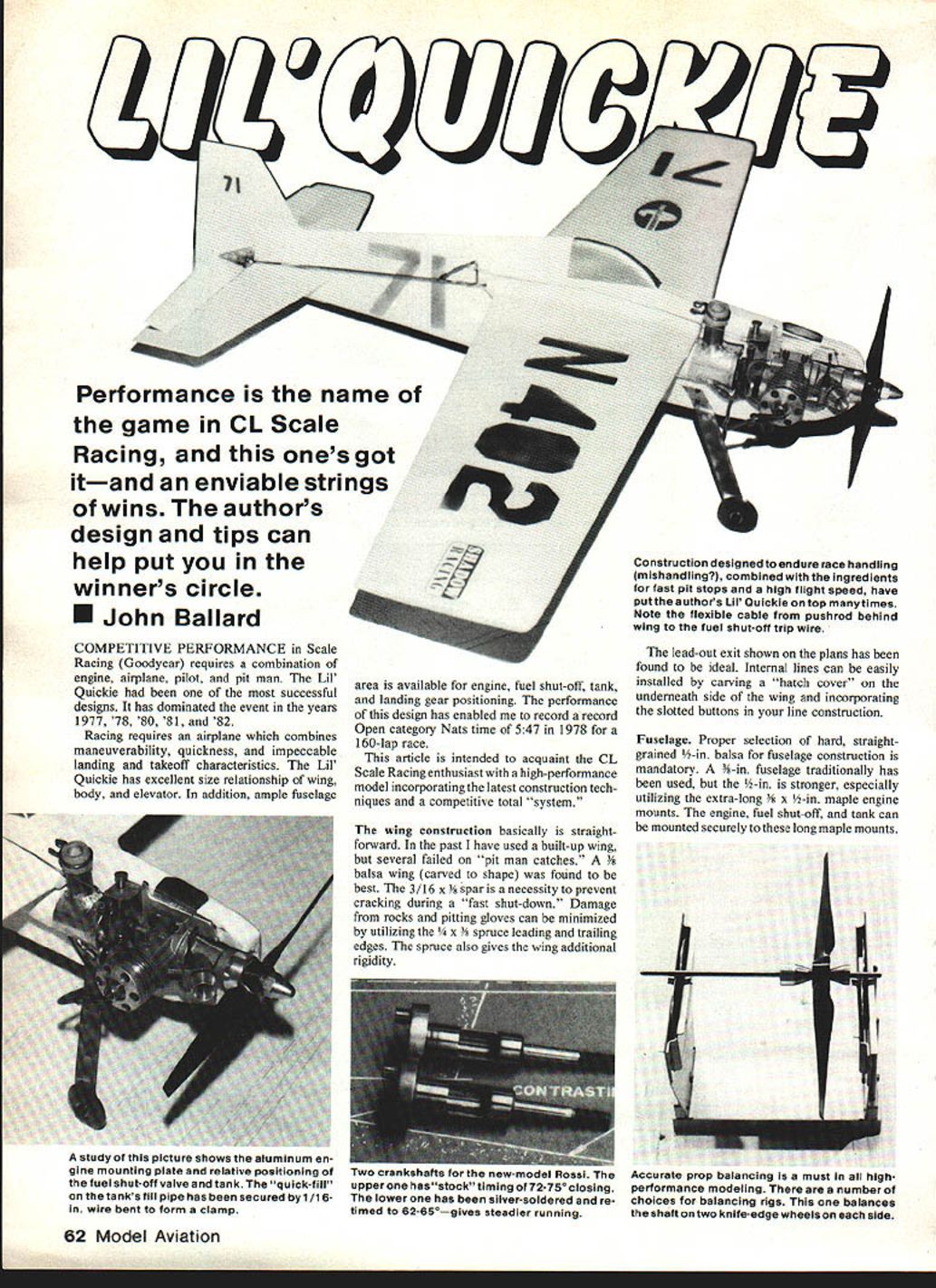
Performance is the name of the game in CL Scale Racing, and this one's got it — plus an enviable string of wins. The Lil' Quickie has been one of the most successful designs, dominating the event in 1977, 1978, 1980, 1981, and 1982.
Competitive performance in Scale Racing (Goodyear) requires a combination of engine, airplane, pilot, and pit man. Racing requires an airplane that combines maneuverability, quickness, and impeccable landing and takeoff characteristics. The Lil' Quickie has an excellent size relationship of wing, fuselage, and elevator, and ample fuselage area for engine, fuel shut-off, tank, and landing gear positioning. The performance of this design enabled a record Open category Nats time of 5:47 in 1978 for a 160-lap race.
This article acquaints the CL Scale Racing enthusiast with a high-performance model incorporating current construction techniques and a competitive total "system."
Wing
Wing construction is straightforward. In the past I used a built-up wing, but several failed on pit-man catches. A 3/16 x 5/8-in. spar is a necessity to prevent cracking during a fast shut-down. Damage from rocks and pitting gloves can be minimized by using 1/4 x 3/8-in. spruce leading and trailing edges; the spruce also gives the wing additional rigidity.
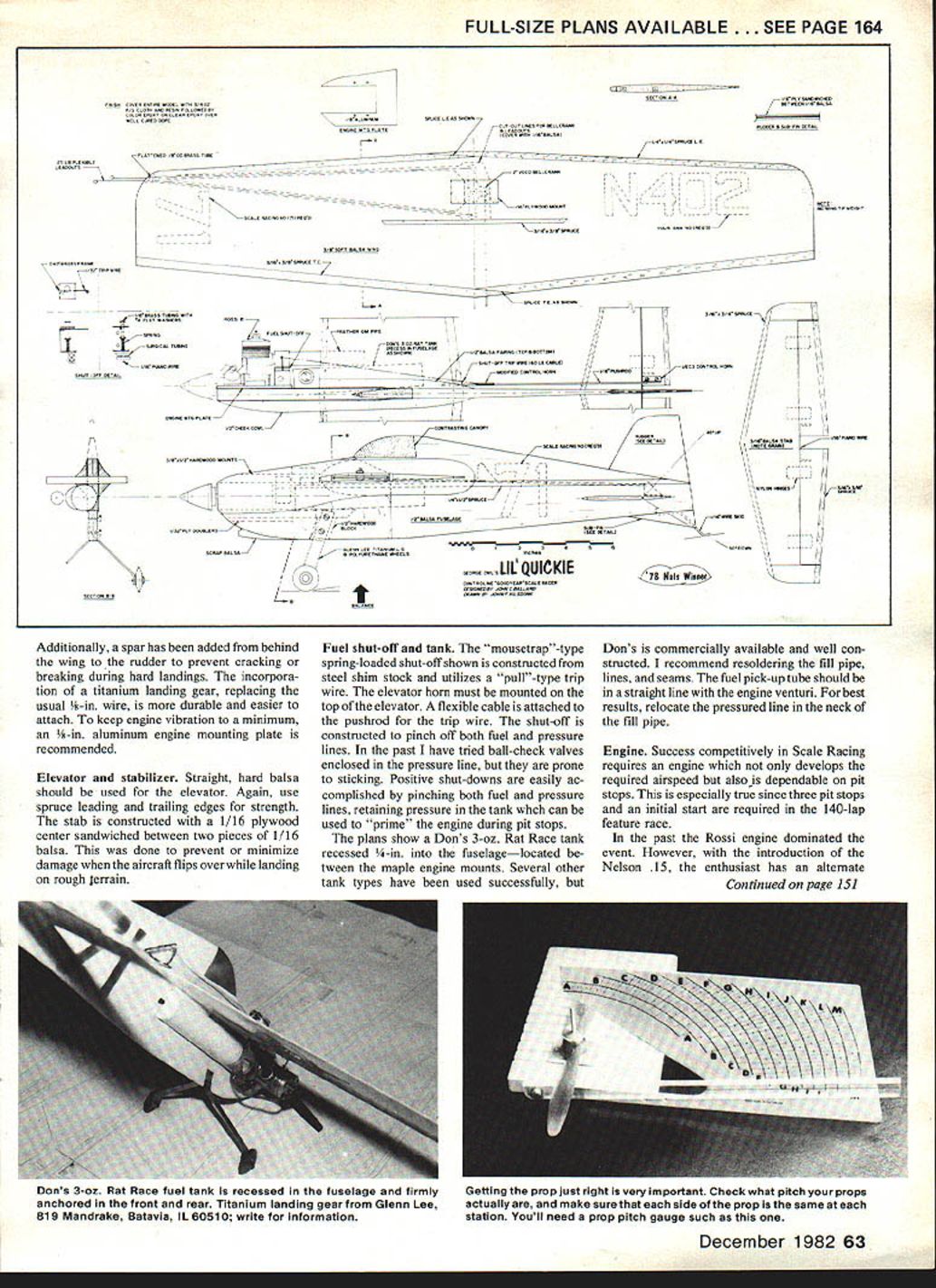
The lead-out exit shown on the plans has proven ideal. Internal lines can be easily installed by carving a hatch cover on the underside of the wing and incorporating slotted buttons in your line construction.
Fuselage
Proper selection of hard, straight-grained 1/4-in. balsa for fuselage construction is mandatory. A 3/8-in. fuselage has traditionally been used, but 1/4-in. is stronger, especially when using extra-long 3/8 x 1/2-in. maple engine mounts. The engine, fuel shut-off, and tank can be mounted securely to these long maple mounts.
Additionally, a spar has been added from behind the wing to the rudder to prevent cracking or breaking during hard landings. Incorporating a titanium landing gear, replacing the usual 3/64-in. wire, is more durable and easier to attach. To keep engine vibration to a minimum, a 1/16-in. aluminum engine mounting plate is recommended.
Elevator and stabilizer
Use straight, hard balsa for the elevator and spruce leading and trailing edges for strength. The stabilizer is constructed with a 1/16-in. plywood center sandwiched between two pieces of 1/16-in. balsa. This construction helps prevent or minimize damage when the aircraft flips over while landing on rough terrain.
Fuel shut-off and tank
The "mousetrap"-type spring-loaded shut-off shown is constructed from steel shim stock and utilizes a pull-type trip wire. The elevator horn must be mounted on the top of the elevator. A flexible cable is attached to the pushrod for the trip wire. The shut-off is constructed to pinch off both fuel and pressure lines. Ball-check valves enclosed in the pressure line tend to stick; positive shut-downs are more easily accomplished by pinching both fuel and pressure lines, retaining pressure in the tank which can be used to prime the engine during pit stops.
The plans show Don's 3-oz. Rat Race tank recessed 1/4-in. into the fuselage, located between the maple engine mounts. Several other tank types work successfully, and Don's tank is commercially available and well constructed. I recommend resoldering the fill pipe, lines, and seams. The fuel pick-up tube should be in a straight line with the engine venturi. For best results, relocate the pressure line to the neck of the fill pipe.
Both Don's tank and a simple brass-shim tank work well. Don's can be purchased; the brass-shim tank does not require recessing the fuselage.
Engine
Competitive success in Scale Racing requires an engine that develops the required airspeed and is dependable on pit stops. This is especially true since three pit stops and an initial start are required in the 140-lap feature race.
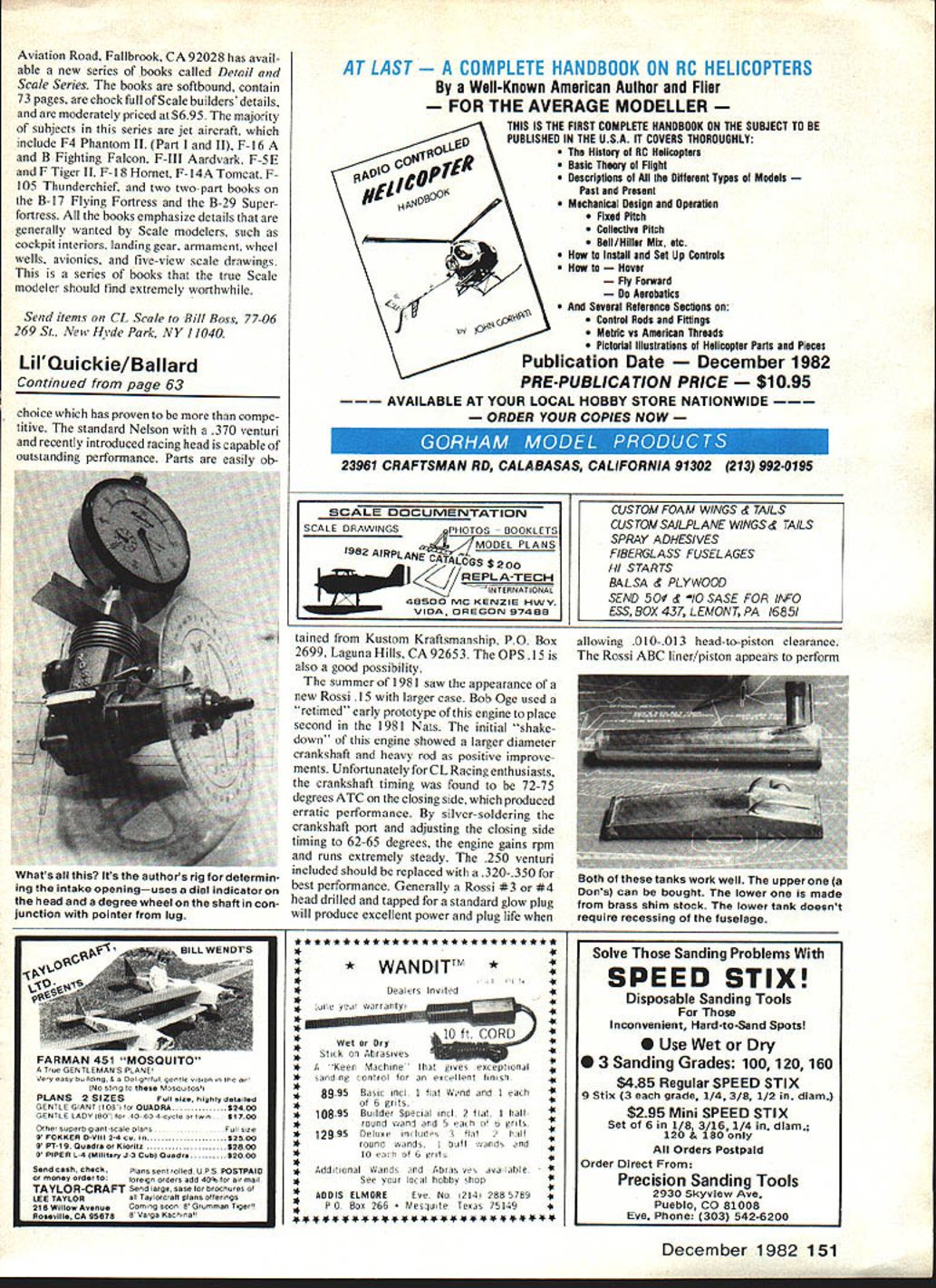
In the past the Rossi .15 dominated the event. With the introduction of the Nelson .15, enthusiasts gained a competitive alternative. The standard Nelson with a .370-in. venturi and the recently introduced racing head is capable of outstanding performance. Parts are available from Kustom Kraftsmanship, P.O. Box 2699, Laguna Hills, CA 92653. The OPS .15 is also a good possibility.
The summer of 1981 saw the appearance of a new Rossi .15 with a larger case. Bob Oge used a retimed early prototype of this engine to place second in the 1981 Nats. Initial shakedown showed a larger-diameter crankshaft and heavy rod as positive improvements. The crankshaft timing, however, was 72–75 degrees ATC on the closing side, which produced erratic performance. By silver-soldering the crankshaft port and adjusting the closing-side timing to 62–65 degrees, the engine gains rpm and runs extremely steadily. The .250-in. venturi included should be replaced with a .320–.350-in. venturi for best performance. Generally, a Rossi 3 #1 or #4 head drilled and tapped for a standard glow plug will produce excellent power and plug life when allowing .010–.013-in. head-to-piston clearance. The Rossi ABC liner/piston appears to perform well.
Propeller
With the limited power of a .15-size engine, choice and pitch of propeller can affect performance dramatically. Initially a carved Top Flite 7 x 6 speed prop was used to mold a fiberglass copy. After considerable testing and pitching it was molded by Walt Perkins of Shadow Racing, 1100 S.E. 28th St., Ocala, FL 32670. Walt molded the prop in carbon fiber and epoxy. After minimal de-flashing and rework, excellent terminal speed and superior acceleration on takeoff were obtained. The diameter of the Shadow copy is about 6-3/4 in., with the pitch at 5-3/4 in. on all stations from Station 2 to the tip. Different engines and atmospheric conditions may require different propeller selection.
It is imperative that the prop be balanced carefully and the hub trued up. Several excellent commercial balancers are available — I use the Harry Higley Hub Balancer even prior to pitching.
Racing is a team effort — hard work and preparedness deliver dividends. The system presented here can produce a consistent winner.
If you have any comments or questions, address them to me in care of Model Aviation.
Transcribed from original scans by AI. Minor OCR errors may remain.

