

Lite Bipe
"Here it is, folks—probably the ugliest model airplane ever designed, and an excellent example of 'form follows function.' Every iota of crudity and ugliness is there to make this aircraft a competition fun fly winner." — John Hunton
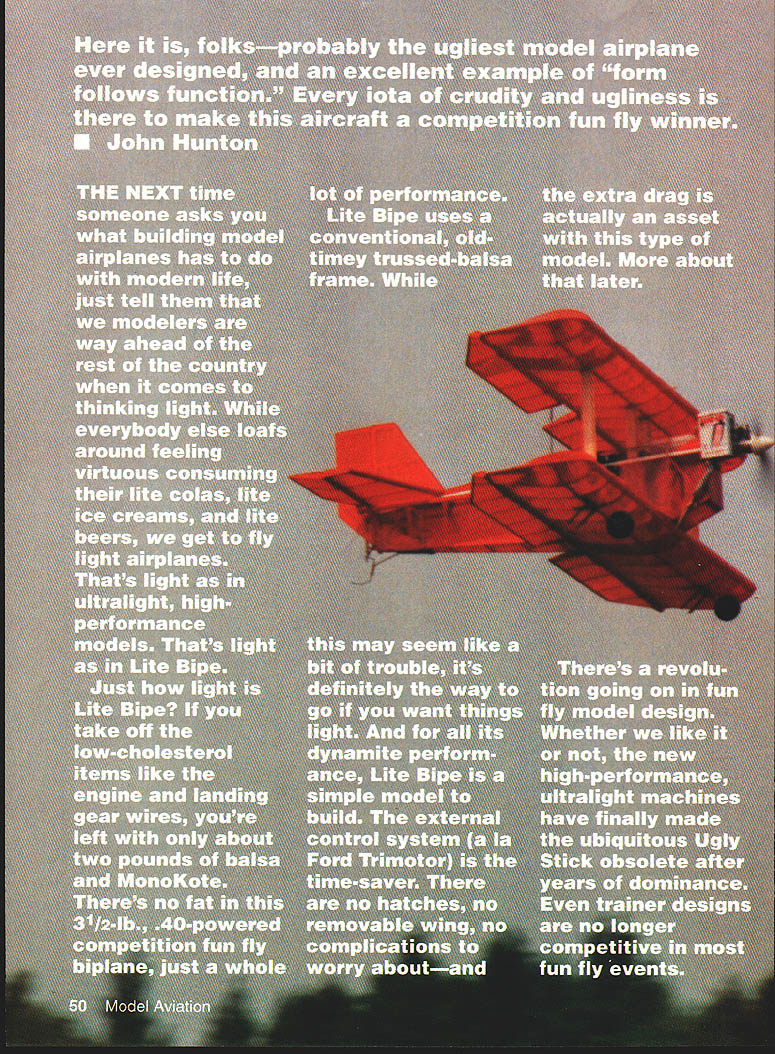
Here’s an ultralight, high-performance biplane designed for competition fun-fly events. Lite Bipe strips everything down to save weight: remove the engine and landing gear wires and the structure is only about two pounds of balsa and MonoKote. The finished, .40-powered prototype weighs about 3 lb 5 oz and delivers impressive performance while remaining simple to build and maintain.
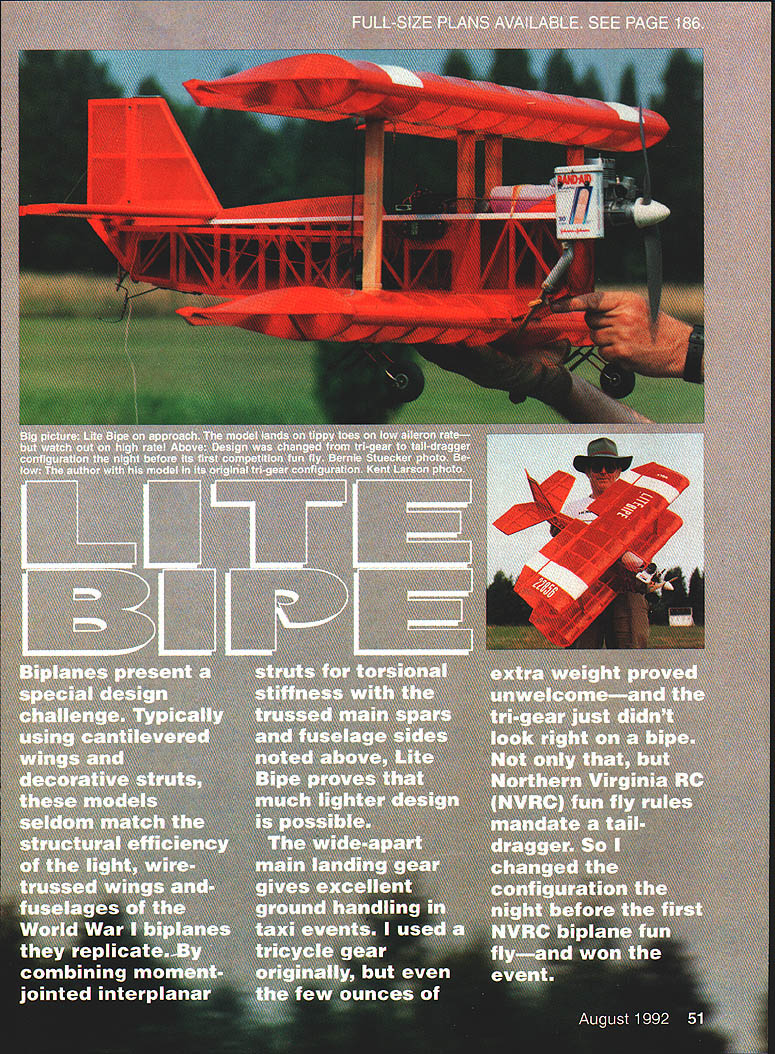
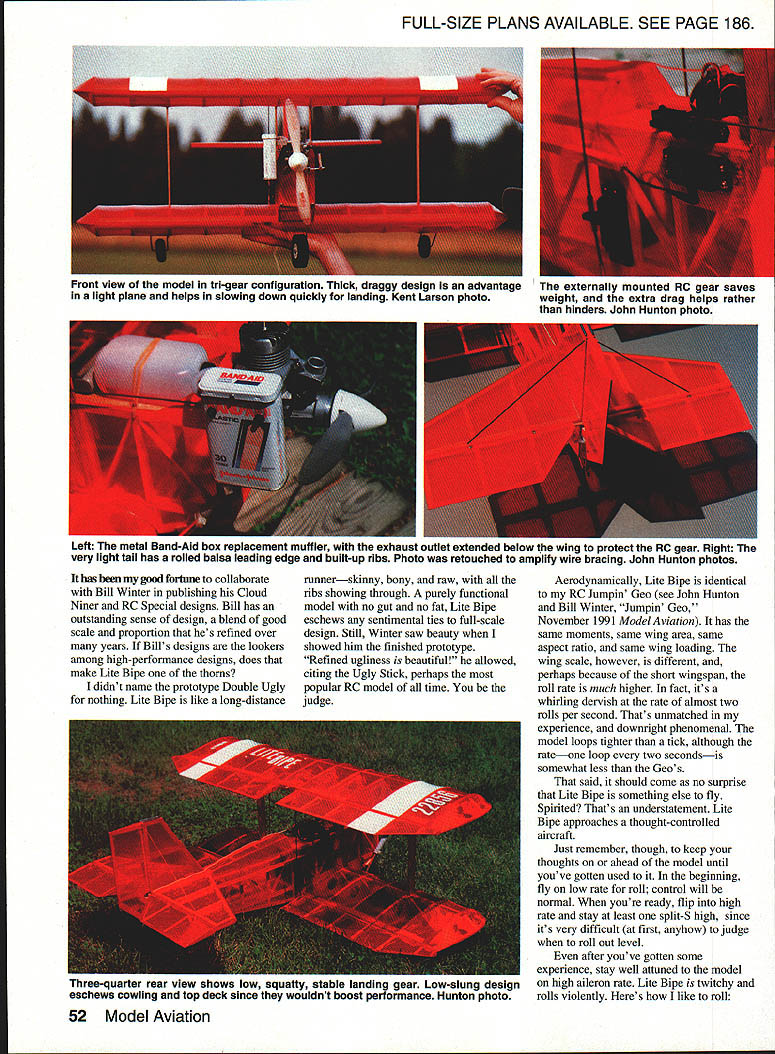
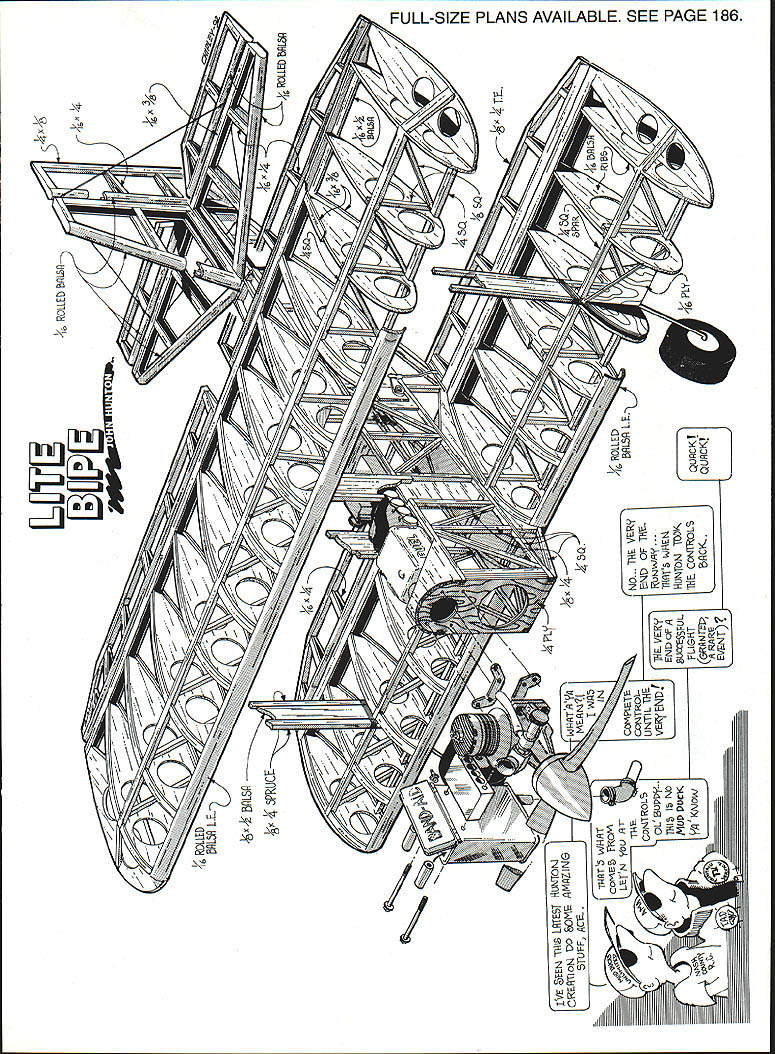
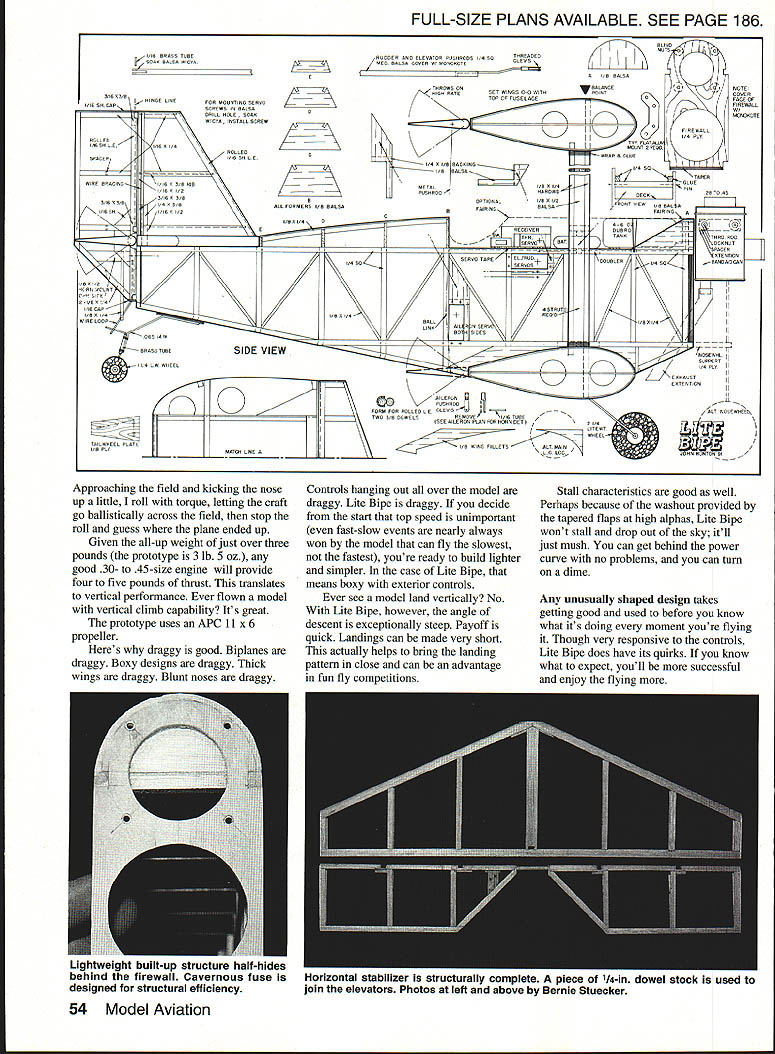
Lite Bipe uses a conventional, trussed-balsa frame. The external control system (a la Ford Trimotor) saves time and complexity—no hatches, no removable wing, few complications—and the extra drag from exposed controls is actually an asset for this type of model.
There’s a revolution in fun-fly design: ultralight, high-performance models are replacing the ubiquitous Ugly Stick. Biplanes usually suffer from inefficient cantilever wings and decorative struts, but Lite Bipe combines moment-jointed interplanar struts for torsional stiffness with trussed spars and fuselage sides, proving much lighter designs are possible.
The wide-apart main landing gear provides excellent ground handling for taxi events. A tricycle gear was tried but proved too heavy and visually wrong for a biplane; also, local rules mandated a taildragger. Switching to taildragger the night before a contest resulted in a win.
Aerodynamically, Lite Bipe is essentially identical to the RC Jumpin’ Geo (see John Hunton and Bill Winter, "Jumpin' Geo," November 1991 Model Aviation): same moments, wing area, aspect ratio, and wing loading. Because of its shorter wingspan, however, Lite Bipe has a much higher roll rate—nearly two rolls per second—and loops tightly (about one loop every two seconds). It is very spirited and responsive—approaching "thought-controlled" handling—so pilots must stay ahead of the airplane.
Flight characteristics and handling
- All-up weight: just over 3 lb (prototype 3 lb 5 oz).
- Recommended engine: .30–.45-size (a good .30–.45 will provide 4–5 lb thrust). Prototype uses an APC 11x6 propeller and an O.S. .40 SF ABC engine (a K&B .45 is equivalent; you could probably go as small as a .28).
- Vertical performance: excellent; the model will climb vertically.
- Roll and pitch: very quick and twitchy due to light weight and short moments. Use dual rates on roll controls—low rate for normal flight and high rate for rolling maneuvers.
- Stall and low-speed: good stall characteristics—tends to mush rather than drop. Reduced weight lowers stall speed roughly 33% (e.g., 24 mph to ~16 mph), enabling very slow approaches and short landings.
- Drag: intentionally high. Boxy fuselage, exposed controls, thick wings, and blunt nose all contribute to drag, which helps slow the model for competition tasks that reward low-speed handling more than top speed.
- Landings: angle of attack of the running gear strongly influences takeoff/landing behavior. Lite Bipe was rigged with a lower angle of attack at the tail wheel to favor short, controllable landings over fast takeoffs.
- Recommended technique: start on low aileron rate until familiar. When using high rate, remain at least one split-S high to allow safe roll-outs and to avoid disorientation. A favored entry: approach, kick the nose up slightly to counter torque, roll with the torque across the field, then stop the roll as needed.
RC Lite Bipe — quick specs
- Type: Competition fun-fly biplane
- Wingspan: 37 inches
- Recommended engine size/type: O.S. .40 SF ABC (range: .30 to .45 cu in)
- Number of RC channels recommended: Four
- Expected flying weight: 3 lb 5 oz (prototype)
- Type of construction: Built-up, trussed-balsa frame
- Covering/finish recommended: Transparent MonoKote; clear polyurethane
Construction
Be selective when choosing balsa. If ordering by mail, use a supplier that will select wood by density. Typical industry classifications:
- Very light: 4–6 lb/ft³
- Light: 6–9 lb/ft³
- Medium: 9–12 lb/ft³
- Hard: 12–16 lb/ft³
Use very light balsa for most parts, but medium-weight balsa for spars, fuselage longerons, and diagonal members. Order about 50% more wood than you think you’ll need so you can pick the best pieces. The completed framework should weigh about a pound. Assemble with thin CyA (cyanoacrylate) and use a baking-soda/CyA mixture for filling.
Fuselage
- Cover the plan with waxed paper, pin down the side members, and build the sides as shown on the plan.
- Use medium-weight balsa for the main fuselage frame; longerons should come from the best wood available. Use lightweight balsa for structure below the main frame.
- Cut the sides halfway through to inset the cabane struts and install a doubler behind this cutout.
- Pin the sides over the top-view plan before joining.
- Install crossmembers, cut out the firewall, and install blind nuts for the engine mount. Install other formers, turtledeck stringers, servo and wing-mount fairings, and wing fillets.
- Let in servo mounting plates and top-deck sheeting. Install the curved top-front fairing to stabilize the engine mount.
- Block-sand the fuselage sides flush and smooth stringers. Fuelproof exposed balsa parts with polyurethane.
Wings
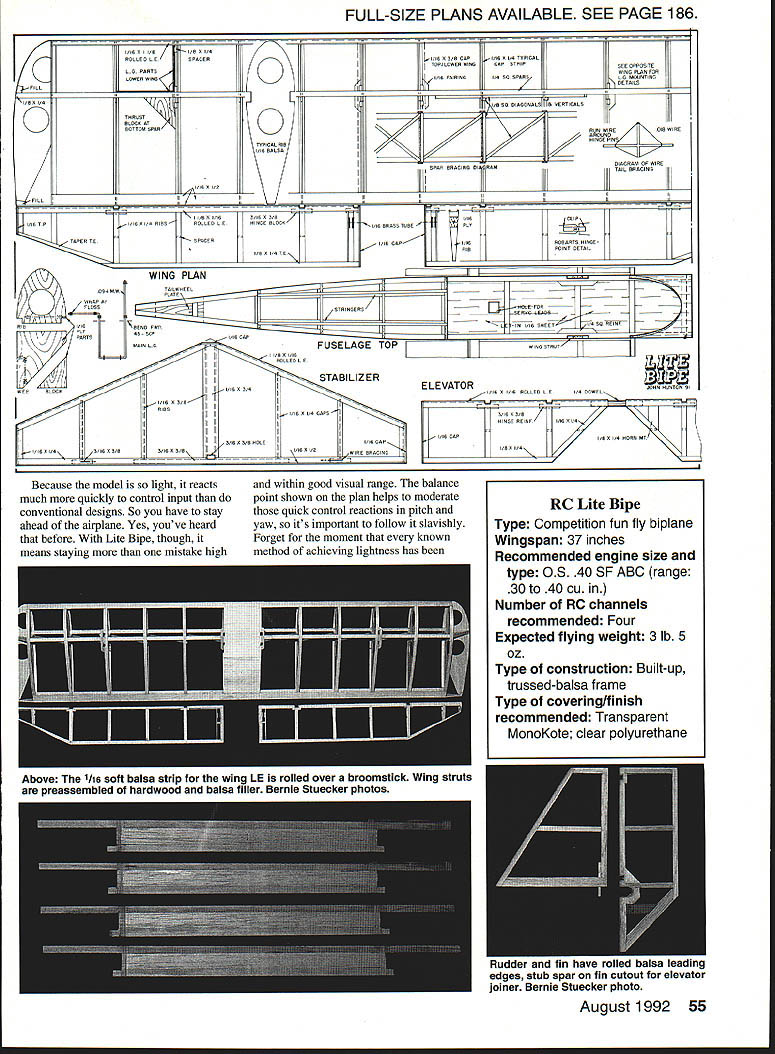
- Cut a soft balsa strip for the leading edge. Wet it, wrap it around a broomstick with an elastic bandage, and let it dry overnight.
- Cut out all wing ribs, plus four extra for the tips. Lightening holes are optional and have limited benefit for weight savings.
- Use medium-weight balsa for spars and diagonals. Pin the lower spar to the waxed-paper-covered plan and install ribs.
- Install the trailing-edge vertical portion, blocking and spacing accurately at the rib trailing edges. Install the top spar and diagonals. Run diagonals for top and bottom wings in opposite directions for best stiffness.
- Install 1/8-in. sq. uprights at each rib, glue on the rolled leading edge, and install other trailing-edge sheet parts.
- Build the second wing half the same way. Add tip parts (clipped ribs) and cap strips. Wrap landing-gear wire to the plywood gear parts and install.
Wing struts
- Strut construction: hardwood strut members extend from the bottom spar of the lower wing to the top spar of the upper wing. The hardwood rear strut extends from the top spar of the lower wing to the bottom spar of the top wing. Balsa filler spans only between wing surfaces. No diagonal bracing is required because strut bracing handles torsional loads.
- Wrap assembled struts with thread top and bottom, coat with CyA, and check wing alignment carefully before attachment.
Empennage and ailerons
- Roll leading-edge sheeting around a pair of 3/8-in. dowels, wrap with elastic bandage, and dry.
- Pin leading and trailing edges to the plan; install lower then upper rib parts and spacers. Install hinge reinforcement and sheet tips.
- Install rear-spar doublers that penetrate the stabilizer for fin support. Stabilizer has a part-span spar.
- Fin and rudder have rolled balsa leading edges—wet, wrap around a dowel, secure and dry overnight.
- Install hardwood mounts for rudder and elevator horns; drill and install nuts (don’t install horns yet). Join elevators with a piece of dowel.
- Ailerons are built topside down. This produces built-in warp at the tip for washout. Each aileron includes a special support and a pin for the control linkage.
Covering
- Transparent MonoKote is recommended; it seems to weigh less than opaque and metallic finishes.
- Attach covering at the center of a panel, pull toward the edges, and fasten. Smooth wrinkles and clear-coat exposed balsa with polyurethane.
Final assembly
- Assemble wings and tail to the fuselage. Bare abutting surfaces, align accurately, and glue.
- Attach wing struts, affixing them firmly at the spars. Fill voids with CyA and baking soda.
- Add empennage rigging to help prevent damage in a nose-over. Use high-strength wire or old braided control line. Run wire around hinges, gather and pull at the bottom of the fuselage, and glue joints with CyA.
- On the prototype, a 1/8-in. rod through the wing center section provided an attachment for a bomb-drop mount using rubber bands.
Lightweight muffler
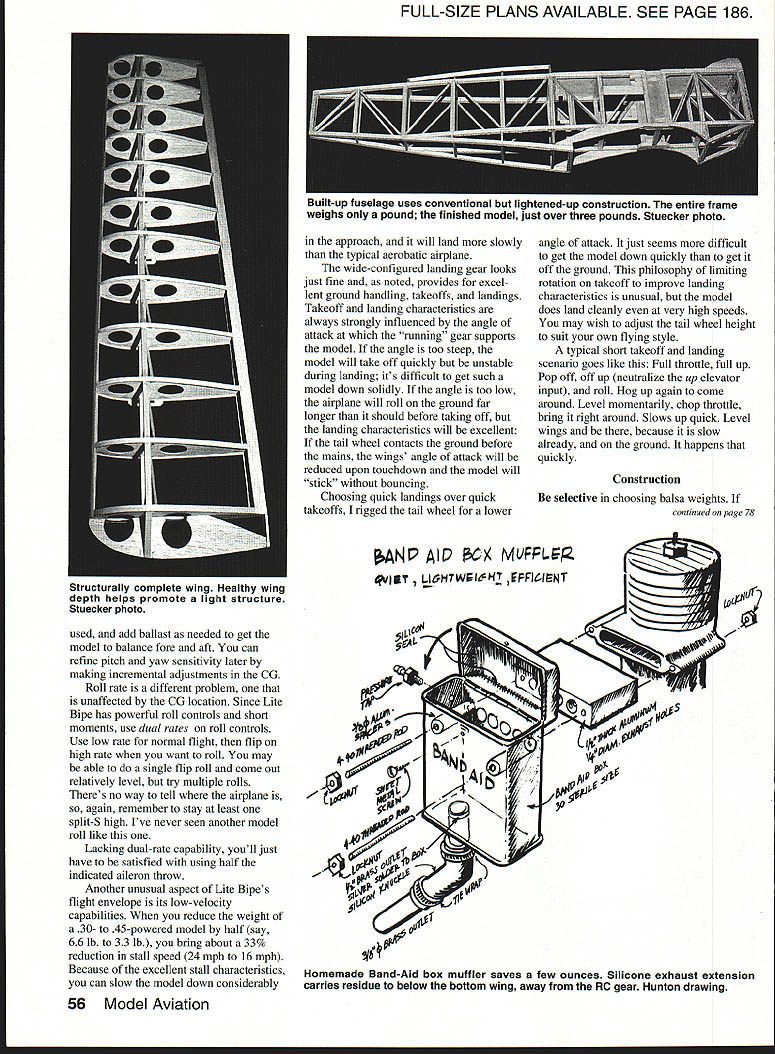
- Save ounces by building a muffler from a metal can (e.g., a Band-Aid can).
- Cut aluminum spacers sized to support the can the proper distance from the engine exhaust stack. Drill four 1/4-in. outlet holes and clearance holes for attachment screws.
- Cut two spacers to span the can’s width for support. Use an awl to create a pressure-tap anchorage in the tinplate, tap and install a nipple.
- Drill an exhaust hole in the can bottom and silver-solder a brass tube matching the engine’s exhaust outlet.
- Assemble the can to the engine with a threaded rod and locknuts. Coat the inside of the can top with silicone, close the top, and secure with a sheet-metal screw. Add a silicone exhaust extension to route residue below the bottom wing. This system is light and effective.
Engine
- Prototype: O.S. .40 SF ABC (K&B .45 equivalent). A .28 could work for even lighter weight. Keep the model light for best results.
Handling tips and trimming
- Adhere closely to the balance point shown on the plan to moderate quick pitch and yaw reactions. If necessary, add small amounts of ballast to achieve fore-and-aft balance; refine sensitivity with incremental CG adjustments.
- Use dual rates for roll. Without dual-rate capability, reduce aileron throw to about half.
- Stay well ahead of the airplane—fly on low rate until you’re comfortable, then use high rate cautiously and maintain altitude when performing rolls.
- Because of low weight, reactions are fast; remain within good visual range and at safe altitude margins while you learn the model’s quirks.
Remarks and acknowledgements
- Lite Bipe is intentionally unpretty—purposefully lean and functional rather than flashy. Bill Winter collaborated on design work for Cloud Nine RC Special; his sense of proportion helped refine the prototype’s appearance. Refined ugliness can be beautiful in its own way.
- Aerodynamically similar to the RC Jumpin’ Geo, Lite Bipe’s shorter wingspan and light structure make it uniquely quick in roll and very capable in vertical performance.
Build light, keep it simple, and enjoy a biplane that’s designed to win fun-fly events by flying both slowly and precisely when it counts.
Transcribed from original scans by AI. Minor OCR errors may remain.

