
Little Tiger
By Dave Hull
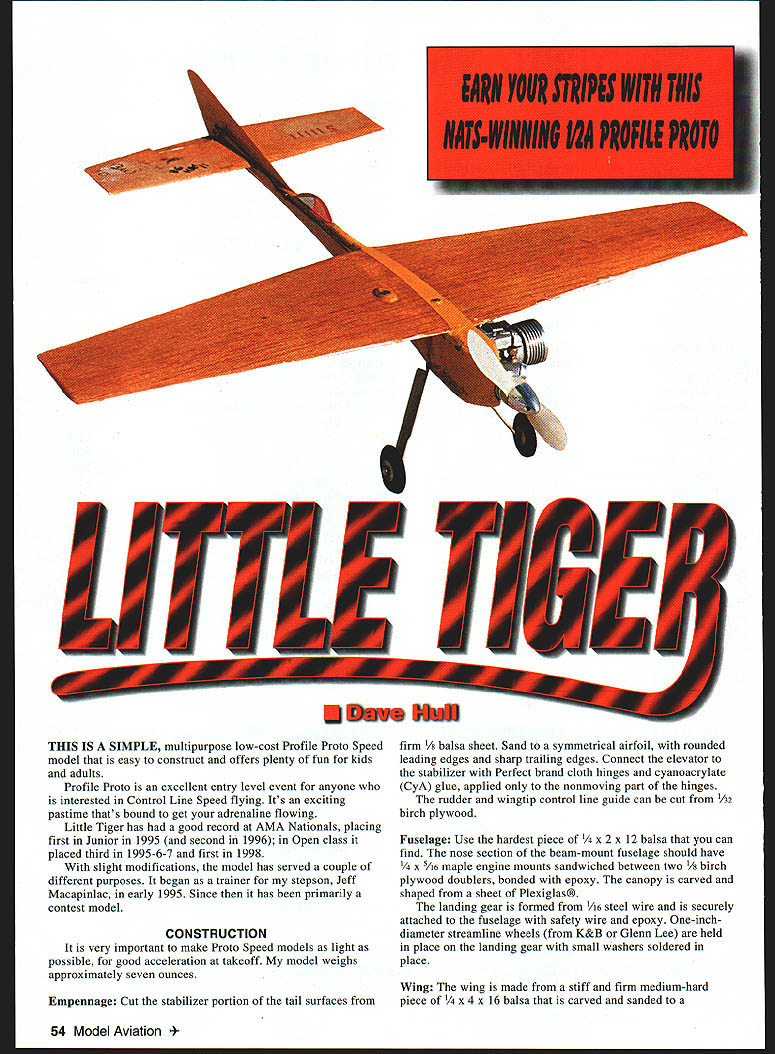
This is a simple, multipurpose low-cost Profile Proto Speed model that is easy to construct and offers plenty of fun for kids and adults.
Profile Proto is an excellent entry-level event for anyone interested in Control Line Speed flying. It's an exciting pastime that's bound to get your adrenaline flowing.
Little Tiger has a strong contest record: first in Junior at the AMA Nationals in 1995 (second in 1996); in Open class it placed third in 1995–1997 and first in 1998. With slight modifications the model has served different purposes. It began as a trainer for my stepson, Jeff Macapinlac, in early 1995 and has since been primarily a contest model.
Construction
General
- Keep the model as light as possible for good acceleration at takeoff. My model weighs approximately 7 ounces (flying weight about 6–7 ounces).
- Use quality hardwood and firm balsa where noted. Prime and sand parts smooth before final assembly.
Empennage
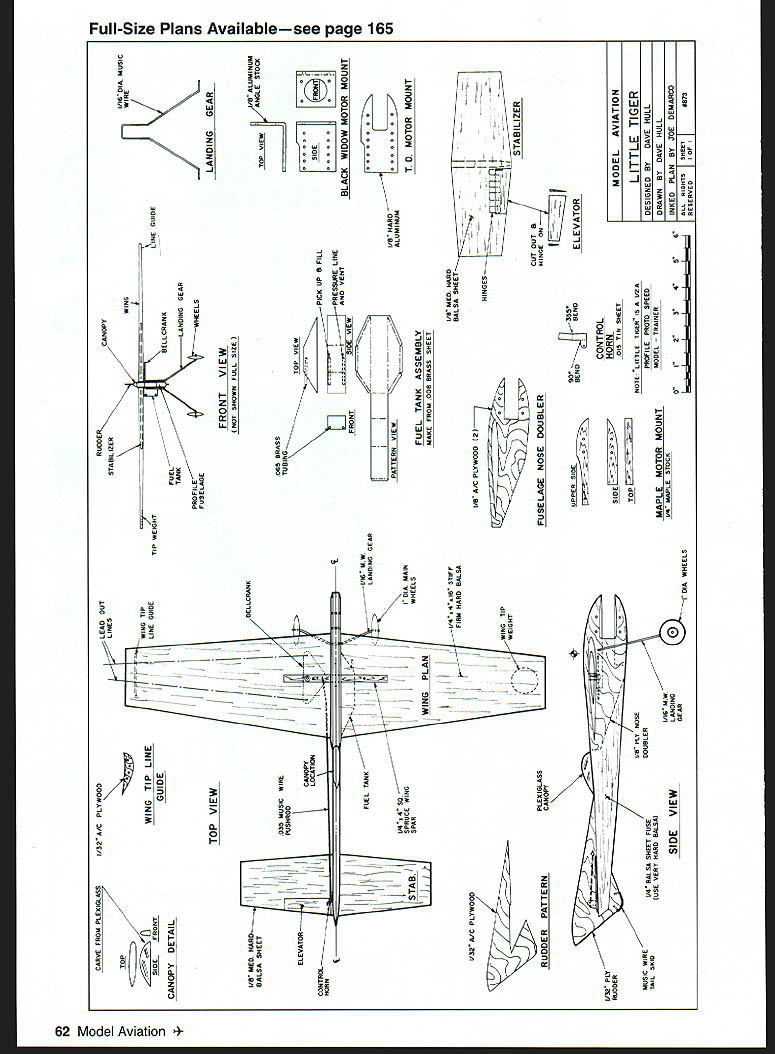
- Cut the stabilizer portion of the tail surfaces from firm 1/8" balsa sheet.
- Sand to a symmetrical airfoil (NACA 63-009): rounded leading edges and sharp trailing edges.
- Connect the elevator to the stabilizer with Perfect brand cloth hinges and cyanoacrylate (CyA) glue, applying glue only to the nonmoving part of the hinges.
- Cut the rudder and wingtip control line guide from 1/32" birch plywood.
Fuselage
- Use the hardest piece of 1/4" x 2" x 12" balsa you can find for the beam-mount fuselage.
- Nose section: use 1/4" x 1/16" maple engine mounts sandwiched between two 1/8" birch plywood doublers, bonded with epoxy.
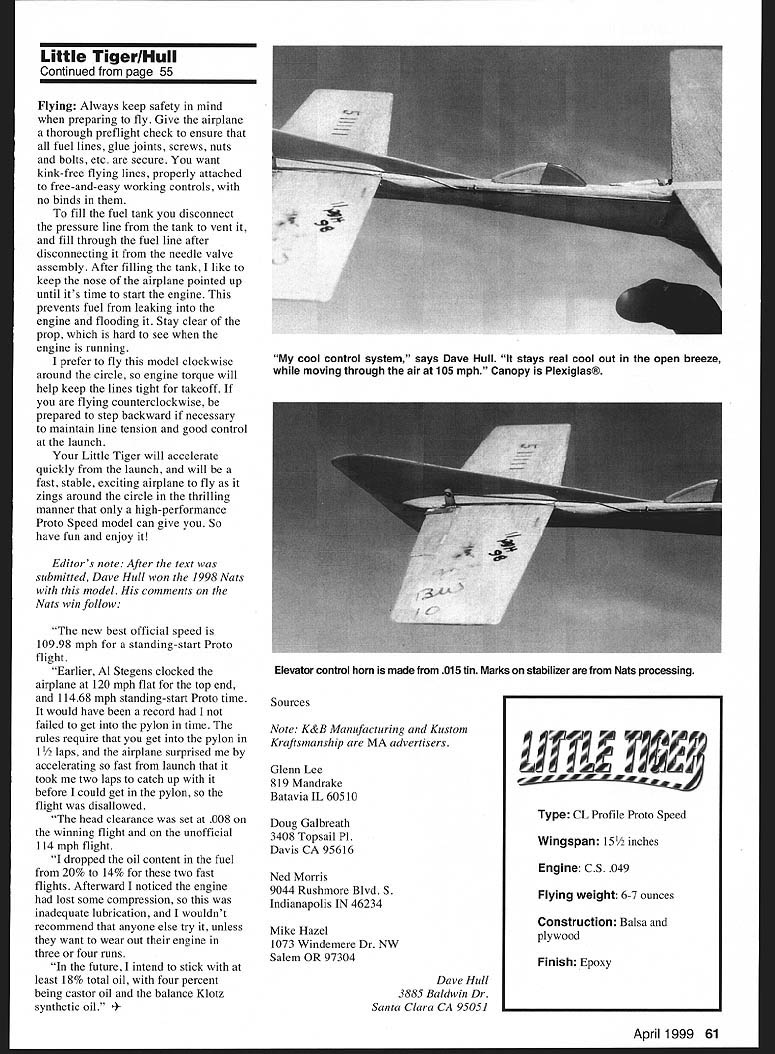
- Carve and shape the canopy from a sheet of Plexiglas®.
Landing Gear
- Form the landing gear from 1/16" steel wire.
- Securely attach to the fuselage with safety wire and epoxy.
- Use 1" diameter streamline wheels (from K&B or Glenn Lee) held with small washers soldered in place.
Wing
- Make the wing from a stiff medium-hard piece of 1/4" x 4" x 16" balsa and carve/sand to a symmetrical NACA 63-009 airfoil.
- Cut a slot in the center of the wing for a 1/4" square spruce spar, 4" long, used for the bellcrank anchor.
- Bellcrank anchor and bellcranks can be obtained from Ned Morris or Kustom Kraftsmanship.
- Pushrod: .035" music wire.
- Control horn: .015" tin.
Controls
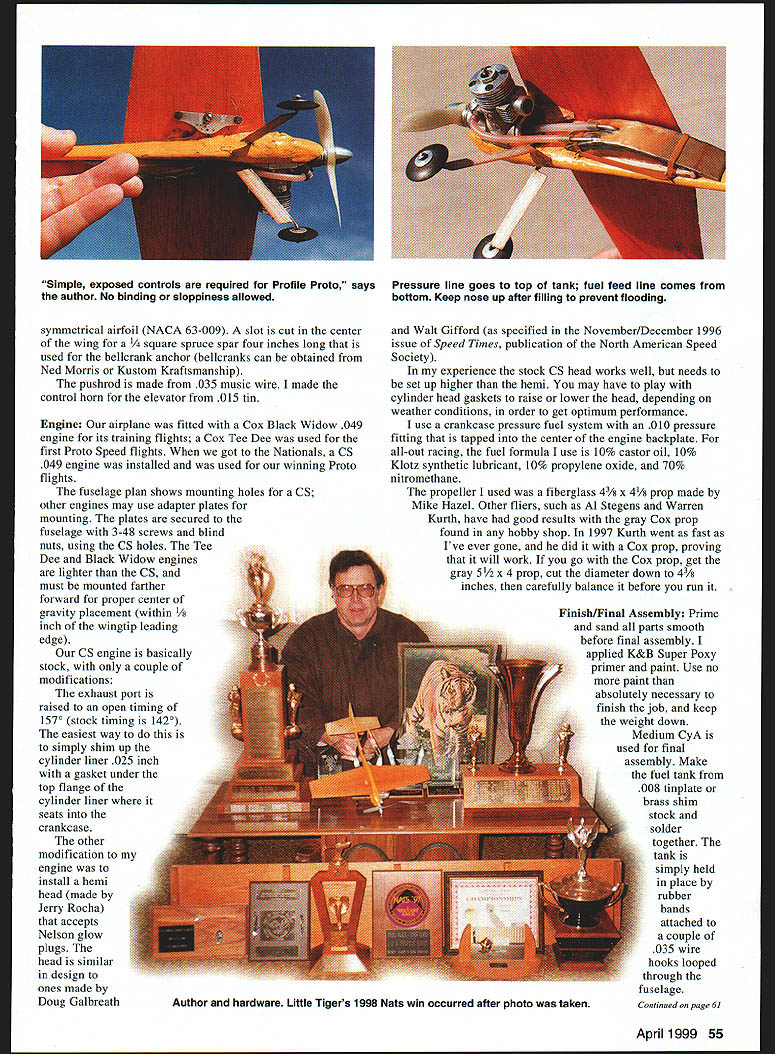
- Simple exposed controls are required for a Profile Proto.
- No binds or sloppiness is allowed—controls must be free and precise.
- The pressure line goes to the top of the tank; the fuel feed line comes out the bottom.
Engine
- The airplane has been flown with various .049 engines:
- Cox Black Widow .049 (training flights)
- Cox Tee Dee .049 (early training)
- CS .049 (contest/Nationals)
- The fuselage plan shows mounting holes for CS; other engines may use adapter plates. Mounting plates are secured with 3-48 screws and blind nuts using the CS holes.
- Tee Dee and Black Widow engines are lighter than the CS and must be mounted farther forward for proper center-of-gravity placement (within 1/8" of the wing leading edge).
CS Engine Modifications (used on contest model)
- Raise the exhaust port and open the timing to about 157° (stock timing is 142°). The easiest method is to shim up the cylinder liner 0.025" with a gasket under the top flange where the liner seats the crankcase.
- Install a hemi head (e.g., by Jerry Rocha) that accepts Nelson glow plugs; similar designs made by Doug Galbreath and Walt Gifford have been used. The stock CS head works well but typically needs to be set higher than the hemi; use cylinder head gaskets to adjust head clearance for weather/optimum performance.
- Use a crankcase-pressure fuel system. Tap a 0.010" pressure fitting into the center of the engine backplate.
Fuel
- All-out racing fuel formula used: 70% nitromethane, 10% castor oil, 10% Klotz synthetic lubricant, 10% propylene oxide.
- Editor experience: be cautious reducing oil—insufficient oil will wear the engine. For high-speed flights Dave later recommended at least 18% total oil (4% castor, remainder Klotz synthetic).
Propeller
- Preferred: fiberglass 4-3/8" x 4-1/2" prop made by Mike Hazel.
- Cox prop option: gray Cox prop (recommended: start with 5-1/2" x 4" gray Cox prop, cut diameter down to 4-3/8", then carefully balance before running). Several fliers have had good results with modified Cox props.
Finish / Final Assembly
- Prime and sand all parts smooth before final assembly.
- Apply K&B Super Poxy primer paint; use no more paint than absolutely necessary to keep weight down.
- Use medium CyA for final assembly.
- Make the fuel tank from .008" tinplate or brass shim stock and solder together.
- Mount the tank with rubber bands attached to a couple of .035" wire hooks looped through the fuselage.
Flying
- Always keep safety in mind. Conduct a thorough preflight check: fuel lines, glue joints, screws, nuts, bolts, etc.
- Ensure flying lines are kink-free and controls operate without binds.
- To fill the tank: disconnect the pressure line from the tank to vent it, then fill through the fuel line after disconnecting it from the needle valve assembly.
- After filling, keep the nose up until starting the engine to prevent flooding.
- Stay clear of the prop, which is hard to see when running.
- Preferred flight direction: clockwise around the circle so engine torque helps keep the lines tight at takeoff. If flying counterclockwise, be prepared to step backward at launch to maintain line tension and control.
- Little Tiger accelerates quickly from launch and is fast, stable, and exciting to fly.
Editor's Note (Dave Hull — Nats report)
- After submission, Dave Hull won the 1998 Nats with this model.
- New best official speed: 109.98 mph for a standing-start Proto flight.
- Earlier unofficial: Al Stegens clocked the airplane at 120 mph flat for top end and 114.68 mph standing-start Proto time (would have been a record, but disallowed for not getting into the pylon within 1.5 laps).
- Head clearance on the winning and unofficial 114 mph flights: set at .008".
- For the fastest two flights Dave dropped oil content from 20% to 14%, which resulted in some loss of compression—insufficient lubrication. He does not recommend such low oil unless you accept rapid engine wear.
- Future recommendation: at least 18% total oil, with 4% castor oil and the balance Klotz synthetic oil.
Sources
Note: K&B Manufacturing and Kustom Kraftsmanship are advertisers.
- Glenn Lee, 819 Mandrake, Batavia, IL 60510
- Doug Galbreath, 3408 Topsail Pl., Davis, CA 95616
- Ned Morris, 9044 Rushmore Blvd. S., Indianapolis, IN 46234
- Mike Hazel, 1073 Windemere Dr. NW, Salem, OR 97304
- Dave Hull, 3885 Baldwin Dr., Santa Clara, CA 95051
Specifications
- Type: CL Profile Proto Speed
- Wingspan: 15-1/2"
- Engine: C.S. .049 (commonly used)
- Flying weight: 6–7 ounces (approx. 7 oz)
- Construction: Balsa and plywood
- Finish: Epoxy (K&B Super Poxy primer)
Full-Size Plans Available — see page 165
Transcribed from original scans by AI. Minor OCR errors may remain.

