
London Bridge Seaplane Classic
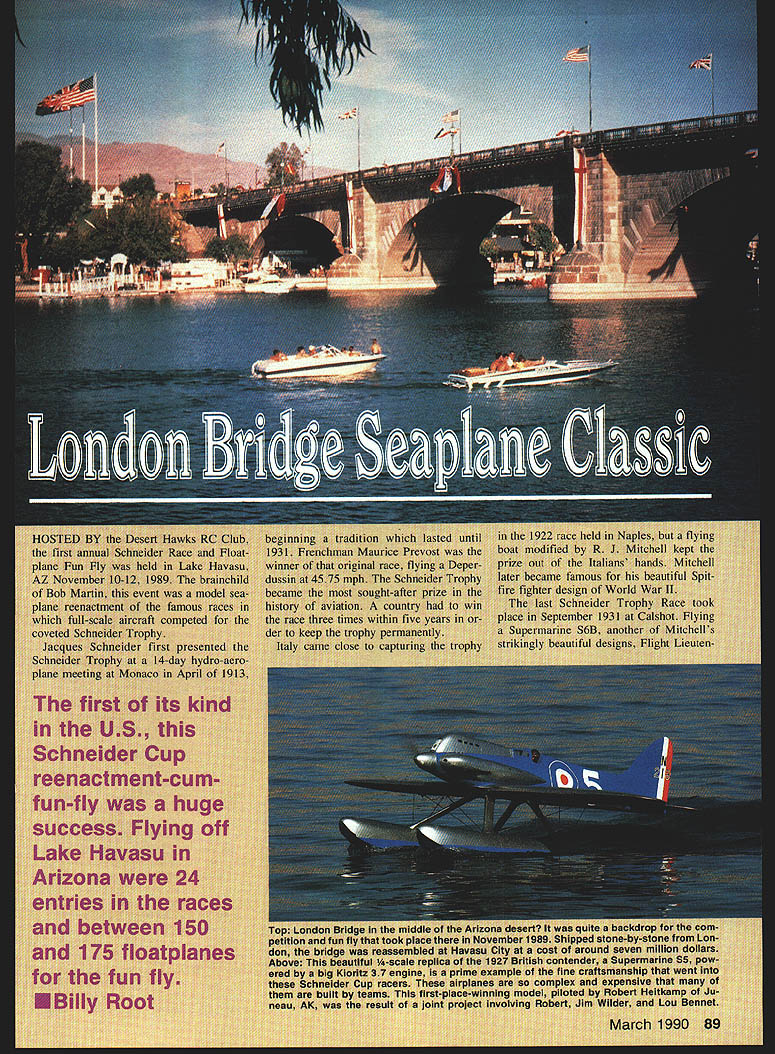
HOSTED BY the Desert Hawks RC Club, the first annual Schneider Race and Floatplane Fun Fly was held on Lake Havasu, AZ, November 10–12, 1989. The brainchild of Bob Martin, this event was a model seaplane reenactment of the famous races in which full-scale aircraft competed for the coveted Schneider Trophy.
Schneider Trophy — brief history
Jacques Schneider first presented the Schneider Trophy at a 14-day hydro-aeroplane meeting at Monaco in April 1913, beginning a tradition that lasted until 1931. Frenchman Maurice Prévost won the original race, flying a Deperdussin at 45.75 mph. The Schneider Trophy became one of the most sought-after prizes in the history of aviation. A country had to win the race three times within five years in order to keep the trophy permanently.
Italy came close to capturing the trophy in the 1922 race held in Naples, but a flying boat modified by R. J. Mitchell kept the prize out of the Italians' hands. Mitchell later became famous for his Spitfire fighter design of World War II.
The last Schneider Trophy Race took place in September 1931 at Calshot. Flying a Supermarine S6B, another of Mitchell's strikingly beautiful designs, Flight Lieutenant J. N. Boothman of Great Britain took first place with a speed of 340 mph. Boothman's win brought the trophy to England permanently.
When one considers that the most modern front-line fighters of the late 1920s and early 1930s were biplanes with top speeds of 150–185 mph, the performance achieved by these Schneider raceplanes is all the more startling. Most of the Schneider racers of 1930–31 were designed to exceed 400 mph, but technical problems foiled that goal. On October 23, 1934, the Italian team broke the world speed record for propeller-driven floatplanes flying the Macchi MC-72 at 440 mph — a record that still stands today. Much of the technology learned from these races was later used in fighter aircraft of World War II.
Event overview
Meeting Bob Martin at the QSAA Fly-In the previous year, I was impressed by the ambitiousness of his project. Organizing an event of this size involves many details, and Martin had the cooperation of the Nautical Inn, a resort oasis with palm trees, lush landscaping, and a private beach. Lake Havasu also boasts the authentic London Bridge, brought to the U.S. and reassembled over the lake at a cost of around seven million dollars. English-style villages, restaurants, and shops made the setting even more attractive.
Since Lake Havasu is only about 150 miles from my home in Las Vegas, I planned to attend from the beginning. When MA editor Carl Wheeler asked me to photograph and cover the meet, I quickly committed.
We left for Lake Havasu at 5 a.m. on Friday, driving past the El Dorado Dry Lake where the QSAA Fly-In had been held a week earlier. The unpredictable desert winds had ruined the last two days of that event, and we hoped for better weather at Havasu. We got it. Arriving after three hours of desert driving, we found perfect flying weather with temperatures in the low eighties.
Overflying the beach as we approached was what looked like a full-size Schneider aircraft. If I hadn't known better, I'd have sworn it was the original plane instead of a scale revival. On the field were at least 150–175 radio-controlled floatplanes, ranging from Cubs to Ugly Stiks.
On the way to the beach we browsed the manufacturers' display area, where we found everything from fiberglass floats for all sizes of aircraft to an aviation art gallery. The first person I talked to was Joe Bird, who has a fine line of kits. Whenever I see Joe, my day is usually a good one.
Not so many years ago you'd have seen mostly Kraft radios at a contest like this. At Havasu, the transmitter upland area had more radios by Futaba, Airtronics, and JR than other brands. As for props, we saw predominantly Zingers with a smaller number of other brands. There were a large number of Master Airscrews — that's been the case at every contest I've attended in the last few years.
Format and entries
The format combined the Schneider Race with a fun fly. Unsure of the turnout, organizer Martin thought this the best approach. Flying off Lake Havasu were 24 entries in the races and between 150 and 175 floatplanes for the fun fly.
Of the approximately 25 entries in the Schneider races, four lost out in the time trials on Thursday, and several more encountered technical problems during the fly-in. This was the first event of its kind in the U.S., so there was a lot to learn. The aircraft were very large, expensive, and mostly scratch-built; over half were built by teams of modelers.
Though many expected to see three or four planes racing at once, that proved impractical. With craft modeled after vintage 1913–1931 Schneider raceplanes, there weren't enough of any single year to race together.
One objective of the contest was to duplicate, in scale terms, the racing speed achieved by the full-scale craft from a particular Schneider Race year. That way a 1913 Deperdussin could legitimately compete against a 1931 Supermarine S5 in scale terms.
After static judging (points for craftsmanship, scale dimensions, and finish), a panel of three judges scored the aircraft on flight characteristics. Points were given for takeoff, flight realism, and how closely the flier approached the target speed for racers of that particular year.
Race results — top finishers
To give a better idea of how target speed figured in the overall scoring, here are the numbers for the first- to fourth-place winners:
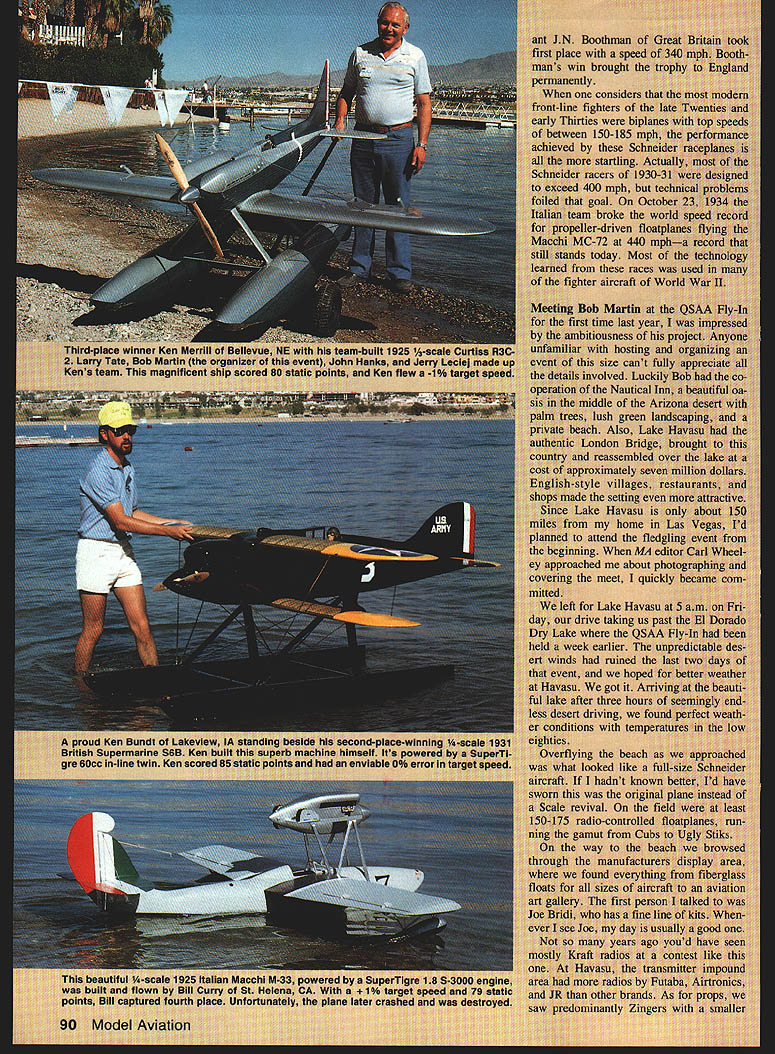
- First place — Robert Heitkamp, 1927 Supermarine S5
- Actual speed: 80.8 mph
- Target speed: 84.9 mph
- Error: 4% under target
- Static points: 87
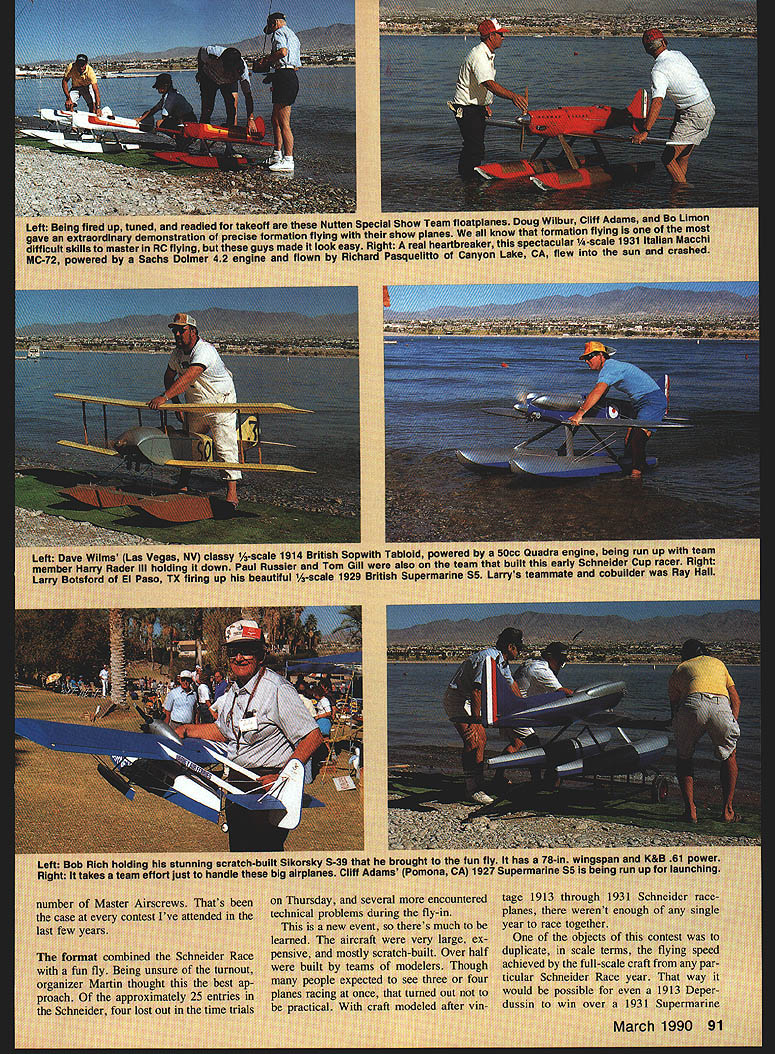
- Second place — Ken Bundt, 1931 S6B
- Actual speed: 84.3 mph
- Target speed: 85.0 mph
- Error: 0% (rounded)
- Static points: 85
- Third place — Ken Merrill, 1925 Curtiss R3C-2
- Actual speed: 76.3 mph
- Target speed: 77.8 mph
- Error: 1%
- Static points: 80
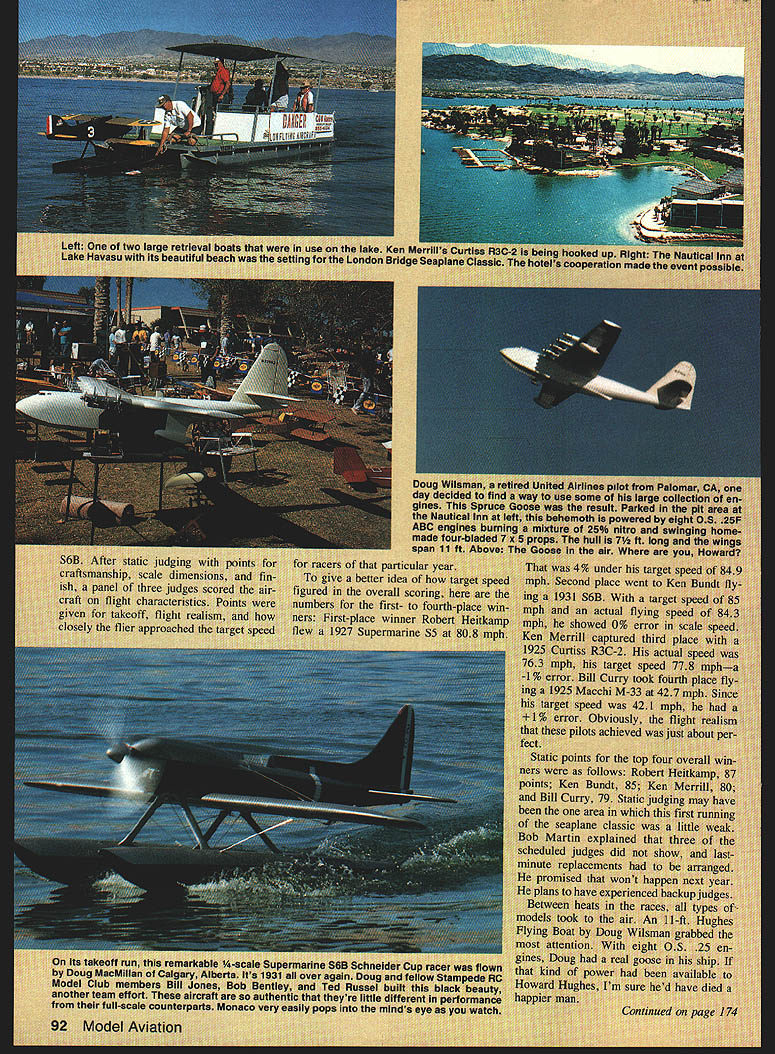
- Fourth place — Bill Curry, 1925 Macchi M-33
- Actual speed: 42.7 mph
- Target speed: 42.1 mph
- Error: 1% (over)
- Static points: 79
The flight realism achieved by these pilots was excellent.
Static judging may have been the one area in which this first running of the Seaplane Classic was a little weak: three of the scheduled judges did not show, and last-minute replacements had to be arranged. Bob Martin promised that won't happen next year and plans to have experienced backup judges.
Other flying and demonstrations
Between heats in the races, all types of models took to the air. An 11-ft. Hughes Flying Boat by Doug Wilsman grabbed the most attention. With eight O.S. .25 engines, Doug had a real goose in his ship. Doug Wilber, Cliff Adams, and Bo Limon gave a fine formation flying demonstration in Nutten Specials with smoke — formation flying looked effortless, but of course it isn't. Formation flying is one of the most difficult feats in radio control.
Bob Martin seems to have thought of everything. There were two large retrieving boats ready to go into action, and even a man with scuba diving gear in case anything sank to the bottom of the lake.
Incidents and safety
That is exactly what happened on Saturday when Richard Pasquelitto's Red Macchi MC-72 crashed and sank. The Macchi was totally destroyed, and the scuba diver had no luck retrieving its costly Sachs Dolmer 42 two-cycle engine from the lake bottom.
Besides Pasquelitto's Macchi, there were three other crashes on Saturday. The QSAA team's Sopwith Tabloid suffered aileron servo failure, and Bill Curry's fourth-place Macchi M-33 went down after radio problems.
Observations and commentary
Having the good fortune to live in an area with nine to ten months of great flying weather, I've attended a variety of contests — Scalemasters Tournament, Champions meets, Fourth Air Force Fly-Ins, Phoenix SAM Free Flight Championships, Eighth Air Force Fly-Ins in Phoenix, SAM Free Flight Championships, and QSAA Fly-Ins. The Schneider Seaplane Classic shows every promise of becoming another world-class meet on the western contest circuit. Expecting at least 40 more entries next year, Bob Martin plans to let the event grow and hopes to increase participation substantially.
For one competitor, this was the first race he had ever won — what a way to break the ice.
Of special interest — the Kaze Killer flew well, but the Kaze did better. At this point, I'd give the Kaze Killer a 0 and the Kaze a 3.
This was a great contest. Thanks to Jim Allen and everyone who worked so hard to put it on.
Noise measurements — Gary Hover
Gary Hover took some noise readings at this year's race and provided the following update:
"While at the Championships race, I took some random noise level readings using AMA's equipment. I conducted my test using a single aircraft/power model — a SuperTiger X40 turning at 21,900 rpm. It was hand-held at one meter above the asphalt. At three meters in front and 90° to the prop, I obtained a reading of 118 dB. While directly behind the airplane without obstruction, I obtained only 110 dB.
"Just for grins, the highest reading obtained was 135 dB at 90° to the propeller and one meter's distance. That's why you need to wear your ear protection.
"For an actual race, I obtained a reading of 93 dB from the pits at a distance of approximately 450 ft and at 90° to the race course. That was with four models in close proximity, so it isn't bad."
I propose that racing be exempt from noise restrictions because of its low frequency of use. In other words, just as with full-size automobile racing, racing is an all-out sport. Given that races are held infrequently at specific sites, the actual noise impact on average is not appreciably higher. If we do choose to limit noise, place the requirement at, say, 125 dB at three meters so that, with current technology, most of us can comply.
Thanks to Gary for the measurements.
Closing and next year
Next year's race is expected to be held in Florida. Wouldn't you like to be there? Join the NMPRA and get in on the action. See you next fall.
— Billy Root
Transcribed from original scans by AI. Minor OCR errors may remain.

