
THE LONG, LONG TRAIL
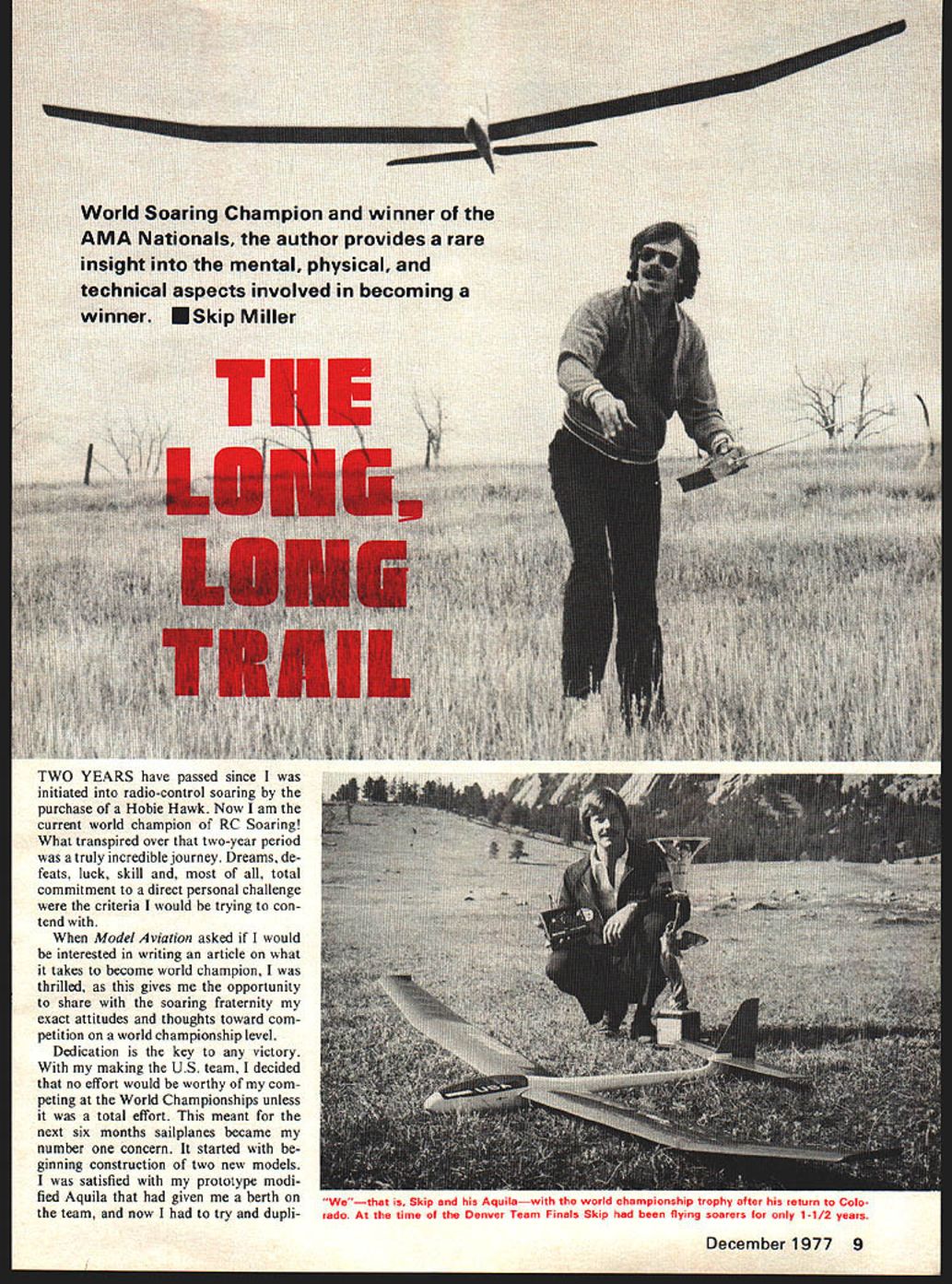
World Soaring Champion and winner of the AMA Nationals, the author provides a rare insight into the mental, physical, and technical aspects involved in becoming a winner. ■ Skip Miller
TWO YEARS have passed since I was initiated into radio-control soaring by the purchase of a Hobie Hawk. Now I am the current world champion of RC Soaring! What transpired over that two-year period was a truly incredible journey. Dreams, defeats, luck, skill, and, most of all, total commitment to a direct personal challenge were the criteria I would be trying to contend with.
When Model Aviation asked if I would be interested in writing an article on what it takes to become world champion, I was thrilled, as this gives me the opportunity to share with the soaring fraternity my exact attitudes and thoughts toward competition on a world championship level.
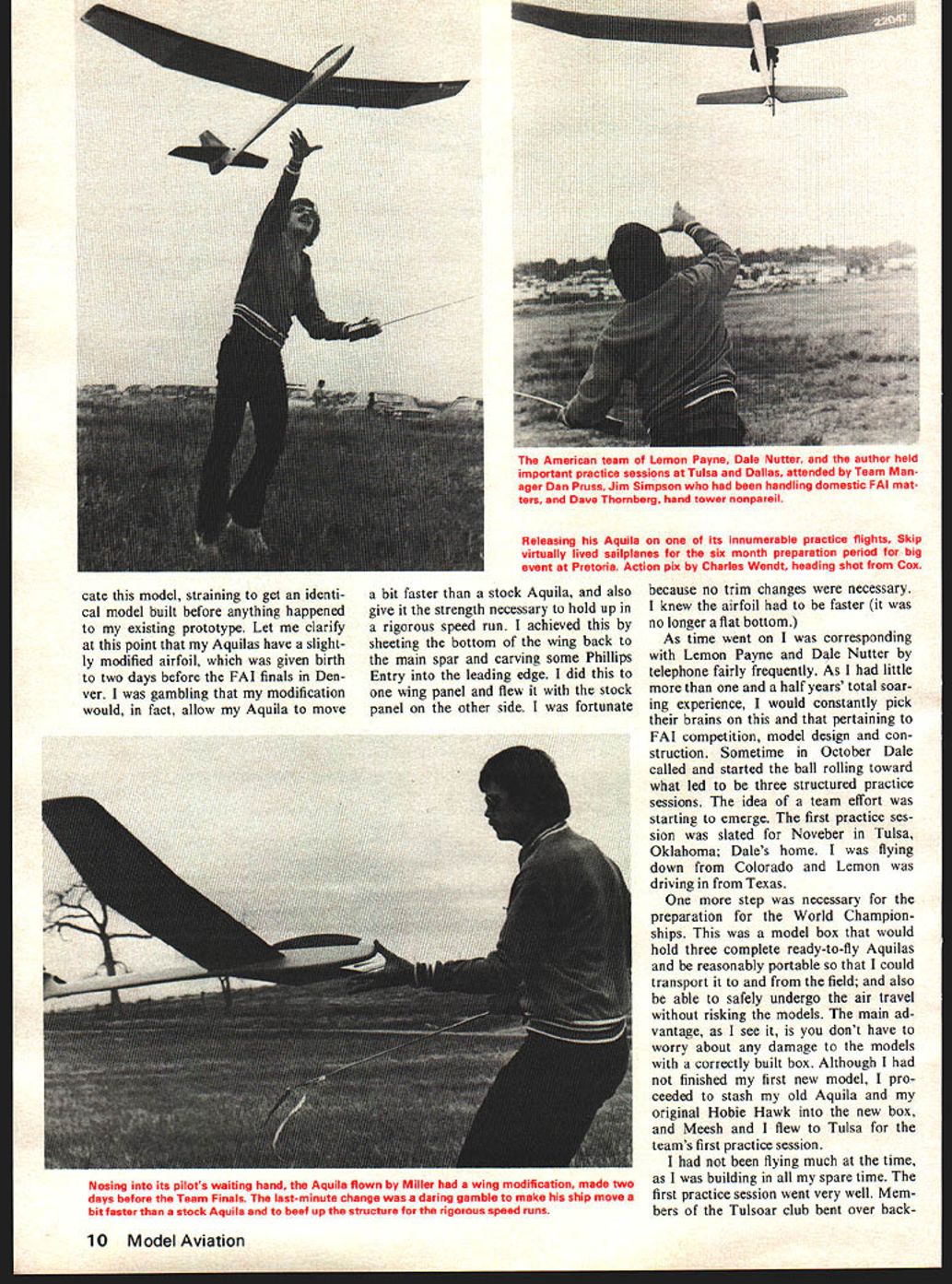
Dedication is the key to any victory. With my making the U.S. team, I decided that no effort would be worthy of my competing at the World Championships unless it was a total effort. This meant for the next six months sailplanes became my number one concern. It started with beginning construction of two new models. I was satisfied with my prototype modified Aquila that had given me a berth on the team, and now I had to try and duplicate this model, straining to get an identical model built before anything happened to my existing prototype. Let me clarify at this point that my Aquilas have a slightly modified airfoil, which was given birth to two days before the FAI finals in Denver. I was gambling that my modification would, in fact, allow my Aquila to move
a bit faster than a stock Aquila, and also give it the strength necessary to hold up in a rigorous speed run. I achieved this by sheeting the bottom of the wing back to the main spar and carving some Phillips Entry into the leading edge. I did this to one wing panel and flew it with the stock panel on the other side. I was fortunate because no trim changes were necessary. I knew the airfoil had to be faster (it was no longer a flat bottom).
As time went on I was corresponding with Lemon Payne and Dale Nutter by telephone fairly frequently. As I had little more than one and a half years' total soaring experience, I would constantly pick their brains on this and that pertaining to FAI competition, model design and construction. Sometime in October Dale called and started the ball rolling toward what led to the three structured practice sessions. The idea of a team effort was starting to emerge. The first practice session was slated for November in Tulsa, Oklahoma; Dale's home. I was flying down from Colorado and Lemon was driving in from Texas.
One more step was necessary for the preparation for the World Championships. This was a model box that would hold three complete ready-to-fly Aquilas and be reasonably portable so that I could transport it to and from the field; and also be able to safely undergo the air travel without risking the models. The main advantage, as I see it, is you don't have to worry about any damage to the models with a correctly built box. Although I had not finished my first new model, I proceeded to stash my old Aquila and my original Hobie Hawk into the new box, and Meesh and I flew to Tulsa for the team's first practice session.
I had not been flying much at the time, as I was building in all my spare time. The first practice session went very well. Members of the Tulsoar club bent over backwards.
Skip Miller's Modifications to the Aquila
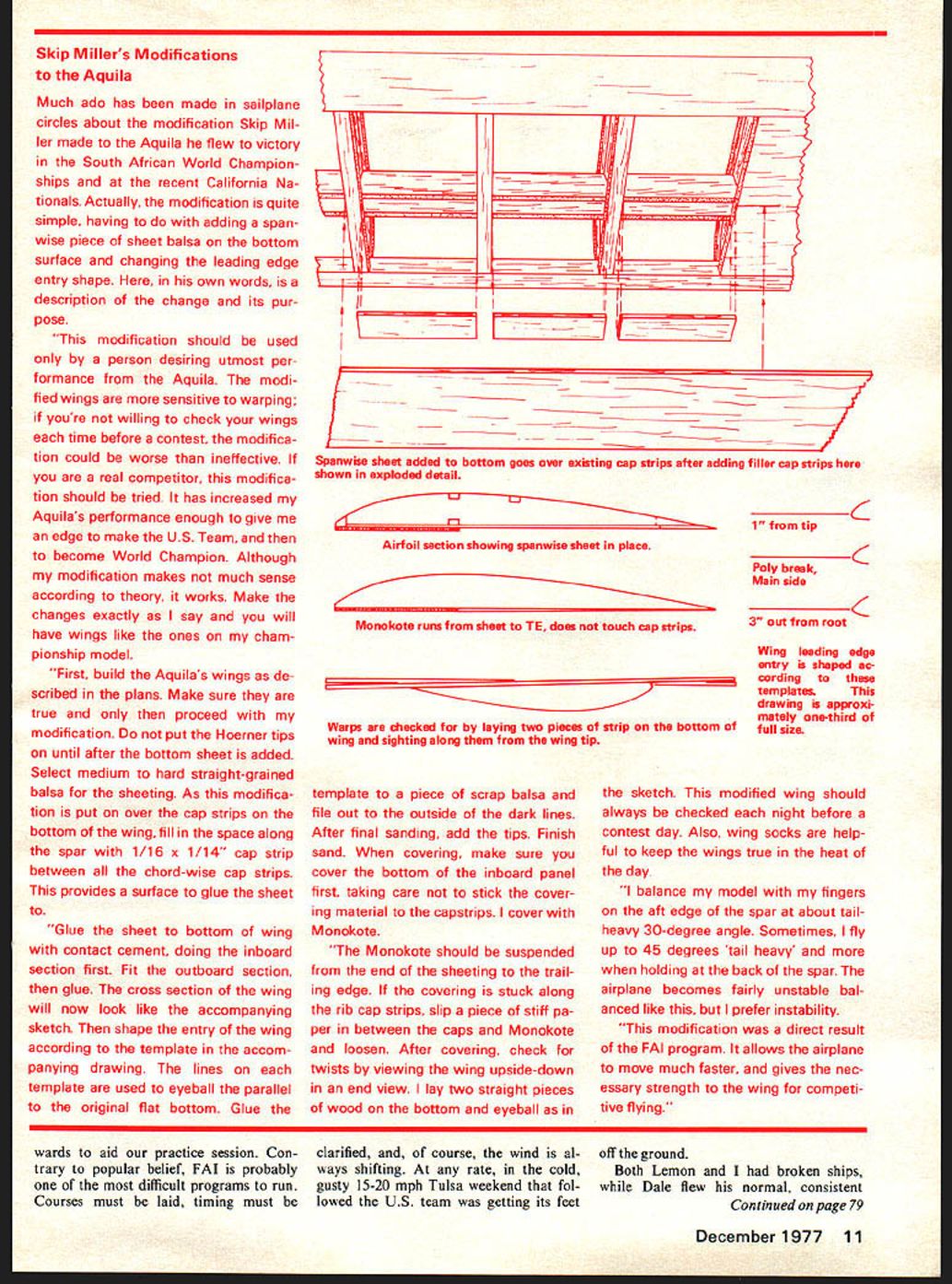
Much ado has been made in sailplane circles about the modification Skip Miller made to the Aquila he flew to victory in the South African World Championships and at the recent California Nationals. Actually, the modification is quite simple, having to do with adding a spanwise piece of sheet balsa on the bottom surface and changing the leading edge entry shape. Here, in his own words, is a description of the change and its purpose.
"This modification should be used only by a person desiring utmost performance from the Aquila. The modified wings are more sensitive to warping; if you're not willing to check your wings each time before a contest, the modification could be worse than ineffective. If you are a real competitor, this modification should be tried. It has increased my Aquila's performance enough to give me an edge to make the U.S. Team, and then to become World Champion. Although my modification makes not much sense according to theory, it works. Make the changes exactly as I say and you will have wings like the ones on my championship model."
"First, build the Aquila's wings as described in the plans. Make sure they are true and only then proceed with my modification. Do not put the Hoerner tips on until after the bottom sheet is added. Select medium to hard straight-grained balsa for the sheeting. As this modification is put on over the cap strips on the bottom of the wing, fill in the space along the spar with 1/16 x 1/4" cap strip between all the chord-wise cap strips. This provides a surface to glue the sheet to."
"Glue the sheet to bottom of wing with contact cement, doing the inboard section first. Fit the outboard section, then glue. The cross section of the wing will now look like the accompanying sketch. Then shape the entry of the wing according to the template in the accompanying drawing. The lines on each template are used to eyeball the parallel to the original flat bottom. Glue the template to a piece of scrap balsa and file out to the outside of the dark lines. After final sanding, add the tips. Finish sand. When covering, make sure you cover the bottom of the inboard panel first, taking care not to stick the covering material to the capstrips. I cover with Monokote."
"The Monokote should be suspended from the end of the sheeting to the trailing edge. If the covering is stuck along the rib cap strips, slip a piece of stiff paper in between the caps and Monokote and loosen. After covering, check for twists by viewing the wing upside-down in an end view. I lay two straight pieces of wood on the bottom and eyeball as in the sketch. This modified wing should always be checked each night before a contest day. Also, wing socks are helpful to keep the wings true in the heat of the day."
"I balance my model with my fingers on the aft edge of the spar at about tail-heavy 30-degree angle. Sometimes I fly up to 45 degrees 'tail heavy' and more when holding at the back of the spar. The airplane becomes fairly unstable balanced like this, but I prefer instability."
"This modification was a direct result of the FAI program. It allows the airplane to move much faster, and gives the necessary strength to the wing for competitive flying."
Contrary to popular belief, FAI is probably one of the most difficult programs to run. Courses must be laid, timing must be clarified, and, of course, the wind is always shifting. At any rate, in the cold, gusty 15-20 mph Tulsa weekend that followed the U.S. team was getting its feet off the ground. Both Lemon and I had broken ships, while Dale flew his normal, consistent steady self. At the end of two days all flights being flown and scored as in competition, Lemon was first, I was second, and Dale third. Interesting to note, this was the exact placing of our finish in the Finals. We also could derive our strong and weak points from our concentrated efforts. After numerous rap and repair sessions (Lemon and I had determined we were good at breaking airplanes), we had determined that Lemon was very strong in all three events (Distance, Duration and Speed); I was strong in Duration and Distance; and Dale was strong in Duration and Speed.
We said our farewells and back I went to Boulder to practice and build, and practice and build. I should note that I am president of a small land surveying company in Colorado, and up through December we are incredibly busy: so it wasn't all model airplanes yet!
Finally my work slowed down and I began to concentrate solely on the team effort for South Africa. I also was playing a fair amount of racquetball at this time. It helps to develop quick reflexes and keep the competitive spirit razor sharp. I recommend any competitive sport as very good training for glider competition, as you develop the concentration necessary to change bad luck to good luck. I believe this is the "inner game" of competition. The major obstacle to success is usually yourself. I found myself constantly trying to sharpen my concentration, making up imaginary situations and trying to work through them to the last detail. In the words of Dan Pruss, "The team that makes the fewest mistakes wins." I feel there was nothing more important to our success than the elimination of potential mistakes by thinking all situations through.
Finally, I had my first new Aquila finished, just in time for a January practice session in Dallas, Texas. Dan Pruss, the soon to be affirmed team manager, was to attend, along with Jim Simpson, who had been handling most of the domestic FAI problems. Dave Thornberg was also flying in, as we had selected Dave to be our field helper and hand-tow expert, and he had agreed. Everything up to this point had been covered at our personal expense. The three of us unanimously desired Dan to be our team manager and Dave to be our field team helper. This decision was based upon each of their personal qualifications to perform very demanding and specific jobs.
Unfortunately, this practice session was plagued with rain, and some bad luck for myself. On my first flight of the new Aquila, I was slowly checking its turning characteristics, when at about 200 feet I was shot down by stray radio interference. It landed hard upside-down, but only the fuselage was destroyed. All the flying surfaces were intact. Undaunted, I put my new ship back in the box, grabbed my old Aquila, and away I went. I had flown one duration flight when it began to rain, a good excuse to head back to Lemon’s to dry out and begin talk about team business. Dan began with the idea of team uniforms, and then started playing tailor with all of our dimensions. Frequency problems, designation of responsibility for equipment, and various other problems were solved. Questions were answered and our team unity was really starting to show.
The second day of practice was in thick Dallas fog. I can remember Thornberg towing me up with only 100 meters of line, and my Aquila disappearing on top of the launch. Honest! And what was more amazing to me, the four and a half minute dead-air flights that could be achieved. With the thinner air in Colorado, you could probably count on one and a half to two minutes from that height. As you can see this practice session was not as successful as our first in terms of flying, but we did get to talk a lot about FAI which, in the end, made all of us that much more prepared. Our third practice session to be held in Colorado was scratched, as Lemon and I were way behind on building, and the time element was creeping up on us. All of February and part of March was devoted to repair of my new model, finishing construction of my next model, practicing one to two hours every day, testing hi-starts, polishing hand-tow techniques (Meesh was hand-towing me), and final preparation. My newest model was flown until we reached South Africa. Three Aquilas in a box, radios, hi-starts, hand tows, spare parts, clothes for three weeks, and off we went from Colorado, meeting the team in New York. Half way around the world we arrived in South Africa pre-
pared and unified to fly in the First World Championships of Radio Control Soaring.
A day of rest and then it was practice every day under the watchful eye of Dan and Dave. These two cannot be commended highly enough for their efforts toward the team. Dan was always on the run getting the chutes and Dave easily pulled 50 handtows per day. Unbelievable support, which helped Lemon, Dale and me develop the confidence for every launch situation. Dan also took care of hundreds of small problems that kept our soaring machine running smooth and true. Finally, the World Championships were to begin with an official practice day. This was designed to make sure all timers, judges, and field help knew the do’s and don’ts of FAI, so that the World Championships could be performed without a hitch.
I was amazed to see how many competitors elected not to fly on the practice day. Here a flier could dry run everything from start to finish, make his last-minute adjustments on his sailplane and become centered on exactly how he was going to approach each situation. It was finally real, all the hard work, the long nights, the anticipation were about to unfold. The World Championships were about to be- gin!
I will refrain from detail on the World Championships. Stories and photographs were published in magazines both here and abroad (MA, July 1977). I will say that I was extremely fortunate to win the World Championships. I had both good and bad luck, with decisions, judgment, and exhaustion all key factors in my victory. But I did not stand alone. Shawn Bannister pushed me all the way. He pushed so hard he fell to third position. And Frikke Roos, a newcomer like myself, showed the determination and concentration necessary to stay on top and did.
In the final analysis I became the World Champion of RC Soaring and the U.S. was the number one team. But it was not me alone that won the title and honor. I could not have done it without Lemon Payne, Dale Nutter, Dan Pruss, Dave Thornberg, and Meesh Rheault who were patient enough to lend me support and teach me the knowledge that was necessary to capture the title.
I am proud to have been a member of the first U.S. effort in international RC Soaring. Through our total team effort we have established the U.S. as the country to keep pace with in the next World Championships. I feel we all left South Africa fulfilled. We had responded to direct personal challenge and had succeeded as a team.
Transcribed from original scans by AI. Minor OCR errors may remain.

