
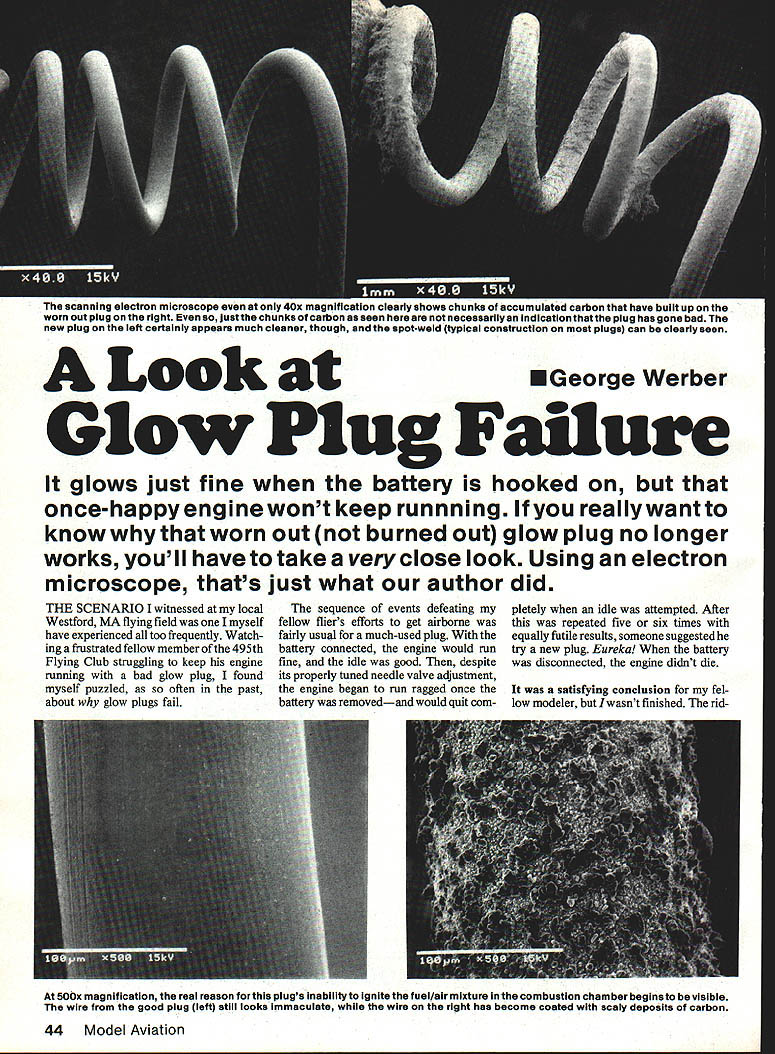
A Look at Glow Plug Failure
George Werber
THE SCENARIO
I witnessed a scene at my local Westford, MA flying field that I have experienced all too frequently. A frustrated member of the 495th Flying Club was struggling to keep his engine running with a bad glow plug. With the battery connected the engine ran fine and the idle was good. But once the battery was removed the engine began to run ragged and would quit completely when an idle was attempted. After repeating this five or six times, someone suggested trying a new plug. Eureka — when the battery was disconnected, the engine didn't die.
That satisfying conclusion didn't end my curiosity. The riddle of what makes a glow plug fail had grabbed hold of me, and I asked to take the discarded plug home to investigate. I decided to improvise a glow-plug laboratory and use the microscopes available to me at work to see what was going on inside the little troublemaker.
THE INVESTIGATION
First I ruled out a leaking plug. I subjected the plug to a couple hundred psi of compressed air and checked with the soap-bubble test; it passed. Then I connected a battery and looked at what I call a normal glow. Comparing the faulty plug filament to a new plug with the naked eye, the old filament looked just a little duller and maybe a shade darker — not discernibly bad.
Because the naked eye was inconclusive, I used a low-power optical microscope and a Dremel grinding wheel to carefully remove a portion of each plug and completely expose the heating coil. I prepared both a used plug and a new plug of the same brand for comparison photos. Chemical analysis showed the plug heater conformed to the industry standard for thermocouple wire used in temperature measurement: 90% platinum and 10% rhodium, with a 0.007" diameter.
Next I examined the old and new heating coils under a scanning electron microscope (SEM) at progressively increasing magnifications. In all photos the new coil is marked "A" and the bad coil is "B."
- At 40x magnification only relatively minor differences were apparent. The worn coil looked slightly warped; the new coil appeared clean aside from a spot-weld common to most plugs.
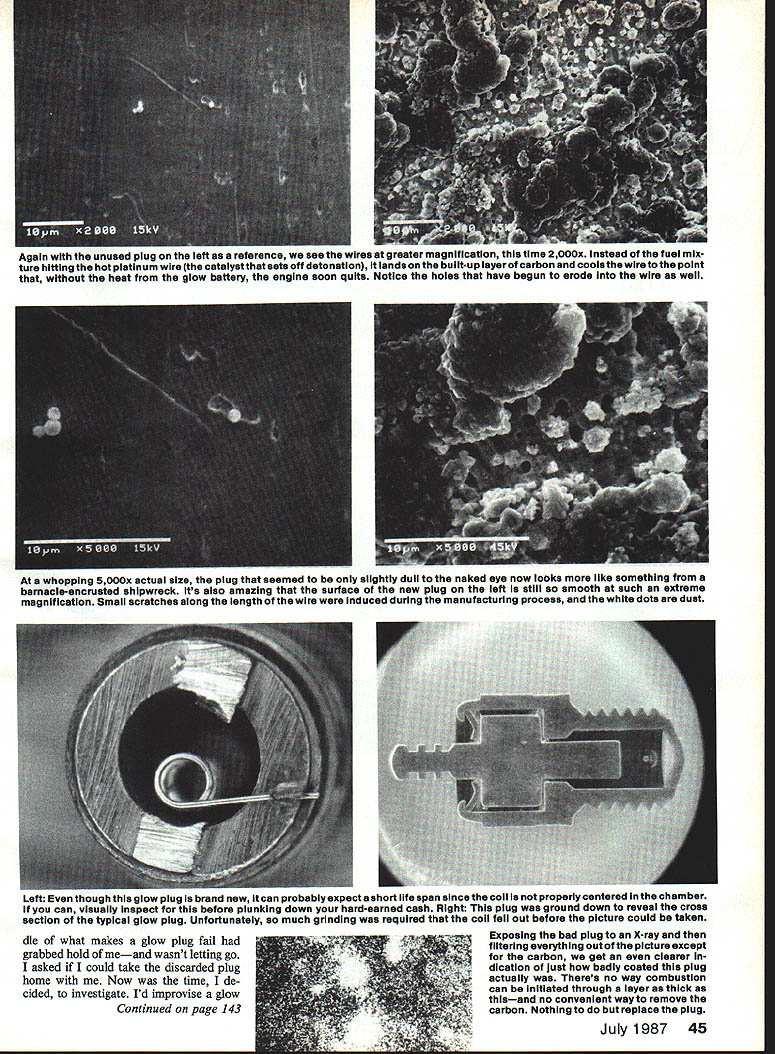
- At 500x magnification the differences became clear: the worn plug wire was coated with scaly deposits of carbon, while the good wire still looked immaculate. The fuel/air mixture cannot reach the hot platinum wire catalyst when the filament is covered, and the carbon layer cools the wire so that even with the battery connected the engine soon quits once the battery is removed.
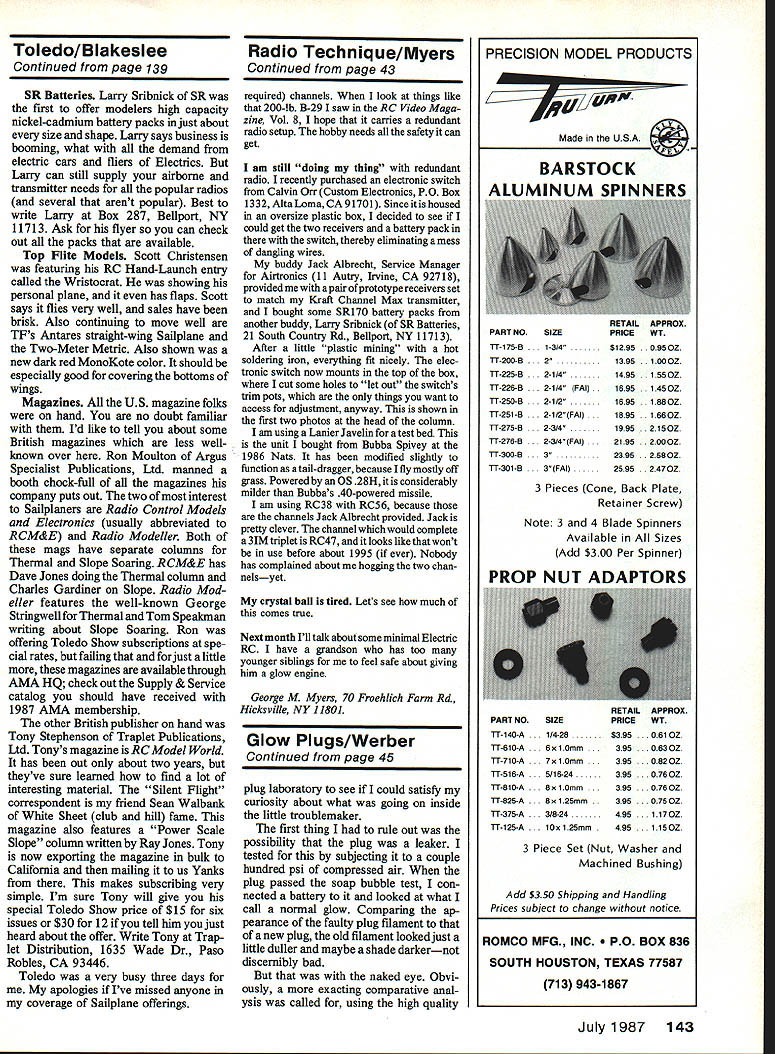
- At 2,000x and 5,000x magnification the damage was dramatic. Holes had begun to erode the wire, and at 5,000x the plug appeared barnacle-encrusted. What looked only slightly dull to the naked eye now looked badly corroded and pitted. By contrast, the new plug surface remained smooth even at extreme magnification; small scratches were manufacturing marks and tiny white dots were probably dust.
I also exposed the bad plug to an X-ray and filtered the image to show only carbon. The X-ray carbon map clearly indicated substantial carbon buildup on the worn plug — a layer too thick for combustion to be initiated through, and not something easily removed.
CHEMICAL ANALYSIS
To analyze the chemical nature of the deposit I bombarded the bad coil with electrons at 20,000 volts (energy-dispersive X-ray analysis). High-energy electrons cause materials to emit X-rays characteristic of their elemental composition. The experiment showed that over 95% of the X-rays from the bad coil were produced by carbon. Comparing the carbon X-ray photo with the SEM images shows the more luminous clusters correspond to the larger clumps of carbon seen in the SEM.
What produces the carbon isn’t definitive. It could come from combustion products, from varnish (which is primarily carbon), or from both.
POSSIBLE CAUSES
Analyzing the results, I hypothesize three principal situations that can contribute to glow plug failure:
- The platinum heating coil has been physically bent or warped out of shape, reducing its effectiveness.
- Over time carbon can diffuse into the platinum of the coil, counteracting the platinum’s ability to catalyze combustion. If carbon penetrates beyond the outer surface, it will destroy the platinum’s catalytic property.
- A thick layer of carbon forms on the filament, shielding it from the heat of combustion and rendering it incapable of igniting the next stroke. This is likely the major cause.
PREVENTION AND NOTES
- Even though a glow plug may appear acceptable at a casual glance, microscopic inspection shows why some plugs fail prematurely. One important preventive step is to visually inspect the coil and its centering in the combustion chamber before buying — if the coil is poorly centered the plug is likely to have a shorter life.
- I attempted to reveal internal construction by grinding down a used plug to show a cross section typical of most plugs; unfortunately much grinding was required and the coil fell out before a cross-section photo could be taken.
- There is no safe cure for the carbon buildup that appears to be the main culprit. According to chemists I consulted, removing the carbon would require extremely toxic chemicals and is not a practical solution.
- Even a new plug can be defective: I carefully removed the idle bar from a brand-new plug and found the coil badly off-center, making premature failure a certainty. Always inspect new plugs for proper coil centering.
Doing these glow plug experiments satisfied my curiosity and reinforced a simple lesson: finding a good glow plug — and keeping it that way — can be problematic. Happy flying, and may your engines run smooth.
Transcribed from original scans by AI. Minor OCR errors may remain.

