
Looking Back: Contests As I Remember
By Earl F. Stahl (June 1991)
A dividing line
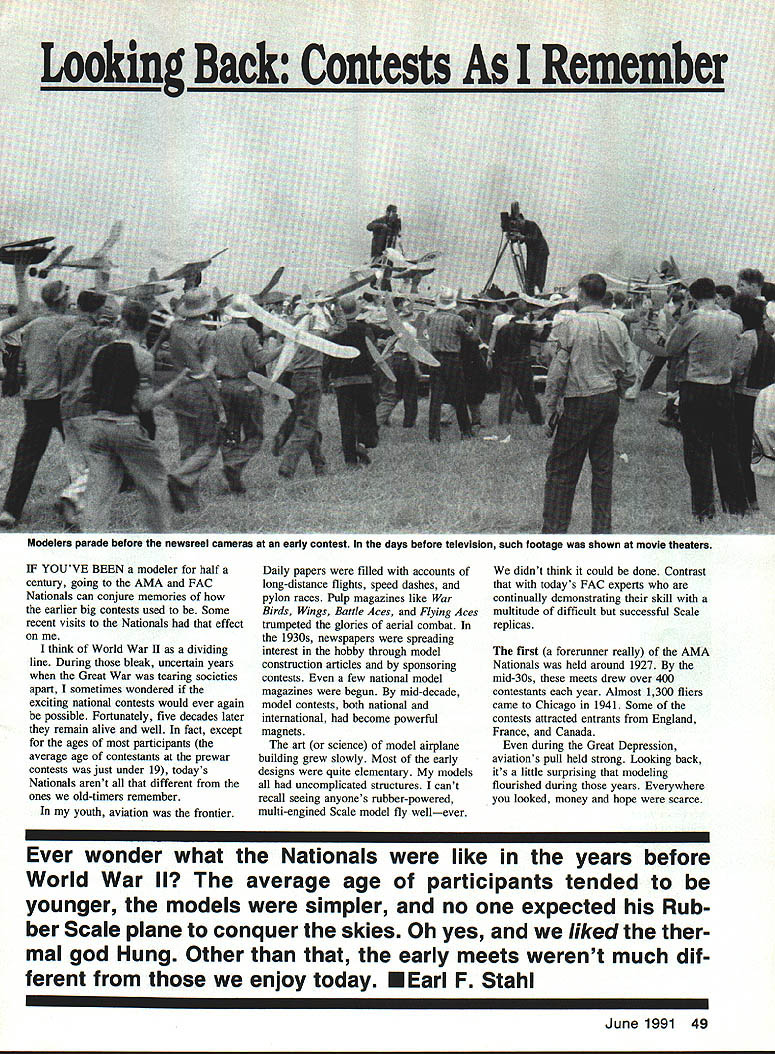
I think of World War II as a dividing line. During those bleak, uncertain years of the war I sometimes wondered if the exciting national contests would ever again be possible. Fortunately, five decades later they remain alive and well. Except for the ages of the participants (the average age of contestants at the prewar contests was just under 19), today's Nationals aren't all that different from the ones we old-timers remember.
Aviation and the 1930s
In my youth, aviation was the frontier. Daily papers were filled with accounts of long-distance flights, speed dashes, and pylon races. Pulp magazines like War Birds, Wings, Battle Aces, and Flying Aces trumpeted the glories of aerial combat. By the 1930s newspapers were spreading interest in the hobby through model-construction articles and by sponsoring contests. A few national model magazines had begun by mid-decade. By then, model contests—both national and international—had become powerful magnets.
- The first forerunners of the AMA Nationals were held around 1927.
- By the mid‑1930s these meets drew over 400 contestants each year.
- Almost 1,300 fliers came to Chicago in 1941.
- Some contests attracted entrants from England, France, and Canada.
Even during the Great Depression, aviation's pull held strong. Looking back, it's a little surprising that modeling flourished during those years—everywhere you looked, money and hope were scarce.
Model design and competition
The art (or science) of model airplane building grew slowly. Most early designs were quite elementary; models had uncomplicated structures. I can't recall seeing anyone's rubber-powered, multi-engined scale model fly well—ever. We didn't think it could be done. Contrast that with today's FAC experts, who continually demonstrate skill with a multitude of difficult but successful scale replicas.
In the prewar Nationals most rubber-powered contestants tuned their models for maximum duration: a rapid, high climb with moderate power followed by a stable, slow glide. Thermals could prolong the glide, and being "grabbed by the thermal and hung on" was a badge of distinction. At the 1936 Nationals we learned that Europeans sometimes used lesser bursts of power early and longer motor runs at lower altitudes—an approach that influenced many later competitive rubber-powered scale flights. Other events—gasoline-powered models and radio-control experiments—were growing in popularity, but roughly three-quarters of Nationals activity still centered on rubber-powered events.
Traveling to the Nationals
Travel to the Nationals was an adventure in itself, made harder by Depression-era economics and limited mobility.
- Few young folks had cars; Sunoco gas cost about six gallons for a dollar.
- Many traveled by train or Greyhound bus; I often rode with my model boxes lashed to the bus roof, protected only by a canvas tarp.
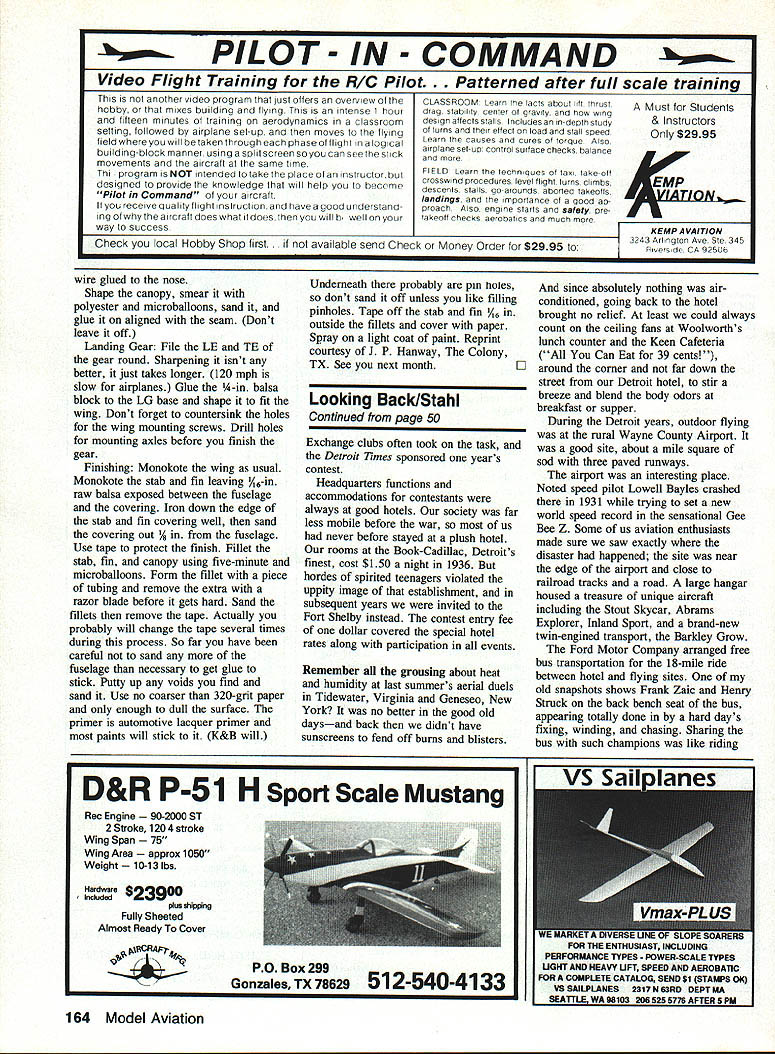
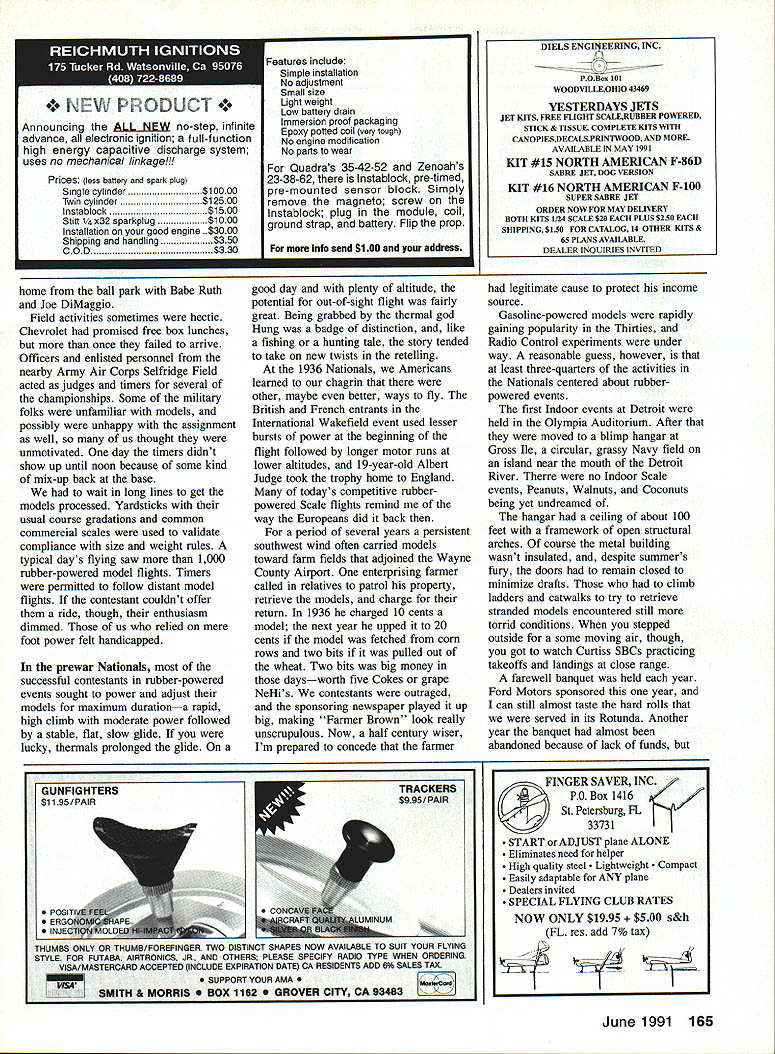
- Some groups bought a bus (one for about $100) and drove it cross-country.
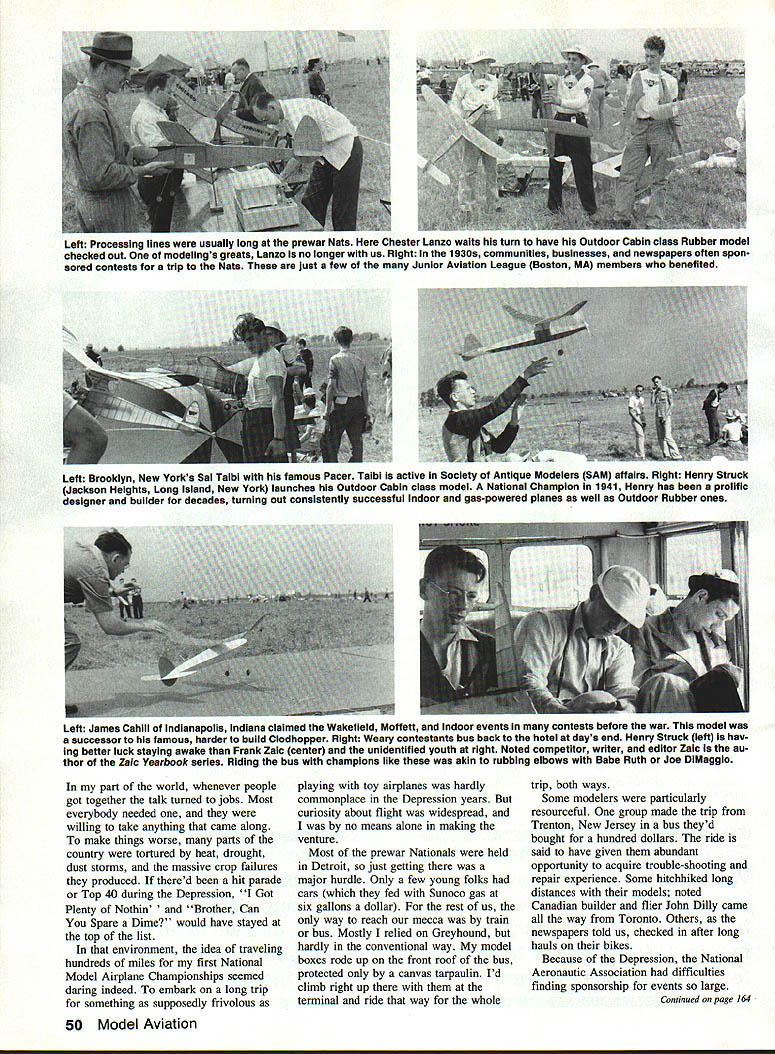
- Others hitchhiked long distances; noted Canadian builder John Dilly came from Toronto.
- A few contestants arrived after long hauls on bicycles.
Because of the Depression, the National Aeronautic Association had trouble finding sponsorship. Exchange clubs often stepped in, and newspapers like the Detroit Times sponsored contests.
Accommodations and comforts
Headquarters and accommodations were usually good hotels—many of us had never stayed in such places. Our rooms at the Book‑Cadillac, Detroit's finest, cost $1.50 a night in 1936. After we violated the "uppity" image of that establishment, later groups were invited to the Fort Shelby instead. The contest entry fee of one dollar typically covered special hotel rates and participation in all events.
No one had air-conditioning, so heat and humidity were as much a problem then as they are now. We relied on ceiling fans at Woolworth's lunch counter and the nearby Keen Cafeteria ("All You Can Eat for 39 cents!") for a breeze and a cheap meal.
Flying sites and field activities
During the Detroit years outdoor flying was at the rural Wayne County Airport, about a square mile of sod with three paved runways. It was an interesting site—Lowell Bayles crashed there in 1931 while trying to set a new world speed record in the Gee Bee Z. A large hangar housed unusual aircraft like the Stout Skycar, Abrams Explorer, Inland Sport, and the new Barkley Grow twin-engined transport.
Ford Motor Company arranged free bus transportation for the 18-mile ride between hotel and flying sites. Field activities could be hectic:
- More than once Chevrolet failed to deliver promised box lunches.
- Officers and enlisted personnel from nearby Army Air Corps Selfridge Field acted as judges and timers; some were unfamiliar with models and, at times, appeared unmotivated.
- Timers were sometimes delayed—one day they didn't arrive until noon because of a base mix-up.
- Models were processed in long lines; yardsticks and common commercial scales validated compliance with size and weight rules.
- A typical day's flying saw over 1,000 rubber-powered model flights.
Timers were permitted to follow distant model flights; contestants who couldn't offer a ride felt handicapped if the timer had to walk. Those reliant on thermals and out-of-sight flights often returned with memorable tall tales.
Indoor events in Detroit began in the Olympia Auditorium and later moved to a blimp hangar at Gross Ile, a circular grassy Navy field near the mouth of the Detroit River. The hangar had a 100-foot ceiling with open structural arches; with doors closed to minimize drafts the interior could be torrid. When you stepped outside, you could watch Curtiss SBCs practicing at close range.
Challenges and anecdotes
One recurring annoyance was the farmer who retrieved models that drifted into adjoining fields. In 1936 he charged 10 cents; in 1937 the fee rose to 20 cents from the corn and a "two‑bit" charge if fetched from wheat—big money then. Contestants were outraged and the sponsoring newspaper sensationalized the story; with hindsight, the farmer had legitimate cause to protect his income.
Banquets and after-dinner speakers were an annual tradition. Ford sponsored one banquet; another nearly failed for lack of funds until Roy Scripps hired the lake steamer Greater Buffalo and saved the affair. Speakers like Marine aerobatic airman Al Williams were polished communicators; others, like Roscoe Turner, could not capture the same excitement on the podium that they did in the air.
The Detroit Times gave the 1936 Nationals exceptional coverage—large pictures of contestants and models filled front pages. One memorable photo showed Ben Shereshaw's mammoth twin‑boom gas pusher heading toward a tall man and a fleeing woman, with a fence, house, and barn beyond. I never found out how that ended.
Organization and legacy
The Academy (the Academy of Model Aeronautics) was founded in 1936. The media attention and photos of crowded flying sites likely influenced organizers to consider flying-site selection, crowd control, and liability insurance for the long term.
If you've been a modeler for half a century, going to the AMA Nationals can conjure memories of those earlier big contests. The hobby was part of a youth aviation frontier; interest in flight was widespread, and curiosity about aviation drove many to make daring journeys in hard times. Other than the ages of participants, many aspects of the Nationals then and now are remarkably similar.
- The techniques of competitive flying evolved—European contestants in events like the International Wakefield influenced American approaches.
- Indoor events and new classes (Peanuts, Walnuts, Coconuts) came later; they were yet undreamed of in the early meets.
- The spirit of competition, camaraderie, and the occasional mishap remain part of the tradition.
Those were glorious days for aviation and modeling. The hobby was becoming better known all the time, and model contests continued to inspire successive generations.
— Earl F. Stahl
Transcribed from original scans by AI. Minor OCR errors may remain.

