
Los Banos Scale Slope Soar-In
By David M. Sanders
In its fourth year, the South Bay Soaring Society's (SBSS) annual Los Banos Slope Scale Soar-In is shaping up to be one of the major events on the U.S. scale soaring calendar. Unique in setting and scope, the contest provides a great opportunity for a wide range of scale soaring enthusiasts to show their skills in a number of flying and construction formats. This was my second year attending, and it has become a much-anticipated weekend for myself and many others.
Event overview and attendance
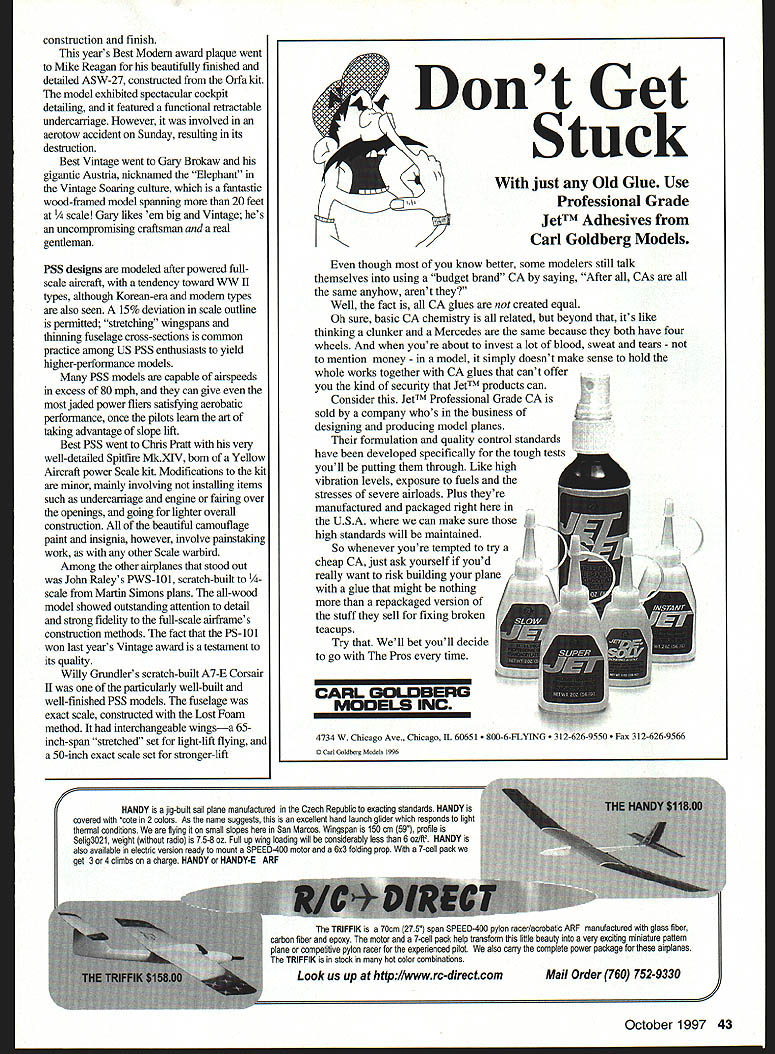
The Soar-In was held the weekend of May 16–18 at the scenic Los Banos Reservoir State Park. The site’s awesome 300-foot slopes offered outstanding smooth, clean lift—even with very little wind. Conditions were not quite as good as last year’s, but they still provided plenty of flyable lift for the majority of the more than 60 pilots registered, who brought along more than 100 models.
Slope lift conditions were light, but each day provided excellent general flying weather, with plenty of thermal activity when the wind was down. Wind was light in the morning hours; afternoons brought good breezes that kept reasonably loaded airplanes easily flyable.
A tip for enjoying slope events: have models suitable for various conditions. I brought a lightweight semiscale hand-launch glider for light lift and heavily loaded warbirds for the “big air.”
Event director Lynsel Miller and his assistant Sean Sharif arranged rounds of flying that kept aircraft of dissimilar performance from flying together, minimizing the chances of midair collisions.
Launch options
If fliers didn’t feel the slope lift at a given hour was adequate and wanted to take advantage of thermals, there were other launch options. A winch was available each day, and aerotowing was provided on Saturday and Sunday.
Because of its rising popularity in North America, aerotow has become a regularly scheduled activity at the fly-in. Scale sailplanes (three-meter span and larger) are launched via a releasable towline behind a powered radio-control aircraft—the same way the majority of full-scale sailplanes are launched today. Aerotow is widely practiced in scale flying and is considered one of the safest methods for launching large-scale sailplanes, although accidents can still occur.
This year’s towing duties were performed by Jerry Arana—an SBSS member and a Salinas Aeromodelers member—with his 1/3-scale, Zenoah G-45–powered Fly Baby biplane, specially fitted with a releasable towline positioned behind the cockpit. Robin Lehman, one of the United States’ premier authorities on aerotow procedures, was on hand to assist pilots new to the technique as well as those with aerotow experience.
Awards (Pilots’ Choice)
Although the event is a fly-in and not specifically billed as a competition, Pilots’ Choice awards are given for three categories of airframe: Modern, Vintage, and Power Slope Scale (PSS).
The generally recognized break-off line between Modern and Vintage sailplanes is circa 1950: prototypes in production before that date are considered Vintage; those after are Modern. The cutoff is evident in the mostly wood-and-fabric Vintage models, which differ greatly from the all-fiberglass Modern airplanes. Both types are optimized to achieve scale flight performance, and the larger scale models are nearly indistinguishable from their full-scale counterparts when in flight.
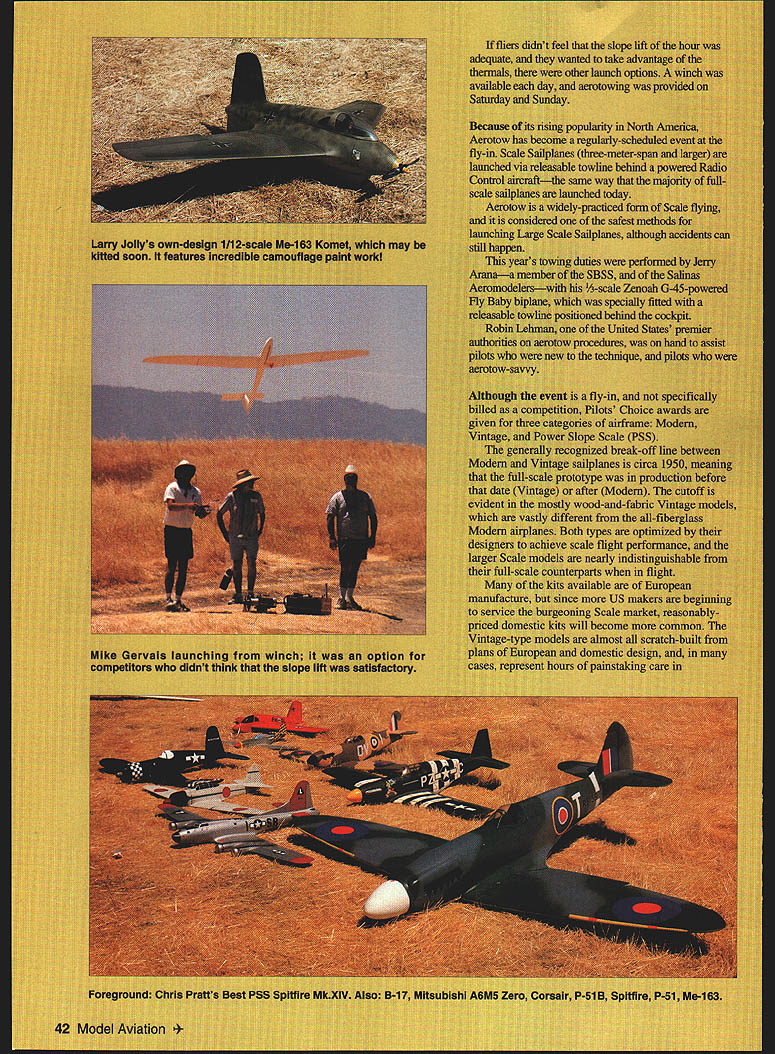
- Best Modern: Mike Reagan — ASW‑27 (Orfa kit). The model exhibited spectacular cockpit detailing and featured a functional retractable undercarriage. Unfortunately, it was destroyed in an aerotow accident on Sunday.
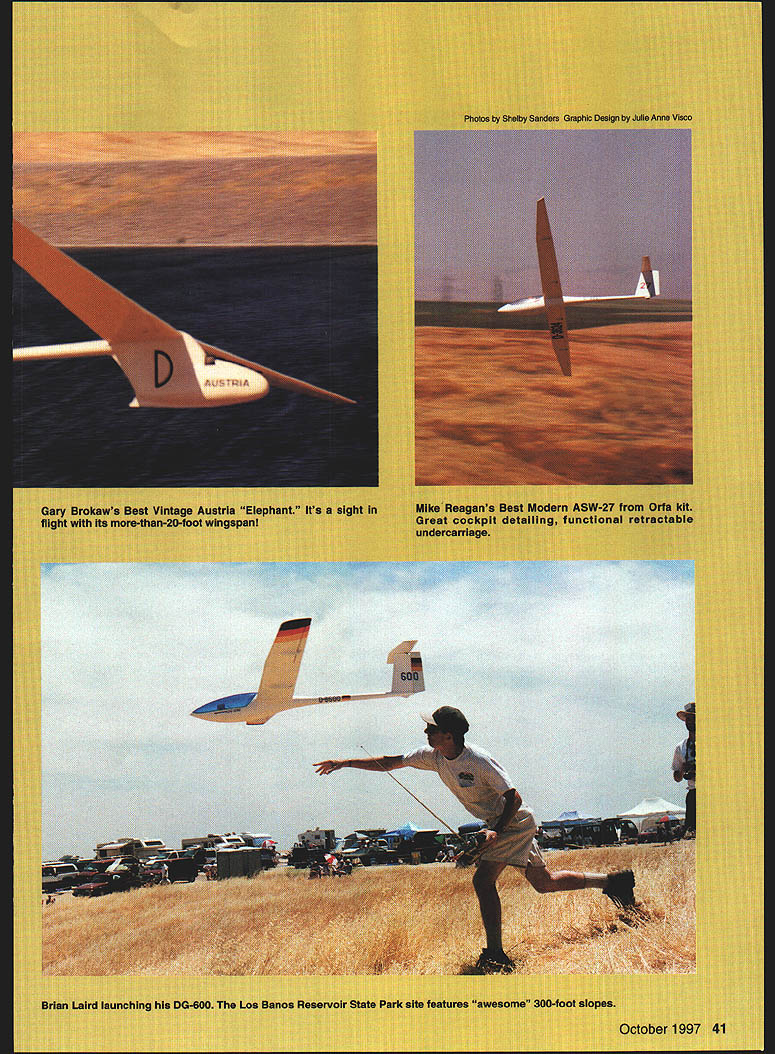
- Best Vintage: Gary Brokaw — Austria “Elephant.” A fantastic wood-framed model spanning more than 20 feet at 1/4 scale. Gary is an uncompromising craftsman and a real gentleman.
- Best PSS: Chris Pratt — Spitfire Mk.XIV (Yellow Aircraft power-scale kit). The model was very well detailed; PSS kits are often lightly modified (omitting undercarriage or engine details and favoring lighter construction) while retaining painstaking paint and insignia work.
PSS designs are modeled after powered full-scale aircraft, often WW II types, though Korean-era and modern types appear as well. A 15% deviation in scale outline is permitted, so “stretching” wingspans and thinning fuselage cross-sections are common practice among U.S. PSS enthusiasts to yield higher-performance models. Many PSS models are capable of airspeeds in excess of 80 mph and can deliver satisfying aerobatic performance once pilots learn to take advantage of slope lift.
Notable models and builders
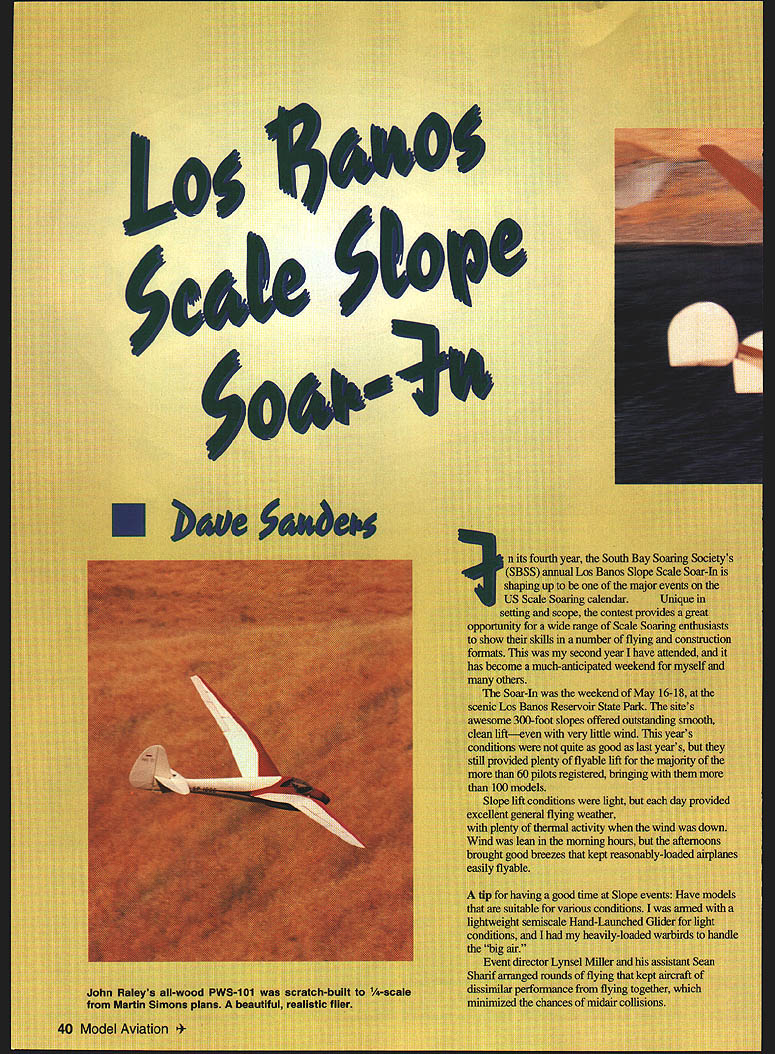
- John Raley’s PWS‑101: Scratch-built to 1/4 scale from Martin Simons plans. The all-wood model showed outstanding attention to detail and strong fidelity to the full-scale airframe’s construction methods. The PWS‑101 won last year’s Vintage award.
- Willy Grundler’s A‑7E Corsair II: Scratch-built with an exact-scale fuselage constructed using the lost-foam method. It featured interchangeable wings—a 65-inch “stretched” set for light-lift flying and a 50-inch exact-scale set for stronger lift. The flying profile and paint work faithfully represented VA‑W on the USS Nimitz; Willy’s craftsmanship is top-notch.
- Larry Jolly’s Me‑163 Komet: A menacing 1/12-scale model suitable for either slope or Speed 400 electric power; it may soon be kitted. The camouflage paint work was excellent.
- Many large Modern scale aircraft exhibited fine cockpit detailing, including full-body pilot figures, safety belts, instrument panels, and control systems.
Full-scale attraction
Another highlight was Friday’s impressive low-level flyby by Paul Grieshaber in his full-scale Fouga Magister CM‑170. The Fouga is a French training jet of 1950s vintage and the world’s first jet-powered primary trainer. Paul is a member of the Diablo Valley Soaring Society of Pleasanton, California, and divides his attention between models and full-scale flying. When performing maneuvers, the Fouga’s twin turbofan engines burn roughly 180 gallons of fuel per hour. Paul is a commercial pilot (737s for USAirways) and has flown with two acrobatic teams in air shows across the country.
Atmosphere, logistics, and closing
The fly-in is a fun event with none of the pressures of competition—just a great bunch of people to fly with and visit. The town of Los Banos is nearby for creature comforts that make the event more enjoyable. Camping is available on park land at the opposite side of the reservoir, and participants with RVs are welcome to stay at the event site.
Congratulations to Lynsel Miller and Sean Sharif for a very enjoyable weekend of flying and camaraderie!
For information on next year’s event, contact Lynsel Miller at (408) 275‑6403 for a registration packet, which includes information on local hotels and restaurants. See you there in 1998!
David M. Sanders 34455 Camino El Molino Capistrano Beach, CA 92624
Transcribed from original scans by AI. Minor OCR errors may remain.

