
Lost Hills Free Flight Team Finals
By Jim Haught
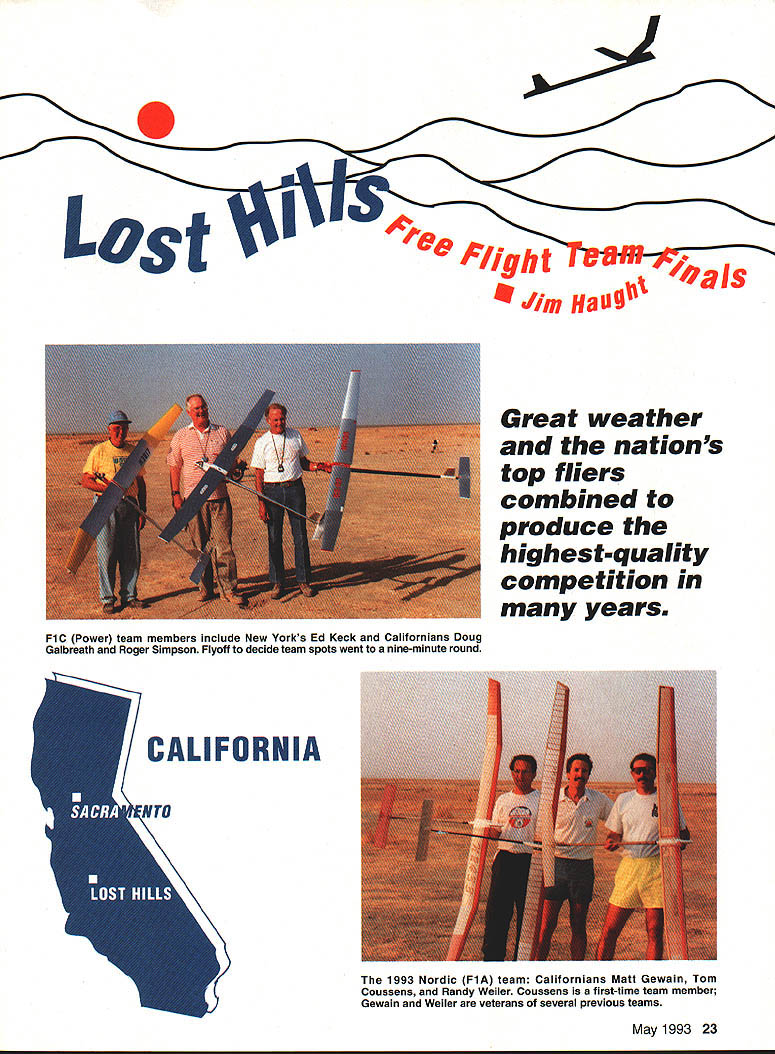
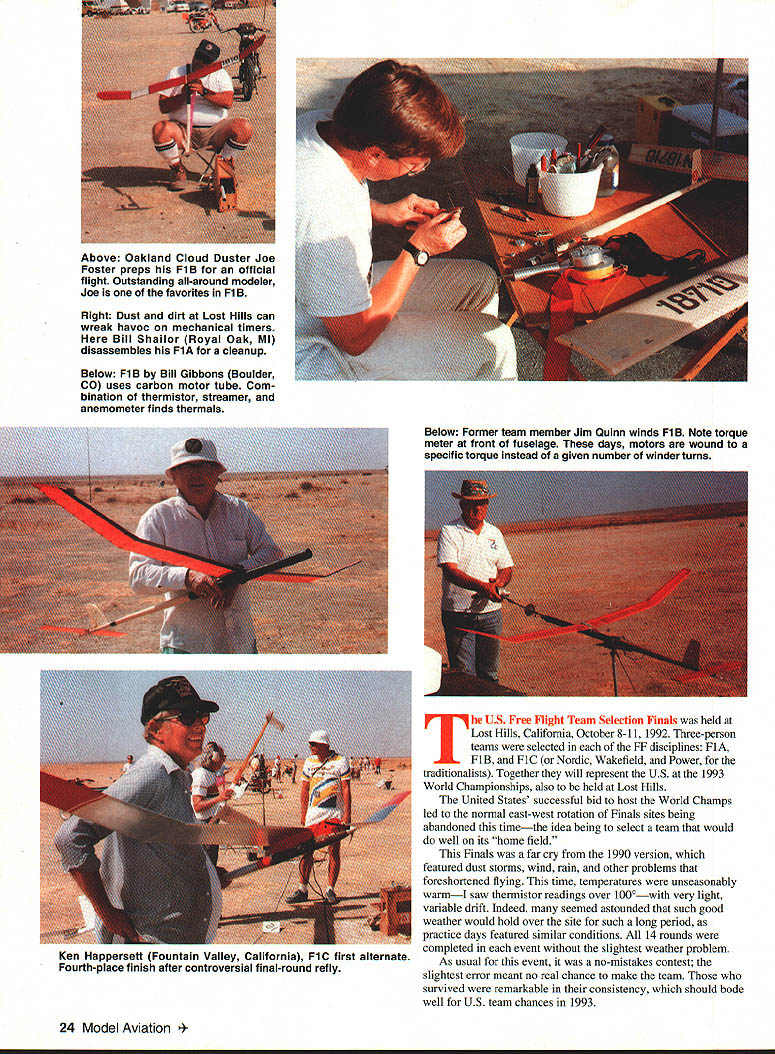
Great weather and the nation's top fliers combined to produce the highest-quality competition in many years. The U.S. Free Flight Team Selection Finals was held at Lost Hills, California, October 8–11, 1992. Three-person teams were selected in each FAI discipline: F1A, F1B, and F1C (Nordic, Wakefield, and Power for the traditionalists). Together they will represent the U.S. at the 1993 World Championships, also to be held at Lost Hills.
The United States' successful bid to host the World Champs altered the normal east–west rotation of Finals sites—the idea being to select a team that would do well on its "home field."
These Finals were a far cry from the 1990 version, which featured dust storms, wind, and rain that foreshortened flying time. Temperatures were unseasonably warm (I saw thermistor readings over 100°F), with very light, variable drift. Practice days featured similar conditions, and all 14 rounds were completed in each event without the slightest weather problem. As usual for this competition, it was a no-mistakes contest; the slightest error meant no real chance to make the team. Those who survived were remarkable in their consistency, which bodes well for U.S. team chances in 1993.
Contestants flew seven rounds over each of two days, with a mandatory third day of timing duty. The three events thus took three days to fly, with all flyoffs held on the morning of Day Four.
Some highlights:
F1B (Wakefield)
- Entrants: 41 fliers, making F1B the most popular FAI event at this Finals.
- Approaches varied widely: some used a short, fast climb ("blast-'em-up-fast") while others used longer prop runs and extended cruising. For example, Adam Tracy recorded a 27-second prop run; Walt Ghio preferred a 56-second run and set up a model optimized for light-air conditions. Only a final-round miss kept Ghio from making the team.
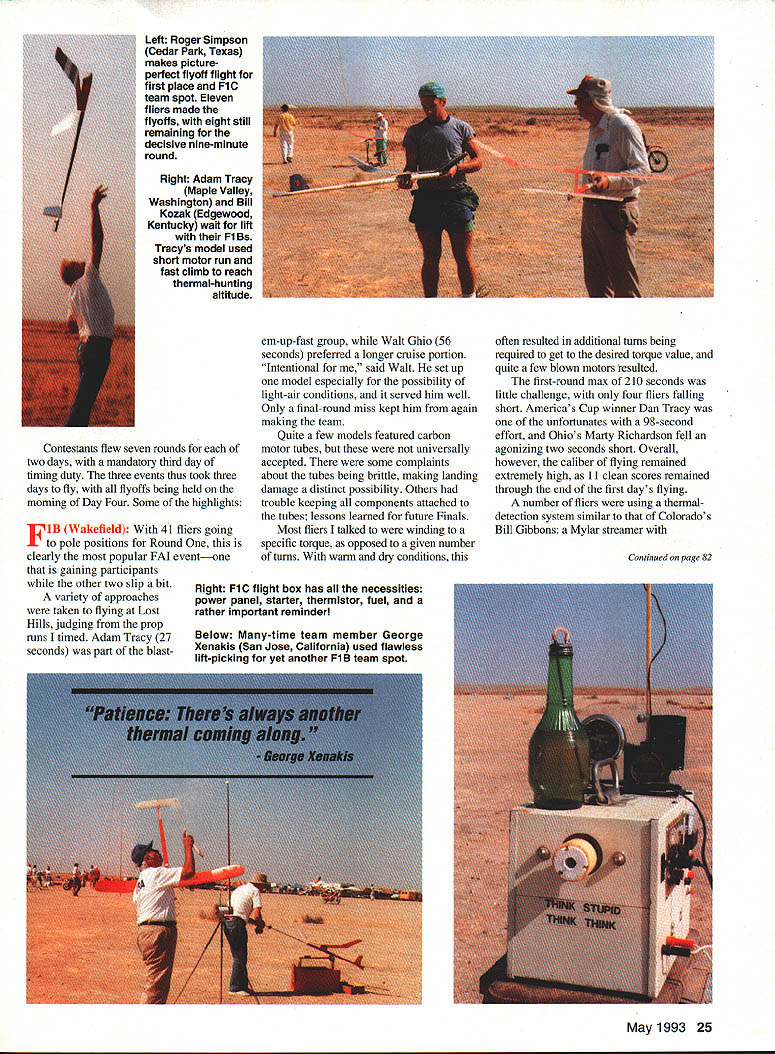
- Equipment notes: Carbon motor tubes were common but not universally loved—some found them brittle, increasing landing-damage risk; others had trouble keeping components attached to the tubes. Many fliers wound to a specific torque rather than a fixed number of turns; in warm dry air this often required additional turns to reach the desired torque and led to a few blown motors.
- Early rounds: The first-round max of 210 seconds posed little challenge—only four fell short. Despite a few high-profile misses (America's Cup winner Dan Tracy had a 98-second effort; Marty Richardson missed by two seconds), eleven clean scores remained through the first day's flying.
- Thermal detection: Several fliers used a system similar to Bill Gibbons'—a Mylar streamer with a thermistor coupled to an anemometer to detect the "fill breeze" when thermals pass through. "I don't launch until all three agree," said Bill; the fill breeze helps prevent models from gulling over and leaving the thermal prematurely.
- Final rounds: After Round 13 there were six perfect scores, but three of those dropped in the final round, leaving the team as follows:
- Chris Matsuno (Missouri)
- George Xenakis (California)
- Fred Pearce (Texas)
- Alternate: Bill Turner (dropped only 10 seconds in Round 2)
- Notes: Pearce and Matsuno achieved team spots after years of close calls; Xenakis relied on patience and superb lift-picking with relatively simple, proven models.
F1A (Nordic)
- Entrants: 22 glider fliers.
- Conditions and strategy: Drift was very light and variable, favoring high-performance models and making thermal detection difficult. A three-minute (180-second) model for light air was essential. Sixteen of 22 made the first-round max.
- Bunt systems: I was surprised to see only two bunt-equipped models (Andrew Barron and Pierre Brun), and neither used the bunt on all flights. With commercially available bunt hardware becoming available, more adoption is expected in future Finals.
- Field feature: A slight depression southeast of the main launch area—similar to the infamous "Isaacson's Hole" at Taft—caused models not already climbing to fall out of lift quickly. Conditions were often more consistent toward the western end of the flight line; many fliers towed there regardless of pole position.
- Day One: Six clean scores remained at the end of Day One—five Californians and Floridian Harry Grogan. Several former team members (e.g., Isaacson, Elder, Bradley, Parker) were out of contention.
- Flyoff: The top five after regular rounds were Pierre Brun, Tom Coussens, Matt Gewain, Don Leath, and Randy Weller. A 7:30 a.m. flyoff two days later decided the team.
- Pierre Brun used a bunt model and scored 196 in the flyoff—excellent but not enough to win.
- Don Leath (the only flier using an old twanger-style towhook) launched one of his best flights and scored 202 for fourth place. He vowed to return with revised towhooks and still-air models.
- Matt Gewain towed into a favorable area, made an outstanding launch, and his Pacer secured a team spot.
- Randy Weller flew a version of the Wishbone/RI-14 series with an extremely flat, slow glide and made the team easily.
- Tom Coussens, aided by Lee Hines and Jim Parker for trimming and obstruction removal, flew his Sonnrise to the top spot in the flyoff.
- F1A team selected:
- Tom Coussens
- Matt Gewain
- Randy Weller
- Notes: All three are from California, which should aid team practice and cohesion. Don Leath remains a competitive flier to watch in future years.
F1C (Power)
- Entrants: 28 fliers.
- Early rounds: The first four-minute (240-second?) max (note: F1C first-round max referenced as four minutes in the report) was largely unchallenging—26 of 28 made it. Several who missed did so due to DTs (dead-stick terminations) or pilot error; overall the event was a no-mistakes contest. After seven rounds there were still 14 clean scores; after nine rounds there were 11, and this elite group held through the last five rounds to qualify for a mass flyoff the next morning.
- Flyoff field and storylines: The final group read like a Who's Who of F1C, including Doug Joyce (canard models), Gil Morris (the only flapper seen), Charlie Caton (veteran with recent minor disasters), Doug Galbreath (who survived a midair and repaired his model), Ken Oliver, Mike Achterberg, Bob Gulati, Ken Happersett, Ed Keck, Ken Phair, and Roger Simpson. The quality of the field prompted speculation that a long flyoff (ten minutes or more) would be needed to reduce the field, but organizers scheduled to keep flyoff rounds in the least-active conditions possible.
- Flyoff progress: All 11 qualifiers made the five-minute first round. Joyce, Achterberg, and Caton dropped out on the seven-minute second round (by a total of 21 seconds). Gil Morris barely made one early round by less than a second. The nine-minute round raised tension considerably, with very quiet concentration along the line as the remaining fliers sought a decisive result.
- Notes: The F1C contest at Lost Hills featured exceptionally high-quality flying and tight margins. The preliminary rounds served effectively as a qualifier for the demanding flyoff rounds, where pilot skill and model performance determined the final team composition.
Summary
- Event: U.S. Free Flight Team Selection Finals, Lost Hills, California, October 8–11, 1992.
- Weather: Unseasonably warm, very light and variable drift; all 14 rounds completed with no weather interruptions.
- Team selections announced:
- F1B (Wakefield): Chris Matsuno; George Xenakis; Fred Pearce. Alternate: Bill Turner.
- F1A (Nordic): Tom Coussens; Matt Gewain; Randy Weller.
- F1C (Power): Final flyoff produced an elite selection; competition was exceptionally strong (individual F1C team members not specified in this report).
- Outlook: The remarkable consistency and high caliber of flying at this Finals should bode well for U.S. team prospects at the 1993 World Championships at Lost Hills.
Transcribed from original scans by AI. Minor OCR errors may remain.

