
Lots of Foam!
By Gordy Stahl
As a Simitar enthusiast, I'd never given much thought to the foam I use for wing cores in my models. But recent headlines about foam used in fast food restaurants for ecological reasons made me want to learn more.
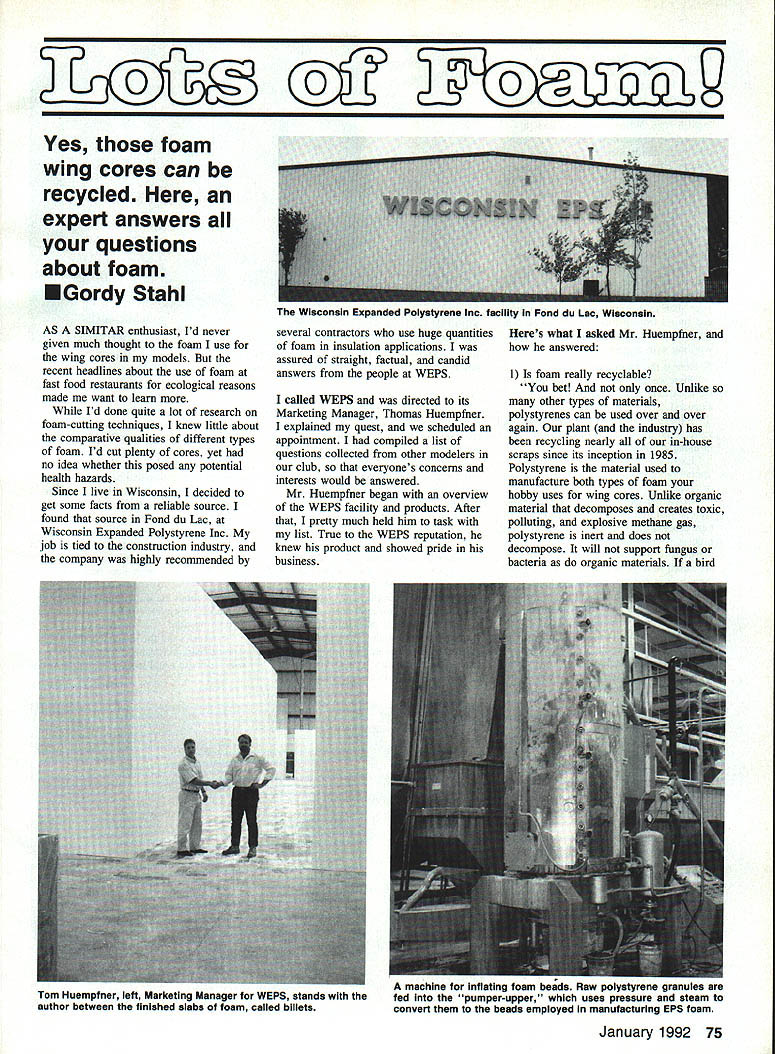
Although I'd done a lot of research on foam-cutting techniques, I knew little about the comparative qualities of different types of foam and whether cutting cores posed any potential health hazards. Since I live in Wisconsin, I decided to get facts from a reliable source: Wisconsin Expanded Polystyrene Inc. (WEPS) in Fond du Lac. My job is tied to the construction industry, and the company was highly recommended by several contractors who use large quantities of foam in insulation applications.
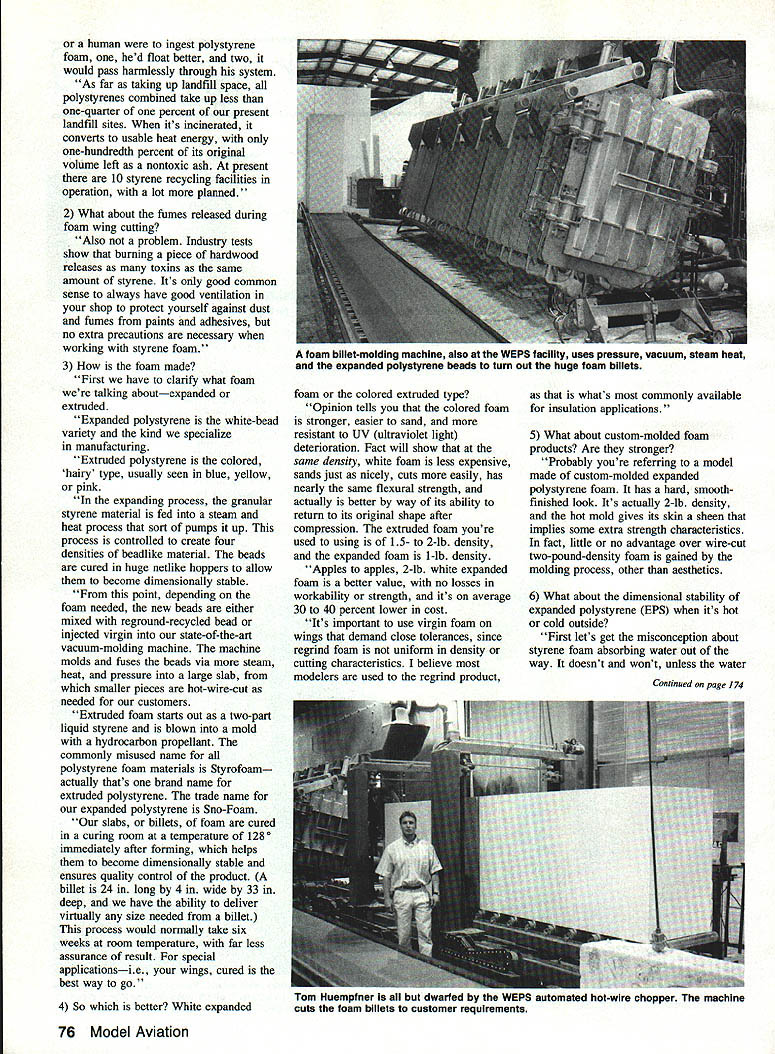
I called WEPS and was directed to Marketing Manager Thomas Huempfner. I explained my quest, and we scheduled an appointment. I had compiled a list of questions collected from other modelers in our club so that everyone's concerns would be answered.
Mr. Huempfner began with an overview of the WEPS facility and products. After that, I held him to task with my list. True to WEPS's reputation, he knew his product and showed pride in his business.
Q&A with Thomas Huempfner
- Is foam really recyclable?
You bet! And not only once. Polystyrenes can be used over and over again. WEPS (and the industry) has been recycling nearly all in-house scraps since its inception in 1985. Polystyrene is the material used to manufacture both types of foam hobbyists use for wing cores.
Unlike organic material that decomposes and creates toxic, polluting, explosive methane gas, polystyrene is inert and does not decompose. It will not support fungus or bacteria as organic materials do. If a bird or a human ingests polystyrene foam, the pieces would pass harmlessly through the system.
As far as landfill space, polystyrenes combined take up less than one-quarter of one percent of present landfill sites. If incinerated, polystyrene converts to usable heat energy and is reduced to non-toxic ash, about one-hundredth of its original volume. There are styrene recycling facilities in operation now and many more planned.
- What about fumes released during foam wing cutting?
Also not a problem. Industry tests show burning a piece of hardwood releases about the same amount of toxins as burning styrene. It's common sense to always have good ventilation in your shop to protect yourself against dust, fumes, paints, and adhesives. No extra precautions are necessary when working with styrene foam beyond normal shop ventilation.
- How is foam made?
First, we must clarify what kind of foam we're talking about—expanded or extruded.
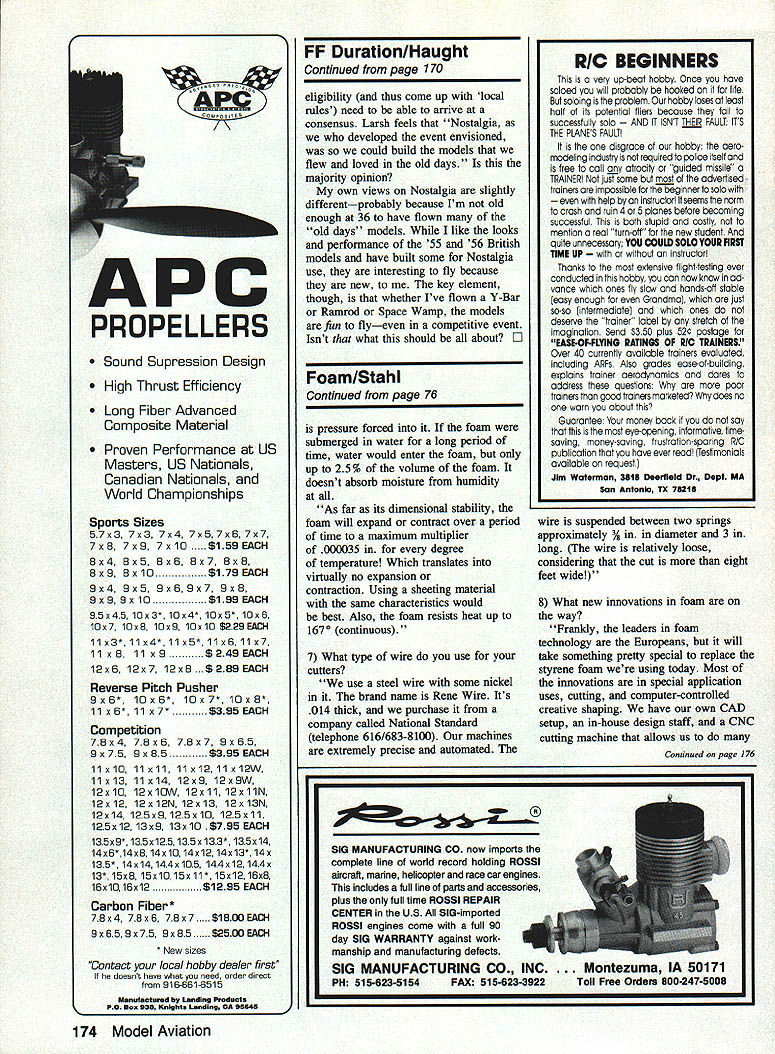
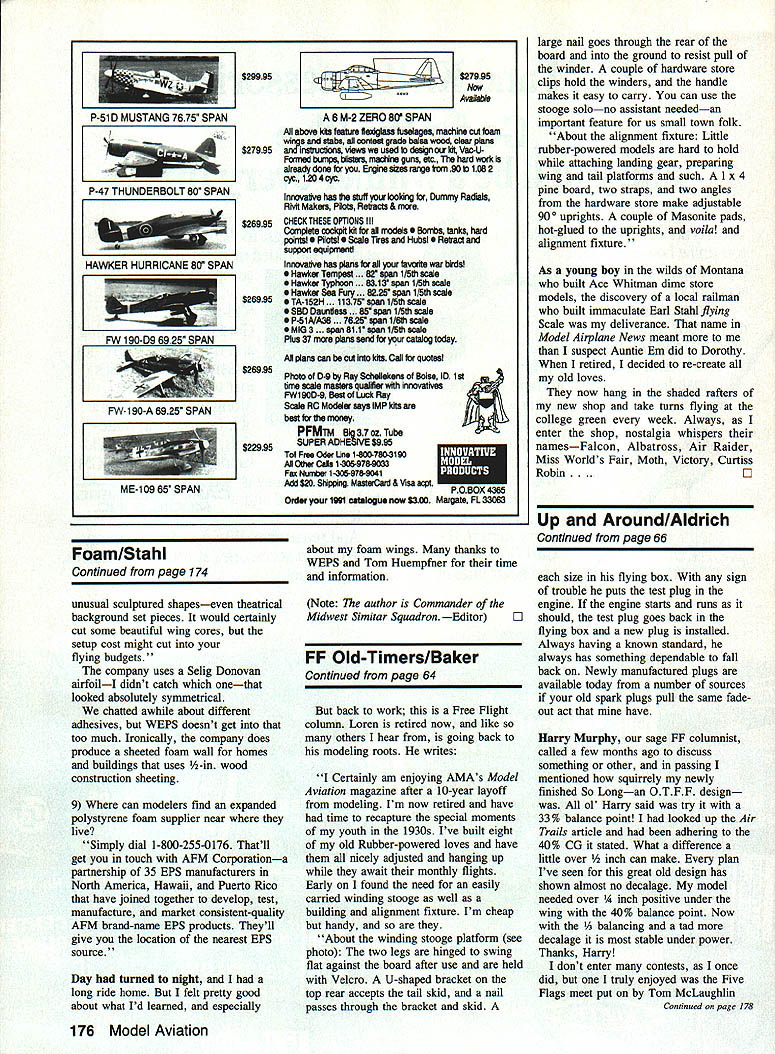
- Expanded polystyrene (EPS) is the white-bead variety WEPS specializes in. In the expanding process, granular styrene is fed with steam and heat to "pump up" the granules into beadlike material. The process is controlled to create four densities of beadlike material. The beads are cured in large netlike hoppers to become dimensionally stable. Depending on need, the new beads are either mixed with reground (recycled) bead or injected as virgin material into a vacuum-molding machine. The machine molds and fuses the beads via steam, heat, and pressure into large slabs or smaller pieces that are hot-wire cut to customer sizes.
- Extruded polystyrene starts as a two-part liquid styrene which is blown in the mold by a hydrocarbon propellant. The commonly misused name "Styrofoam" is actually a brand name; extruded polystyrene is the trade name for that other type.
Expanded polystyrene cures in a curing room at room temperature. A typical billet is 24 feet long, 4 feet wide, and 33 inches deep. WEPS can deliver virtually any size needed. The billet process would normally take six weeks at room temperature; far less time is required with certain special applications (for example, wings), which are best cured by other methods.
- So which is better—white expanded foam or colored extruded foam?
Opinion says colored extruded foam is stronger, easier to sand, and more resistant to UV deterioration. The fact is, at the same density, white expanded foam will perform the same. White foam is less expensive, sands just as nicely, and cuts easily.
"Apples to apples," 2-lb. white expanded foam is a better value, with no losses in workability or strength, and it's on average 30 to 40 percent lower in cost.
It's important to use virgin foam on wings that demand close tolerances, since regrind foam is not uniform in density or cutting characteristics. Most modelers are used to regrind product because that's what's commonly available for insulation applications.
- What about custom-molded foam products? Are they stronger?
If you're referring to a model made of custom-molded expanded polystyrene foam, it has a hard, smooth, finished look. It's actually 2-lb. density, and the hot mold gives its skin a sheen that implies extra strength. In fact, little or no advantage over wire-cut two-pound-density foam is gained by the molding process other than aesthetics.
- What about the dimensional stability of expanded polystyrene (EPS) when it's hot or cold outside?
First, let's clear the misconception that styrene foam absorbs water. It doesn't, unless water is pressure-forced into it. If the foam were submerged for a long period, water would enter, but only up to 2.5% of the foam's volume. It doesn't absorb moisture from humidity.
As for dimensional stability, the foam will expand or contract over time by a maximum multiplier of .000035 inches for every degree of temperature, which translates into virtually no expansion or contraction. Using a sheeting material with the same characteristics would be best. Also, the foam resists heat up to 167° (continuous).
- What type of wire do you use for your cutters?
We use a steel wire with some nickel in it. The brand name is Rene Wire. It's .014 inches thick, and we purchase it from a company called National Standard (telephone 616/683-8100). Our machines are extremely precise and automated. The wire is suspended between two springs approximately 3/8 inch in diameter and 3 inches long. The wire is relatively loose, considering that the cut can be more than eight feet wide.
- What new innovations in foam are on the way?
Frankly, the leaders in foam technology are the Europeans, but it will take something pretty special to replace the polystyrene foam we're using today. Most innovations are in special application uses, cutting, and computer-controlled creative shaping.
WEPS has its own CAD setup, an in-house design staff, and a CNC cutting machine that allows many unusual sculptured shapes—even theatrical background set pieces. It would certainly cut beautiful wing cores, but setup cost might cut into your flying budgets.
The company uses a Selig Donovan airfoil (I didn't catch which one) that looked absolutely symmetrical. We chatted about different adhesives, but WEPS doesn't get into that much. Interestingly, the company does produce a sheeted foam wall for homes and buildings that uses 1/8-inch wood construction sheeting.
- Where can modelers find an expanded polystyrene foam supplier near them?
Dial 1-800-255-0176. That will connect you with AFM Corporation—a partnership of 35 EPS manufacturers in North America, Hawaii, and Puerto Rico that have joined to develop, test, manufacture, and market consistently quality AFM brand-name EPS products. They'll give you the location of the nearest EPS source.
Day had turned to night, and I had a long ride home, but I felt good about what I'd learned — and especially about my foam wings. Many thanks to WEPS and Tom Huempfner for their time and information.
(Note: The author is Commander of the Midwest Simitar Squadron. —Editor)
Transcribed from original scans by AI. Minor OCR errors may remain.

