
Low Cost: Torque Meter
A.A. Lidberg
A simple way to learn more about rubber motors, their capacity, and how to select motors to fine-tune model performance.
A torque meter can be used to compare rubber motors, determine an optimum motor for a model, and help you learn about the characteristics of rubber motors. Commercial torque meters are available but they are quite expensive. One can easily be made from scrap material in just a few minutes, however, and it will serve the purpose quite well as both a teaching device and a practical tool.
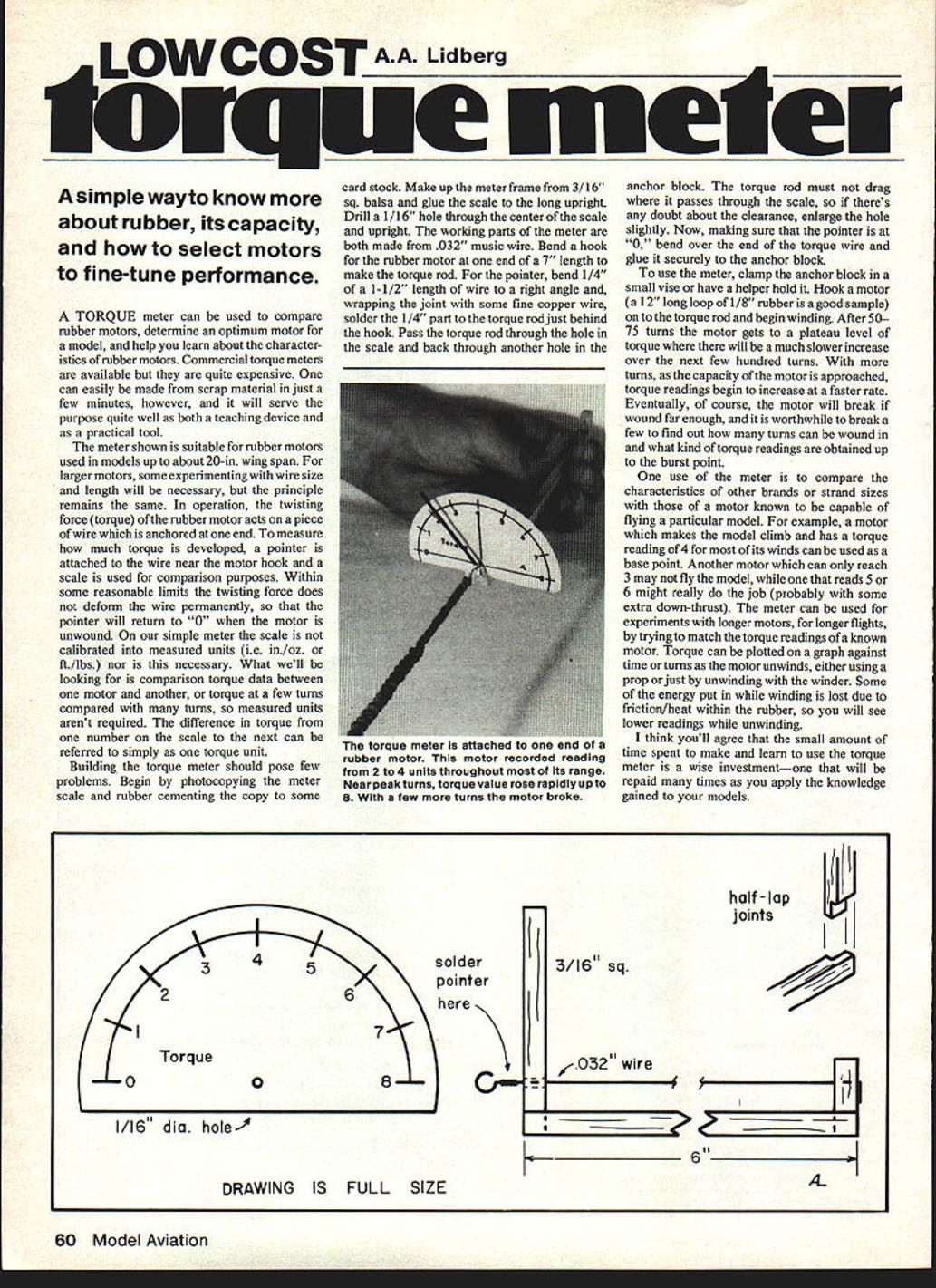
The meter shown is suitable for rubber motors used in models up to about a 20‑inch wingspan. For larger motors, some experimenting with wire size and length will be necessary, but the principle remains the same. In operation, the twisting force (torque) of the rubber motor acts on a piece of wire anchored at one end. To measure how much torque is developed, a pointer is attached to the wire near the motor hook and a scale is used for comparison. Within reasonable limits the twisting force does not deform the wire permanently, so the pointer will return to "0" when the motor is unwound.
On this simple meter the scale is not calibrated into measured units (for example in./oz. or ft./lbs.) — and this is not necessary. What is being sought is comparative torque data between one motor and another, or torque at a few turns compared with many turns. The difference in torque from one number on the scale to the next can be referred to simply as one torque unit.
Construction
Building the torque meter should pose few problems. Suggested steps:
- Photocopy the meter scale and rubber-cement the copy to some card stock.
- Make the meter frame from 3/16" square balsa and glue the scale to the long upright.
- Drill a 1/16" hole through the center of the scale and upright.
- Make the working parts from .032" music wire:
- Bend a hook for the rubber motor at one end of a 7" length to form the torque rod.
- For the pointer, bend 1/4" of a 1-1/2" length of wire to a right angle. Wrap the joint with fine copper wire and solder the 1/4" part to the torque rod just behind the hook.
- Pass the torque rod through the hole in the scale and back through another hole in the anchor block. The torque rod must not drag where it passes through the scale; if there is any doubt about clearance, enlarge the hole slightly.
- With the pointer at "0", bend over the end of the torque wire and glue it securely to the anchor block.
Using the meter
- Clamp the anchor block in a small vise or have a helper hold it.
- Hook a motor (a 12" long loop of 1/8" rubber is a good sample) onto the torque rod and begin winding.
- Observe the torque as you wind:
- After about 50–75 turns the motor reaches a plateau level of torque where increases become much slower over the next few hundred turns.
- As you continue winding and approach the motor's capacity, torque readings begin to increase at a faster rate.
- Eventually the motor will break if wound far enough. It is worthwhile to break a few to determine how many turns can be wound and what torque readings are obtained up to the burst point.
Note: Some of the energy put in while winding is lost due to internal friction/heat in the rubber, so you will see lower readings while unwinding.
Applications and notes
- Compare brands and strand sizes: Use a motor known to be capable of flying a particular model as a baseline. For example, a motor that makes the model climb and has a torque reading of 4 for most of its winds can be a reference point. Another motor that only reaches 3 may not fly the model; one that reads 5 or 6 might be suitable (probably requiring some extra down-thrust).
- Experiment with longer motors for longer flights by trying to match the torque readings of a known motor.
- Plot torque versus time or turns as the motor unwinds, either using a prop or by unwinding with the winder, to study performance.
The small amount of time spent making and learning to use the torque meter is a wise investment — it will be repaid many times as you apply the knowledge gained to your models.
Transcribed from original scans by AI. Minor OCR errors may remain.

