
LSF Level V Flight
I have been a member of the League of Silent Flight for many years, but I still remember the day when I received the voucher for Level I. At that time many of the tasks that lay ahead seemed truly beyond my skill as a modeling enthusiast. However, through the years, with the help of so many good friends in the soaring community, I have finally been able to complete all of the Level V tasks.
I remember those first precision landing attempts in the quiet of the evening in Yellow Springs, Ohio—gently bringing my Zaic Floater in toward the landing spot. We would run out with the tape and eagerly measure the distances for those first landing goals. Years later came the special tasks required for Level IV and V which were the most interesting and challenging: slope soaring and those long cross-country and thermal duration flights. However, the greatest legacy of LSF has been the friendships gained at the countless contests across the Midwest where I learned what a great sport RC sailplaning really is.
Clubs and background
I am a life member of DARTS (Dayton Area Thermal Soarers), and it was with the help of my good friends in the DARTS club that I had completed all of the Level V tasks with the exception of the eight-hour slope flight before I moved to the Carolinas. Once settled in the south, I joined a club in the Hendersonville, NC area called the High Country Soaring Society. This young, growing club is very active in both thermal and slope soaring. It is from the members of HCSS that I have learned what it is like to throw my favorite airplane off the top of a mountain!
Early attempts and final preparations
In the fall of 1985 I finally began to get serious about completing this last task for Level V. The first attempt was on Big Bald, a mountain peak about 5,600 feet high on the Tennessee–North Carolina border. The second was at Butler Mountain, just south of Asheville, NC. Both attempts ended with my time in the air falling far short of the required eight hours, due either to deteriorating cloud conditions or insufficient wind.
Finally, on August 24, 1986, all the conditions were right. Planning and execution for an eight-hour attempt involve some logistics:
- The site must have winds from the correct direction, because many slope sites favor only one or two wind directions.
- There must be enough LSF Level II or higher members present to properly sign vouchers.
- Frequency control is important because each flier must have a discrete frequency for the entire day.
- There must be sufficient daylight available at the end of the flight to safely bring down the airplane.
Planning for the attempt began a week earlier at a contest in Brevard, NC. Randy White, a member of HCSS and an avid slope soarer, coordinated planning during the week. A weather check late on Friday predicted northerly winds with a cold front due Sunday night. Butler Mountain favors a northerly wind, which is not very common in the mountains in summer, so the predicted conditions were excellent. Royes Salmon was coming from Oak Ridge, TN, and was also going to attempt an eight-hour flight. Jack Koontz from Hendersonville and Randy, who lives in Skyland, NC, were going to attempt four-hour flights. The group planned to be on top of Butler Mountain at 9:15 a.m. on Sunday.
The site
The Butler Mountain site is on a 700-foot-high mountain directly south of Asheville, NC, which itself is about 2,200 feet above sea level. The mountain has a beautiful grassy dome and is surrounded on all sides by dense trees and bushes. On a clear day one can see all of Asheville spread out below, and the peaks of the Great Smoky Mountains rise clear and sharp on the western horizon.
Aircraft and equipment
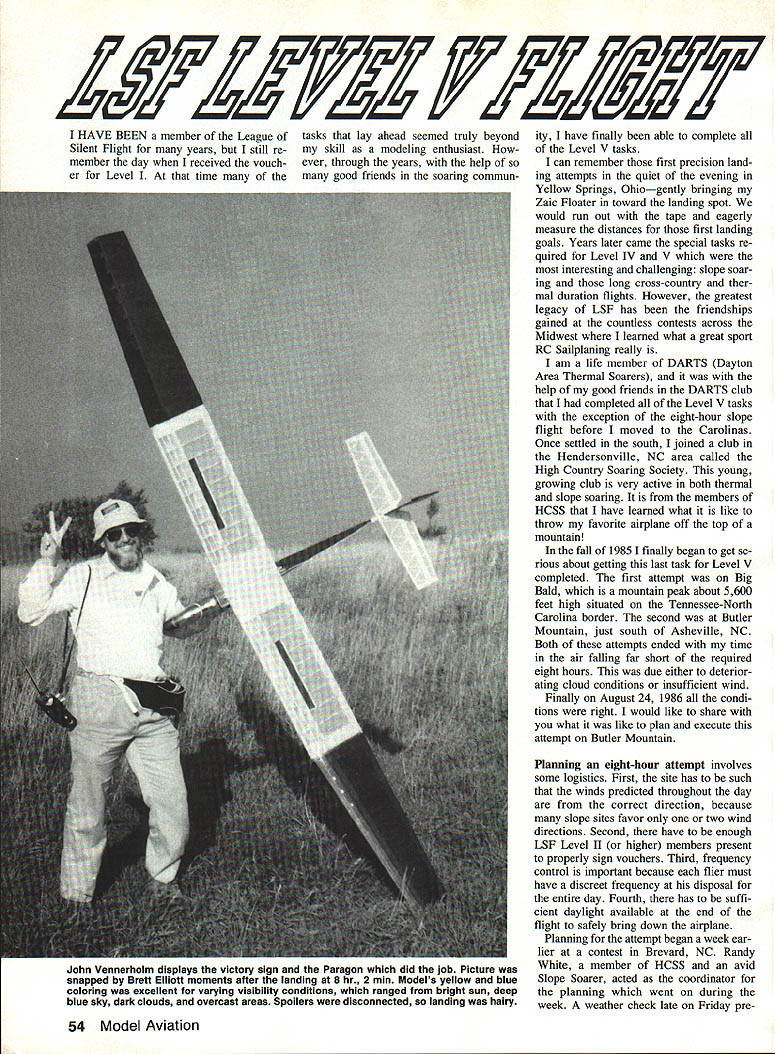
The Asheville weather department had issued a 10-knot forecast, but a quick check showed winds in excess of 25 knots. These high winds concerned us because of the kind of aircraft we planned to fly. Royes had brought an airplane of his own design that was fairly heavily ballasted with batteries but was essentially a floater. Jack was flying an Aquila. Randy was flying a Standard Class airplane of his own design with good penetration. I was flying a Paragon borrowed from Randy, to which I had added one pound of lead ballast in the fuselage bay directly ahead of the wing spar.
Royes had serious reservations about flying his sailplane even with ballast and decided to stand down to see if the wind would abate within the next hour and a half—the time window we calculated he would need to launch in the morning and still have adequate flight time before dusk.
I gave the Paragon a test hop and found that even with the added ballast I could just sustain a position ahead of the mountain by flying directly into the wind. I was sure the wind velocity would decrease somewhat as the airplane moved up and away from the mountaintop, so I elected to fly with full ballast and hope the wind would not increase during the day. I was using only rudder and elevator on the Paragon, leaving the spoilers disconnected to conserve battery power. Later in the day I would wish I hadn't done that!
The Futaba transmitter had its normal internal power supply, but I also had a waist pack of eight alkaline D cells with soldered connections, using a flexible lead to a DIN plug that originally was the trainer plug on the side of the transmitter. I had added a slide switch to the transmitter which allowed me to switch to external power. I planned to start flying with transmitter power on external, and if the meter showed a drop into the red I could switch to internal power and know that there would be at least two hours of flying time remaining. The flight pack consisted of four alkaline C cells with soldered connections. With only two servos on line, this was probably enough power for several eight-hour flights, but I wanted to be sure batteries would not be a concern. There were going to be enough other things to worry about during this long day.
The flight
I launched at 10:27 a.m. for my official flight. About 250 feet down the north side of Butler Mountain is a row of large trees which creates a fierce horizontal vortex or rotor that you must penetrate to get into the main lift. The only way to succeed is to launch and dive along the contour of the hill through the rotor, keeping the nose down so the airplane can withstand the buffeting. The airplane went through some violent rolls before it finally passed through the rotor. Once it entered the smooth laminar air out in front of the mountain, the airplane shot up like it was on an elevator.
If the airplane is not successful in penetrating the wind coming up the face of the mountain, there is no way it will reach the area of maximum velocity directly over the top. If you don't have excess penetration ability, it is important never to let the airplane fall behind the front of the mountain's crest. If this occurs, even diving steeply toward the ground will only cause it to fall further back—and those trees eat airplanes!
There was a low cloud deck over the mountain. Visibility up to the clouds was good, although the actual bottom of the overcast was indefinite. We estimated the cloud bottoms were about 600 to 700 feet above the top of the mountain. I spent the first hour keeping the airplane generally pointed straight out from the mountain and not allowing it to get too high. There was some periodic low scud, and the airplane showed signs of beginning to disappear now and then. I was very concerned about it getting completely swallowed in the clouds.
At the beginning of the second hour we could feel an increase in air temperature, and the bottom of the cloud deck began to rise noticeably. Shortly before noon Randy and Jack launched their aircraft to begin their four-hour attempts. Having other aircraft aloft was helpful—the three of us could move to various areas of the sky and get a better feel for changing visibility and wind patterns. Royes decided to forego his attempt because of the high winds.
After noon the cloud deck bottom rose high and we had essentially unlimited range out over the valley. We could reach heights where the stabilizers became indistinct due to distance and the gray overcast. During the third hour the cloud cover began to break, revealing clear blue sky in places. We saw small cumulus clouds form out over the valley; as they moved toward the mountain they would build and fill out and become dark gray underneath. As each cloud passed, we could speed into its core and get excellent lift. When the air was very smooth, a spot seen by an airplane at extreme height was very difficult to see; we would have to be on top of a formation to be sure. Turbulence and the possibility of flutter due to high speeds are definite hazards in conditions like that.
When we were flying in clear air, we often had to find altitudes that any one of us could reach with a particular wing loading. Typically, the airplanes would settle to a comfortable height of about 1,500 feet above the mountaintop and then drift out over the same distance in front. That seemed to be the static point for slope soaring for much of the afternoon.
As the day wore on I experienced a predictable physiological situation. I had been careful about my fluid intake the night before and during the morning, but nature had its say and I made my first of several trips over to a convenient bush on the windward side of the mountain. Not only does wind tend to blow our airplanes about, it blows hardest when you need it least. When you're trying to keep your eyes on the airplane and your shoes dry, you'll discover a Level V task that isn't on any LSF voucher. Recommendation: stay away from flat rocks when you are off on these excursions.
As the day continued, I passed my first milepost on the flight—3.5 hours—the longest I had ever flown. I expected the same kind of perceptual deterioration I had encountered during earlier attempts. Very slowly I realized I was not taking an active part in flying my airplane. I would find myself acting more like an interested observer and had to mentally jerk myself back into the idea that I had to control the airplane, not just watch it. This problem creeps up on you as your mind wanders with fatigue and is a potentially serious situation about which your friends must keep you aware.
At four hours into the flight the sky was nearly clear. There were still small clouds forming high up, but the bottoms were beyond our reach. There were no recognizable thermals connected with these clouds, although we detected some bubbles of warm air sweeping up the mountain. We used them as they came by, but spent most of our time out in the clear laminar-flow wind.
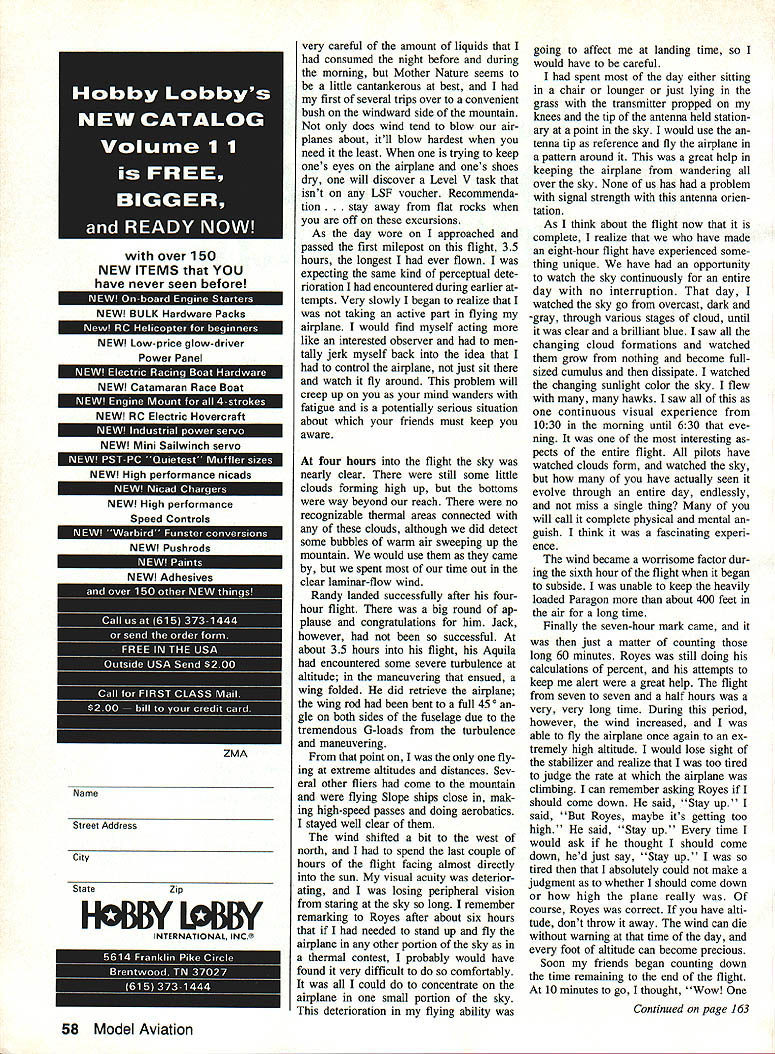
Randy landed successfully after his four-hour flight to a big round of applause and congratulations. Jack, however, had not been so successful. At about 3.5 hours into his flight, his Aquila encountered severe turbulence at altitude; in the maneuvering that ensued a wing folded. He did retrieve the airplane; the wing root had been bent to a full 45° angle on both sides of the fuselage due to the tremendous G-loads from the turbulence and maneuvering.
From that point on I was the only one flying at extreme altitudes and distances. Several other fliers came to the mountain flying slope ships close in, making high-speed passes and doing aerobatics. I stayed well clear of them.
The wind shifted a bit to the west of north, and I had to spend the last couple of hours of the flight facing almost directly into the sun. My visual acuity deteriorated, and I was losing peripheral vision from staring at the sky so long. I remember remarking to Royes after about six hours that if I had needed to stand up and fly the airplane in any other portion of the sky, as in a thermal contest, I probably would have found it very difficult to do so comfortably. It was all I could do to concentrate on the airplane in one small portion of the sky. This deterioration in my flying ability would affect me at landing time, so I had to be careful.
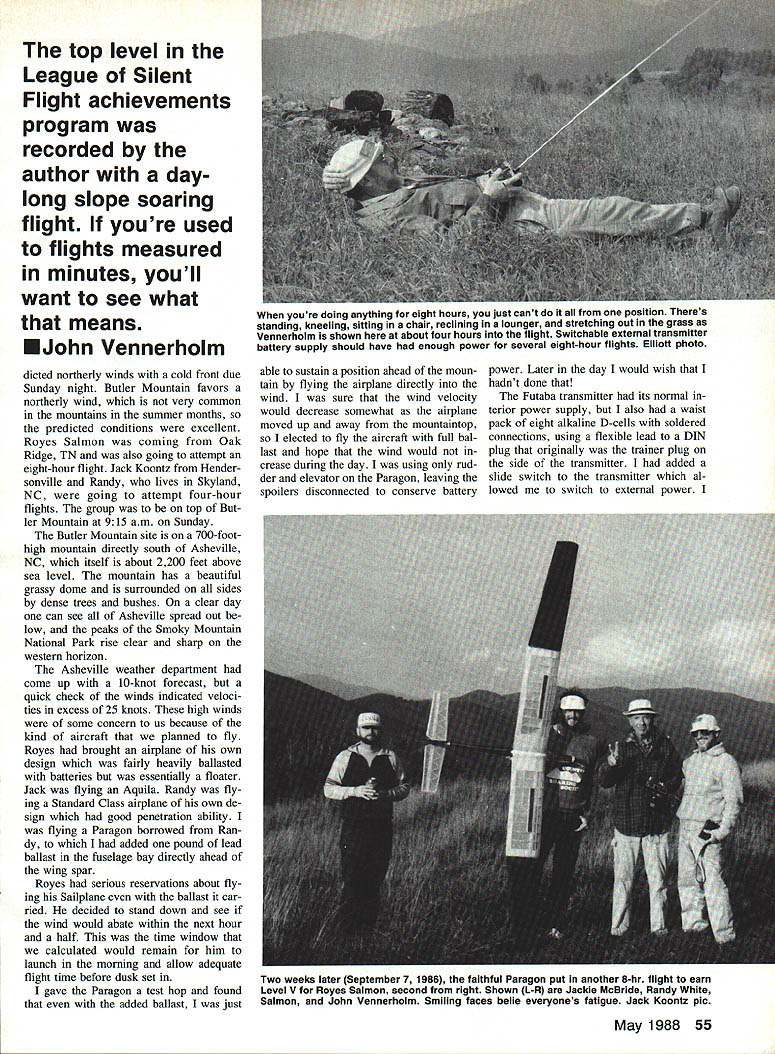
I spent most of the day either sitting in a chair or lounger or just lying in the grass with the transmitter propped on my knees and the tip of the antenna held stationary at a point in the sky. I used the antenna tip as a reference and flew the airplane in a pattern around it. This was a great help in keeping the airplane from wandering. Once in a while I had a problem with signal strength with this antenna orientation.
As I reflect on the flight now that it is complete, I realize that those of us who have made an eight-hour flight experienced something unique. We had the opportunity to watch the sky continuously for an entire day with no interruption. That day I watched the sky go from overcast, dark and gray, through various stages of cloud, until it was clear and a brilliant blue. I saw cloud formations grow from nothing into full-sized cumulus and then dissipate. I watched the changing sunlight color the sky with warm, many-hued tones. I saw all of this as one continuous visual experience from 10:30 in the morning until 6:30 in the evening—one of the most interesting aspects of the entire flight. All pilots have watched clouds form and watched the sky, but how many have actually seen it evolve through an entire day without missing a single thing? Many will call it complete physical and mental anguish. I think it was a fascinating experience.
The wind became a worrisome factor during the sixth hour when it began to subside. I was unable to keep the heavily loaded Paragon more than about 400 feet in the air for a long time.
Finally the seven-hour mark came, and it was then just a matter of counting those long 60 minutes. Royes was still doing his calculations of percent, and his attempts to keep me alert were a great help. The flight from seven to seven and a half hours was very, very long. During this period the wind increased and I was able to fly the airplane once again to an extremely high altitude. I would lose sight of the stabilizer and realize I was too tired to judge the rate at which the airplane was climbing. I remember asking Royes if I should come down. He said, "Stay up." I said, "But Royes, maybe it's getting too high." He said, "Stay up." Every time I asked if he thought I should come down, he'd just say, "Stay up." I was so tired then that I absolutely could not make a judgment as to whether I should come down or how high the plane really was. Of course, Royes was correct. If you have altitude, don't throw it away. The wind can die without warning late in the day, and every foot of altitude can become precious.
Soon my friends began counting down the time remaining to the end of the flight. At 10 minutes to go I thought, "Wow—I can handle this!" They counted me down minute by minute, and then I was racing through the last 60 seconds. Finally they announced eight hours! Everybody cheered (probably because they could finally go home).
The landing
It was time to bring the airplane down very carefully, because even though I had stayed up eight hours, the landing had to be within 200 meters of the launch point. If it wasn't, the whole flight would be wasted. When I stood up from the lounger where I had been sitting for the past two and a half hours, I was so unsteady that Royes had to hold my shoulder and literally keep me from falling over. We walked backwards from where we had been sitting—with Royes leading me just as though I were a beginner at my first thermal contest. I didn't feel comfortable taking my eyes from the airplane and looking down at the ground, changing focus as I walked backwards and turned. My reflexes were very, very slow.
The Paragon didn't have spoilers and was rather heavily loaded with ballast. It was coming in at a pretty high velocity. Since final approach was downhill, the Paragon encountered a strong ground effect and began to accelerate. In this situation the airplane would zoom right past and go off the front of the mountain again. I was too tired to face another approach and knew I had to put the airplane down on the first try. I pushed down elevator and blasted into the grass.
After winning all those tough contests and after all the practice I had making landings for Levels I and II, my last task for Level V resulted in an upside-down landing! Someone was trying to remind me of something. However, the airplane was finally down at my feet after eight hours and two minutes. All that remained then was to get the voucher signed and let Brett Elliott complete his photographic efforts.
Aftermath and thanks
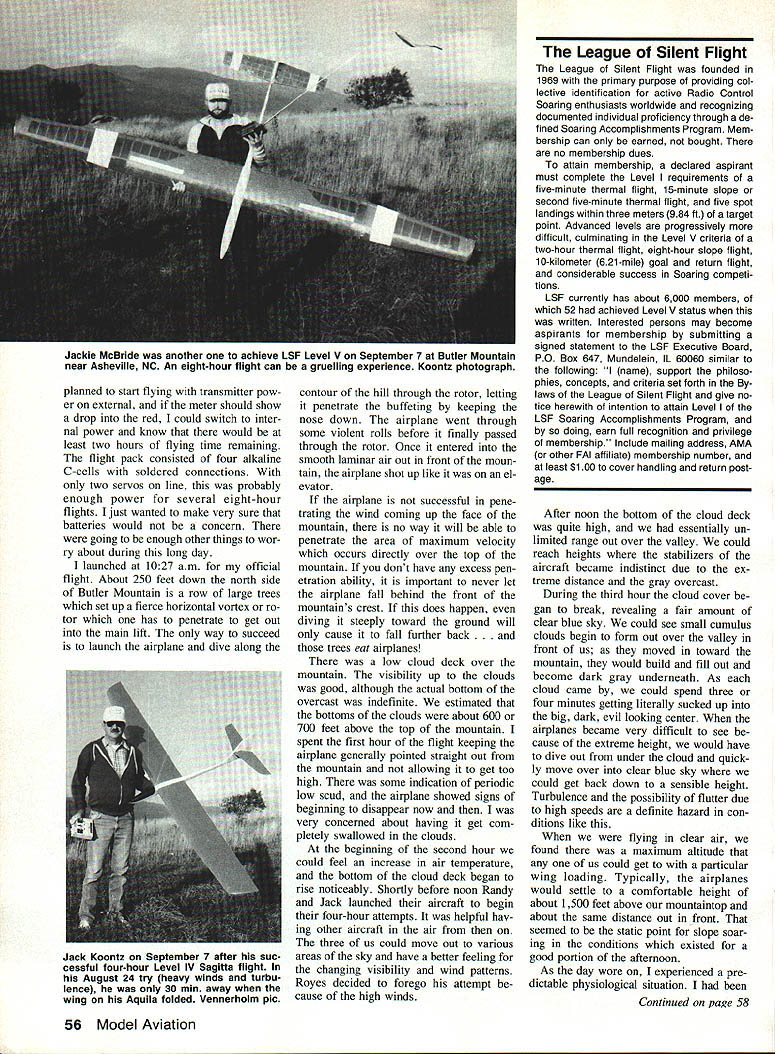
As a postscript, I am pleased to report that two weeks later at the same site Royes Salmon and Jackie McBride, also from Oak Ridge, TN, flew their eight-hour tasks for Level V, and Jack Koontz successfully flew his Level IV four-hour task.
I owe a big debt of gratitude to all those who helped me achieve Level V, and I am pleased to share my experiences to perhaps encourage some of you to continue until you have your Level V as well. It seems that once someone completes a difficult task, others become encouraged to try. That is the real spirit of modeling. For those of you who still look forward to your eight-hour flight, perhaps some of my experiences may help you prepare for that day when you climb a mountain somewhere and throw your favorite bird clean off into another world.
Good luck and lift!
Transcribed from original scans by AI. Minor OCR errors may remain.

