
The LSF Regional Tournament
Flown at 12 different flying sites across the United States and Canada on August 26–27, the biggest ever gathering of eagles attracted over 600 entries. Twelve sites across the USA and Canada saw 615 entries in what has to be the largest soaring event ever. Ten regions held a similar event last year and total entries topped 500. This year’s event was planned as part of a two‑year program with the qualifiers from each region eligible to compete next summer in the LSF Championships.
This year the LSF ran the Two‑Meter event up the soaring flagpole for the first time and 132 members saluted. The entry rules stated one could enter Standard or Unlimited class, plus the Two‑Meter class. This no doubt steered many toward the latter event and it gave the two‑meter birds a shot in the arm. One could also enter Scale in addition to the other classes; the event saw 65 entries, up slightly from last year.
To qualify for next year’s championships, League secretary Warren Tiahrt announced that if one finished first or second in Standard or Unlimited the flier would be eligible. If one finished first in Two‑Meter, Scale, or Junior, that result would also qualify the flier. However, if 20 percent of the entries per class exceeded the figures above, then 20 percent of each class would qualify. In addition, all six LSF Level V members were automatically eligible.
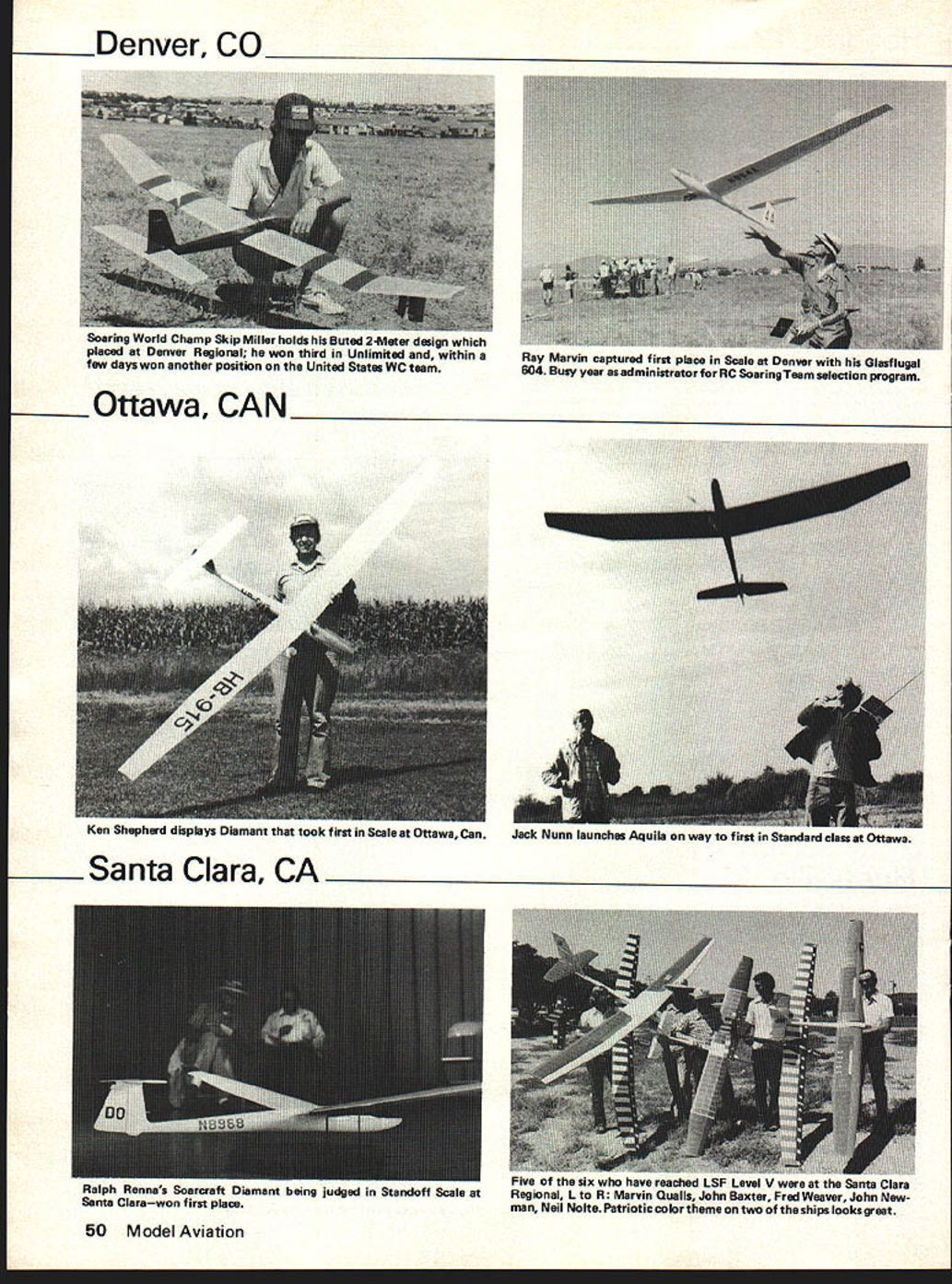
California, because of its large soaring interest, was broken into three regionals and they netted 183 entries. Bob DeMattei CDed and the South Bay Soaring Society hosted the one in Santa Clara—a contest which saw five of the six Level V members in attendance. Three finished 1–2–3 in Unlimited—John Baxter, John Newman, and Fred Weaver. All the winners were from California.
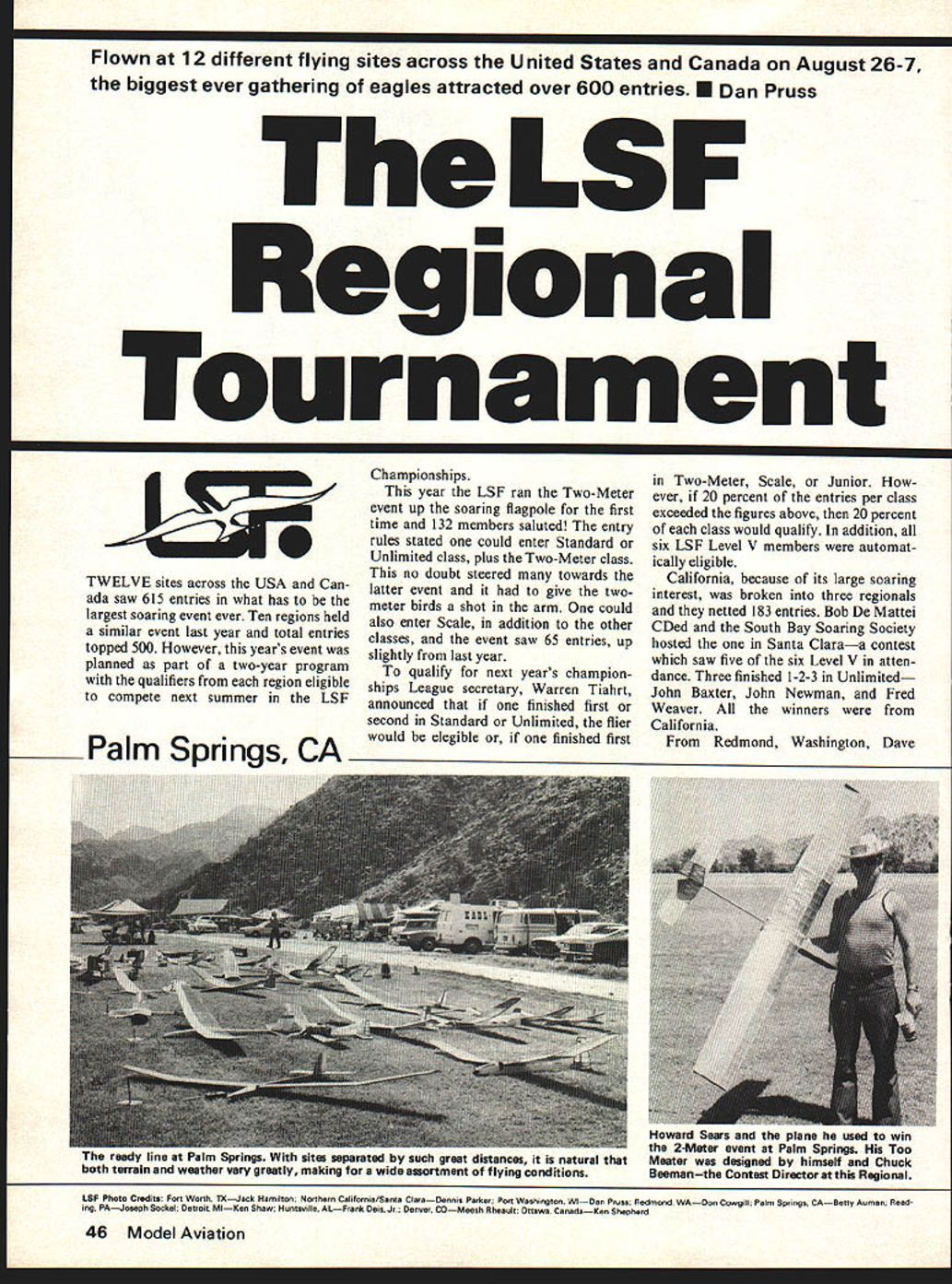
Palm Springs, CA
Harvey claims they had the largest regional in the world! Contestants came from Anchorage, Alaska; Eugene, Oregon; and Calgary, Alberta. Distances traveled ranged from 25 to 2,500 miles. Larry Rice’s trip from Anchorage was worth it—he won Standard class, and Robert Yuchevich from Canada won Scale. The best technical achievement went to Mike Freeman for a computerized scoring system that was described in this column last month.
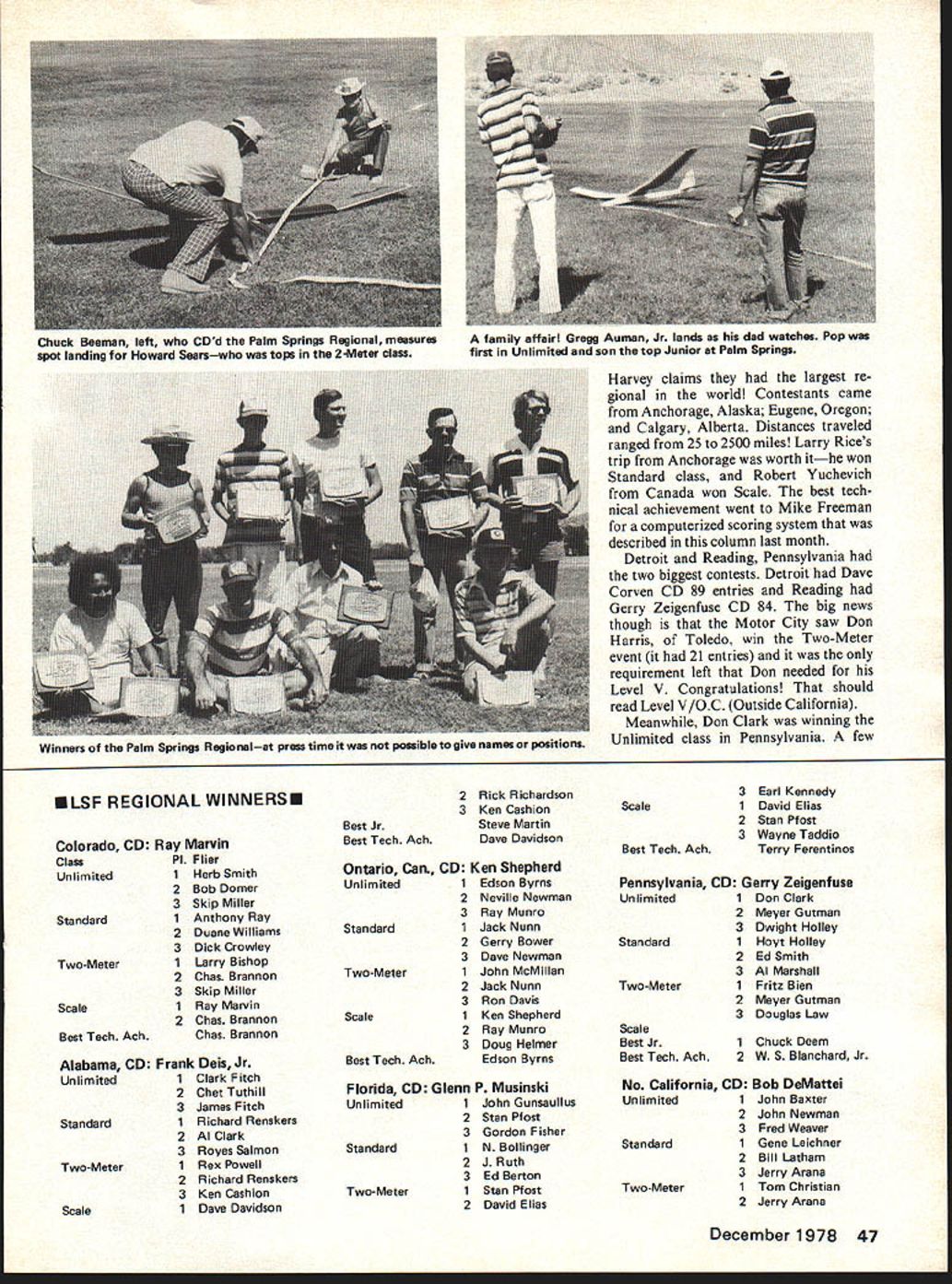
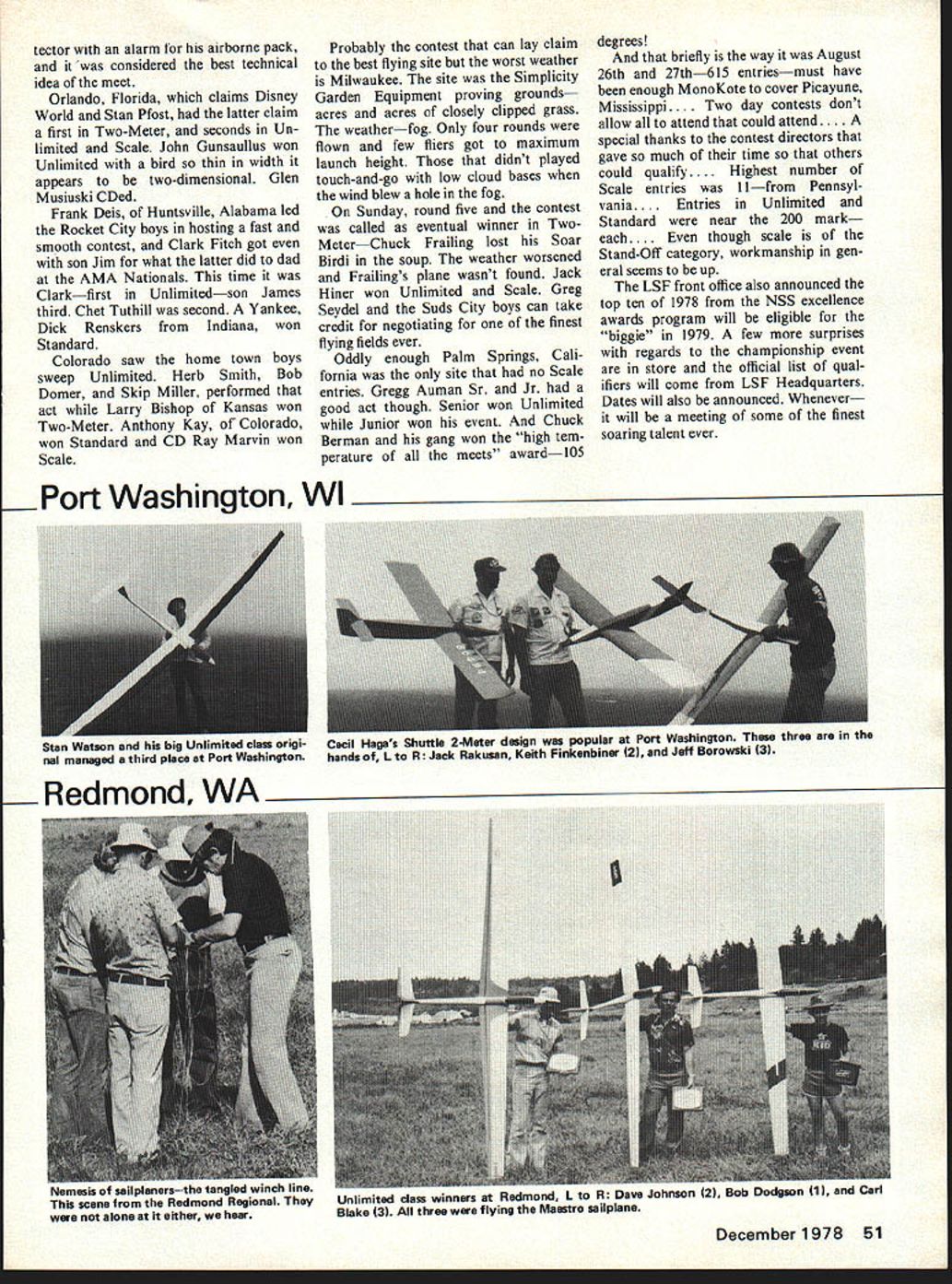
Oddly enough, Palm Springs was the only site that had no Scale entries. Gregg Auman Sr. and Jr. put on a good show: Senior won Unlimited while Junior won his event. Palm Springs also won the “high temperature of all the meets” award—105 degrees!
Detroit, MI and Reading, PA
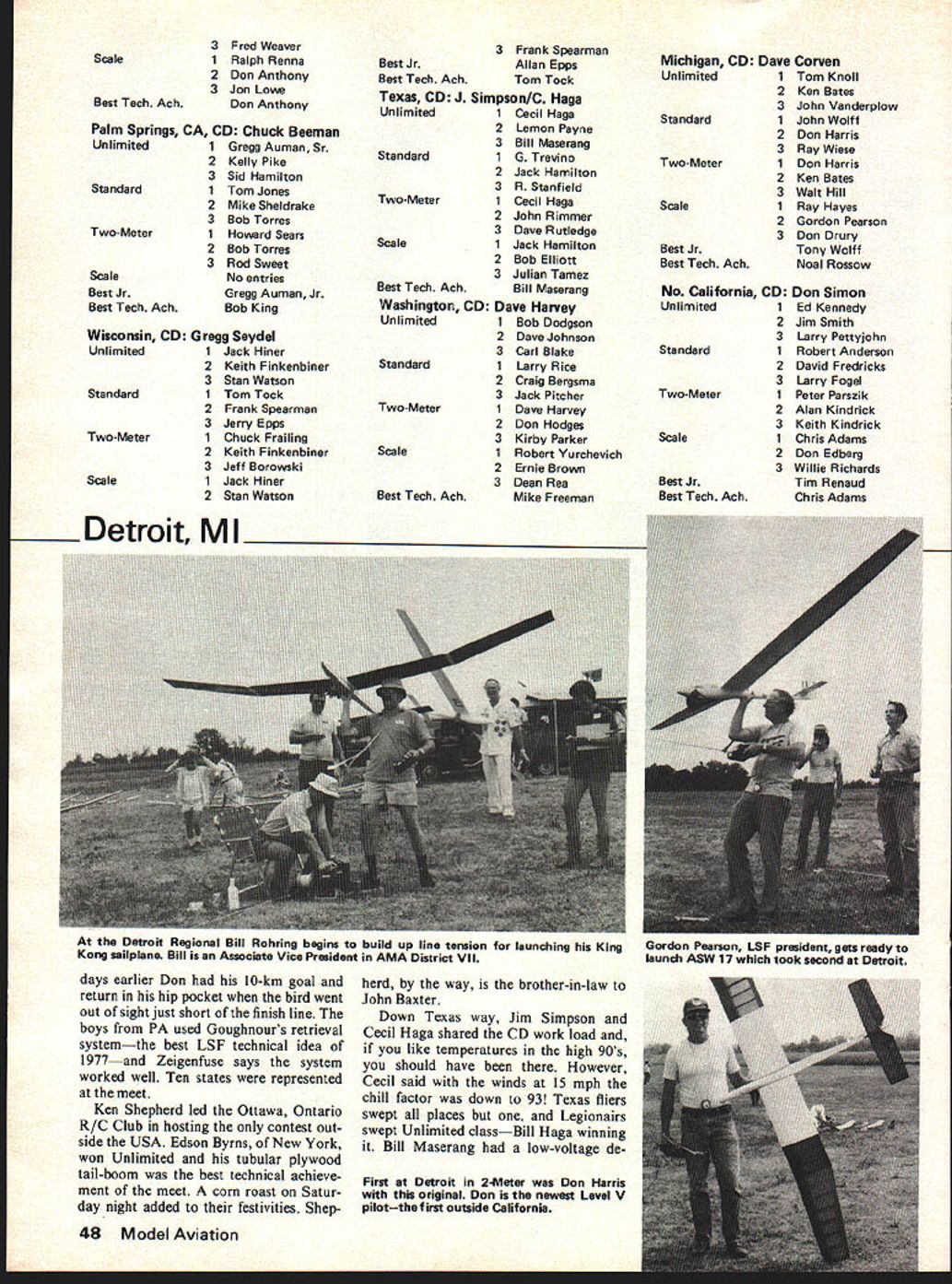
Detroit and Reading, Pennsylvania had the two biggest contests. Detroit, with Dave Corven as CD, drew 89 entries and Reading, CDed by Gerry Zeigenfuse, had 84. The big news was that the Motor City saw Don Harris, of Toledo, win the Two‑Meter event (it had 21 entries); that victory completed the remaining requirement Don needed for his Level V (outside California). Congratulations!
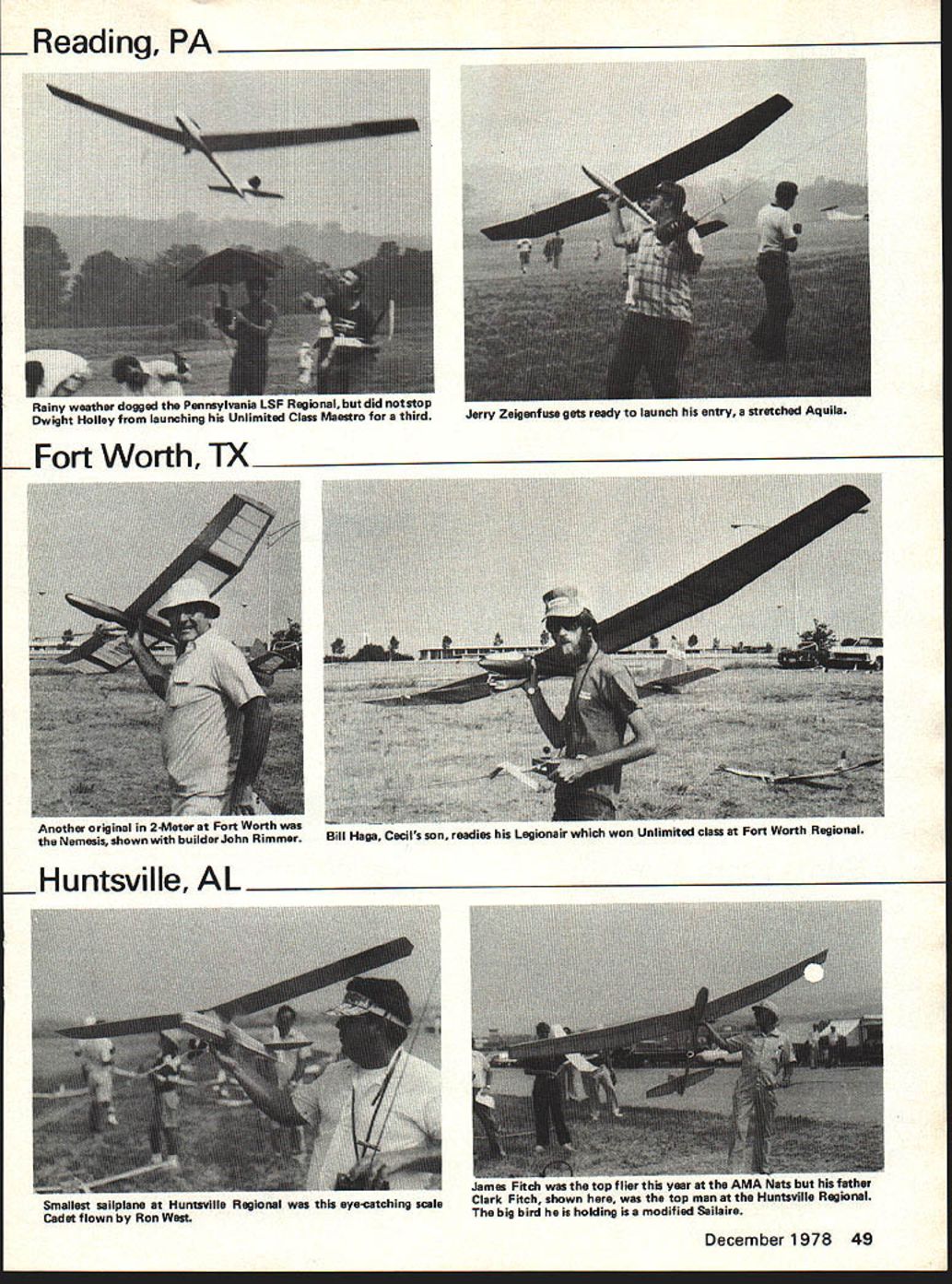
In Pennsylvania, Don Clark was winning the Unlimited class. A few days earlier Don had his 10‑km goal and return in his hip pocket when the bird went out of sight just short of the finish line. The Pennsylvania boys used Goughnour’s retrieval system—the best LSF technical idea of 1977—and Zeigenfuse says the system worked well. Ten states were represented at the meet.
Ottawa, Ontario
Ken Shepherd led the Ottawa R/C Club in hosting the only contest outside the USA. Edson Byrns, of New York, won Unlimited and his tubular plywood tail‑boom was judged the best technical achievement of the meet. A corn roast on Saturday night added to the festivities. Shepherd, by the way, is the brother‑in‑law of John Baxter.
Texas
Down Texas way, Jim Simpson and Cecil Haga shared the CD workload. If you like temperatures in the high 90s, you should have been there; Cecil joked that with the winds at 15 mph the chill factor was down to 93! Texas fliers swept all places but one, and Legionairs swept Unlimited class—Bill Haga won it. Bill Maserang had a low‑voltage detector with an alarm for his airborne pack, and it was considered the best technical idea at that meet.
Orlando, Florida
Orlando, which claims Disney World and Stan Pfost, had Pfost claim a first in Two‑Meter, and seconds in Unlimited and Scale. John Gunsaullus won Unlimited with a bird so thin in width it appeared two‑dimensional. Glen Musiuski CDed.
Huntsville, Alabama
Frank Deis of Huntsville led the Rocket City boys in hosting a fast and smooth contest. Clark Fitch got even with son Jim for what the latter did to dad at the AMA Nationals: Clark finished first in Unlimited and son James was third. Chet Tuthill was second. A Yankee—Dick Renskers from Indiana—won Standard.
Colorado
Colorado saw the hometown boys sweep Unlimited. Herb Smith, Bob Domer, and Skip Miller performed that act while Larry Bishop of Kansas won Two‑Meter. Anthony Kay, of Colorado, won Standard and CD Ray Marvin won Scale.
Milwaukee, WI
Probably the contest that can lay claim to the best flying site but the worst weather was Milwaukee. The site was the Simplicity Garden Equipment proving grounds—acres and acres of closely clipped grass. The weather was fog. Only four rounds were flown and few fliers got to maximum launch height. Those that didn’t played touch‑and‑go with low cloud bases when the wind blew a hole in the fog.
On Sunday, after round five, the contest was called as eventual winner in Two‑Meter—Chuck Frailing—lost his Soar Bird in the soup. The weather worsened and Frailing’s plane wasn’t found. Jack Hiner won Unlimited and Scale. Greg Seydel and the Suds City boys can take credit for negotiating one of the finest flying fields ever.
And that briefly is the way it was August 26 and 27—615 entries. There must have been enough MonoKote to cover Picayune, Mississippi. Two‑day contests don’t allow all who could attend to do so. A special thanks to the contest directors who gave so much of their time so that others could qualify. The highest number of Scale entries from one region was 11—from Pennsylvania. Entries in Unlimited and Standard were near the 200 mark each. Even though Scale is of the stand‑off category, workmanship in general seems to be up.
The LSF front office also announced the top ten of 1978 from the NSS excellence awards program will be eligible for the “biggie” in 1979. A few more surprises with regards to the championship event are in store and the official list of qualifiers will come from LSF Headquarters. Dates will also be announced. Whenever it happens—it will be a meeting of some of the finest soaring talent ever.
Transcribed from original scans by AI. Minor OCR errors may remain.

