
LSF Tournament
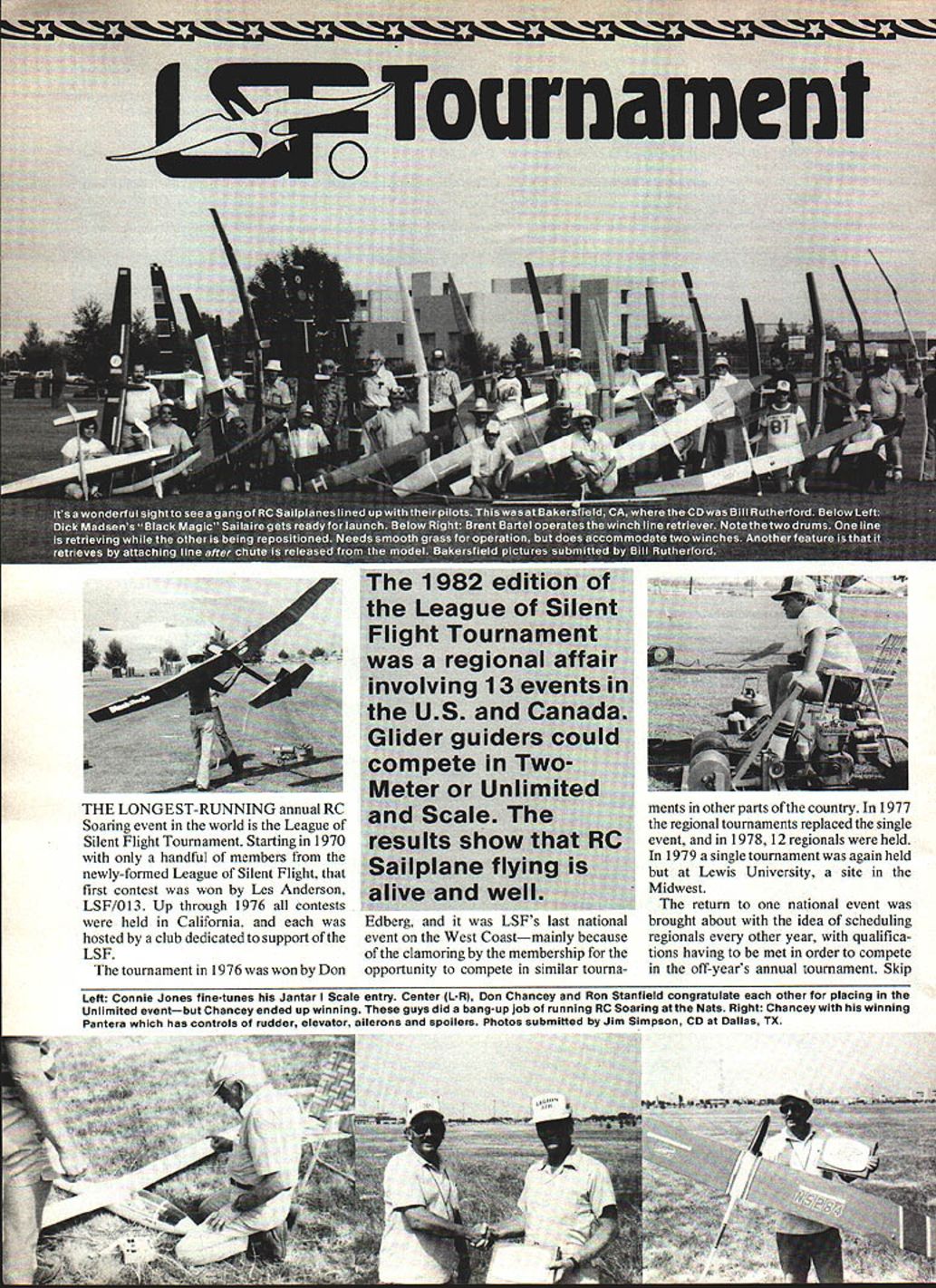
The League of Silent Flight Tournament is the longest-running annual RC soaring event in the world. The first contest was held in 1970 with a handful of members of the newly formed League of Silent Flight; it was won by Les Anderson (LSF/013). Through 1976 the contests were held in California and hosted by clubs dedicated to supporting the LSF.
In 1976 Don Edberg won the tournament; that was LSF's last national event on the West Coast for a while, as members clamored for opportunities to compete in other parts of the country. In 1977 regional tournaments replaced the single-site national event. In 1978 twelve regionals were held. A single national tournament returned in 1979, held at Lewis University in the Midwest (Miller won in 1979). Fourteen regionals were run in 1980, producing the field for the 1981 event, which crowned Ken Bates as grand champion. The LSF’s five-day, multi-task format continued to be the standard.
1982 Regionals
The 1982 schedule returned to regionals. Thirteen clubs volunteered to host events across the U.S. and Canada. Categories were Unlimited, Two-Meter, and Scale; a flier could enter either Unlimited or Two-Meter (or both). Entry counts that year were:
- Two‑Meter: 66 entrants
- Unlimited: 325 entrants
- Scale: 36 entries
- Junior-Senior: 18 entrants
One surprising result: Two‑Meter drew a strong field of 66 entrants. Scale entries (36) showed the class was still healthy. Some Junior‑Senior performances suggested the separate age category still had merit.
Hosts and Contest Directors (selected)
- California (three contests):
- Anaheim — John Brown, CD
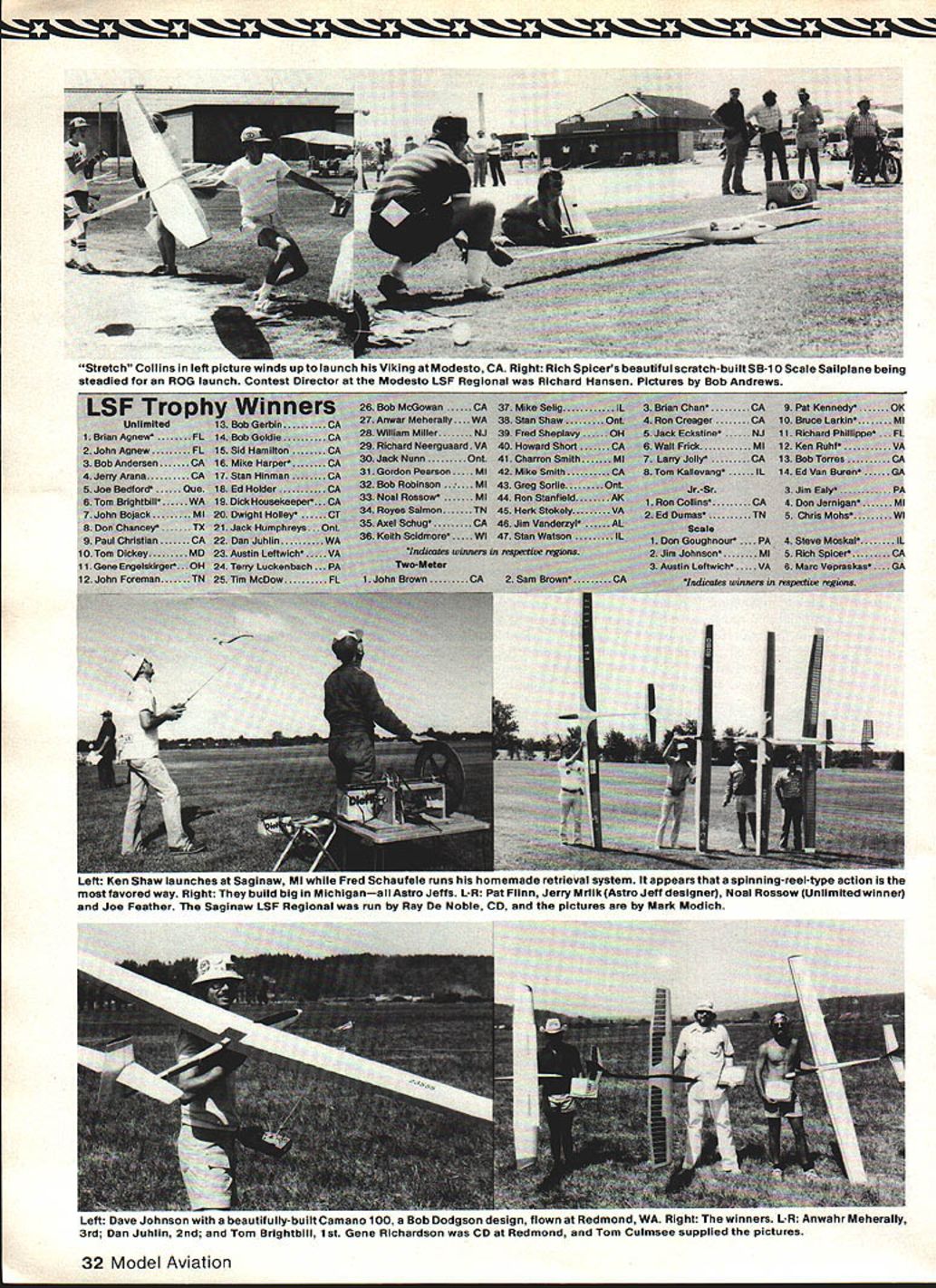
- Modesto — Richard Hansen, CD
- Bakersfield — Bill Rutherford, CD
- Washington State — Gene Richardson, CD
- Florida — Frank Collins, CD
- Fort Lee, VA — Ken Ruhf, CD
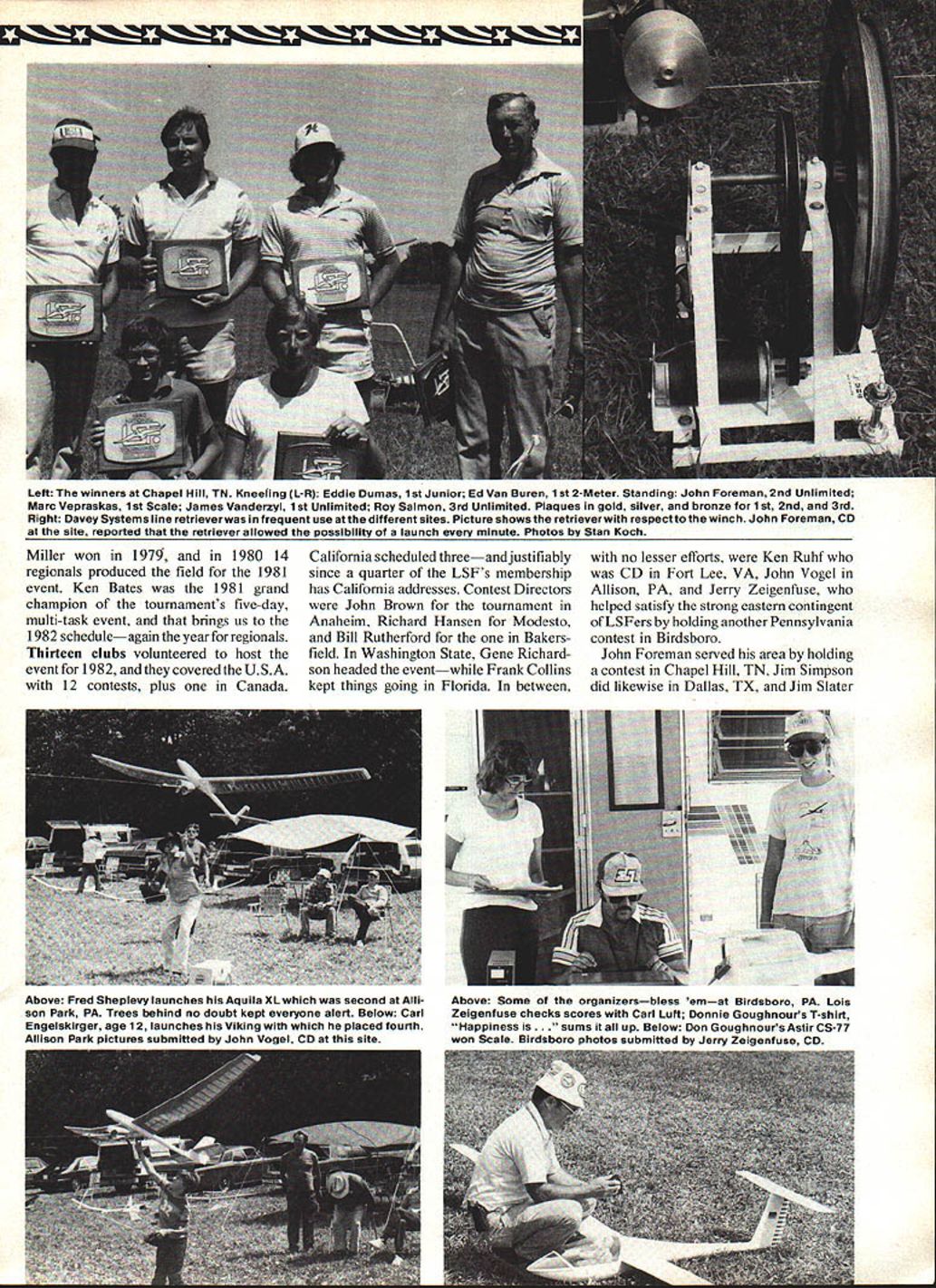
- Allison (Allison?), PA — John Vogel, CD
- Birdsboro, PA — Jerry Zeigenfuse, CD
- Chapel Hill, TN — John Foreman, CD
- Dallas, TX — Jim Simpson, CD
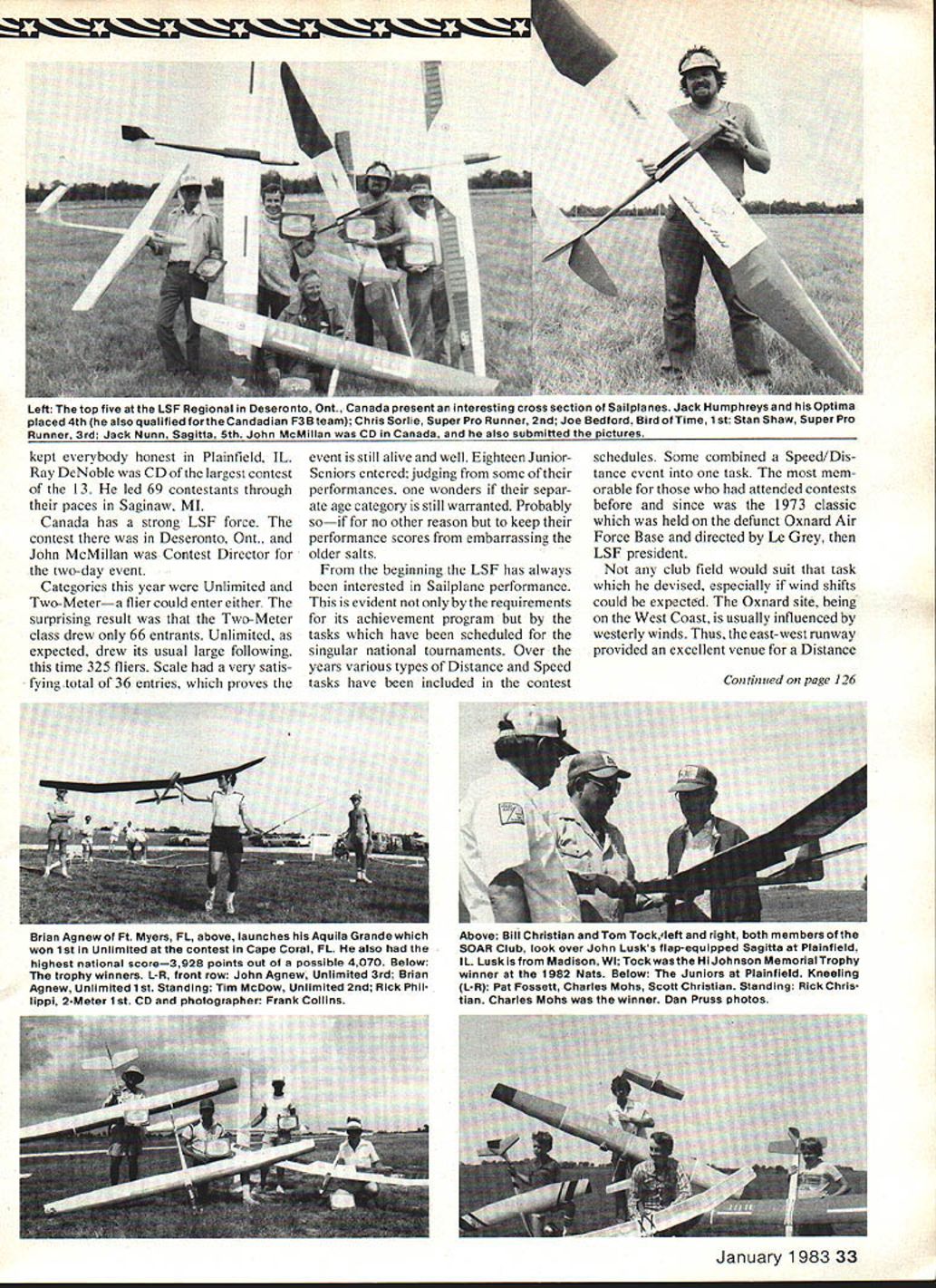
- Plainfield, IL — Ray DeNoble, CD (largest contest: 69 contestants)
- Saginaw, MI — (organized by Jim Slater; strong turnout)
- Deseronto, Ontario, Canada — John McMillan, CD (two-day event)
Competition tasks and scoring
LSF tournaments have long emphasized sailplane performance, with a variety of Distance and Speed tasks used over the years. Memorable among these was the 1973 Oxnard Distance/Speed classic, where fliers flew a quarter mile upwind, returned over the launch area, flew a quarter mile downwind, then returned—covering a mile without leaving the launch spot. The task combined distance and speed and required lift or thermals to complete.
By 1982 most regionals included Duration and Spot Landing tasks, favored for ease of organization and contestant popularity. Typical 1982 tasks included:
- Six‑minute Duration openers (Saturday and Sunday morning)
- Three 10‑minute Duration tasks on Saturday
- Two 10‑minute Duration tasks on Sunday
- A simple in-or-out landing zone worth 50 points
With that schedule a contestant could score a maximum of 4,070 points (in sites using the six‑minute opener; one regional did not include the six‑minute task and was excluded from some listings).
Notable results and highlights
- Highest national score (overall): Brian Agnew, Fort Myers, FL — 3,928 points (Aquila Grande)
- Two‑Meter top score: Larry Jolly, Santa Ana, CA — 3,270 points (Icarus)
- Top Scale score: Rich Spicer, San Jose, CA — 189.2 points (scratch-built SB-10)
- Top Junior‑Senior: Ed Dumas, Knoxville, TN — 2,845 points (Sagitta)
Sidelights from the regionals:
- Bakersfield: Bill Rutherford’s contest produced multiple perfect flights in early rounds. Sid Hamilton and Dick Housekeeper logged several perfect 650-point flights across rounds.
- Plainfield: Billy Sutherland recorded perfect scores with his first two flights, including landings.
- Winch retrieval systems are increasingly common. At Saginaw, two winches allowed organizers to launch over 400 flights in 13 hours.
- All four LSF officers attended the Saginaw contest as contestants.
Awards and qualifications
- Roughly the top 50% of the final standings per category per site were eligible to compete in Tournament 1983, scheduled again for the Joliet Airport in Illinois.
- Top scorers at each regional received prestigious LSF plaques; the number of plaques awarded at each site followed a formula based on entries.
LSF news and developments
- Tournament 1983 (tentative) was scheduled for the week of August 21. Plans announced by League President Warren Plohr included a two-day combined Distance/Speed task followed by three days of Duration; Scale would be included. Qualifiers from the 1982 regionals would be advised of details. Contestants could enter either or both events. Also invited were regional Contest Directors, all LSF Level V holders, and finalists of the F3B U.S.A. Team Selection Program.
- Four new Level V designations were earned in 1982: Otto Heithecker (returning to RC after a five-year break), Jim Bohmer, Warren Plohr, and Bob Steele. With roughly 4,898 members at the time, Level V remained a select group.
Closing
There is pride in displaying LSF colors and in supporting the League. For a dues-free organization, these tournaments have propagated RC soaring and provided revenue to support league activities. On behalf of nearly 5,000 members from almost 30 countries, LSF President Warren Plohr saluted the 13 clubs and their Contest Directors for providing this service.
Membership forms for the League of Silent Flight may be obtained by sending a stamped, self-addressed envelope to:
League of Silent Flight Box 39068 Chicago, IL 60639
Good lift.
Transcribed from original scans by AI. Minor OCR errors may remain.

