
LUCKY 14
Piotr Zawada
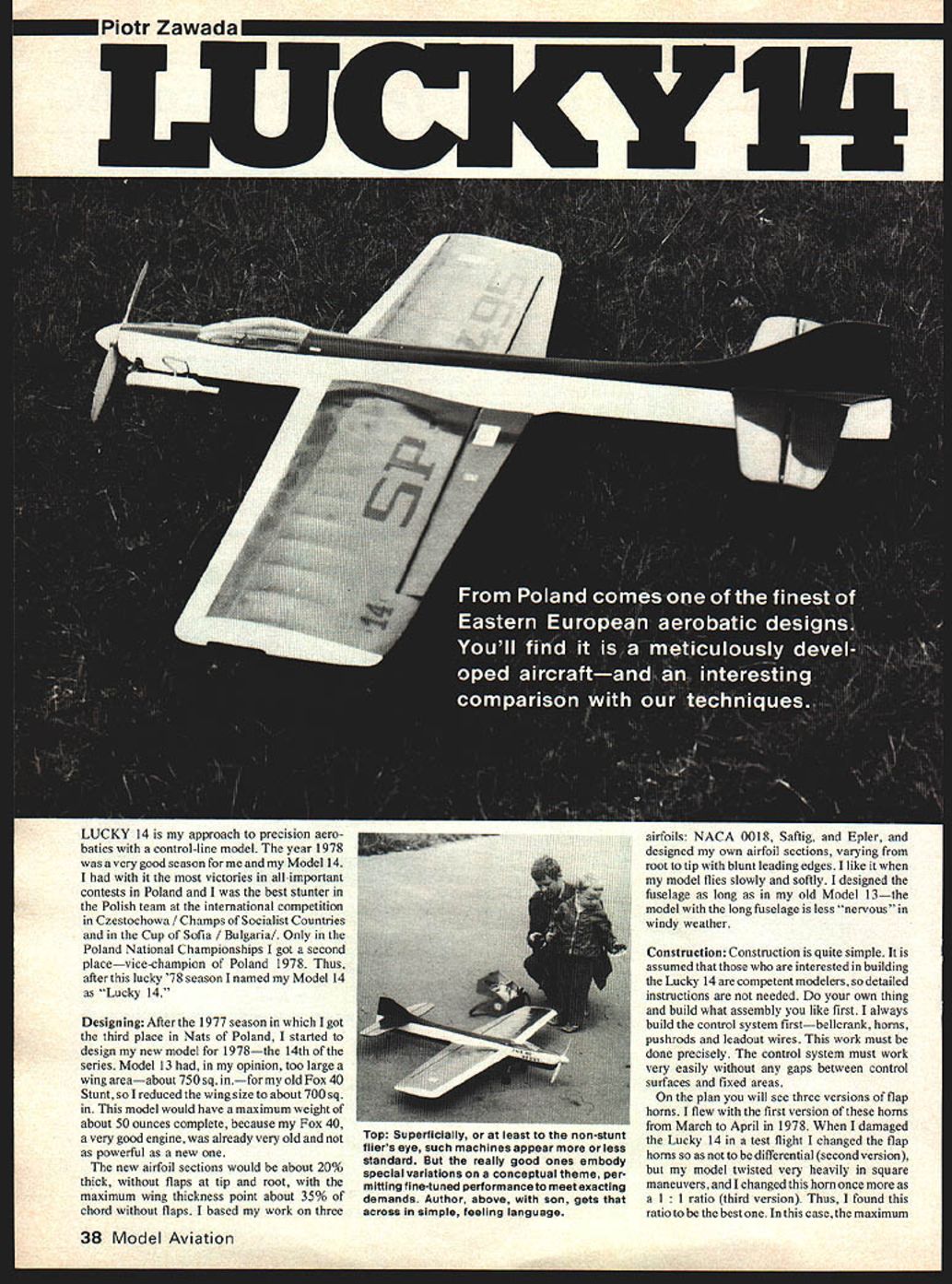
LUCKY 14 is my approach to precision aerobatics with a control-line model. The year 1978 was a very good season for me and my Model 14. I had the most victories in all-important contests in Poland and I was the best stunter on the Polish team at the international competition in Czestochowa (Champs of Socialist Countries) and in the Cup of Sofia (Bulgaria). Only in the Poland National Championships did I place second—vice-champion of Poland, 1978. Thus, after this lucky 1978 season I named my Model 14 "Lucky 14."
Designing
After the 1977 season, in which I took third place in the Nats of Poland, I started to design my new model for 1978—the 14th of the series. Model 13 had, in my opinion, too large a wing area (about 750 sq. in.) for my old Fox .40 Stunt, so I reduced the wing size to about 700 sq. in. The model would have a maximum weight of about 50 ounces complete, because my Fox .40, a very good engine, was already very old and not as powerful as a new one.
The new airfoil sections would be about 20% thick, without flaps at tip and root, with the maximum wing thickness point about 35% of chord. I based my work on three airfoils—NACA 0018, Saftig, and Epler—and designed my own sections, varying from root to tip with blunt leading edges. I like it when my model flies slowly and softly. I designed the fuselage as long as in my old Model 13—the model with the long fuselage is less "nervous" in windy weather.
Construction
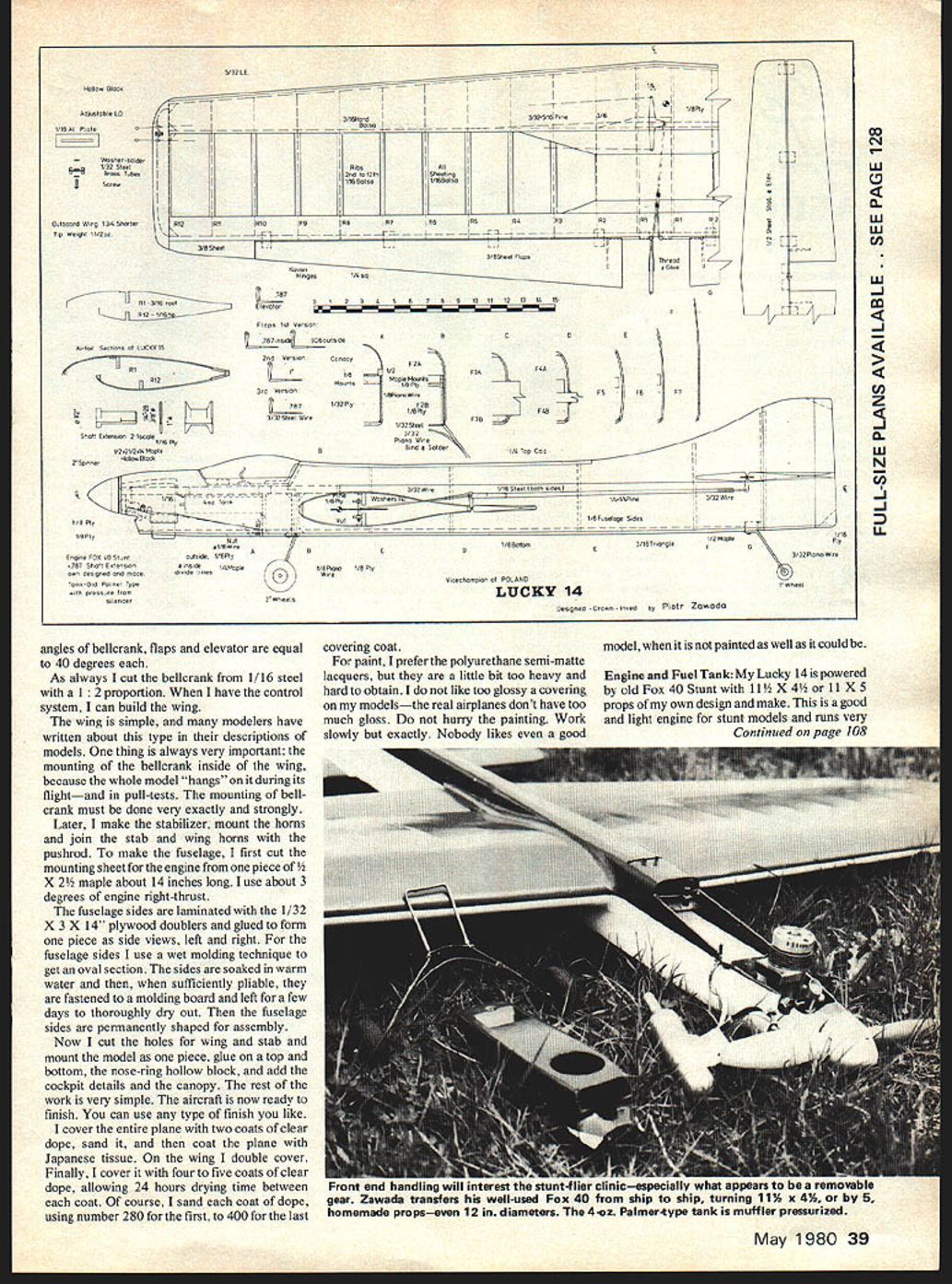
Construction is quite simple. It is assumed that those who are interested in building the Lucky 14 are competent modelers, so detailed step-by-step instructions are not needed. Do your own thing and build in the order you prefer. I always build the control system first—bellcrank, horns, pushrods, and leadout wires. This work must be done precisely. The control system must work very easily without any gaps between control surfaces and fixed areas.
On the plan you will see three versions of flap horns:
- First version: flown March–April 1978.
- Second version: changed to be non-differential after a test-flight damage; this caused heavy twisting in square maneuvers.
- Third version: 1:1 ratio horn; this proved to be the best.
Angles of bellcrank, flaps, and elevator are equal—40 degrees each.
As always, I cut the bellcrank from 1/16-in. steel with a 1:2 proportion. Once I have the control system, I build the wing.
The wing is simple, and many modelers have written about this type. One thing is always very important: the mounting of the bellcrank inside the wing, because the whole model "hangs" on it during flight—and in pull-tests. The mounting of the bellcrank must be done very exactly and strongly.
Later I make the stabilizer, mount the horns, and join the stab and wing horns with the pushrod. To make the fuselage, I first cut the mounting sheet for the engine from one piece of 1/8 × 2½-inch maple about 14 inches long. I use about 3 degrees of right thrust for the engine.
The fuselage sides are laminated with 1/32 × 3 × 14-in. plywood doublers and glued to form one piece as side views, left and right. For the fuselage sides I use a wet-molding technique to get an oval section. The sides are soaked in warm water and then, when sufficiently pliable, are fastened to a molding board and left for a few days to thoroughly dry out. Then the fuselage sides are permanently shaped for assembly.
Now I cut the holes for wing and stab and mount the model as one piece, glue on a top and bottom, add the nose-ring hollow block, and fit the cockpit details and canopy. The rest of the work is straightforward. The aircraft is now ready to finish. You can use any type of finish you like.
I cover the entire plane with two coats of clear dope, sand it, and then coat the plane with Japanese tissue. On the wing I double-cover. Finally, I apply four to five coats of clear dope, allowing 24 hours drying time between each coat. Of course, I sand each coat of dope, using No. 280 for the first, up to No. 400 for the last covering coat.
For paint, I prefer polyurethane semi-matte lacquers, but they are a little heavy and hard to obtain. I do not like too glossy a covering on my models—the real airplanes don't have too much gloss. Do not hurry the painting. Work slowly but exactly. Nobody likes an otherwise good model that is not painted as well as it could be.
Engine and Fuel Tank
My Lucky 14 is powered by an old Fox .40 Stunt with 11½ × 4½ or 11 × 5 props of my own design and manufacture. This is a good and light engine for stunt models and runs very well with large propellers, even 11- or 12-inch diameter props. I use an old Palmer 4-ounce tank with pressure from the silencer—the orifice is about 1/16 in. The tank is one inch deep with the fuel pick-up in the center, but it is mounted about 1/16 in. above the spray bar for steady inverted running. This helps a little in some maneuvers.
Flying
The first few flights should be made in calm or only light wind. I adjust the height of the fuel tank relative to the spray bar, and the speed of the model in straight flight and in the maneuvers with different props. My model must fly slowly with lap times around 5.6 seconds on 67-ft. lines, and with lap times in inverted flight around 6.4 seconds.
The engine runs must be maximum when the model flies upward (two-cycle) and must change quickly to four-cycle when the model flies downward. Then I adjust the leadout lines to the best point for me during the square maneuvers.
My Future Plans
Of course, the 1980 World Championships in Poland! My next model, the Lucky 15 for the 1979 season, I hope will be even luckier. It is being made to similar dimensions as the Lucky 14, but with new airfoil sections—my own design with greater maximum thickness, because this model will be powered by the ST.46. I include these airfoil sections on the plan.
The tailplane will be made like the tailplane of the Stiletto 660 by Les McDonald, but with the stab covered with 1/16-in. balsa.
If you have any questions or ideas about the Lucky 14, feel free to write to me in care of the editor.
Transcribed from original scans by AI. Minor OCR errors may remain.

