
Macchi-Castoldi M.C.72
FOR A DOZEN YEARS from Lindbergh's transatlantic flight until World War II was about to begin, the fastest airplanes in the world were seaplanes. Not GeeBee racers, not jazzy little Army Air Corps pursuits, not special experimental craft. But water-borne machines with huge pontoons hanging below — a seeming contradiction to everything known about streamlining.
There were two main reasons. The Schneider Trophy became politically important and governments were willing to spend vast amounts of money to develop unlimited racing seaplanes as demonstrations of technology. Also, only endless water runways were long enough for airplanes with the small, high-speed wings needed to take off. In those days 10,000-ft concrete strips were still far in the future, so the penalty paid for pontoons was accepted.
To see two devices almost as large as the fuselage hanging from the belly strikes terror into the heart of the modern designer; they helped considerably with buoyancy and takeoff but they also hurt performance. For several years during the reign of the seaplane the world's fastest landplanes were some 100 mph slower than their waterborne cousins. Thanks to the impetus of the magnificent Schneider Trophy competitions, the United States and other nations started trends that led to sleek monoplanes and advanced military racers.
The Italians were among the most enthusiastic and innovative entrants. Macchi, working from about 1926, to a great extent followed the Curtiss racer tradition but went on to produce some of the most beautiful and potent seaplane racers of the era. No primary article text appears on this page — it contains drawings, diagrams and figure captions only. There is no continuation of the article text to extract. No primary article text appears on this page. pontoons hanging below them in seeming contradiction of all that is known about streamlining.
There were two main reasons for this.
One: The Schneider Trophy had become so politically important that governments were willing to spend vast amounts of money to develop unlimited racing seaplanes as a demonstration of their technology. And, two: Only endless "water runways" were long enough for airplanes with small, high-speed wings to take off from. The days of wide, 10,000-ft. concrete strips for 747's were far in the future.
To get off the water, a penalty had to be paid in the form of pontoons. And while the sight of two devices almost as large as the fuselage, hanging from the belly, strikes terror into the heart of a modern designer, they helped considerably more than they hurt. For several years during the reign of the seaplane, the world's fastest landplane was more than 100 mph slower than the best of its water cousins.
Thanks to the impetus of the magnificent Schneider Trophy, the U.S. had started the trend with a series of Curtiss military racers which led to the ultimate biplanes. The sleek two-wingers dominated the Pulitzer and the Schneider races in the mid-1920's, bringing fame to such as Jimmy Doolittle, whose Curtiss R3C-2 is on display in the National Air & Space Museum. But, no matter how you slice it, biplanes can't be the answer to the ultimate problems of speed. They are stuck with too many parts: struts holding an extra wing, double the needed wing-fuselage joints, and of course that silly second wing. They did offer advantages in reduced weight, but improvements in metals and structural design were about to spell the end of the biplane in the race for all-out speed.
The first to turn theory into reality were the Italians, with the start of what was to become an historic series of racing seaplanes from the Macchi works. The M.39 of 1926 was, to a great extent, a monoplane Curtiss racer. In place of the upper wing with its struts were a few slim wires to brace the thin single wing, placed low on the Curtiss-like fuselage. With Mario de Bernardi as pilot, one of three M.39's won the 1926 Schneider at 264 mph, barely 12 mph slower than the absolute world speed record, set on a straight-away course with a French Ferbois landplane in 1924.
The following year, another name destined for glory was added to the records, when a Supermarine S.5, piloted by S. N. Webster, won the 1927 Schneider at the world record pace of 282 mph, though no official record was set. Little more than a month later, it was de Bernardi again, this time in one of the new Macchi M.52's which failed to finish the 1927 Schneider. His speed of 297.82 mph was the first true, absolute world speed record set by a seaplane.
In 1928, the mark (composed of four passes over a 3-km./1.86-mi. course) was raised to 318.46 mph by de Bernardi in a clipped-wing version of the M.52. The world's fastest landplane was now more than 50 mph behind the times, and fading fast.
The British returned with a vengeance! Waghorn won the 1929 Schneider Race in a new Supermarine S.6 at 329 mph, and then Orlebar set a world 3-km. record of 357.7 mph in the same machine, a few days later.
Where were the Italians? Had they seen the handwriting on the wall, and surrendered to the genius of R. J. Mitchell who was soon to create the immortal Spitfire out of his seaplane experience? Not yet! Macchi had developed the M.67, with power up from the M.52's 1,000-hp Fiat to 1,400 hp from an 18-cylinder, three-bank Isotta Fraschini. But it was to come to naught, as one of the M.67's crashed on a test flight, and the other two failed to finish the 1929 Schneider Race.
Well aware that the 1931 Schneider would be the last in this long and important series if the British succeeded in winning for their third straight time, the men of Macchi set to work to create the cleanest and most powerful airplane the world had ever seen. To achieve this, they had to go to a radical design, since the conventional ideas had pretty well been taken to their practical limits. This, in turn, stretched out the development period far beyond the 1931 Schneider and allowed the British to win it without opposition and retire the trophy to the lobby of the Royal Aero Club in London.
While the Italians were following their route, others were attacking the 3-km. world speed record in their own ways. Across the Atlantic, in America, the military had pulled out of the speed race, leaving it wide open to civilians. And this meant the marvelous home-made machines that were thrilling the nation in the National Air Races. Craft like the barrel-shaped GeeBee and the more conventional Wedell-Williams were straining their poor little hearts out, trying to hit 300 mph in the Shell Speed Dash.
But this was small-time stuff to the men who were thinking in terms of 400 mph in seaplanes. And the 1,000-hp P&W Wasps which had the American racing scene excited were mere toys compared with the Rolls Royce and Fiat engines which their European counterparts were using. And which obviously were needed to reach the strange new world of 400 mph.
There were two basic routes which could be followed to greater speed: Radical airframes or radical powerplants. It was clear that some major changes would have to be made if the Italians were ever to beat the 358 mph of the 1900-hp Supermarine. Radical racers had never been very successful in the past, and they still aren't. The 1929 Piaggio P.c.7 racer might have been a real record-breaker, with its retractable hydrofoils in place of pontoons, but it never flew. The contemporary Savoia Marchetti S.65 was a twin-boom affair with 1000-hp engines in either end of the central pod, but it was never de-bugged enough to show its potential.
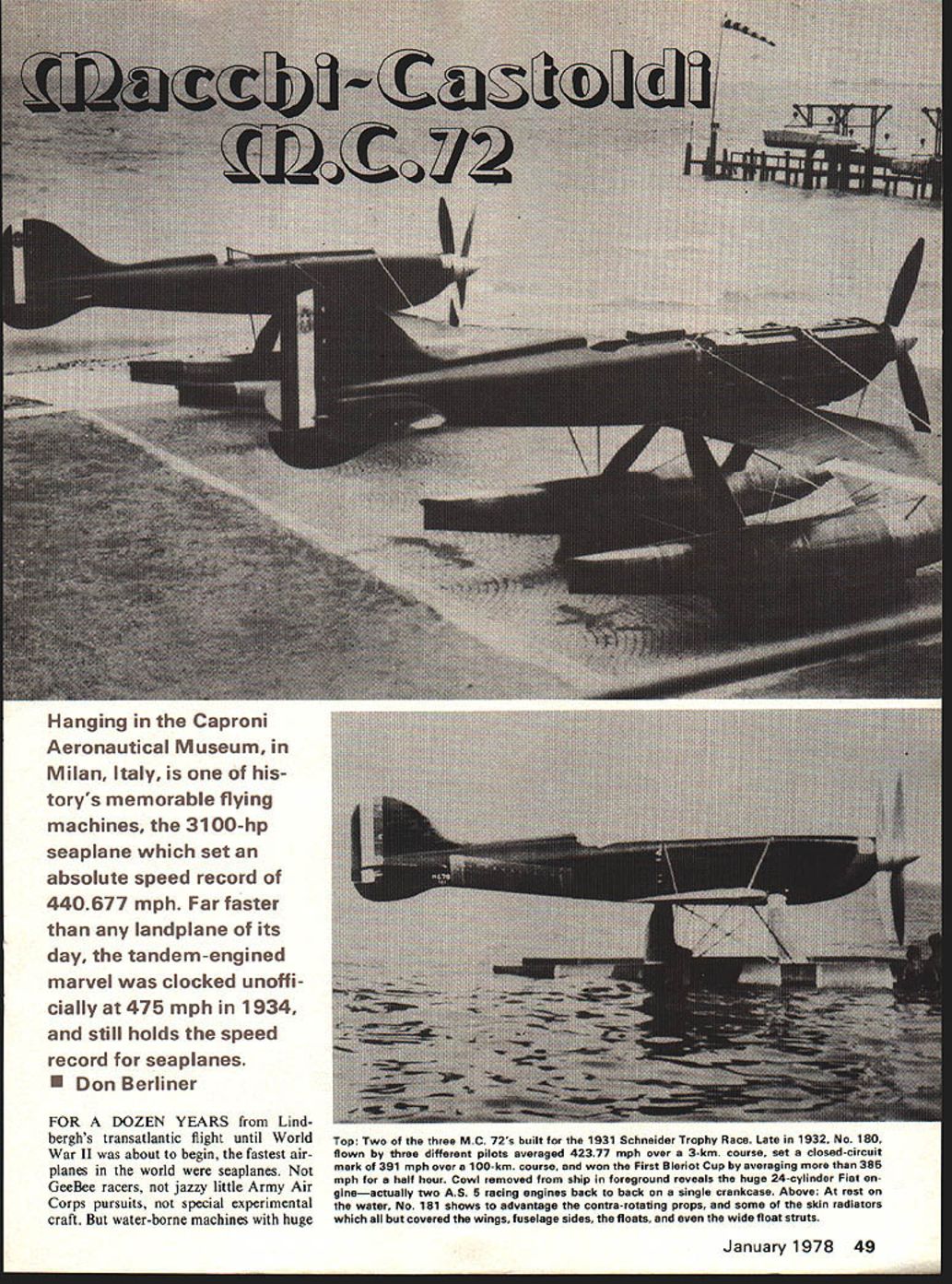
Still, the idea of two engines in one fuselage appealed to the Macchi works. It was one way to combine greatly increased power with the limited drag of a single-engined airplane. Together with the Fiat Company which had built the type A.S.5 engine used in previous successful seaplane racers, Macchi created the ultimate in watercraft, the Macchi-Castoldi M.C.72.
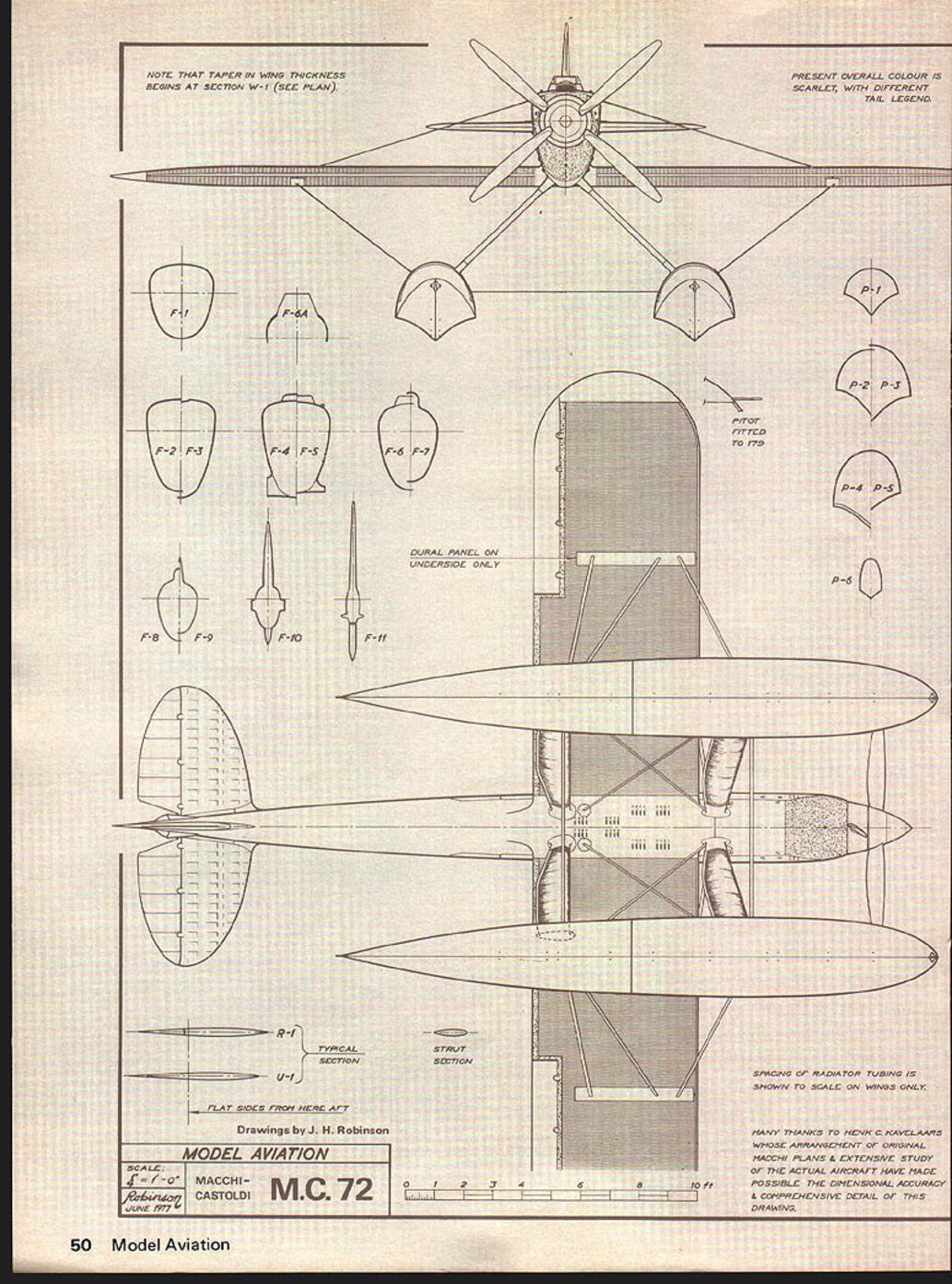
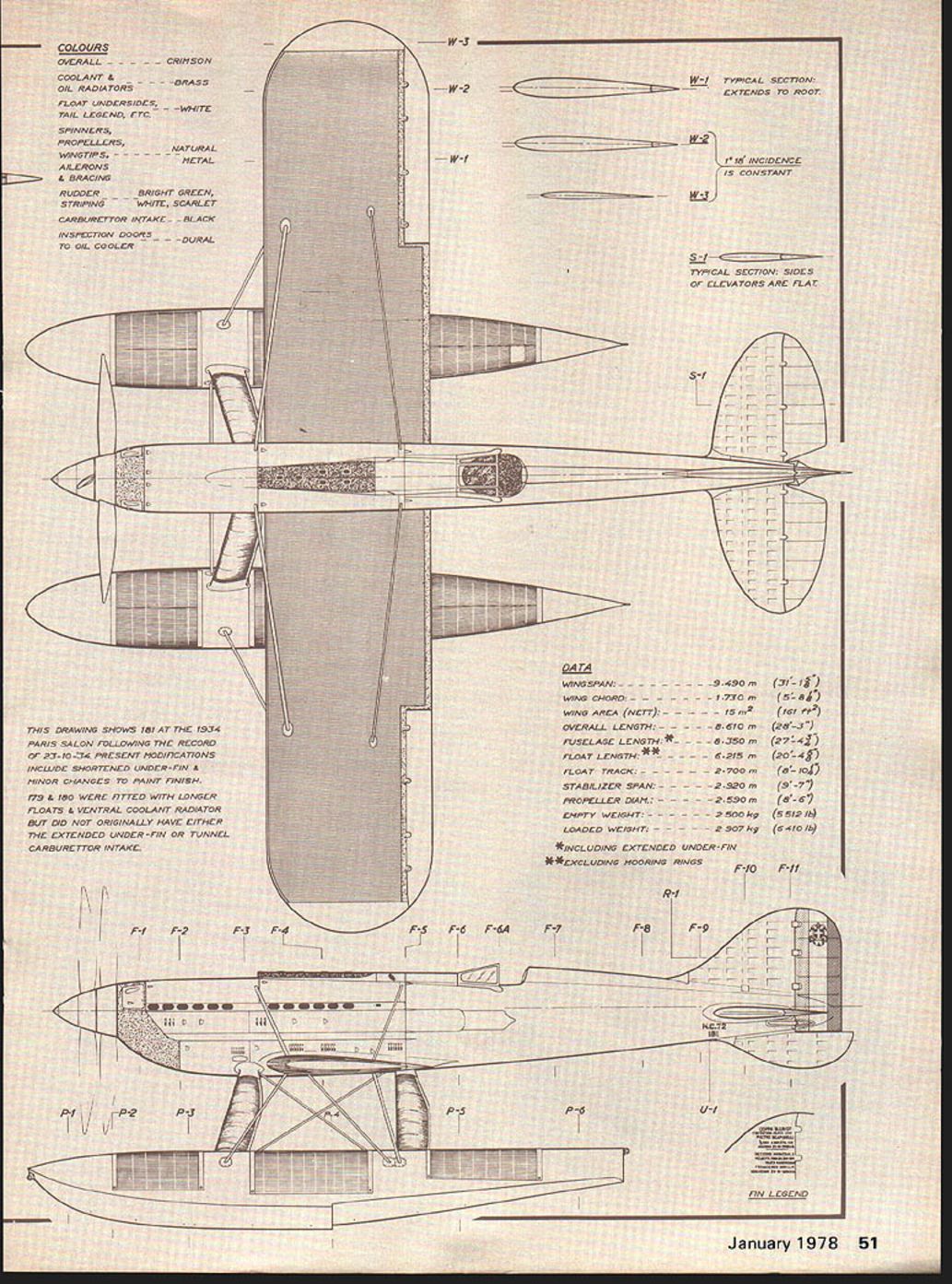
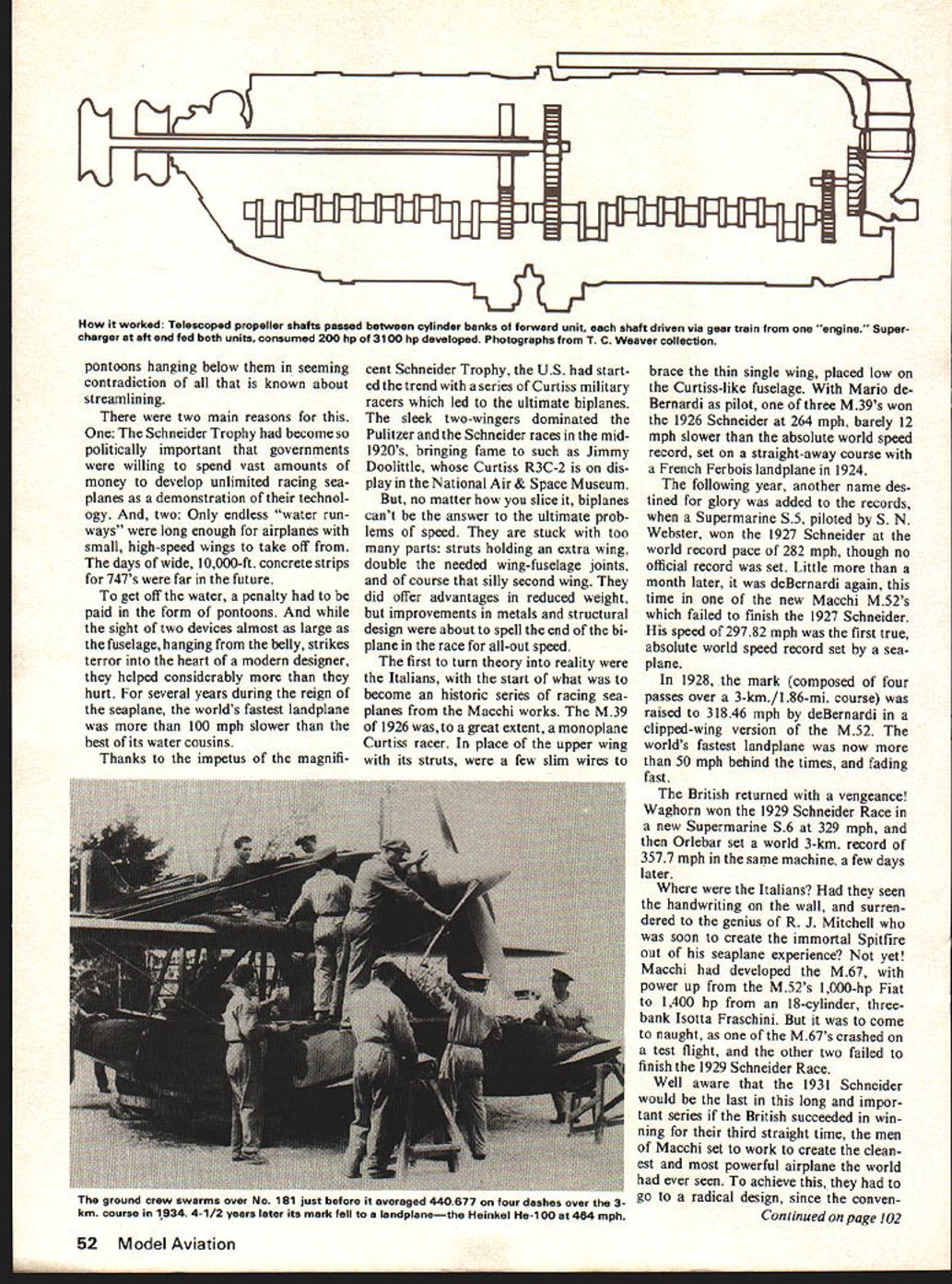
Aerodynamically, it was just more of the same philosophy with which Macchi had done so well in the past, with a long thin fuselage, minimum wings, tiny windshield, huge pontoons and neatly faired strut supporting them. But the powerplant was another kettle of fish. Basically, it was two A.S.5's linked together, back-to-front. There was one crankcase for the two V-12's, but two entirely separate crankshafts, revolving in opposite directions. Each was geared to a propeller drive shaft located between the cylinder banks of the forward "engine." The drive shafts were telescoped and each drove a two-bladed prop. They revolved in opposite directions, thus comprising the first contra-rotating propellers ever installed in an airplane.
This was the most obvious external difference — two props on one centerline — and also the clue to the biggest reason the M.C.72 was superior to all which had come before it. Not only did this permit the full power of the 50-liter (3100 cu. in.) engine to be used, but it eliminated the awful effects of torque, which had caused other powerful racing seaplanes to dig one pontoon deep into the water as power was applied.
It was a great sounding idea, but different enough that the men who created it were in for a long siege of teething troubles. The supercharger, which fed both engines, was the least successful part of the entire operation, according to Dr. Vandone, the engineer in charge of development for Fiat. Its efficiency was low, even for 1931. The rotor-shaft bearings were a problem, as was the friction clutch, which was so small and compact that it either worked too well or not at all. To correct clutch slippage, even at high speed, many different discs were tried, along with many kinds of teeth for the pinion.
One of the major problems faced by men who wanted to go faster than anyone else was cooling the engine. With a fat radial stuck right out front where the wind could get at it, this was no great challenge. But for an airplane with an in-line engine, tightly cowled to reduce drag, cooling became a very big headache.
Ordinary water wasn't up to the task of keeping a racing engine from melting at high rpm, and since ethylene-glycol was just being developed in the U.S.A., and wasn't available at first to the Italians, they went to another technique: skin surface radiators. With far more area than could possibly be achieved with ordinary flow-through radiators, they managed to keep the temperature down to a manageable level long enough to set speed records. While this system was of no value for military or commercial planes, it worked well enough for a short blast. This idea had been used effectively on the Curtiss Racers of the 1920's, and was later to be used on the special Messerschmitt which set a landplane record in 1939, but it soon faded out.
The wings, struts, floats and even the tail of the M.C.72 were covered with skin radiators for the water and oil, and so there was no way to increase the cooling area. The relatively new ethylene-glycol was tried as a coolant, but was found unsatisfactory for this installation. Heat problems showed up first in the valves, and many different techniques were tried for cooling them. Small improvements were made, but not until the cylinder heads were redesigned did the valves cool properly. During tests, more than 1000 valves were made, and 12 different sets of valve-springs-and-camshafts were tried on test engines.
These tests ran from April to June of 1931, leaving just over two months until the Schneider Trophy Race. And there were still problems with the ignition and the supply of fuel-air mixture which was getting to the cylinders. More tests, more changes, and then more tests. The first of the A.S.6 engines to fly in an M.C.72 left the water on June 22. It was a low-compression version of the final engine, developing at most 2300 hp, as against a hoped-for 3000 hp for competition. And it was far from ready: it back-fired on the first flight, and it had trouble with its fuel pumps, and it ran hot, and there was something wrong with the wires bracing the wings, too. Any hope of getting to England for the Schneider was gone.
All attention was then switched to getting the three airplanes ready to attack the world speed record, especially in view of events in other countries. The new Supermarine S.6B came through with a classy win in the final Schneider Race at 340 mph and then wiped out the absolute record of 358 mph with a slashing 407 mph.
In February, 1932, the M.C.72 and its radical engine finally passed the official Italian Government tests which required five passes over a simulated speed course at high power. The British, meanwhile, had decided to let things go, figuring their 407 mph was all that any British airplane could possibly achieve; not until 1938 would they begin to think seriously about getting back into the race.
At Cleveland in 1932, Doolittle increased the landplane record to 294 mph in the Gee Bee R-1 Super Sportster and unknowingly demonstrated just how far the U.S. was behind. Half a year later, on a usually quiet lake on the edge of the Italian Alps, the M.C.72 began to show its stuff.
Piloted by Warrant Officer Francesco Agello, the M.C.72's 2,800-hp Fiat A.S.6 engine showed the world that it had, indeed, been worth all the trouble. In four passes over the 3-km. course on Lake Garda, near Desenzano, Agello averaged 423.77 mph in the first of three nearly-identical airplanes, serial-numbered 179. That was almost 50% faster than the fastest American airplane and the fastest landplane in the world. And there was more to come.
In October, Casinelli used the same airplane to set a world speed record for a 100-km. closed circuit, of 391 mph. And later that same month, a third pilot of the Italian High-Speed Flight, Scapinelli, used #180 to win the first Coupe Bleriot by averaging more than 385 mph for a half hour. Intended as a replacement for the Schneider, the Bleriot Cup was for each year's fastest flight of at least 30 minutes. It was to go permanently to the first pilot who averaged over 1000 kph (621 mph) for a half hour, but that was a pipe-dream at the time.
These praiseworthy achievements of the M.C.72 attracted great acclaim for the Italian Air Force and especially for the bombastic "Il Duce" — Italy's dictator, Benito Mussolini. The applause also went to Gen. Italo Balbo, commander of the Regia Aeronautica (later to die under mysterious circumstances after running afoul of Mussolini), as well as to all those at Macchi and Fiat who were directly responsible for the splendid demonstration.
But, to a great extent, it was the Fascist politicians who received the greatest benefit of the non-political cheers from friends and future foes, alike. And somewhere along the line, it was the Fascists who screwed things up. While never officially admitted (and understandably so), there is solid reason to believe that a civilian test pilot, Simeone Marsone, actually flew an M.C.72 the fastest of all, but Mussolini wanted the credit to go to his Air Force, and so his times were never submitted to the FAI. According to a very good source, Marsone clocked an amazing 475 mph, sometime in 1934.
As it was, the 424-mph mark lasted only a year and a half. On Oct. 23, 1934, Francesco Agello again climbed into an M.C.72 and prepared to let 'er rip over Lake Garda. This time, however, he was in #181 which had smaller and lighter floats and an engine up to its full 3100 hp, of which about 200 hp was absorbed by the supercharger.
His times for the 3-km. dashes were: 15.29 sec., 15.19 sec., 15.18 sec. and 15.23 sec. His speed figured out to 440.677 mph! And while it was far short of the 475 mph which may have been achieved by a civilian, it was filed and it was accepted by the FAI. And it remains, almost 43 years later, the highest official speed ever attained by a prop-driven seaplane.
For 44 years after Agello set it, the M.C.72's record remained the absolute world mark for airplanes of all types. Not until Hans Dieterle flew 464 mph in a prototype Heinkel He-100 did a landplane fly faster than this greatest of all racing seaplanes.
World War II was understandably tough on military racing airplanes. The He-100 and the ferocious Me-209 that barely beat its record a few days later, both were innocent victims of Allied bombing raids; only the fuselage of the Me-209 remains, in a Polish museum. The final record-holding Macchi-Castoldi 72, however, managed to get through some very trying years.
Today, #181 is in the Caproni Aeronautical Museum, in Milan, Italy, looking as beautiful and powerful and unbelievably fast as it did in 1934, when it caused the aviation world to shake its head in wonder.
Editor's Note: At press time information was received from a source expert on the M.C. 72 aircraft, that two of these ships also were lost in training.
Transcribed from original scans by AI. Minor OCR errors may remain.

