
The Magnificent WRAF Field
by Duane Kaasa
Overview
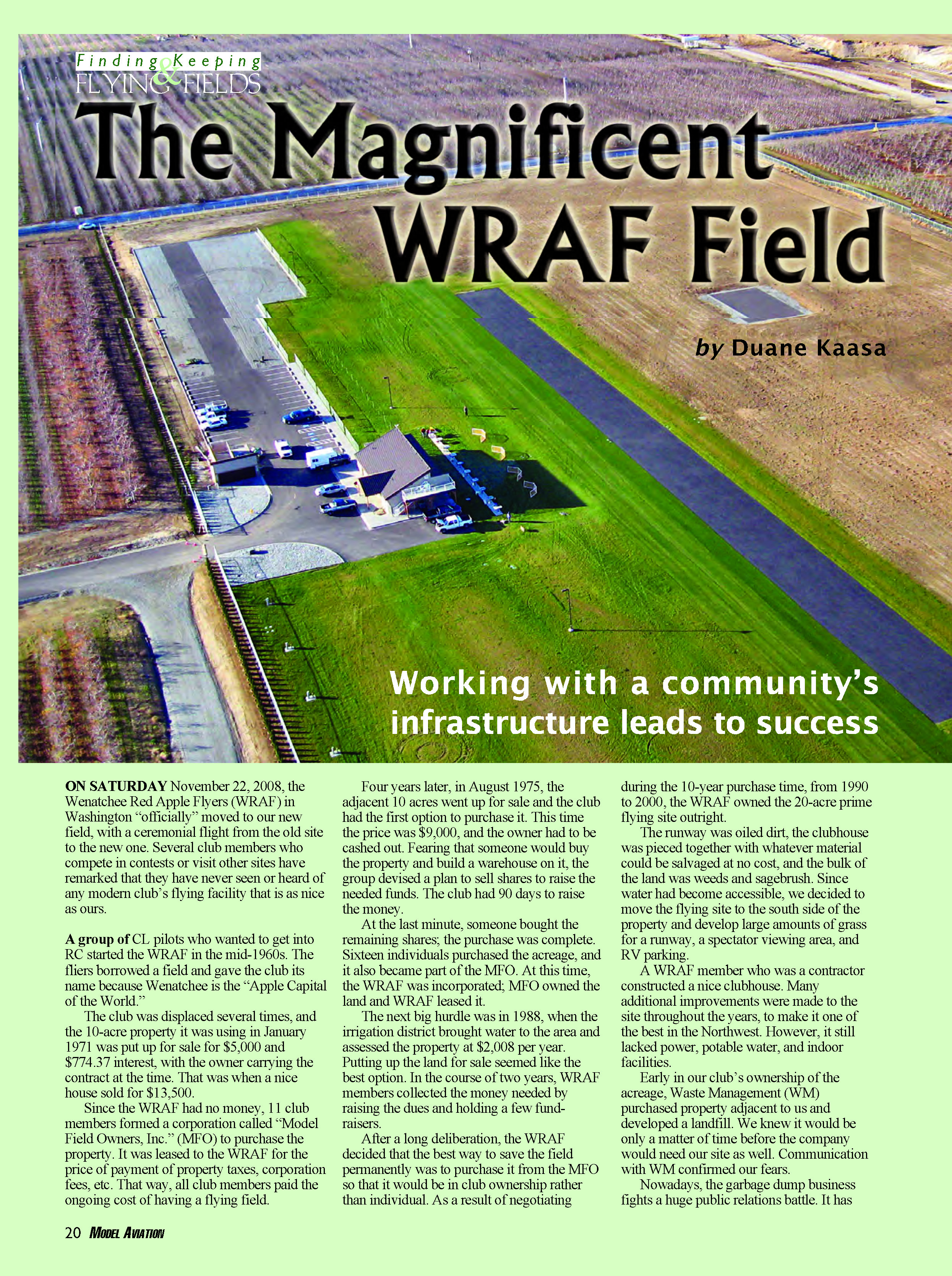
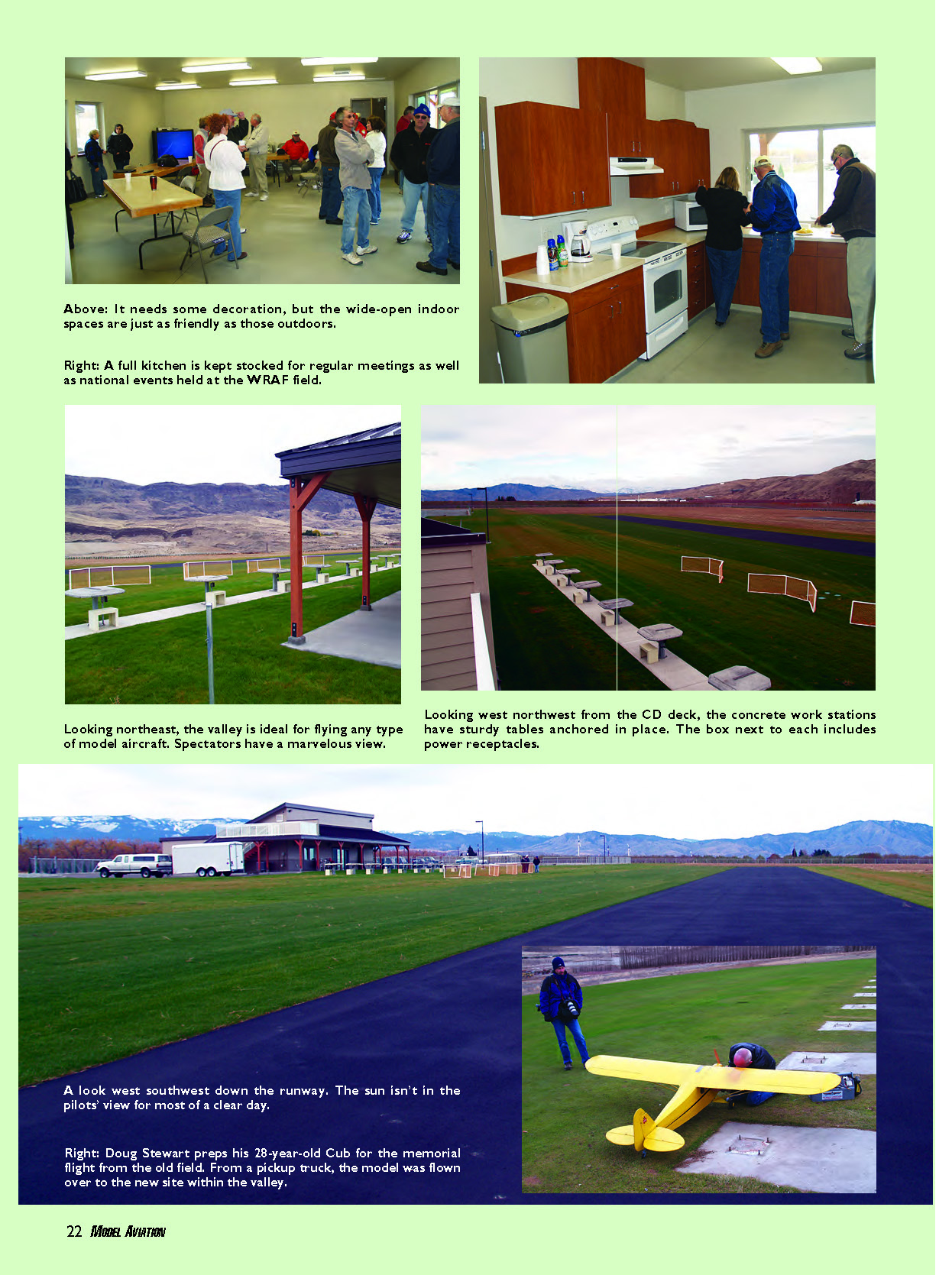
On Saturday, November 22, 2008, the Wenatchee Red Apple Flyers (WRAF) of Washington officially moved to our new field, with a ceremonial flight from the old site to the new one. Several club members who compete in contests or visit other sites have remarked that they have never seen or heard of any modern club’s flying facility that is as nice as ours.
Early history
A group of control-line (CL) pilots who wanted to get into RC started the WRAF in the mid-1960s. The fliers borrowed a field and gave the club its name because Wenatchee is the “Apple Capital of the World.”
The club was displaced several times. In January 1971 the 10-acre property it was using was put up for sale for $5,000 plus $774.37 interest, with the owner carrying the contract. That was at a time when a nice house sold for $13,500.
Since the WRAF had no money, 11 club members formed a corporation called Model Field Owners, Inc. (MFO) to purchase the property. MFO leased the land to the WRAF for the price of paying the property taxes, corporation fees, etc., so that all club members paid the ongoing cost of having a flying field.
In August 1975 the adjacent 10 acres went up for sale and the club had the first option to purchase it. This time the price was $9,000, and the owner had to be cashed out. Fearing that someone would buy the property and build a warehouse on it, the group devised a plan to sell shares to raise the needed funds. The club had 90 days to raise the money. At the last minute, someone bought the remaining shares and the purchase was completed. Sixteen individuals purchased the acreage and it became part of MFO. At this time the WRAF was incorporated; MFO owned the land and WRAF leased it.
Ownership challenges and solution
The next big hurdle came in 1988, when the irrigation district brought water to the area and assessed the property at $2,008 per year. Putting up the land for sale seemed like the best option. Over the course of two years, WRAF members collected the money needed by raising dues and holding fundraisers.
After long deliberation, the WRAF decided the best way to save the field permanently was to purchase it from MFO so that it would be in club ownership rather than individual ownership. As a result of negotiating during a 10-year purchase period (1990–2000), the WRAF owned the 20-acre prime flying site outright.
At that time the runway was oiled dirt, the clubhouse was pieced together with salvaged material, and the bulk of the land was weeds and sagebrush. Since water had become accessible, we moved the flying site to the south side of the property and developed large turf areas for a runway, a spectator viewing area, and RV parking. A WRAF member who was a contractor constructed a nice clubhouse. Many additional improvements were made over the years to make it one of the best in the Northwest. However, it still lacked power, potable water, and indoor facilities.
Partnership with Waste Management and site exchange
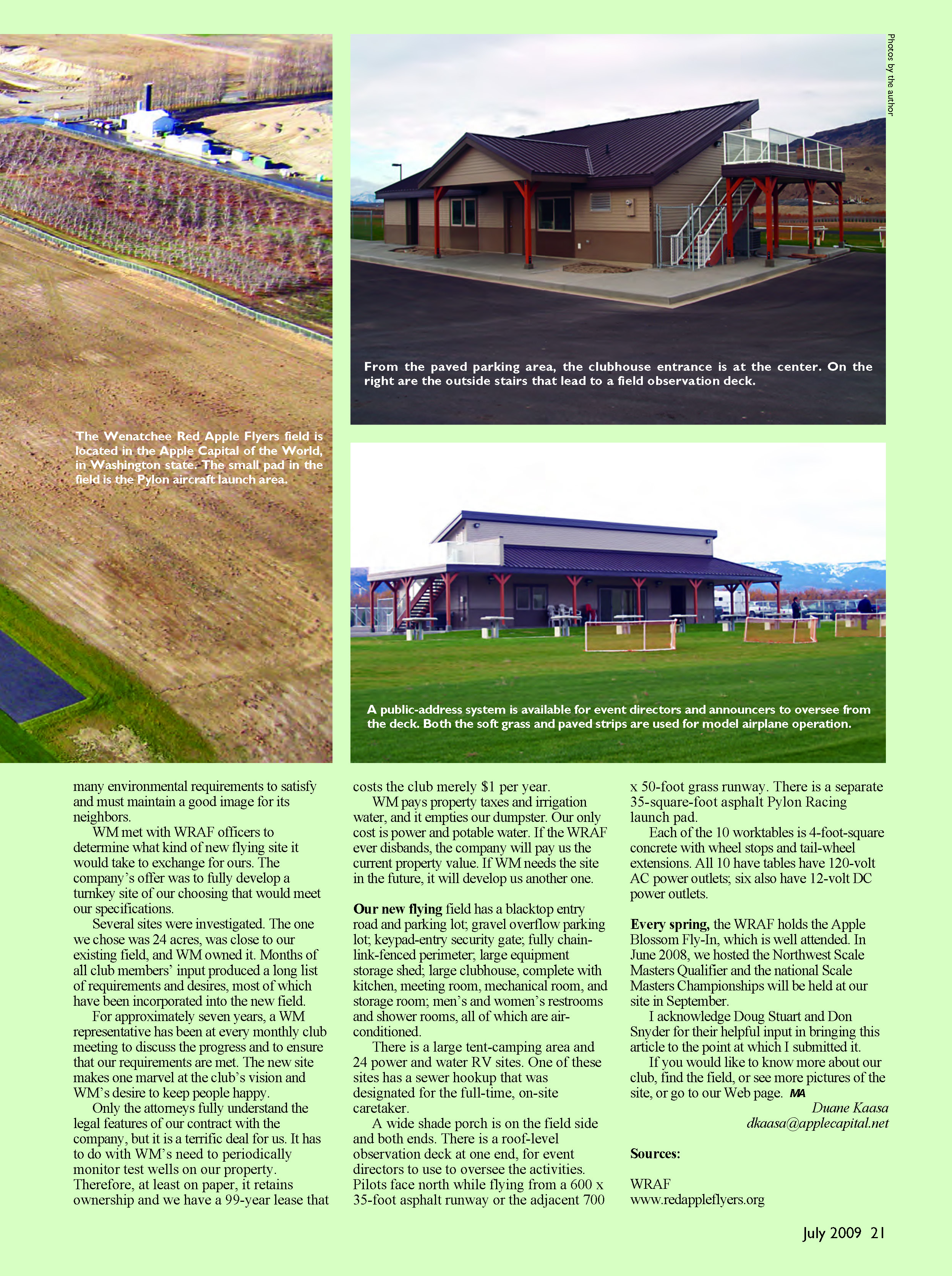
Early in our club’s ownership, Waste Management (WM) purchased property adjacent to us and developed a landfill. We knew it would be only a matter of time before the company would need our site as well. Communication with WM confirmed our fears.
WM met with WRAF officers to determine what kind of new flying site it would take to exchange for ours. The company's offer was to fully develop a turnkey site of our choosing that would meet our specifications. Several sites were investigated. The one we chose was 24 acres, close to our existing field, and WM owned it. Months of input from club members produced a long list of requirements and desires, most of which have been incorporated into the new field.
For approximately seven years a WM representative attended every monthly club meeting to discuss progress and ensure that our requirements were met. The new site makes one marvel at the club's vision and WM's desire to keep people happy.
Only the attorneys fully understand the legal features of our contract with the company, but it is a terrific deal for us. Because WM needs to periodically monitor test wells on our property, WM technically retains ownership while we hold a 99-year lease that costs the club $1 per year. WM pays property taxes and irrigation water, and it empties our dumpster. Our only cost is power and potable water. If the WRAF ever disbands, the company will pay us the current property value. If WM needs the site in the future, it will develop another one for us.
New field facilities
The new flying field includes:
- Blacktop entry road and parking lot, plus a gravel overflow parking area
- Keypad-entry security gate and fully chain-link-fenced perimeter
- Large equipment storage shed
- Large clubhouse with kitchen, meeting room, mechanical room, and storage room
- Men’s and women’s restrooms and shower rooms, all air-conditioned
- Wide shade porch on the field side and both ends of the clubhouse
- Roof-level observation deck at one end for event directors
- Large tent-camping area and 24 RV sites with power and water
- One RV site has a sewer hookup designated for the full-time, on-site caretaker
- Pilots face north while flying from:
- 600 x 35-foot asphalt runway
- 700 x 50-foot grass runway adjacent to the asphalt runway
- Separate 35-foot-square asphalt pylon-racing launch pad
- Ten worktables, each 4-foot-square concrete with wheel stops and tail-wheel extensions
- All 10 tables have 120-volt AC outlets; six also have 12-volt DC outlets
Events
Every spring the WRAF holds the Apple Blossom Fly-In, which is well attended. In June 2008 we hosted the Northwest Scale Masters Qualifier, and the national Scale Masters Championships will be held at our site in September.
Acknowledgments
I acknowledge Doug Stuart and Don Snyder for their helpful input in bringing this article to the point at which I submitted it.
Contact
Duane Kaasa dkaasa@applecapital.net
Sources
No additional primary-article text appears on the original page; the remaining content consisted of photographs and photo captions.
Transcribed from original scans by AI. Minor OCR errors may remain.

