
Make Your Own: Exhaust Manifold
Neil Allen
Here's how to make a neat, clean custom installation that will also quiet your engine.
Many standard mufflers do a reasonably good job of quieting an engine, but there are reasons to make something different. Scale models almost always need a custom exhaust system because sticking a muffler out of the cowling rarely looks right. A custom-made manifold, made as described here, can lead to a separate muffler. If you use a two-stroke engine, you can join the manifold to a muffler with silicone exhaust tubing.
Note: silicone tubing cannot withstand the exhaust pressure and temperature of a four-stroke engine. In that case, this method can only be used to join the manifold to a muffler made of steel, brass, or similar metals that can be silver-soldered to the tubing.
Four-stroke fliers may find that a length of silicone tubing, without a muffler, provides plenty of noise reduction by itself—especially when using a large propeller turning at moderate RPM. This method has been used on world-championship FAI Scale models by several expert builders.
Pattern fliers discovered long ago that the best muffler for power and noise reduction is a tuned-exhaust-pipe system. A tuned pipe needs a manifold to join to the engine, and making your own enables a custom fit to the engine in your fuselage.
Materials and tubing
This method is based on stainless-steel corrugated bendable tubing. The first known modeling use was by Mick Reeves, who sells a range of sizes for modeling use, including 3/8", 1/2", and 5/8" inside diameters. The tubing is very thin-walled and light. It can be bent by hand into fairly tight curves, making it ideal to fit most modeling engine installations.
You can source the tubing from specialist model suppliers (see contact at the end) or local engineering-supply shops. Joining the tubing is done with silver solder—ordinary tin/lead solder cannot be used because it would melt in the exhaust heat. Silver-soldering requires a gas torch and flux; the flux helps the solder flow and gives a neat joint.
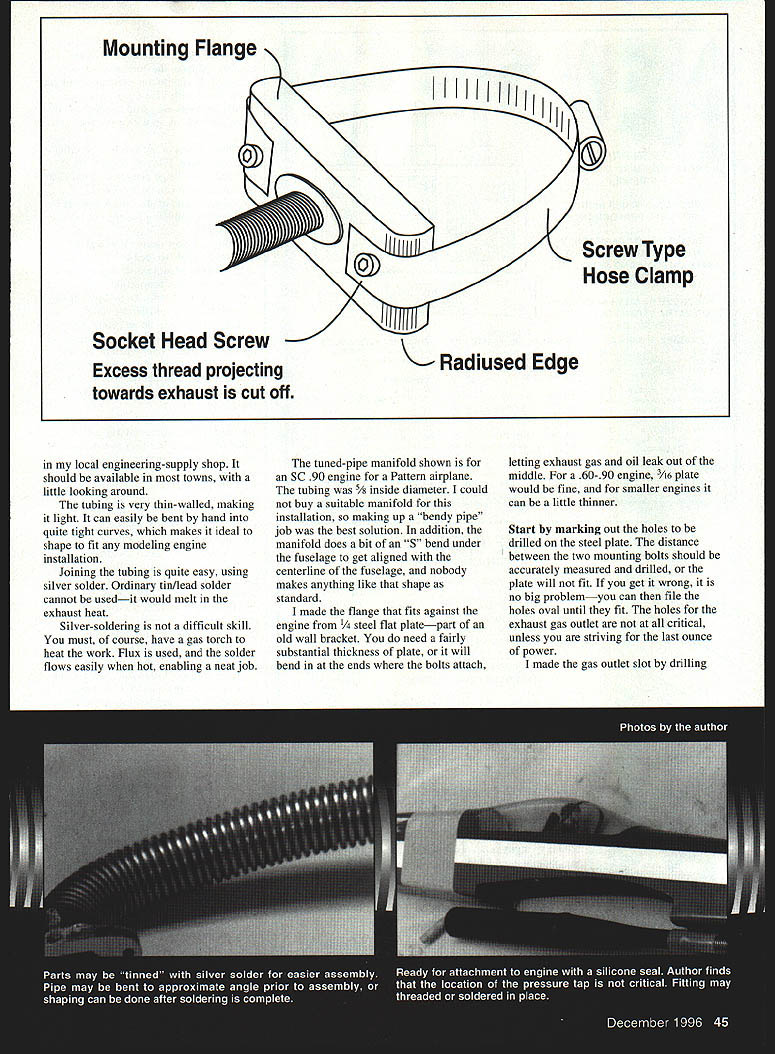
The tuned-pipe manifold shown here was made for an OS .90 engine. Pattern airplane tubing 5/8" inside diameter is a suitable size for this "bendy-pipe" job. Often you cannot buy a manifold that matches your installation, and a custom manifold can include an S-bend under the fuselage to align the exhaust with the fuselage centerline.
Making the flange
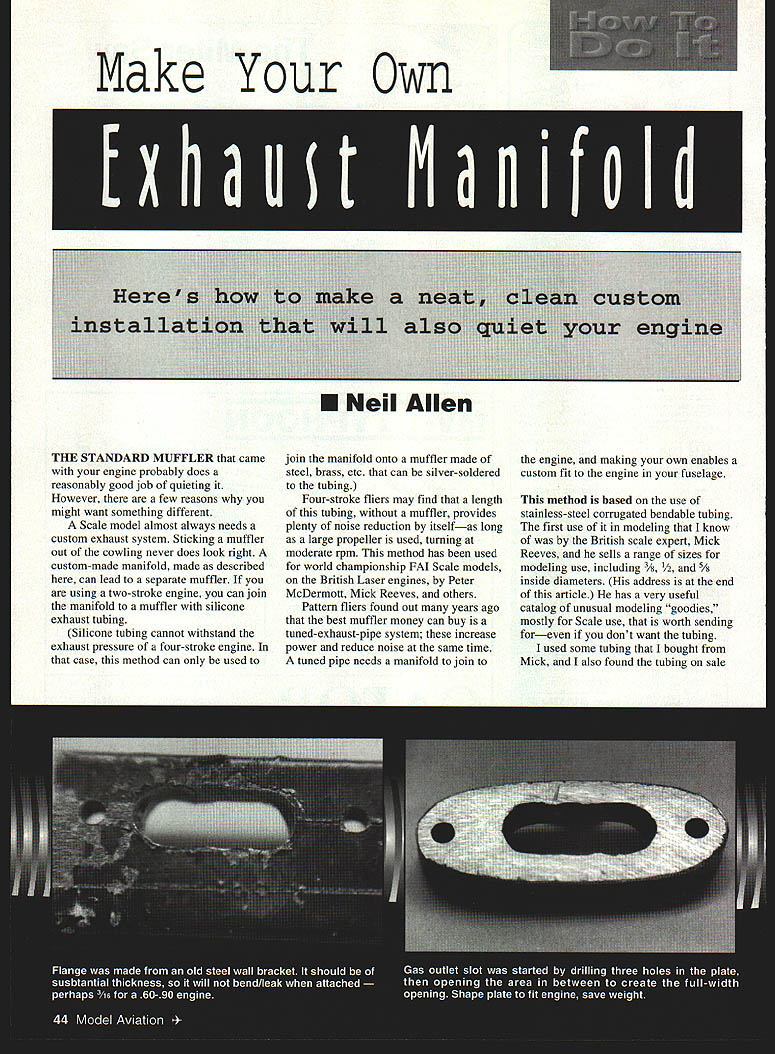
I made the flange that fits against the engine from 1/4" steel flat plate—part of an old wall bracket. Use a fairly substantial thickness of plate or it will bend at the bolt ends and let exhaust gas and oil leak out. For .60–.90 engines, 3/16" plate is acceptable; for smaller engines you can use thinner plate.
Steps:
- Mark out the bolt holes and the exhaust outlet on the steel plate.
- Accurately measure the distance between the two mounting bolts—if the holes are drilled incorrectly the plate may not fit. If you make a mistake you can file the holes oval until they fit.
- Drill three holes for the exhaust gas outlet, then open the area between them to create the full-width slot. The exact shape of the gas outlet is not critical unless you are after the last ounce of power.
- Shape and lighten the plate as required. The plate can be left rectangular, but tapering and rounding the ends will reduce weight and improve appearance.
- Check the fit by bolting the flange onto the engine and file any holes to fit.
When drilling holes that will be opened into a slot, hold the metal securely (use Vise‑Grips) and be cautious if you move the flange while the drill is rotating—things can get lively when holes join.
Pressure nipple and muffler pressure
Decide whether you want to use a pressure nipple to feed exhaust pressure to the engine. Most two-strokes run best with muffler pressure, but four-strokes should not use it. Engines fitted with fuel pumps normally do not use muffler pressure.
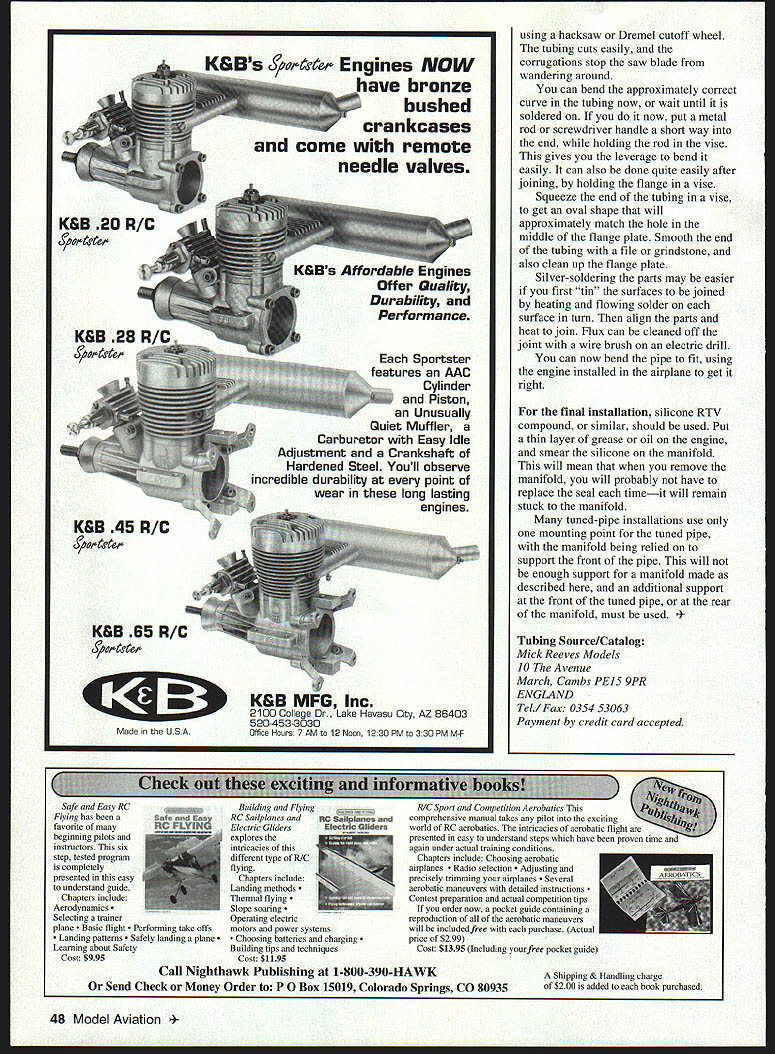
Contrary to some claims, the pressure tap location makes little practical difference. Field tests using a simple U-tube manometer showed about 1/2 psi regardless of where the tap is located. Flight experience confirms you can tap pressure at any convenient point, which makes installation neater with less tubing from the tank filler to the pressure point.
If you want muffler pressure, the easiest place to get it is in the flange or exhaust manifold. You can tap and thread the flange and screw the nipple in, or silver-solder a nipple in place. If you don’t have a tap, file the threads off the nipple and silver-solder it into a drilled hole that is a tight fit.
Cutting, bending, and joining tubing
- The corrugated tubing cuts easily with a hacksaw or Dremel cutoff wheel; the corrugations help hold the blade steady.
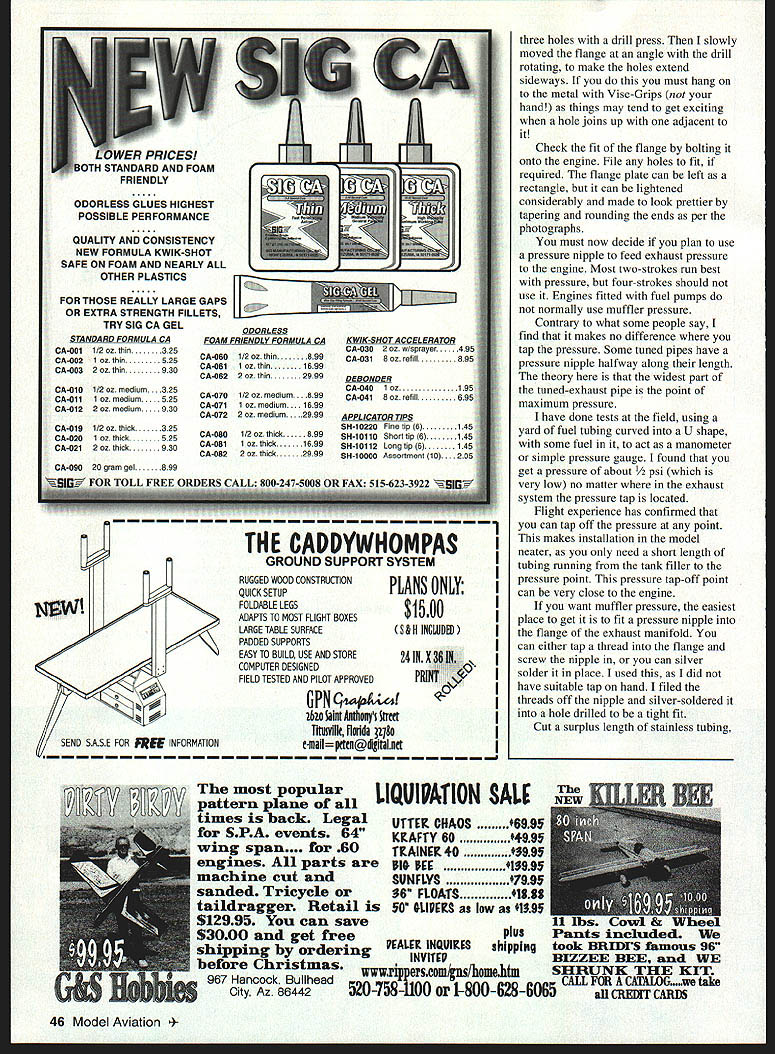
- You can bend the approximate curve in the tubing before soldering or wait until after joining. To bend before joining, insert a metal rod or screwdriver handle a short way into the end and hold the rod in a vise to give leverage.
- Squeeze the end of the tubing in a vise to create an oval that will match the flange hole. Smooth the tubing end with a file or grindstone and clean up the flange.
- Silver-soldering the parts is easier if you "tin" each surface first—heat and flow solder on each mating surface, then align and heat to join. Use flux and clean it off with a wire brush on an electric drill.
After soldering, you can bend the pipe to final fit using the engine installed in the airplane to get alignment correct.
Final installation and support
For final assembly use a thin layer of silicone RTV compound (or similar) as a gasket. Put a thin film of grease or oil on the engine face and smear silicone on the manifold; this helps the gasket remain stuck to the manifold so it does not need replacement every removal.
Many tuned-pipe installations use only one mounting point and rely on the manifold to support the front of the pipe. That single mounting point is not enough support for a manifold made as described here. Provide an additional support at the front of the tuned pipe or at the rear of the manifold.
Tubing source / catalog
Mick Reeves Models 10 The Avenue March, Cambs PE15 9PR ENGLAND Tel./Fax: 0354 53063 Payment by credit card accepted.
Transcribed from original scans by AI. Minor OCR errors may remain.

