
Make Your Own Timer . . . for electric or ignition models
A. A. Lidberg
Competition flying (or even practical sport flying) of ignition-engine old-timers or electric free-flight models requires a timer capable of shutting off the current at 25 seconds. For those who prefer the consistency of mechanical, tick-off type timers, the commercial options are few. One ready-made switch-equipped timer of this type is available from 77 Products at a cost of about $16.00. However, with about two hours of your time, you can produce an excellent timer for about $7.00 using a K-Mart or similar camera timer. If you have a spare Tick-off in your collection, the switch-converted timer can be built for little more than the cost of a switch. I have made three of these timers and have been pleased with their operation.
Switch
Two types of Radio Shack switches are readily usable for a timer:
- Lever (micro) switch: rated at 5A/250Vac (#275-016 at $1.29). Good for ignition or high-current electric models. The lever switch mounts on the front of the face plate.
- Slide switch: rated at 0.3A/120Vac (#275-406 at 2 for 59¢). Good for ignition or low-current electric models. The slide switch mounts behind the plate.
Timer Modifications
No changes are needed for Tick-off timers, unless the timer will not run long enough. The arm can be repositioned in 1/4-turn increments as necessary to allow the mainspring to unwind to a lower tension and slow down.
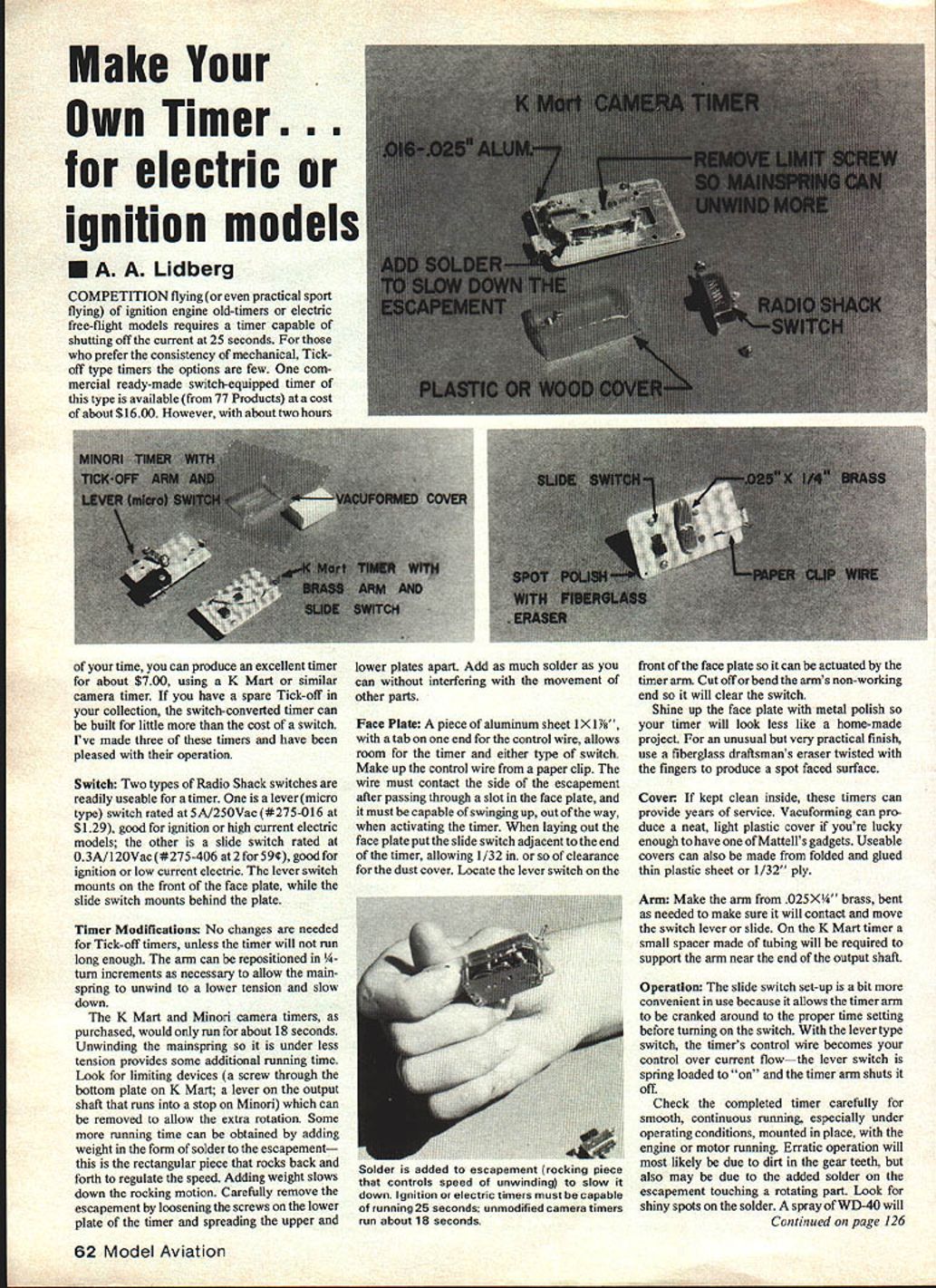
The K-Mart and Minori camera timers, as purchased, would only run for about 18 seconds. Unwinding the mainspring so it is under less tension provides some additional running time. Look for limiting devices (for example, a screw through the bottom plate on the K-Mart model or a lever on the output shaft that runs into a stop on the Minori) which can be removed to allow the extra rotation.
Some more running time can be obtained by adding weight in the form of solder to the escapement — this is the rectangular piece that rocks back and forth to regulate the speed. Adding weight slows down the rocking motion. Carefully remove the escapement by loosening the screws on the lower plate of the timer and spreading the upper and lower plates apart. Add as much solder as you can without interfering with the movement of other parts.
Face Plate
A piece of aluminum sheet 1 x 1 1/8 inches, with a tab on one end for the control wire, allows room for the timer and either type of switch. Make the control wire from a paper clip. The wire must contact the side of the escapement after passing through a slot in the face plate, and it must be capable of swinging up, out of the way when activating the timer.
When laying out the face plate, put the slide switch adjacent to the end of the timer, allowing about 1/32 in. clearance for the dust cover. Locate the lever switch on the front of the face plate so it can be actuated by the timer arm. Cut off or bend the arm's non-working end so it will clear the switch.
Shine up the face plate with metal polish so your timer will look less like a home-made project. For an unusual but very practical finish, use a fiberglass draftsman's eraser twisted with the fingers to produce a spot-faced surface.
Cover
If kept clean inside, these timers can provide years of service. Vacuforming can produce a neat, light plastic cover if you're lucky enough to have one of Mattel's gadgets. Usable covers can also be made from folded and glued thin plastic sheet or 1/32" ply.
Arm
Make the arm from .025 x 1/4" brass, bent as needed to make sure it will contact and move the switch lever or slide. On the K-Mart timer a small spacer made of tubing will be required to support the arm near the end of the output shaft.
Operation
The slide-switch setup is a bit more convenient in use because it allows the timer arm to be cranked around to the proper time setting before turning on the switch. With the lever-type switch, the timer's control wire becomes your control over current flow — the lever switch is spring loaded to "on" and the timer arm shuts it off.
Check the completed timer carefully for smooth, continuous running, especially under operating conditions, mounted in place, with the engine or motor running. Erratic operation will most likely be due to dirt in the gear teeth, but may also be due to the added solder on the escapement touching a rotating part. Look for shiny spots on the solder. A spray of WD-40 will help clean and lubricate the timer.
Ignition and electric models may have their own peculiar characteristics, but they provide their own kinds of satisfactions, too. Try them — you might like ’em.
Note
The K-Mart timers normally sell for $4.96, which is a bargain, but every now and then they are marked down to about $4. Other materials cited include K&S aluminum sheet and brass strip, available from the hobby shop.
Transcribed from original scans by AI. Minor OCR errors may remain.

