
Man Power - an update
Don Berliner
NO MATTER how outlandish the challenge, there will always be a few people turned on by it. No matter how far-fetched the rules, the mere hint of a competition will excite those to whom "impossible" simply identifies a goal. And if the prize goes unclaimed for 15 years, despite a series of brilliantly organized attempts upon it, that only makes the chase more exciting. So it has been for the race to develop a man-powered airplane.
Years of work to create a successful "ultra-light" airplane (one having less than 20 hp) in both the U.S. and Great Britain failed to result in anything halfway useful. To fly with so little power means very large wings, very low weight and thus wing loadings and power loadings far outside sensible ranges. The silly things might fly well inside the Astrodome, but taking them outside where the winds blow is asking for trouble. The dream of flying with almost no power remained a topic for otherwise empty hours.
In spite of years of intense effort, and flights for the better part of a mile, no one has completed the Figure-8 course to claim the $114,000 Kremer prize.
With this uninspiring background to ponder upon, an Englishman (who else?) proceeded to create the need for a class of flying machines which would make the conventional ultra-light look, by comparison, like a heavily-loaded supersonic jet. Industrialist Henry Kremer specified "human power, only" for an airplane which could fly a figure-8 around pylons a half mile apart. The prize, at first, was "only" $14,000. Years later, after it had been raised over $100,000, winning it seemed quite as impossible as ever. And yet more men tried. And more men tried. And still more men continue to try. Through it all, the odds have remained the same: Almost hopeless. The Kremer Prize seems as safe as if it were for the first bicycle trip to the Moon.
Now, don't get the idea that no man-powered airplane has ever flown. Far from it! At least a dozen different ones have cruised through the calm, friendly air close to a long, flat runway, their pilots huffing and puffing for dear life. Several have made flights of more than 500 yards and lasting a minute, yet the goal — a mile flight around pylons — seems far out of reach today.
Kremer first waved money around 1959. Perhaps that's what makes it interesting. Despite successes, no one seems to have a very clear idea of how to go about developing an airplane which will fly the figure-8 course. The problem, in a nutshell, is a ludicrous lack of horsepower. Laboratory and field tests agree the most that can be expected of a healthy human is about one-half horsepower. That's about what you can get from a model aero engine of 30 cu. in. displacement. As far as flying an airplane with the pilot inside on such power, that's an insane game — for people much interested in playing the game of winning.
Just lifting a human off the ground means a man-powered airplane must have a take-off weight of 100 lbs — an impossibly light structure; vast wings would be needed to lift such a machine at low speed. The gross weight must climb to at least 200 lbs. To get a 200-lb airplane flying on one-half horsepower is difficult indeed. Once basic dimensions are arrived at, you should have the end of serious thoughts about flying by man-power alone. Except, of course, the occasional nut thinks he isn't bound by the same laws of physics that keep the rest of us from stepping off the space age into the void.
Just two years after Henry Kremer offered the prize, such foolishness produced the first man-powered airplane to take to the skies — if you can call an airplane a couple of feet above the runway. On Nov. 9, 1961 veteran modeler Derek Piggott pedaled his way along the runway at Lasham Gliding Centre, southwest London, and parted company with native English soil, alighting 50 yards away after having climbed to some six feet altitude — the first time in history a man had flown under his own power. A week later, a second man-powered airplane flew — the Hatfield group's Puffin. By the end of the year the machine had flown as far as 700 yards in a straight line and made turns to 800. Early in 1962 Puffin pilot John Wimpey stayed aloft almost 1,000 yards.
Progress was rapid; people could hardly be blamed for assuming a mile-long figure-8 for the Kremer Prize was just a matter of time. Wimpey's flight remained the unofficial world record for 10 years, and no one has yet approached the turns achieved in those first months. It wasn't that people weren't trying, nor that they weren't learning from others' experiences. Man-powered airplanes were flown during the 1960s in South Africa, Japan, Austria as well as Great Britain. In 1967 Henry Kremer apparently decided the initial prize of $14,000 wasn't enough to get the job done and doubled it. By the early 1970s there was still activity. The huge (120' wingspan) Weybridge "Dumbo" flew in 1971, followed a few months later by the "Jupiter," considerably smaller at 80'. In early 1972, Peter Wright flew his 71' almost flying wing 120 yards on his first try. A month later, the "Liverpool" — built from the remains of the wrecked "Puffin" by Liverpool University Prof. Keith Sherrin and his students — is more of a sport/trainer than a contender for Kremer honors.
Action continued both hot and heavy (or, rather, cool and very light). In June of 1972, RAF Flt. Lt. John Potter set an unofficial distance record of 1,171 yards (2/3 of a mile) in the "Jupiter." And at the end of the year, the first of the two-seaters — the "Tourac," built by the Hertfordshire Pedal Aeronauts — flew. By July, 1973, it had gone 700 yards.
Man Power—an Update
As a further encouragement, Kremer, in 1973, upped the still-unclaimed prize to 50,000 pounds, which is worth about $105,000 as this is written. And still no one has actually made an attempt to fly the figure-8 course, because making any kind of turn is far harder than flying straight, and that's tough enough.
The reasons for this are disturbingly basic. In order to get a man-powered airplane off the ground, it must develop all the lift possible, without getting too heavy. That means very long wings to reduce the span loading. And with long wings, an airplane travelling less than 20 mph and turning will lose some of its precious lift unless the turn is very, very gradual. And, of course, that would mean flying even farther. But a tighter turn will mean an inboard wingtip will stand a good chance of stalling, or at least dropping. And at an altitude of only a few feet, a slight drop will bring the tip into the ground.
That's what can happen under ideal conditions! How about a day on which the wind is blowing . . . as if there is any other kind of day! More than about 5 mph of wind causes very serious problems even before the airplane is ready to be launched. Just imagine moving it out of the hangar and across the field, with its wings of at least 100 feet and wing loading (empty) of as little as 3/4 lb./sq. ft.! That's about half the wingloading of a good competition free-flight model . . . but the model doesn't have to contend with wings stretching 50 feet on either side of its fuselage.
Once the man-powered craft is in position, the fun begins. The pilot/athlete carefully positions himself on the skimpiest of seats and straps his feet onto bicycle pedals. With his handlers at the wingtips, he begins pedalling for all he's worth. The strange propeller—7-10' in diameter, made of laminated balsa, and weighing around three pounds—slowly begins to turn and the airplane moves forward. Its wings level by themselves. As it reaches the blazing speed of 15 mph, it slowly lifts up to a height of five feet. Still very much in ground-effect and with the pilot straining every muscle to maintain power and to control the great bird at the same time, it quietly sails along the runway, descends and slides to a stop.
Assuming it hasn't been damaged and there is a spare pilot and the weather hasn't turned sour, there could be another attempt. There isn't much time, though, because the conditions permitting this kind of flying exist, at best, only for a short time after sunrise and again just before sunset. It has to be calm, warm, and dry.
And so the obstacles and handicaps and drawbacks pile up. Weather, size, power, control, weight. Yet, as the difficulties become more obvious, the number of serious, well-organized groups of talented people determined to beat the odds increases.
A look at some of the currently active projects, and then at a couple of really futuristic ideas, should give some idea of just what approaches seem to hold the best chances for success:
Project Jupiter
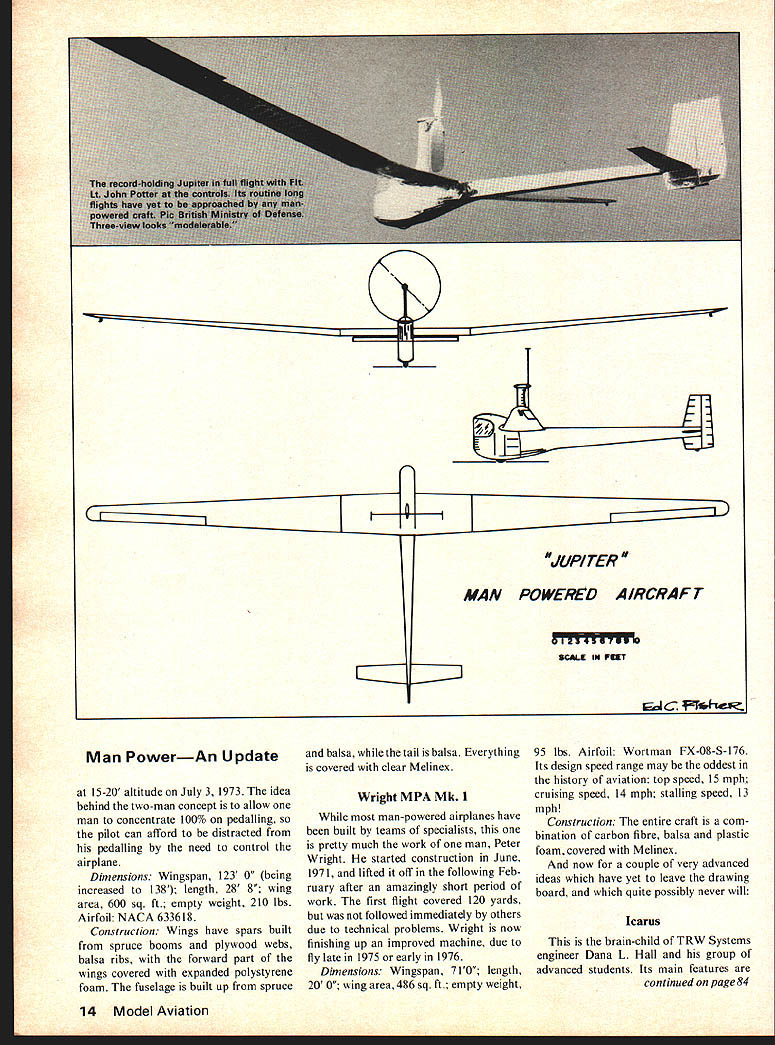
The current record-holder, it is managed and flown by Flt. Lt. John Potter, RAF. Jupiter was begun in 1960, seriously damaged by fire in 1969 just before it was to have been completed, and finally flown on Feb. 9, 1972. Its best to date is an unofficial flight of 1,350 yards in about two minutes.
Dimensions: wingspan, 80'; length, 29'; wing area, 300 sq. ft.; empty weight, 146 lbs.; flying weight, 300 lbs. Maximum speed, 30 mph; cruising speed, 20 mph; stalling speed, 18 mph; ceiling (to date) 25-30'. Airfoil, NACA 653618.
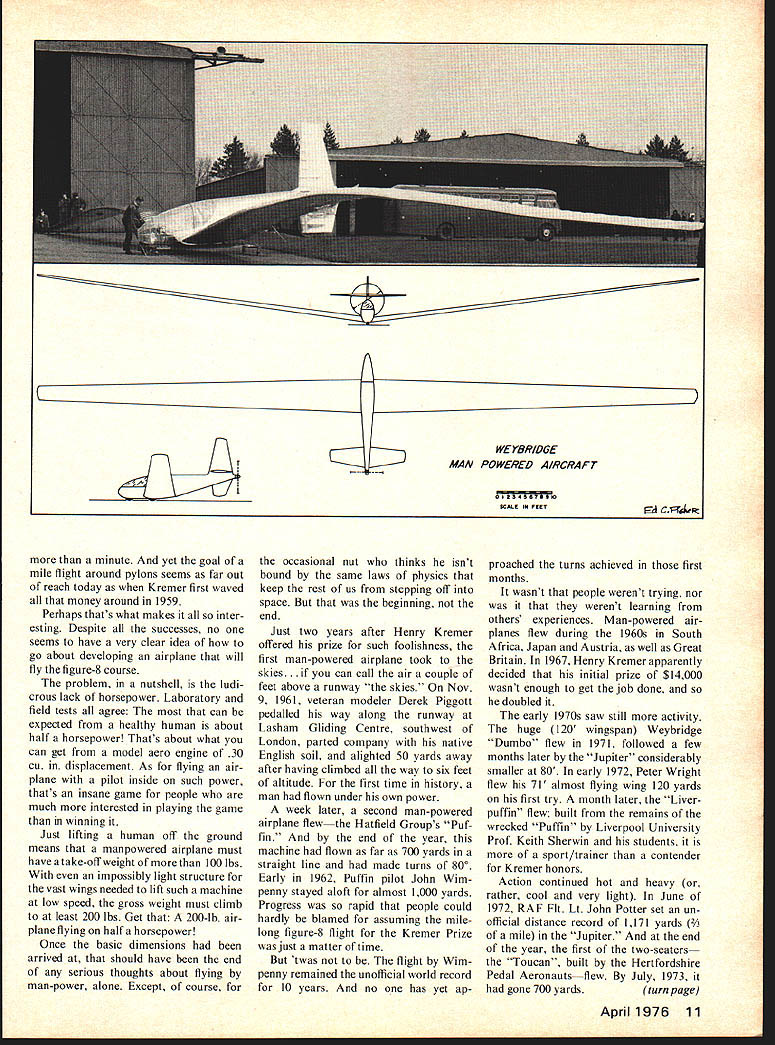
Weybridge Mercury
Probably the largest single-seat airplane ever flown, it was built in 1968-70 as "Dumbo" with help from the Royal Aeronautical Society and British Aircraft Corp. The first flight, with glider pilot Chris Lovell at the controls, was on Sept. 18, 1971, and covered 50 yards. It was then returned to the shop for modifications and later transferred to the group which owns the Jupiter.
Dimensions: Wingspan, 120' 4"; length, 21' 0"; wing area 485 sq. ft.; empty weight, 175 lbs. Airfoils: Wortman FX63-IM-180 at root, FX68-M-160 at mid-span and FX68-M-140 at tip.
Construction: The wings have aluminum alloy tube main spars, balsa ribs and leading and trailing edges. Fuselage has a basic framework of aluminum alloy tubing with balsa frames and stringers. The tail has a plywood and spruce box-spar structure with balsa ribs and leading and trailing edges. The entire airplane is covered with clear Melinex plastic. Maximum speed is estimated at 16 mph and stalling speed at 11 mph.
Toucan
The first successful two-man machine, it was built in 1967-72 by the Hertfordshire Pedal Aeronauts, a group of Handley Page engineers. Its first flight was on Dec. 23, 1972, and the longest (crewed by Bryan Bowen and Derek May) was for 700 yards.
Man Power—An Update
at 15-20' altitude on July 3, 1973. The idea behind the two-man concept is to allow one man to concentrate 100% on pedalling, so the pilot can afford to be distracted from his pedalling by the need to control the airplane.
Dimensions: Wingspan, 123' 0" (being increased to 138'); length, 28' 8"; wing area, 600 sq. ft.; empty weight, 210 lbs. Airfoil: NACA 633618.
Construction: Wings have spars built from spruce booms and plywood webs, balsa ribs, with the forward part of the wings covered with expanded polystyrene foam. The fuselage is built up from spruce and balsa, while the tail is balsa. Everything is covered with clear Melinex.
Wright MPA Mk. 1
While most man-powered airplanes have been built by teams of specialists, this one is pretty much the work of one man, Peter Wright. He started construction in June, 1971, and lifted it off in the following February after an amazingly short period of work. The first flight covered 120 yards, but was not followed immediately by others due to technical problems. Wright is now finishing up an improved machine, due to fly in 1975 or early in 1976.
Dimensions: Wingspan, 71' 0"; length, 20' 0"; wing area, 486 sq. ft.; empty weight, 95 lbs. Airfoil: Wortman FX-08-S-176. Its design speed range may be the oddest in the history of aviation: top speed, 15 mph; cruising speed, 14 mph; stalling speed, 13 mph!
Construction: The entire craft is a combination of carbon fibre, balsa and plastic foam, covered with Melinex.
It will not have a couple of every advanced idea which have yet to leave the drawing board, and which quite possibly never will.
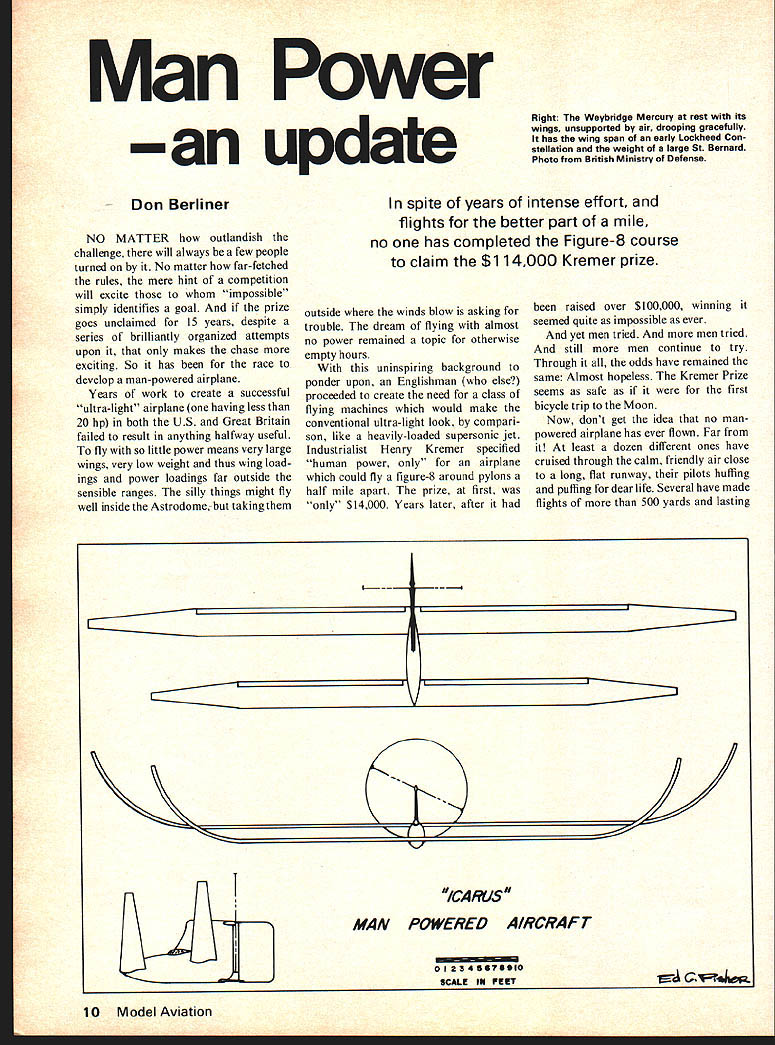
Icarus
This is the brain-child of TRW Systems engineer Dana L. Hall and his group of advanced students. Its main features are the tandem-wing arrangement which reduces the critical over-all wingspan; the slave/pilot combination which is steadily gaining popularity, and the strangely curled-up wingtips which are designed to control tip vortices, but may not be worth the trouble to build.
Dimensions: Wingspan, front wing 65'; rear wing 60'; length, 19'; wing area, front wing 250 sq. ft., rear wing 300 sq. ft.; empty weight 167 lbs.; flying weight, 467 lbs. Airfoil (both wings): Wortman FX-67-K-170. Estimated cruising speed, 22 mph.
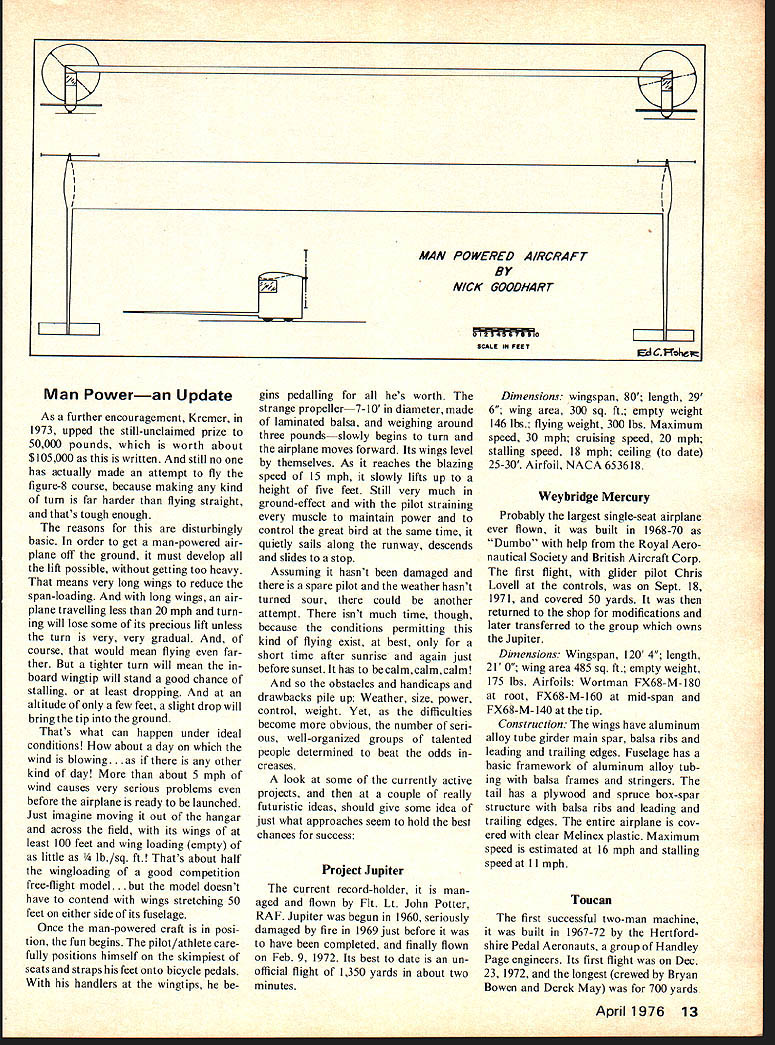
Goodhart
This is the most unusual design of all, and is the handiwork of Rear Adm. "Nick" Goodhart, Royal Navy, one of the great men of the British sailplane movement. His idea was to reduce the induced drag as much as possible by developing an airplane that can be flown within 1½ feet of the ground. He reasoned that if the boundary layer at the wing root could be kept attached the wing would operate in ground effect with very little induced drag.
The Goodhart machine has a fuselage which is basically a low-drag wing-shaped body from which the wings extend only a short distance. The pilot sits in a recumbent position inside the body and pedals to a pair of pusher propellers mounted at the rear. The machine has been tested in towed flights and by a small rocket assist but has not yet made a free human-powered flight.
Goodhart thinks his machine has the best chance of all to win the Kremer prize, but it will take a lot of careful development to make it practical. There are other projects being actively worked on, such as the two‑man biplane at Massachusetts Institute of Technology. Its wings folded up as it was ready to lift off for its first flight, however, and it is now being re‑built. Others are not as far along, but something could pop out of the woodwork at any moment, for the builders of man‑powered airplanes are often on the secretive side until they're ready to perform.
But until something quite unexpected happens, this mighty aeronautical challenge will remain untouched. And even when the Kremer Prize has been claimed, it will stand as a tribute to the imagination of man. As a beacon lighting the way toward the next outlandish goal, which could be flapping‑wing flight. Or human flight without any kind of wings. Or...
No matter how outlandish the challenge, there will always be a few people turned on. No matter how far‑fetched the rules, a mere hint of competition will excite. The impossible, simply because it identifies a goal, will be chased. The prize went unclaimed for 15 years despite a series of brilliantly organized attempts; that made the chase exciting. So has the race to develop the man‑powered airplane.
Years of work to create a successful ultra‑light airplane having less than 20 hp in both the U.S. and Great Britain failed to result in anything halfway useful. To fly on little power means very large wings and very low weight; thus wing loadings and power loadings are far outside sensible ranges. Silly things might fly well inside an Astrodome—but taking them into the open air presents severe problems. Despite years of intense effort and flights of better than a mile, no one had completed the figure‑8 course required to claim the $114,000 Kremer Prize. Outside winds blow and ask for trouble; the dream of flying on almost no power remained a topic of otherwise empty hours and uninspiring background until an Englishman elsewhere proceeded to create a new class of flying machines that would make the conventional ultra‑light look, by comparison, like a heavily‑loaded supersonic jet.
Industrialist Henry Kremer specified that a human‑powered airplane should be able to fly a figure‑8 around pylons half a mile apart. The prize for first was $14,000. Years later, after more than $100,000 had been raised, winning seemed quite impossible — yet men tried, men tried, and still men continue to try. Through it all the odds have remained the same. Almost hopeless, the Kremer Prize seems as safe as the first bicycle trip to the Moon.
Now don't get the idea that no man‑powered airplane has ever flown. Far from it; at least a dozen different ones have cruised through calm, friendly air close to long, flat runways, pilots huffing and puffing for dear life. Several have made flights of 500 yards lasting a minute; yet the goal — a mile flight around pylons — seems far out of reach today.
Kremer first waved his money around in 1959. Perhaps that's what makes it interesting. Despite successes, no one seems to have a very clear idea of how to go about developing an airplane that will fly the figure‑8 course. The problem, in a nutshell, is the ludicrous lack of horsepower. Laboratory and field tests agree you can expect a healthy human to produce about one‑half horsepower. That's about what you can get from a model aero engine of 30 cu. in. displacement. As far as flying an airplane with a pilot inside on such power, that's an insane proposition — which is precisely the game people are much interested in playing: the game of winning.
Just lifting the human off the ground means a man‑powered airplane must have a take‑off weight of about 100 lbs., an impossibly light structure; vast wings are needed to lift such a machine at low speed. Gross weight must climb to at least 200 lbs. Get a 200‑lb airplane flying on half a horsepower? Once basic dimensions are arrived at, you should have no end of serious doubts about flying on man‑power alone. Except, of course, for the occasional nut who thinks he isn't bound by the same laws of physics that keep the rest of us from stepping off into space.
Just two years after Henry Kremer offered the prize, such foolishness produced the first man‑powered airplane that could be called an airplane. It rose a couple of feet above the runway on Nov. 9, 1961, when veteran modeler Derek Piggott pedaled along the runway at Lasham Gliding Centre, southwest of London, became airborne and alighted about 50 yards away after having climbed to roughly six feet altitude — the first time in history a man had flown under his own power. A week later the second man‑powered airplane, the Hatfield Group's Puffin, flew. By the end of the year that machine had flown as far as 700 yards in a straight line and made turns to 800 feet. Early in 1962 Puffin pilot John Wimpenny stayed aloft almost 1,000 yards.
Progress was rapid and people could hardly be blamed for assuming a mile‑long figure‑8 flight for the Kremer Prize was only a matter of time. The flight by Wimpenny remained an unofficial world record for 10 years; no one has yet approached the turns achieved in those first months. It wasn't that people weren't trying or weren't learning from others' experiences. Man‑powered airplanes were flown during the 1960s in South Africa, Japan, Austria as well as Great Britain. In 1967 Henry Kremer apparently decided the initial prize of $14,000 wasn't enough to get the job done and doubled it. By the early 1970s there was still activity.
Transcribed from original scans by AI. Minor OCR errors may remain.

