

Man-Powered Blimp
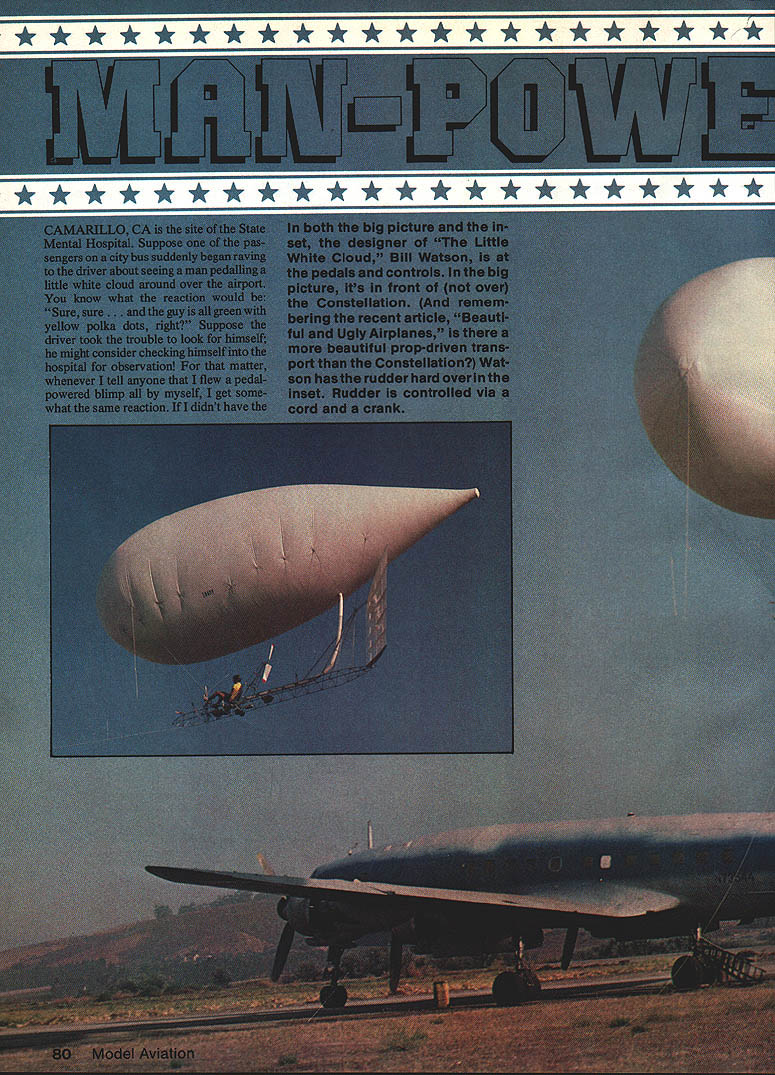
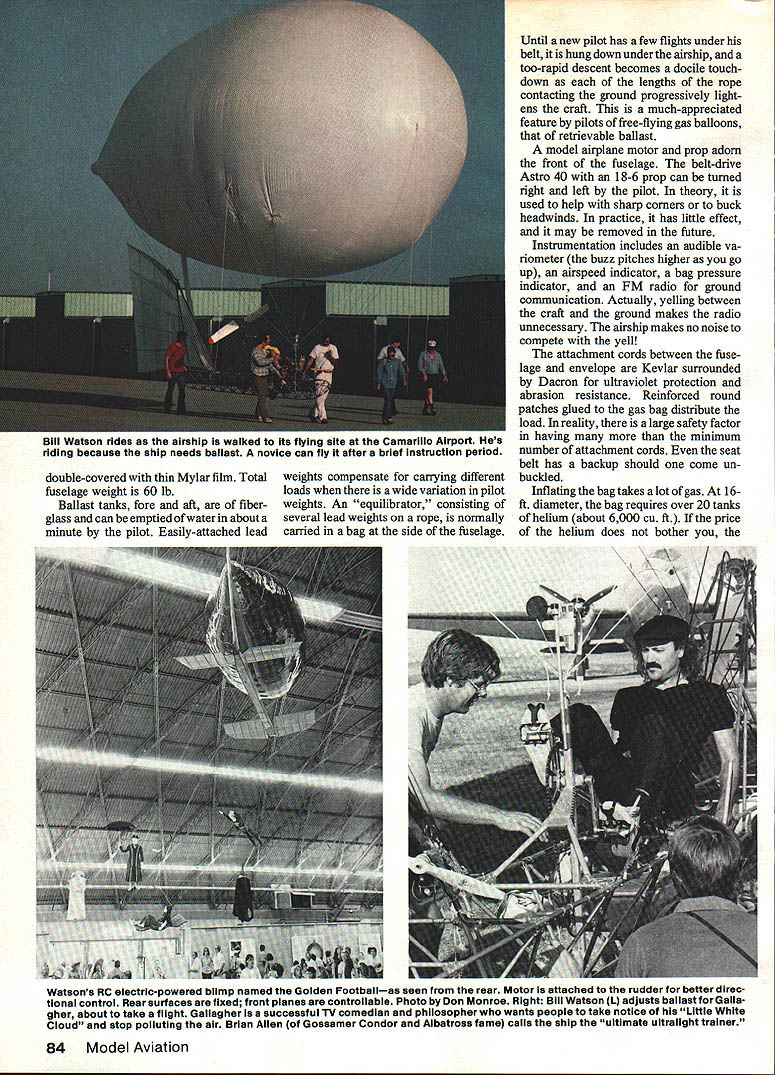
CAMARILLO, CA — Suppose one of the passengers on a city bus suddenly began raving to the driver about seeing a man pedalling a little white cloud over the airport. You know the reaction. I get much the same response whenever I tell anyone I flew a pedal-powered blimp by myself. If I didn't have the photos to prove it, I might wonder if it was all in my imagination.
The genius behind the "little white cloud" is Bill Watson of Van Nuys, CA. I've known him since his school days in the Sixties. He started making small homemade blimps from dry-cleaners' bags, heat-sealed with a soldering iron, rubber-band powered and filled with hydrogen he produced himself. Those early blimps would putter about in circles for minutes and were always the hit of our indoor scale meets.
Bill went on to help lead model-blimp activities in Los Angeles. Hundreds of youngsters built and flew blimps in our Aeroplanes and Flying Machines classes—first from dry-cleaners' bag material and later from better materials such as Zeppelin fabric and film.
Early radio-control blimps: the Golden Football
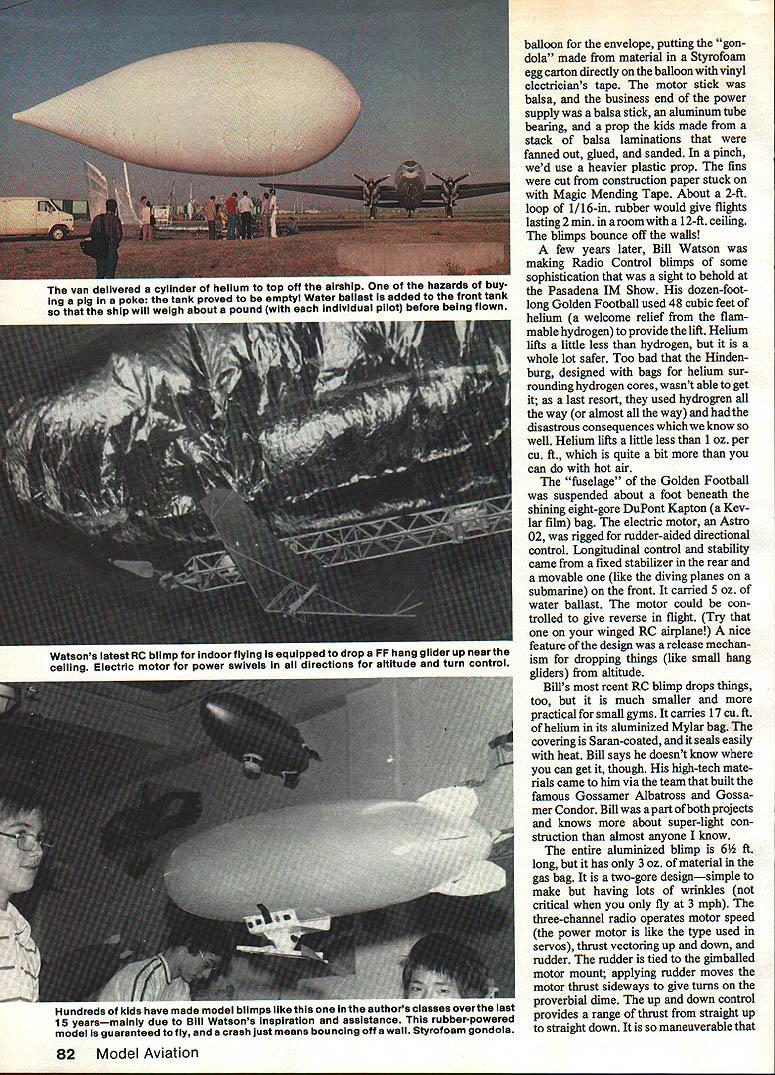
A memorable sight at the Pasadena IM Show was Bill's dozen-foot-long "Golden Football." It used about 48 cubic feet of helium (a welcome relief from flammable hydrogen). Helium lifts a little less than hydrogen (about 1 oz per cu. ft.) but is far safer.
Key features of the Golden Football:
- Eight-gore DuPont Kapton film envelope, shining and rigid-looking.
- Fuselage suspended about a foot beneath the envelope.
- Electric motor (Astro 02) with rudder-aided directional control.
- Longitudinal stability from a fixed rear stabilizer and a movable fore stabilizer (submarine-style diving planes).
- 5 oz water ballast in the nose; motor could be reversed in flight.
- A release mechanism to drop small items (e.g., model hang gliders) from altitude.
Small indoor RC blimps
Bill's more recent RC blimps were much smaller, suitable for gyms and indoor flying. One typical indoor model:
- Aluminized Mylar bag with Saran-coated seals, heat-sealed.
- About 17 cu. ft. helium capacity.
- Entire aluminized blimp about 6½ ft long; gas bag material weight ≈ 3 oz.
- Two-gore design (simple to make; surface wrinkles are acceptable at low speeds).
- Three-channel radio: motor speed, thrust-vectoring (up/down), and rudder.
- Rudder tied to a gimbaled motor mount so applying rudder moves motor thrust sideways for very tight turns.
- Thrust vectoring allows a thrust range from straight up to straight down, giving excellent maneuverability.
Hundreds of kids built rubber-powered or simple RC blimps in the author's classes over 15 years. Typical classroom construction items included Styrofoam egg-carton gondolas, balsa motor sticks, laminated balsa props, construction-paper fins, magic mending tape, and a small rubber loop (about 2 ft of 1/16-in. rubber) for 2-minute flights in a 12-ft room.
The man-powered airship project
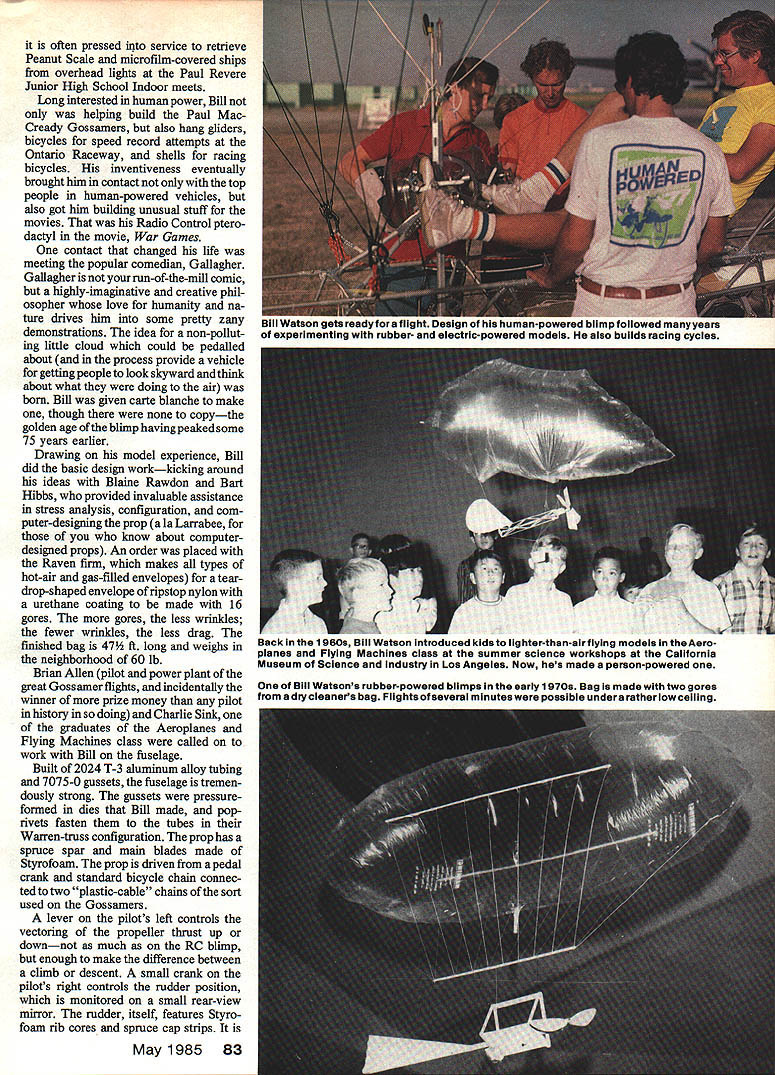
Bill Watson's interest in human-powered vehicles extended beyond models. He helped build Paul MacCready's Gossamer vehicles, hang gliders, racing bicycle shells and other human-powered craft. His work brought him into contact with designers and teams involved with the Gossamer Condor and Gossamer Albatross, which in turn provided access to some advanced, ultralight materials and construction techniques.
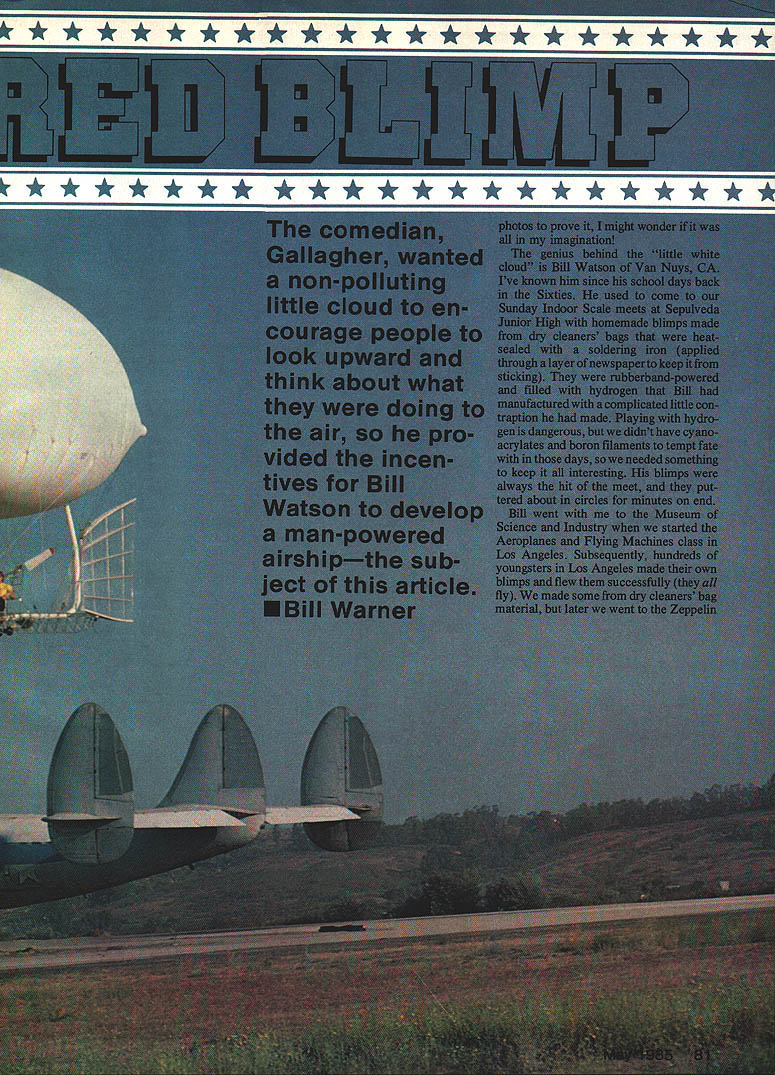
A life-changing contact for Bill was meeting the comedian Gallagher. Gallagher wanted a non-polluting little cloud that could be pedaled about as an attention-getting, eco-conscious demonstration. Bill was given carte blanche to design and build a man-powered airship.
Design team and envelope
Bill worked the design with help from Blaine Rawdon and Bart Hibbs (stress analysis, configuration) and used computer-designed prop techniques (à la Larrabee). An order was placed with the Raven firm for a teardrop-shaped envelope:
- Ripstop nylon with urethane coating.
- 16 gores (more gores = fewer wrinkles = less drag).
- Finished envelope: 47½ ft long, about 16 ft diameter, weight ≈ 60 lb.
- Inflating the bag requires a lot of gas: roughly 6,000 cu. ft. (over 20 helium tanks).
- Envelope cost: about $13,000.
Fuselage, propulsion and controls
Fuselage and drive:
- Built from 2024-T3 aluminum tubing and 7075-T6 gussets in a Warren-truss configuration.
- Gussets pressure-formed in dies Bill made; pop-riveted construction.
- Propeller: spruce spar with Styrofoam main blades, adjustable on the ground.
- Prop driven by a pedal crank and standard bicycle chain, coupled to two "plastic-cable" chains like those used on the Gossamers.
- A belt-drive Astro 40 with an 18x6 prop was mounted on the nose to assist with tight turns or headwinds (in practice it had limited effect and could be removed).
Pilot controls:
- Left lever: vectoring the propeller thrust up or down (affects climb/descent).
- Right crank: rudder position, monitored via a small rear-view mirror.
- Rudder construction: Styrofoam rib cores, spruce cap strips, double-covered with thin Mylar film.
- Total fuselage weight: about 60 lb.
Ballast and safety:
- Fore and aft fiberglass ballast tanks can be emptied of water in about a minute.
- Easily attached lead weights compensate for varying pilot weights.
- An "equilibrator" (several lead weights on a rope) is carried at the side of the fuselage. For novice pilots the equilibrator can trail to the ground during touchdown and progressively lighten the ship for a gentle descent—useful retrievable-ballast behavior borrowed from free-flying gas balloons.
- Attachment cords between the fuselage and envelope: Kevlar core surrounded by Dacron for UV protection and abrasion resistance; reinforced round patches glued to the gas bag distribute loads. Multiple redundant attachments and backup seat-belt features increase safety.
Instrumentation and communication:
- Audible variometer (pitch higher with climb).
- Airspeed indicator.
- Bag pressure indicator.
- FM radio for ground communication (rarely necessary; the craft is quiet and shouting suffices).
First flights at Camarillo
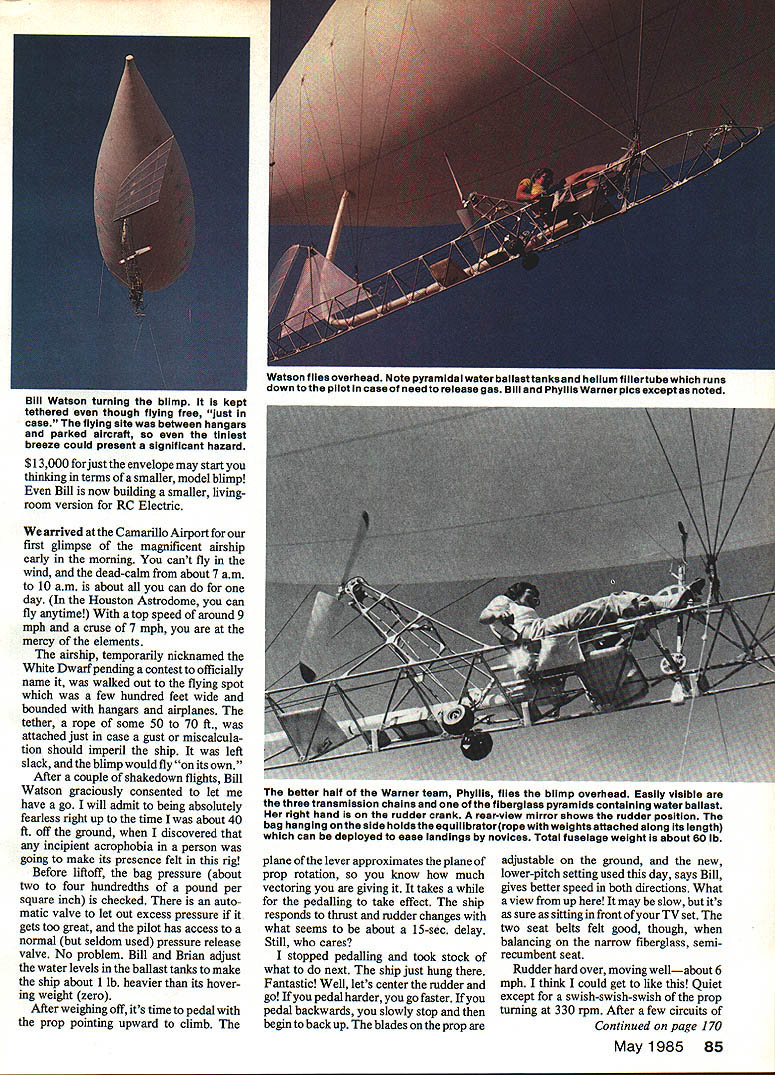
We arrived at the Camarillo Airport early; calm conditions (typically dead calm between 7 a.m. and 10 a.m.) are essential for flying this slow, low-powered craft. The airship, temporarily nicknamed the White Dwarf (later the Peripatetic Raindrop), was walked out and tethered with a slack 50–70 ft rope for safety.
Preflight checks and trim:
- Bag pressure checked (about 0.02–0.04 psi).
- Automatic and manual pressure-release valves provided.
- Water ballast adjusted so the ship sat slightly heavier than neutral hover (pilot supplies the pedaled thrust).
Flight characteristics:
- Top speed ≈ 9 mph, cruise ≈ 7 mph; at these speeds wind quickly dominates handling.
- The ship responds to thrust and rudder with a noticeable delay—roughly 10–15 seconds—so anticipation is required.
- Pedaling harder increases forward speed; pedaling backward can slow and produce reverse thrust.
- The prop's rpm was low (around 330 rpm on one flight), producing a gentle swish rather than a roar.
- The pilot sits semi-recumbent in a narrow fiberglass seat and uses two seat belts; visibility and the feeling of being aloft are memorable.
Training and public flights:
- After initial shakedown flights, Bill Watson let me pedal the craft to about 40 ft. up—an exhilarating experience that revealed a touch of acrophobia even in an otherwise fearless person.
- Throughout the morning experienced pilots (Bill, Brian, Charlie, Gallagher) and novices (my wife, Bill's 12-year-old nephew, a kindergarten teacher) all flew and enjoyed the ship.
- The craft proved easy to train on: Brian Allen called it "ludicrously easy to train someone in," and emphasized its structural strength.
Materials, costs and practical notes
Construction materials:
- Envelope: ripstop nylon with urethane coating (large manned envelope was costly and heavy).
- Small-model materials: aluminized Mylar or Saran-coated film, heat-sealable seams, Styrofoam gondolas, balsa props, and simple rubber power for rubber-powered models.
Costs and logistics:
- Large teardrop envelope: about $13,000 and hundreds of tanks of helium for inflation.
- For most hobbyists, small RC or rubber-powered models are far more practical and economical.
Modeling tips:
- For rubber-powered blimps: add weight until the model just hovers, then add a tad more so it settles when power runs out.
- If the prop is mounted below the gas bag, the thrust tends to pitch the nose up and the ship will climb naturally—similar to large blimps like the Goodyear.
- Vectored thrust is a useful refinement if you want precise RC control.
Uses and possibilities
- Promotional blimps are increasingly used for advertising and stunts (commercial models available).
- Military and surveillance interest exists in some countries for small, low-signature gas craft.
- A human-powered blimp could be adapted for short passenger rides (e.g., indoor venues) with souvenir photography or videotape sales.
- There is the imaginative possibility of human-powered blimp races as a sporting event.
Closing
Bill Watson's long experience with models, his work on human-powered vehicles, and his inventiveness produced an elegant, surprisingly practical man-powered airship. From dry-cleaners' bag models and classroom projects to a full-size pedal-powered craft, the progression shows how low-tech curiosity and lightweight construction can create something delightful and eye-opening.
— Bill Warner
Transcribed from original scans by AI. Minor OCR errors may remain.

