
Marcel Riffard's Speed Record Caudrons
Text and drawing by Harry Robinson
By the late 1930s it was generally accepted that all-metal construction and engines of 1,000 hp or more were essential requirements for any aircraft expected to set new speed records. Nevertheless, in Europe a number of constructors continued to build high-speed machines of wood and to make use of relatively low-powered engines. In England, the de Havilland engineers repeated the success of their 1934 racing Comet with the remarkable all-wood Albatross airliner, and successive models of Edgar Percival's Mew Gull continued to record the fastest speed in each year's King's Cup Race. Across the Channel, Marcel Riffard, Technical Director and Chief Engineer of Avions Caudron, continued to use wooden construction for a wide variety of racing, sport, training and even military aircraft.
Highly respected in France as a producer of virtually unbeatable thoroughbred racing machines, Riffard had already startled the American air-racing fraternity with his sleek "bolide bleu" Caudron C.460, flown with such devastating success by Michel Detroyat in the 1936 National Air Races at Los Angeles. The engineer directly responsible for this machine was Caudron's Chef du Bureau de Prototypes, Georges Otfinovsky, who had already established basic features of the design during Caudron preparation for the 1933 Coupe Deutsch de la Meurthe race at Étampes, south of Paris. Four examples of the much-improved C.460 type were constructed for the 1934 event and one of these, fitted with a neatly spatted fixed landing gear and redesignated C.450, won that year's Coupe Deutsch race over 2,000 km. The following year, with retractable landing gear fully resolved, the C.460 won at 275.9 mph and set a 1,000 km closed-course record of almost 278 mph; another placed second at 263.6 mph and a third, flown at full throttle, set a new 100 km closed-course mark of 291.6 mph. The success of Detroyat and the C.460s needs no repetition.
French efforts to regain speed records
During 1935–36 the French Air Ministry accelerated its active encouragement of the aircraft industry to regain France's pre-eminence in the world's aviation records, many of which were held by Italy, Germany and the USA. Caudron's landplane speed record, returned to the United States in September 1935 by Howard Hughes' figure of 352.46 mph, prompted Marcel Riffard to determine that Caudron aircraft should recapture the prize for France.
Record attempts followed. The C.561, a radically modified development of the C.460 originally intended for the 1936 Coupe Deutsch race, was unsuccessful. Riffard's next thought was an all-wood C.710 light fighter; the prototype-stage project received the designation C.711, to have retractable landing gear and increased power, but this was soon abandoned. Riffard then decided to combine the fuselage of the C.710 with the proven Coupe Deutsch-type wing and a retractable undercarriage. Design of the new aircraft was carried out by the same team under Maurice Devlieger, Caudron's Chef du Bureau de Série, who was already working on development of the C.710 fighter. The composite machine, designated C.712, used the wing, undercarriage and horizontal tail of the C.560 aircraft built for the Coupe Deutsch race of 1935, mated to the revised fuselage.
The C.712 arrived at the military airfield of Istres, some 23 miles west of Aix-en-Provence, on 22 December 1936. Take-off, climb and handling characteristics were excellent, but extensive engine/propeller modifications proved necessary. In a record attempt on 29 April 1937 the revised C.712 was destroyed when control was lost following elevator damage caused during takeoff by flying stones which covered most of the field in great profusion. Raymond Delmotte, Caudron's chief test pilot, descended safely by parachute.
Nevertheless, the C.712 had amply demonstrated the practicability of the C.560/C.710 formula and had been timed at a speed between 385 and 390 mph while still accelerating more than a mile from the start of the 3-km course. Only a quarter of an hour after his accident, Delmotte was confidently speaking of trying again with a new aircraft, and before the end of May Riffard had decided to build a more developed machine.
Development of the C.714R
A small design team, headed by Georges Otfinovsky, immediately began work on the new aircraft. Most features of the new design were originated by Riffard himself and it was Riffard's very considerable experience and expertise which determined the general layout and all structural innovations of the new machine. Construction began in June or July 1937 but proceeded slowly, largely through lack of capital at the factory and the partial mobilization of French manpower during the years prior to September 1939.
For over a year the new aircraft was referred to by Riffard as "a derivative of the C.712," and was in fact first designated C.712.R (R = record) to indicate both its function and its descent from the earlier machine. By early 1938 it had become necessary to pursue the Armée de l'Air role of the light fighter, which by then had been developed into a more acceptable prototype designated C.714. It was decided to redesignate the record aircraft to suggest that both it and the fighter were of a common type. Thus, when the record aircraft had proved itself, the Armée de l'Air would, it was expected, be more easily convinced of the value of the fighter. By June 1938 the C.712.R had been redesignated C.714.R. In reality the only components common to both machines were the basic fuselage truss, the capacity of the 19-litre Renault engine and the name Caudron.
However, capital for completing the C.714R and financing an attempt on the record was still not available and the unfinished C.714R remained in its hangar at Issy-les-Moulineaux. Following an order for twenty C.R.714 C1 fighters in November 1938, Avions Caudron was obliged to concentrate on military production and work on the record aeroplane was brought almost to a standstill.
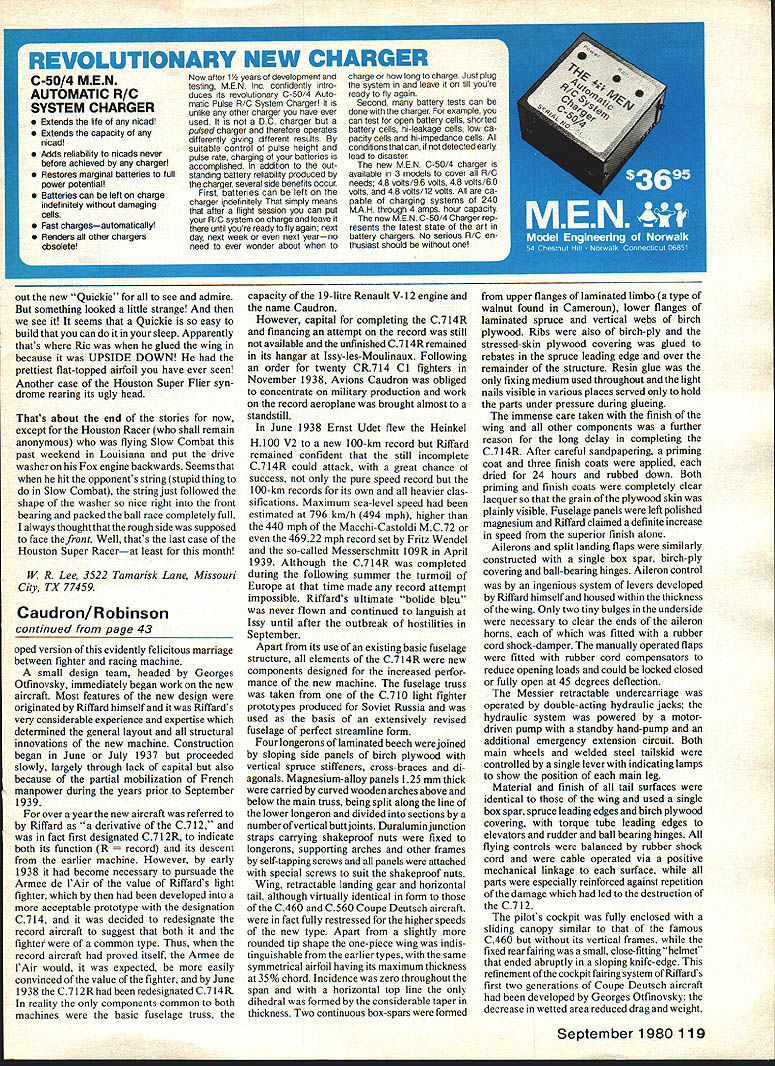
In June 1938 Ernst Udet flew the Heinkel H.100 V2 to a new 100-km record but Riffard remained confident that the still incomplete C.714R could attack, with a great chance of success, not only the pure speed record but the 100-km records for its own and all heavier classifications. Maximum sea-level speed had been estimated at 796 km/h (494 mph), higher than the 440 mph of the Macchi-Castoldi M.C.72 or even the 469.22 mph record set by Fritz Wendel and the so-called Messerschmitt 109R in April 1939. Although the C.714R was completed during the following summer, the turmoil of Europe at that time made any record attempt impossible. Riffard's ultimate "bolide bleu" was never flown and continued to languish at Issy until after the outbreak of hostilities in September.
Design and construction details
Apart from its use of an existing basic fuselage structure, all elements of the C.714R were new or components designed for the increased performance of the new machine. The fuselage truss was taken from one of the C.710 light fighter prototypes produced for Soviet Russia and was used as the basis of an extensively revised fuselage of perfect streamline form.
- Four longerons of laminated beech were joined by sloping side panels of birch plywood with vertical strut stiffeners, cross-braces and diagonals.
- Magnesium-alloy panels 1.25 mm thick were carried by curved wooden arches above and below the main truss, being split along the line of the lower longeron and divided into sections by a number of vertical butt joints.
- Duralumin junction straps carrying shackle-proof nuts were fixed to longerons, supporting arches and other frames by self-tapping screws, and all panels were attached with special screws to suit the shackle-proof nuts.
Wing, retractable landing gear and horizontal tail, although virtually identical in form to those of the C.460 and C.560 Coupe Deutsch aircraft, were in fact fully restressed for the higher speeds demanded of the new type. Apart from a slightly more rounded tip shape the one-piece wing was indistinguishable from the earlier types, with the same symmetrical airfoil having its maximum thickness at some 35% chord. Incidence was zero throughout the wing, and with a horizontal top line the only dihedral was formed by the considerable taper in thickness.
Two continuous box spars were formed from upper flanges of laminated limba (a type of walnut found in Cameroun), lower flanges of laminated spruce and vertical webs of birch plywood. Ribs were also of birch-ply and the stressed-skin plywood covering was glued to rebates in the spruce leading edge and over the remainder of the structure. Resin glue was the only fixing medium used throughout and the light nails visible in various places served only to hold the parts under pressure during gluing.
The immense care taken with the finish of the wings and all other components was a further reason for the long delay in completing the C.714R. After careful sandpapering, a priming coat and three finish coats were applied, each dried for 24 hours and rubbed down. Both priming and finish coats were completely clear lacquer so that the grain of the plywood skins was plainly visible. Fuselage panels were left polished and Riffard claimed a definite increase in speed from the superior finish alone.
Ailerons, flaps and control linkages
Ailerons and split landing flaps were similarly constructed with a single box-spar, birch-ply covering and ball-bearing hinges. Aileron control was by an ingenious system of levers developed by Riffard himself and housed within the thickness of the wing. Only two thin tubes in the underside were necessary to clear the ends of the aileron horns, each of which was fitted with a small rubber shock-damper. The manually operated flaps were fitted with rubber cord compensators to reduce loads and could be locked closed or fully open at 45° deflection.
Undercarriage
The Messier retractable undercarriage was operated by double-acting hydraulic jacks; the hydraulic system was powered by a motor-driven pump with a standby hand-pump and an additional emergency extension circuit. Both main wheels and the welded steel tailskid were controlled by a single lever with indicating lamps to show the position of each main leg.
Tail surfaces and controls
Material and finish of all tail surfaces conformed in detail to those of the wing and used a single box spar, spruce leading edges and birch plywood covering, with torque-tube leading edges to elevators and rudder and ball-bearing hinges. All flying control and balance loads were carried by rubber shock-cord and were cable operated via a positive mechanical linkage to each surface, while all parts were especially reinforced against repetition of the damage which had led to the destruction of the C.712.
Cockpit, canopy and pilot accommodations
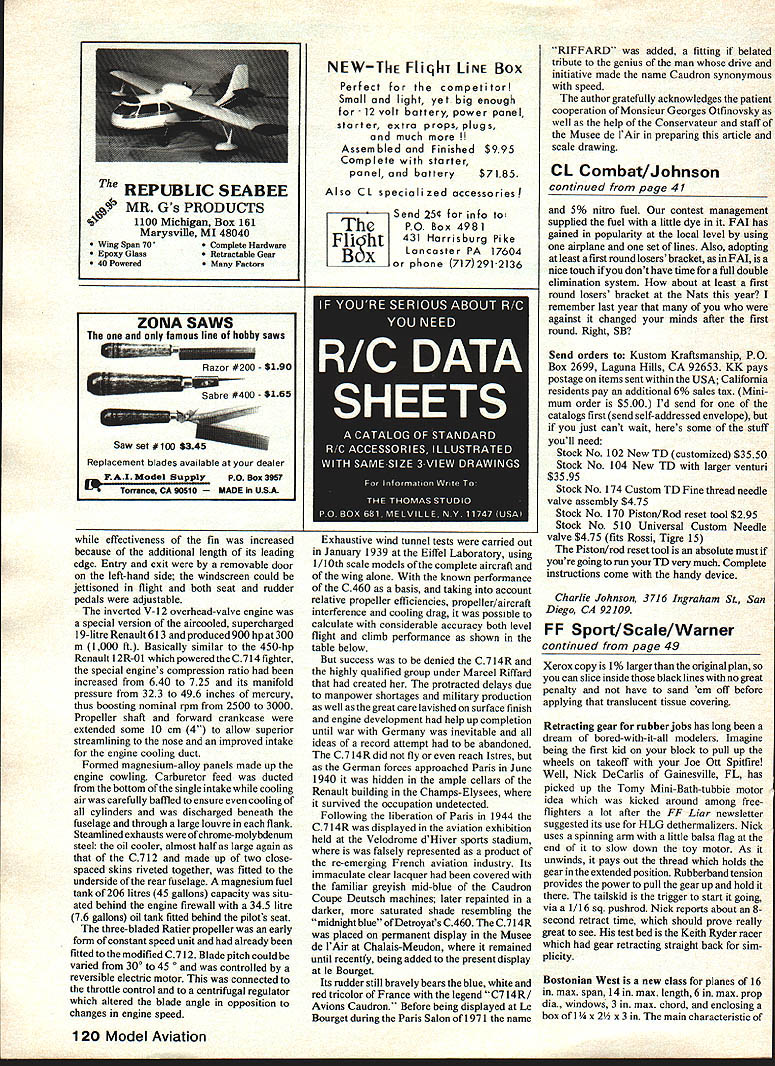
The pilot's cockpit was fully enclosed with a sliding canopy similar to that of the famous C.460 but without its vertical frames; the fixed rear fairing was a small, close-fitting "helmet" that sloped down abruptly into a sloping knife-edge. This refinement of the cockpit fairing system of Riffard's two generations of Coupe Deutsch aircraft had been developed by Georges Otfinovsky; the decrease in wetted area reduced both drag and weight while effectiveness of the fin was increased because of the additional length of its leading edge. Entry and exit were by a removable door on the left-hand side; the windscreen could be jettisoned in flight and both seat and rudder pedals were adjustable.
Engine, cooling and fuel
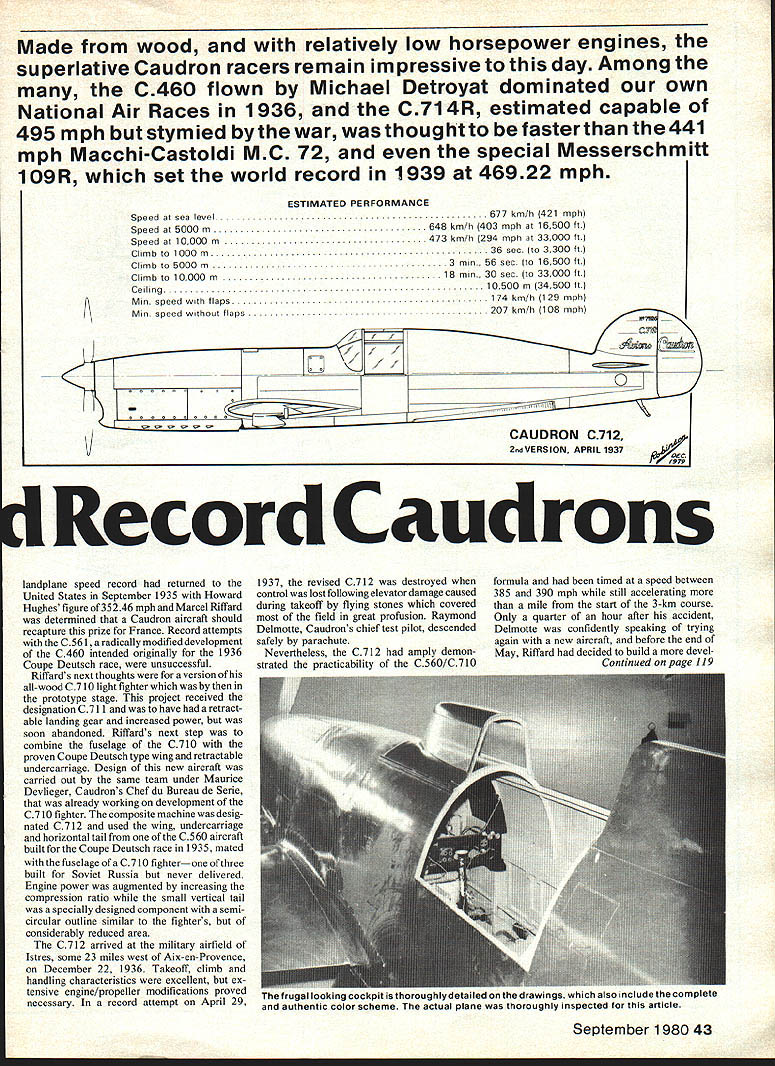
The inverted V-12 overhead-valve engine was a special version of the air-cooled, supercharged 19-litre Renault and produced 900 hp at 3,000 m (1,000 ft.). Basically similar to the 450-hp Renault 12R-01 which powered the C.714 fighter, the special engine's compression ratio had been increased from 6.40 to 7.25 and its manifold pressure from 32.3 to 49.6 inches of mercury, thus boosting nominal rpm from 2,500 to 3,000. Propeller shaft and forward crankcase were extended some 10 cm (4") to allow superior streamlining to the nose and an improved intake for the engine cooling duct.
Formed magnesium-alloy panels made up the engine cowling. Carburettor feed was ducted from the bottom of the single intake while cooling air was carefully baffled to ensure adequate cooling of all cylinders and was discharged beneath the fuselage and through a large louvre in each flank. Streamlined exhausts were of chrome-molybdenum steel; the oil cooler, almost half as large again as that of the C.712 and made up of two close-spaced skins riveted together, was fitted to the underside of the rear fuselage. A magnesium fuel tank of 206 litres (45 gallons) capacity was situated behind the engine firewall with a 34.5 litre (7.6 gallons) oil tank fitted behind the pilot's seat.
Propeller and governor
The three-bladed Ratier propeller was an early form of constant-speed unit and had already been fitted to the modified C.712. Blade pitch could be varied from 30° to 45° and was controlled by a reversible electric motor. This was connected to the throttle control and to a centrifugal regulator which altered the blade angle in opposition to changes in engine speed.
Testing, tunnel work and performance estimates
Exhaustive wind-tunnel tests were carried out in January 1939 at the Eiffel Laboratory, using 1/10th scale models of the complete aircraft and of the wing alone. With the known performance of the C.460 as a basis, and taking into account relative propeller efficiencies, propeller/airscrew interference and cooling drag, it was possible to calculate with considerable accuracy both level flight and climb performance.
But success was to be denied the C.714R and the higher quality groupe under Marcel Riffard that had created her. The protracted delays due to manpower shortages and military production as well as the great care lavished on surface finish and engine development had held up completion until war with Germany was inevitable and all ideas of a record attempt had to be abandoned. The C.714R did not fly or even reach Istres, but as the German forces approached Paris in June 1940 it was hidden in the ample cellars of the Renault building in the Champs-Élysées, where it survived the occupation undetected.
Post-war display and legacy
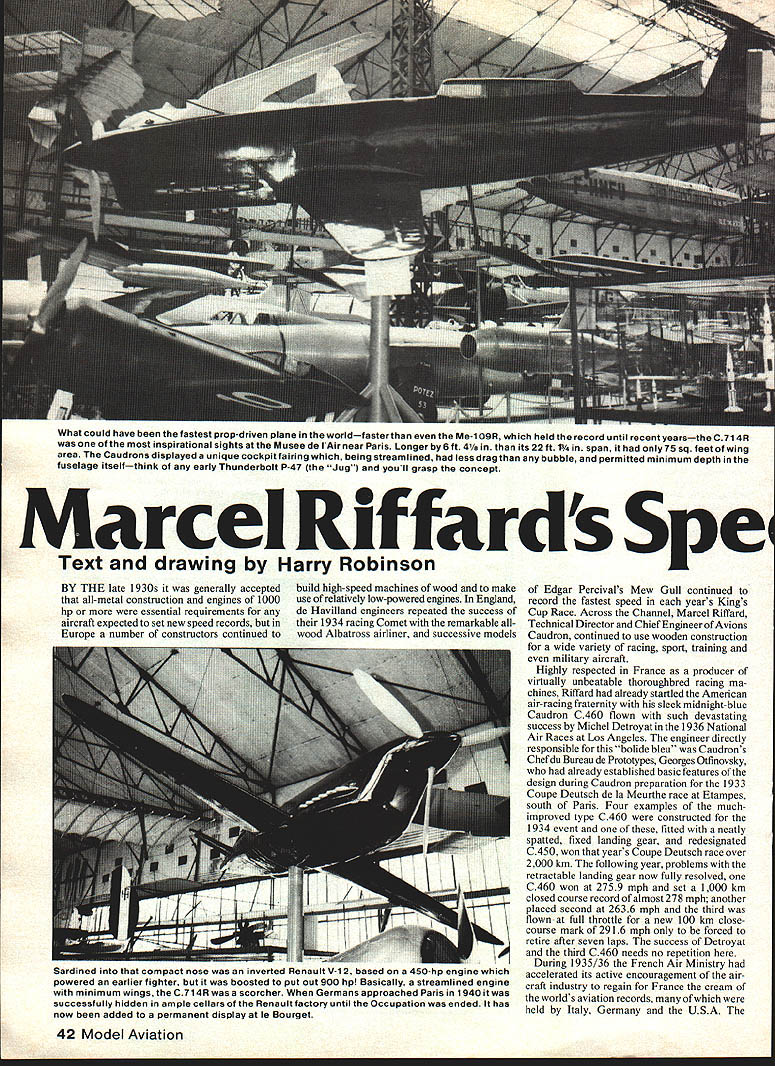
Following the liberation of Paris in 1944 the C.714R was displayed in the aviation exhibition held at the Vélodrome d'Hiver sports stadium, where it was falsely represented as a product of the re-emerging French aviation industry. Its immaculate clear lacquer had been covered with the familiar greyish mid-blue of the Caudron Coupe Deutsch machines; later it reappeared in a darker, more saturated shade resembling the "midnight blue" of Detroyat's C.460. The C.714R was placed on permanent display in the Musée de l'Air at Chalais-Meudon, where it remained until recently, being added to the present display at Le Bourget.
Its rudder still bravely bears the blue, white and red tricolour of France with the legend "C714R / Avions Caudron." Before being displayed at Le Bourget during the Paris Salon of 1971 the name "RIFFARD" was added, a fitting if belated tribute to the genius of the man whose drive and initiative made the name Caudron synonymous with speed.
Acknowledgements
The author gratefully acknowledges the patient cooperation of Monsieur Georges Otfinovsky as well as the help of the conservateur and staff of the Musée de l'Air in preparing this article and scale drawing.
Transcribed from original scans by AI. Minor OCR errors may remain.

