
MARCS National Sailplane Symposium
Byron Blakeslee
Overview
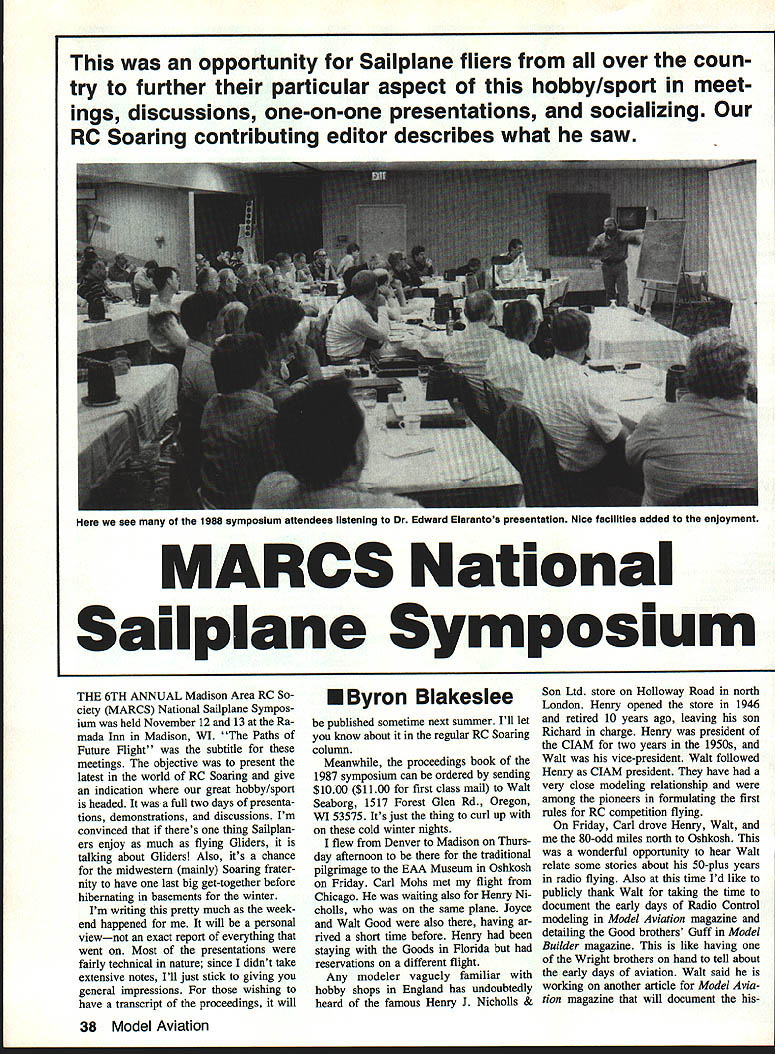
The 6th annual Madison Area RC Society (MARCS) National Sailplane Symposium was held November 12–13 at the Ramada Inn, Madison, WI. The subtitle was "Paths to Future Flight." The objective was to present the latest in R/C soaring and give an indication of where the hobby/sport is headed. The meeting featured two full days of presentations, demonstrations, panel discussions, vendor exhibits, and socializing. Attendance was about 90.
A proceedings book from the 1987 symposium can be ordered for $10.00 ($11.00 first-class) from:
- Walt Seaborg, 1517 Forest Glen Rd., Oregon, WI 53575
Trip to the EAA Museum, Oshkosh
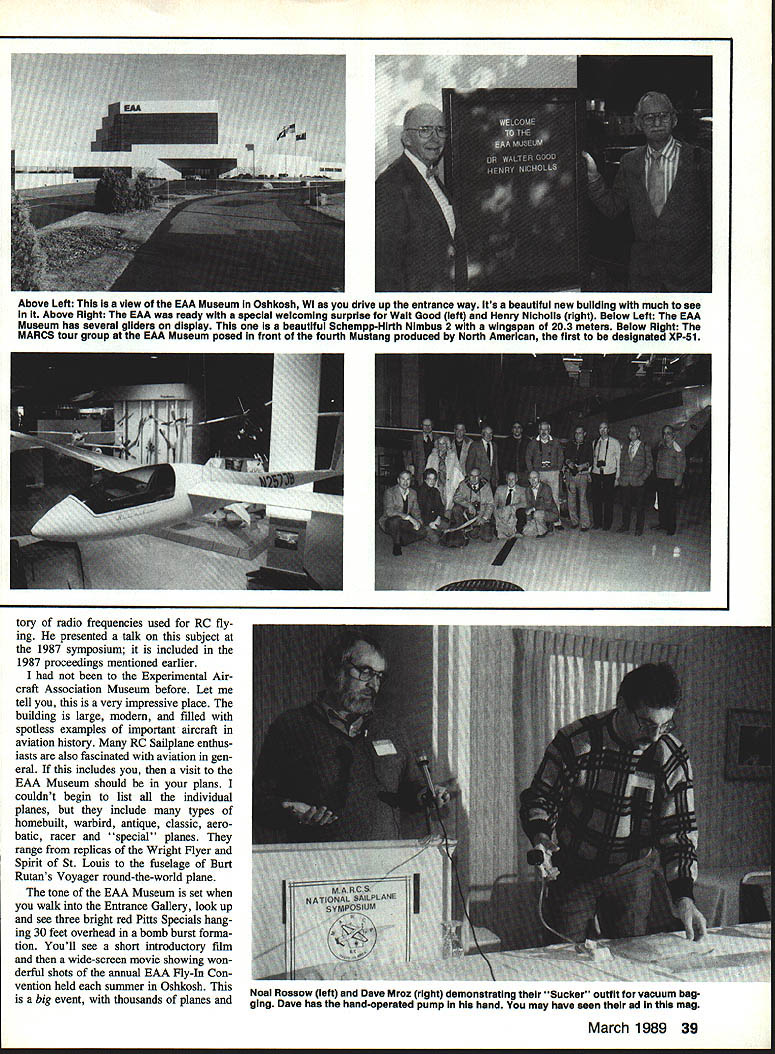
A traditional pilgrimage to the Experimental Aircraft Association (EAA) Museum in Oshkosh took place Friday. A group of about 16 sailplane enthusiasts received a VIP tour from Gene Chase, an EAA director and retired Navy pilot. Highlights of the museum tour:
- Large modern building with many spotless examples of historic aircraft
- Replicas and originals ranging from Wright Flyer and Spirit of St. Louis to Burt Rutan’s Voyager
- Entrance Gallery display with three bright red Pitts Specials suspended overhead
- A widescreen film of the annual EAA Fly-In (over 400,000 attendees during the week)
- Special access to the Pioneer Airport hangars (not normally open to visitors)
Participants included Carl Mohs, Henry J. Nicholls (of Henry J. Nicholls & Son Ltd., Holloway Road, London), Joyce and Walt Good, and others. Henry Nicholls opened his famous London hobby shop in 1946 and served as CIAM president in the 1950s; Walt Good followed as CIAM president. Their long history in international R/C competition was a theme of the trip.
Symposium Sessions and Presentations
Opening Remarks and Early Days of R/C
Chairman Bill Vogel opened the symposium. Walt Good led off with slides and reminiscences about the early postwar days of international R/C competition and friends such as Henry Nicholls. Walt also described his "Gutsy Lady" — a Carl Goldberg Gentle Lady modified with a strengthened wing and a Selig 4061 airfoil:
- CG at about 41% (far aft) and no washout at the tips
- Composite spruce and carbon fiber spars built using 2×2 aluminum angle to clamp pieces straight while epoxy cures
- Satin-finished fiberglass covering bonded to wood/epoxy; Monokote used to keep epoxy from sticking to aluminum
Walt’s historical articles/documentation appear in Model Aviation and Model Builder magazines.
Vacuum Bag Composite Wing Construction
Presenters: Noal Rossow and Dave Mroz (Composite Aircraft Engineering and Supply)
They demonstrated vacuum bagging foam cores with balsa, hardwood, and glass skins. Notable items:
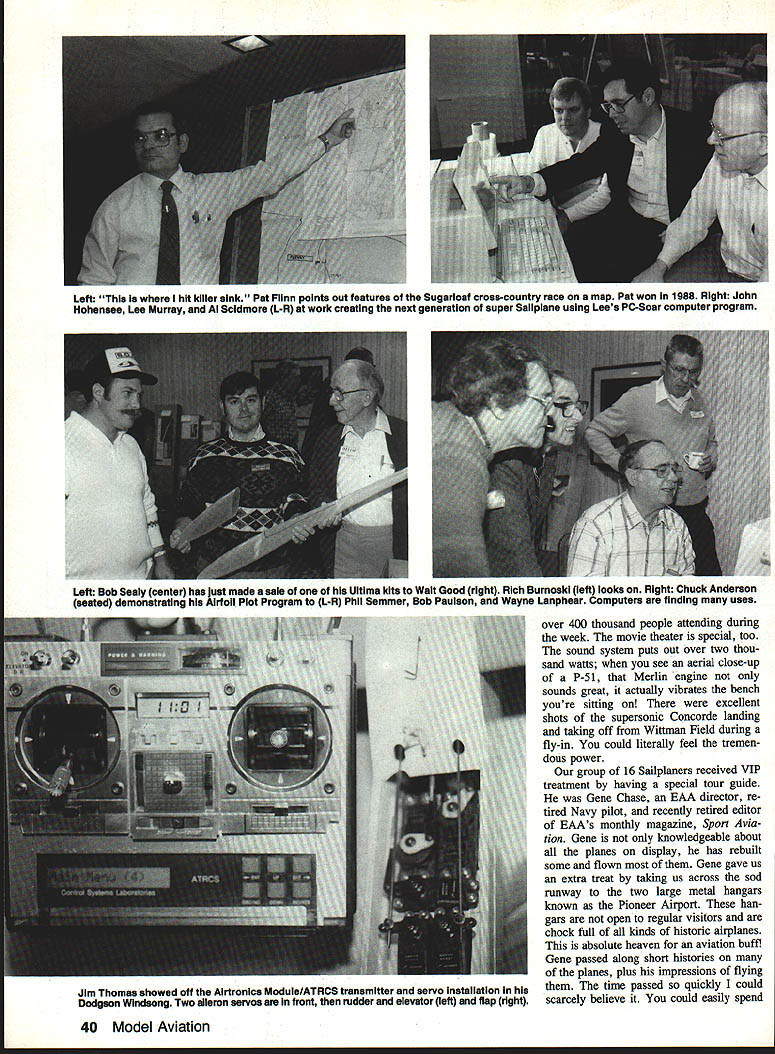
- A hand-operated vacuum pump (the "Sucker Kit") that looks like a pop-rivet tool with a small gauge
- With careful sealing (Mortite caulking) and pre-evacuation, the hand pump achieves about 5 in. Hg — sufficient for white foam
- The Sucker Kit includes pump, hose, clamps, poly bag material, and instructions
- Show special price: $45; regular kit $59.95
- They also sell wood wing skin material (white birch 0.018 in., African mahogany), graphite tape, 14‑mil Mylar, arrow shaft hinge kits, and plan a how-to video (available in April for $39.95)
Contact:
- Composite Aircraft Engineering and Supply, Box 860, Lapeer, MI 48446; phone 1-313-664-3330
Crescent-Shaped Wings
Presenter: Charles Fox
Charles discussed experiments with crescent-shaped wing planforms (swept leading outer portions with straight trailing edge), inspired by Wil Schuemann’s modification of the AS-W 12. Schuemann’s tests and tuft-flow observations showed trailing-edge flow from tip to root causing induced drag; swept tips (the "Schuemann" planform) reduced that effect. The planform influenced the Schempp-Hirth Discus and has become popular on F3B and cross-country (X-C) models.
Electric Sailplanes
Presenter: Craig Christensen
Craig reviewed developments in electric sailplane flying:
- Electrification is growing for fields too small for winch/hi-start use
- Modern batteries, motors, and controllers make electric launches accessible
- Kits such as the Airtronics Eclipse can be bought complete with a motor for about $50
- High-performance F3E setups use large motors (e.g., 60-size Astroflight) and many cells; these planes climb very steeply and fly fast despite heavy wing loadings (20+ oz/ft²) and can still thermal well
- Many audience questions addressed best motor/prop/battery/controller combinations and installation techniques
Contact:
- Craig Christensen, 16550 Linch Path, Lakeville, MN 55044; phone 1-612-435-7406
How to Design a "Perfect" Sailplane
Presenter: David Fraser
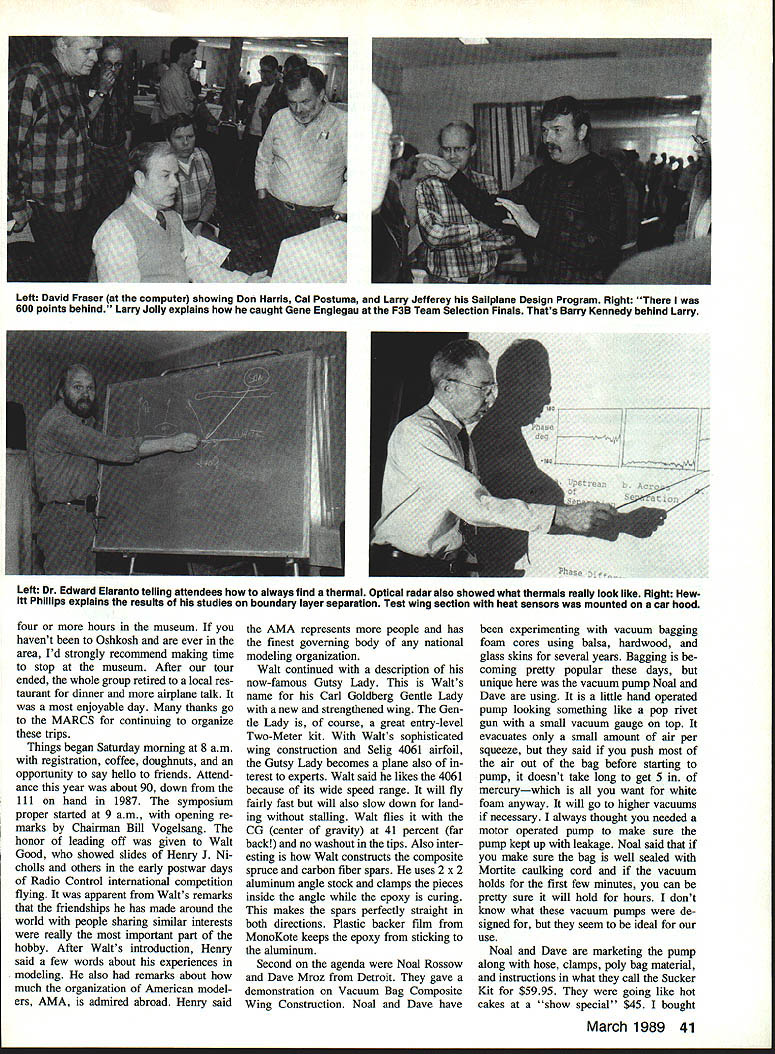
David demonstrated his computer program "Sailplane Design 2.0" which compares model sailplane configurations using low-speed aerodynamic equations and stored airfoil data. Features:
- Accepts airfoil data files, fuselage data, CG, control surface areas, inertial data
- Calculates lift/drag polars and plots effects of airfoil changes, CG shifts, tailplane incidence, weight/location changes, etc.
- Allows interactive parameter changes to see performance effects without trial and error
Program:
- Price $35 (will include Selig-Donovan wind-tunnel data soon)
Contact:
- David Fraser, 1335 Slayton Drive, Maple Glen, PA 19002
F3B Panel Discussion
Panel members: Larry Jolly, Bob Sealy, Rich Burnoski, Wayne Fredette, Byron Blakeslee
- Bob Sealy showed slides from the F3B Team Selection Finals (Los Angeles)
- Rich Burnoski emphasized that F3B is "the ultimate" and compared it to the Olympics of sailplane flying
- The panel discussed the elite skill level required for team selection and the spectator appeal of high-level F3B contests
Computers, Software, and Design Tools
- David Fraser, Lee Murray, and John Hohensee demonstrated sailplane design programs:
- Lee Murray: PC-Soar (IBM compatibles)
- John Hohensee: MaxSoar (Apple Macintosh)
- Contact for PC-Soar: Lee Murray, 1300 N. Bay Ridge Rd., Appleton, WI 54915-2854; phone 1-414-731-4848
- Chuck Anderson demonstrated Airfoil Plot and Wing Design programs that generate scaled airfoils and design tapered wings with skin thickness, spars, and washout
- Contact: Chuck Anderson, Box 305, Tullahoma, TN 37388
- Bob Sealy displayed the new Ultima (129 in. span) thermal ship and fiberglass fuselages (catalog via SASE)
- Contact: Bob Sealy, 521 96th N.E., Blaine, MN 55434
- Jim Thomas demonstrated ATRC-converted Airtronics Module transmitters using his Dodgson Windsong; he favors ATRC computer encoding and described an installation with elevated aileron servos
- Vendors and sellers at the show included Tom Gressman (kits), Wayne Fredette (wood, starter motor drums), and Noal & Dave with Sucker kits and composite materials
Meteorology for Modelers
Presenter: Dr. Edward Elaranto (University of Wisconsin)
Dr. Elaranto, a full-size sailplane pilot and meteorologist specializing in optical radar, showed how optical radar (laser-based) can visualize thermals:
- Optical radar detects rising air by sensing minute dust particles carried in the updrafts
- Displays and time-lapse videotapes showed thermals developing from small plumes to larger structures as the sun warms the ground
- Thermals often form in lines and are affected by topography; they are irregular and "shimmy" rather than being circular bubbles
- Visualization changes the way the presenter and attendees thought about finding and using lift
Trends in F3B Design
Presenter: Larry Jolly
Larry (U.S. F3B team member) discussed trends and team preparations:
- Team requires intensive practice and equipment; projected practice budget about $30,000 for travel and practice sessions
- Trend toward smaller, lighter planes and reduced-power winches so that speed tasks test airframe strength and flying skill rather than sheer launch height
- Larry hopes reduced-power winch rules will be used for upcoming world championships to level launch advantages
Detecting Boundary Layer Separation
Presenter: Hewitt Phillips
Hewitt described experiments to detect airflow separation and turbulence on model wings using electronic sensors:
- Lacking a wind tunnel, he built a "rolling wind tunnel" by mounting a wing above his car and driving
- Used microphonic-type sensors, hot-wire anemometers, and an array of electronic probes to detect where flow detached, was turbulent, and reattached
- Computer-enhanced sensor arrays provided visualizations of separation and turbulence across the wing span
Banquet and After-Dinner Program
Saturday evening featured a buffet banquet and a slide program. Steve Metz of Minnesota presented slides on model and full-size glider flying in Europe, including material from the Vintage Rally in Bourges, France (July 1987), which illustrated vintage-glider activity and camaraderie.
Conclusion
The MARCS National Sailplane Symposium offered a valuable mix of technical presentations, practical demonstrations, vendor exhibits, and social interaction. Topics ranged from construction techniques, composite bagging, and modern airfoils to computer-based design tools, electric propulsion, meteorology, and high-level competition trends. The event provided many ideas, contacts, and resources to take home for winter projects and left attendees looking forward to next year’s symposium.
Transcribed from original scans by AI. Minor OCR errors may remain.

