
MARCS' NEW FIELD
— Walt Seaborg
Background
A situation that at first seemed like disaster was turned around to produce an RC flying site which almost any club can look at with considerable envy.
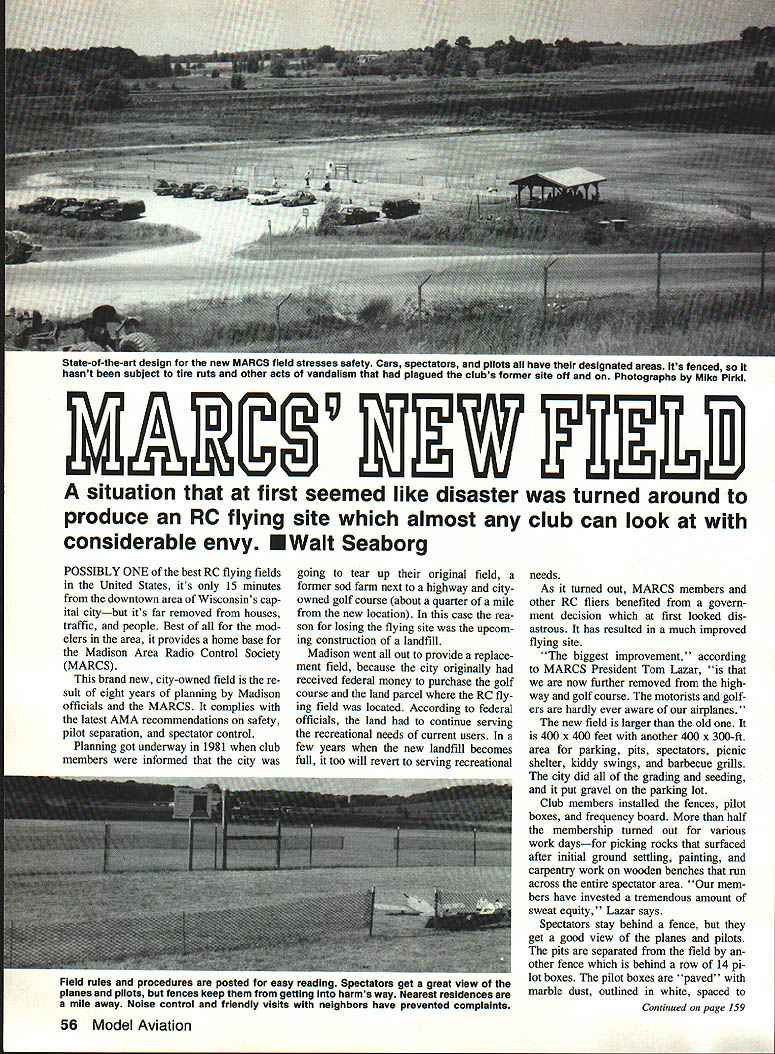
Possibly one of the best RC flying fields in the United States, it is only 15 minutes from the downtown area of Wisconsin's capital city—but it is far removed from houses, traffic, and people. Best of all for local modelers, it provides a home base for the Madison Area Radio Control Society (MARCS).
This brand-new, city-owned field is the result of eight years of planning by Madison officials and MARCS. It complies with the latest AMA recommendations on safety, pilot separation, and spectator control.
Planning got underway in 1981 when club members were informed that the city was going to tear up their original field, a former sod farm next to a highway and a city-owned golf course (about a quarter of a mile from the new location). In this case, the reason for losing the flying site was the upcoming construction of a landfill. Madison went all out to provide a replacement field because the city originally had received federal money to purchase the golf course and the land parcel where the RC flying field was located. According to federal officials, the land had to continue serving the recreational needs of current users. In a few years, when the new landfill becomes full, it too will revert to serving recreational needs.
As it turned out, MARCS members and other RC fliers benefited from a government decision which at first looked disastrous. It resulted in a much improved flying site.
Field layout and facilities
"The biggest improvement," according to MARCS President Tom Lazar, "is that we are now further removed from the highway and golf course. The motorists and golfers are hardly ever aware of our airplanes."
Field features:
- Flying area: 400 x 400 feet.
- Additional area: 400 x 300 feet for parking, pits, spectators, picnic shelter, kiddy swings, and barbecue grills.
- City-provided grading, seeding, and gravel for the parking lot.
- Fences separating spectators and pits from the flying area.
- A row of 14 pilot boxes; pilot boxes are "paved" with marble dust, outlined in white, and spaced to prevent frequency interference.
- All other areas marked off with fences or white lines.
- Professionally lettered signs that designate each area and spell out the rules.
Club effort and improvements
Club members installed the fences, pilot boxes, and frequency board. More than half the membership turned out for various work days to pick rocks that surfaced after initial ground settling, paint, and perform carpentry on wooden benches that run across the entire spectator area.
"Our members have invested a tremendous amount of sweat equity," Lazar says.
Maintenance, safety, and neighborhood relations
For maintenance, the golf course crews mow the grass and control weeds. Even though the new field is surrounded mainly by the landfill and woods, the club is diligent about enforcing silencer rules. The nearest houses are almost a mile away, but club officers made a point of visiting residents within potential earshot. They informed the flying-field neighbors about MARCS and showed them model airplanes. After the first full season of flying, there have been no noise complaints.
There are no foul odors or unsightly views presented by the landfill. Bulldozers constantly bury the trash and garbage, and operations are done beyond a hill out of sight of the field. An added security bonus is that the entire area is fenced. Club members have keys to the landfill gate and lock up after the last flight each evening. That locked gate has stopped the vandalism that occasionally scarred the old unprotected field with vehicle tracks.
The field was named several years ago in honor of the late Roger W. Kettle, a top RC flier and club member who had a special gift for instructing new pilots.
Cooperation and conclusion
Getting this great new flying site has been a major effort by MARCS members, officers, and the field committee. The club realized early on that cooperation with city engineers and elected officials was the only way for the project to succeed.
"We couldn't have done it without constant communication among all concerned," Lazar says. "We kept our members informed, and they guided us every step of the way. Our club leaders met regularly with the city engineers. We did our best to inform our neighbors. You can't miss when you have this kind of cooperation."
Transcribed from original scans by AI. Minor OCR errors may remain.

