
Mariha 1
David Andersen Photos by George Otis
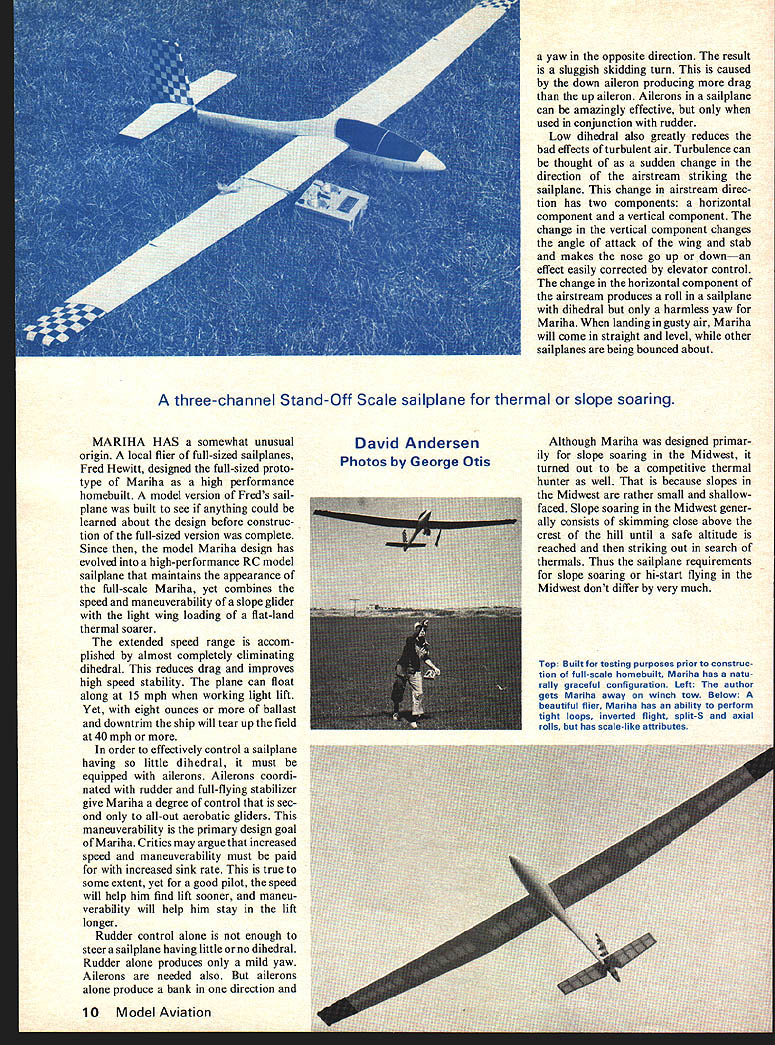
MARIHA HAS a somewhat unusual origin. A local flier of full-sized sailplanes, Fred Hewitt, designed the full-sized prototype of Mariha as a high-performance homebuilt. A model version of Fred's sailplane was built to see if anything could be learned about the design before construction of the full-sized version was complete. Since then, the model Mariha design has evolved into a high-performance RC model sailplane that maintains the appearance of the full-scale Mariha, yet combines the speed and maneuverability of a slope glider with the light wing loading of a flat-land thermal soarer.
The extended speed range is accomplished by almost completely eliminating dihedral. This reduces drag and improves high-speed stability. The plane can float along at 15 mph when working light lift. Yet, with eight ounces or more of ballast and downtrim the ship will tear up the field at 40 mph or more.
In order to effectively control a sailplane having so little dihedral, it must be equipped with ailerons. Ailerons coordinated with rudder and full-flying stabilizer give Mariha a degree of control that is second only to all-out aerobatic gliders. This maneuverability is the primary design goal of Mariha. Critics may argue that increased speed and maneuverability must be paid for with increased sink rate. This is true to some extent, yet for a good pilot, the speed will help him find lift sooner, and maneuverability will help him stay in the lift longer.
Rudder control alone is not enough to steer a sailplane having little or no dihedral. Rudder alone produces only a mild yaw. Ailerons are needed also. But ailerons alone produce a bank in one direction and a yaw in the opposite direction. The result is a sluggish skidding turn. This is caused by the down aileron producing more drag than the up aileron. Ailerons in a sailplane can be amazingly effective, but only when used in conjunction with rudder.
Low dihedral also greatly reduces the bad effects of turbulent air. Turbulence can be thought of as a sudden change in the direction of the airstream striking the sailplane. This change in airstream direction has two components: a horizontal component and a vertical component. The change in the vertical component changes the angle of attack of the wing and stab and makes the nose go up or down—an effect easily corrected by elevator control. The change in the horizontal component of the airstream produces a roll in a sailplane with dihedral but only a harmless yaw for Mariha. When landing in gusty air, Mariha will come in straight and level, while other sailplanes are being bounced about.
Although Mariha was designed primarily for slope soaring in the Midwest, it turned out to be a competitive thermal hunter as well. That is because slopes in the Midwest are rather small and shallow-faced. Slope soaring in the Midwest generally consists of skimming close above the crest of the hill until a safe altitude is reached and then striking out in search of thermals. Thus the sailplane requirements for slope soaring or hi-start flying in the Midwest don't differ by very much.
During Twin City Radio Controllers' fall glider contest, Mariha's pilot lured a 14-minute thermal flight. Unfortunately, in the task five-minute precision event the flight received zero points. Nevertheless, Mariha went on to win third place in spite of the pilot's impetuous behavior.
Mariha's design has evolved over the last four years during two models and four wings preceding the final design. Hundreds of flights in all weather and terrain conditions have been flown. Yet because of its responsiveness, it is not recommended for the beginner glider flyer. Some experience with high-performance sailplanes is recommended before attempting to fly Mariha.
Construction — Wing
The wing is an important part of a sailplane and should be constructed as much to precision as possible. Mariha has a one-piece wing that spans 105 inches. The wingspan was arrived at by determining the biggest possible span that would fit inside a '62 Ford Falcon before deciding to build.
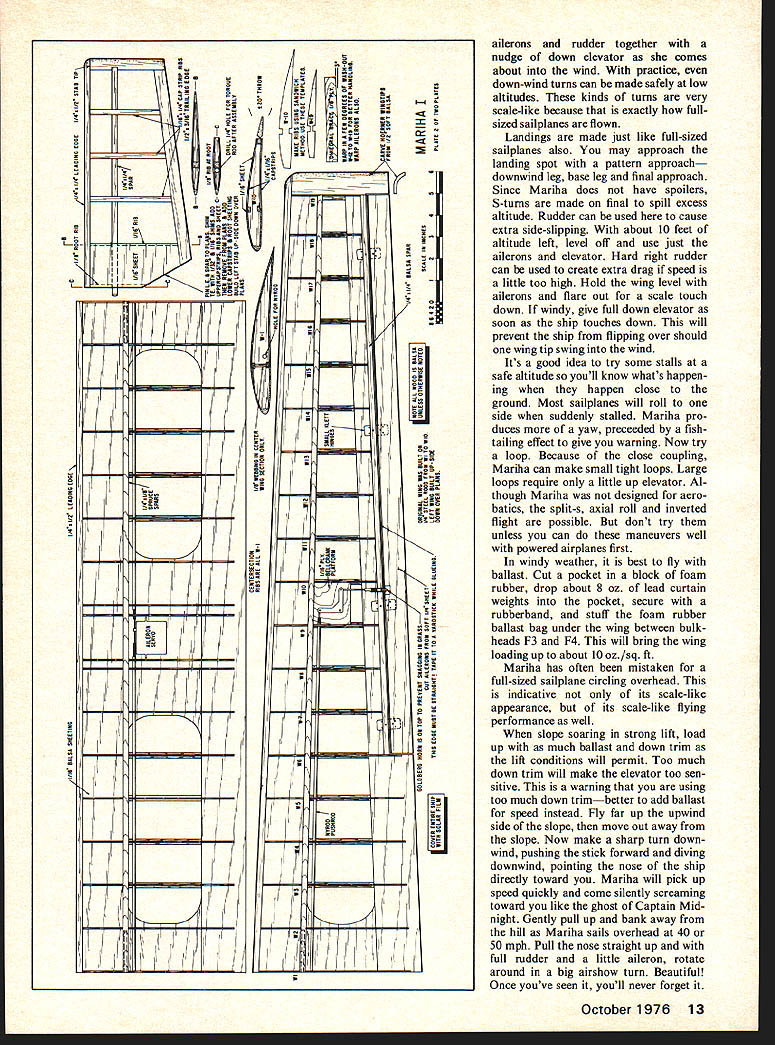
Wing construction is rather conventional. Carefully select wood of equal density on both sides of the wing. It is important to have as little gap at the aileron hinge as possible. Any air gap will add drag and reduce effectiveness. Make the leading edge of the aileron V-shaped while its corresponding fixed surface is flat; the hinge pin should be centered at the apex and inset on both sides of the hinge. Cover mating surfaces of the aileron with Solarfilm before gluing the hinge in place. Cover r place. Cover the rest of the wing later.
The wing panels can be built either flat on a board over the planks with wood scrap shims to hold the ribs at equal incidence angles, or the wing may be built on a wing rod jig. To achieve the correct dihedral angle, pin the center section down flat and prop up the outer wing panels one inch at rib W12 while the glue dries at the dihedral joints. Use a Goldberg aileron connector and affix the servo in place with double-faced foam tape. Add a little washout after covering by heating and twisting the wing tips. This tends to soften the stall.
Mariha 1
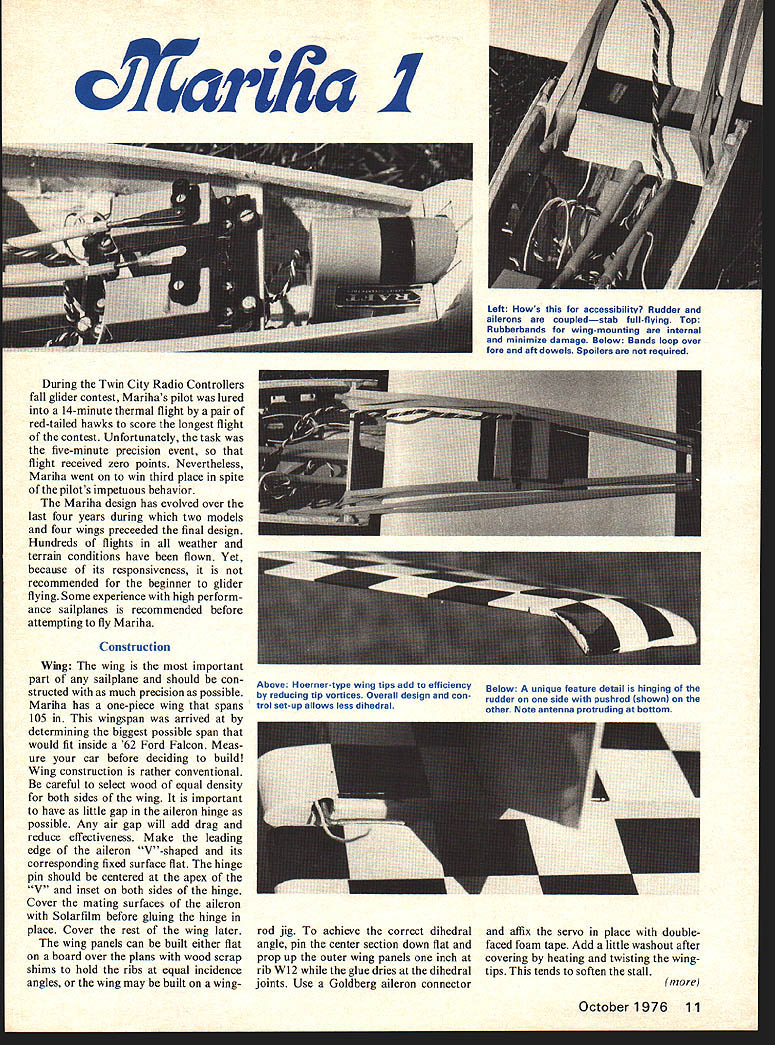
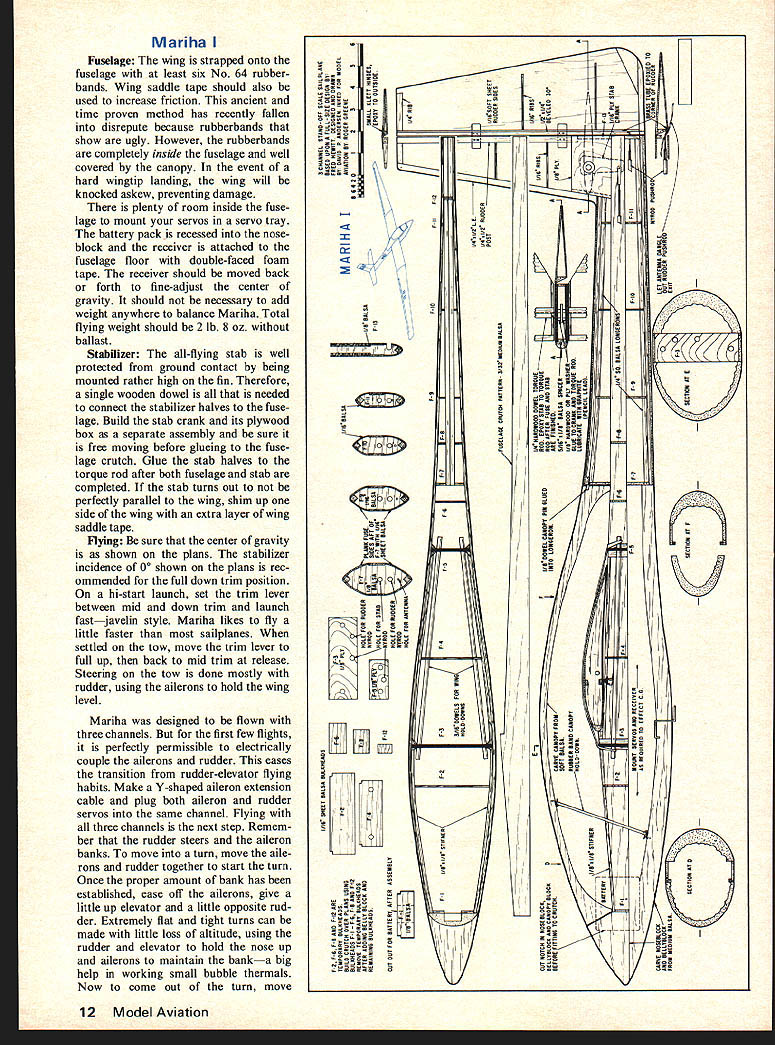
Fuselage: The wing is strapped onto the fuselage with at least six No. 64 rubberbands. Wing saddle tape should also be used to increase friction. This ancient and time-proven method has recently fallen into disrepute because rubberbands that show are ugly. However, the rubberbands are completely inside the fuselage and well covered by the canopy. In the event of a hard wingtip landing, the wing will be knocked askew, preventing damage.
There is plenty of room inside the fuselage to mount your servos in a servo tray. The battery pack is recessed into the noseblock and the receiver is attached to the fuselage floor with double-faced foam tape. The receiver should be moved back or forth to fine-adjust the center of gravity. It should not be necessary to add weight anywhere to balance Mariha. Total flying weight should be 2 lb. 8 oz. without ballast.
Stabilizer: The all-flying stab is well protected from ground contact by being mounted rather high on the fin. Therefore, a single wooden dowel is all that is needed to connect the stabilizer halves to the fuselage. Build the stab crank and its plywood box as a separate assembly and be sure it is free moving before gluing to the fuselage crutch. Glue the stab halves to the torque rod after both fuselage and stab are completed. If the stab turns out to not be perfectly parallel to the wing, shim up one side of the wing with an extra layer of wing saddle tape.
Flying: Be sure that the center of gravity is as shown on the plans. The stabilizer incidence of 0° shown on the plans is recommended for the full down trim position. On a hi-start launch, set the trim lever between up and down trim and launch fast—javelin style. Mariha likes to fly a little faster than most sailplanes. When settled on the tow, move the trim lever to full up, then back to mid trim at release. Steering on the tow is done mostly with rudder, using the ailerons to hold the wing level.
Mariha was designed to be flown with three channels. But for the first few flights, it is perfectly permissible to electrically couple the ailerons and rudder. This eases the transition from rudder-elevator flying habits. Make a Y-shaped aileron extension cable and plug both aileron and rudder servos into the same channel. Flying with all three channels is the next step. Remember that the rudder steers and the aileron banks. To move into a turn, move the ailerons and rudder together to start the turn. Once the proper amount of bank has been established, ease off the ailerons, give a little up elevator and a little opposite rudder. Extremely flat and tight turns can be made with little loss of altitude, using the rudder and elevator to hold the nose up and ailerons to maintain the bank—a big help in working small bubble thermals.
Now to come out of the turn, move the rudder and ailerons together to neutral. If a yaw in the opposite direction results, a sluggish, skidding turn may be caused by a down aileron producing drag while the opposite aileron is up. Ailerons on a sailplane can be amazingly effective when used in conjunction with rudder.
Low dihedral also greatly reduces the bad effects of turbulent air. Turbulence can be thought of as a sudden change in direction of the airstream striking the sailplane. A change in airstream direction has two components, a horizontal component and a vertical component. The change in the vertical component changes angle of attack and the stab makes the nose go up or down—an effect easily corrected by elevator control. The change in the horizontal component of the airstream produces roll (through wing dihedral) and harmless yaw. On landing in gusty air, Mariha will come in straight and level while other sailplanes are being bounced about.
Mariha has a somewhat unusual origin. A local flier of full-sized sailplanes, Fred Hewitt designed the full-scale prototype Mariha. The high-performance homebuilt model version was built to see what could be learned about the design before construction of the full-sized version was complete. Since the model, Mariha's design has evolved into a high-performance R/C model sailplane that maintains the appearance of the full-scale Mariha yet combines speed and maneuverability of a slope glider with the light wing loading of a flat-land thermal soarer and an extended speed range.
This was accomplished by almost completely eliminating dihedral, which reduces drag and improves high-speed stability. The plane can float along in light lift. Yet with eight ounces of ballast and a downtrim, the ship will tear up a field at 40 mph. In order to effectively control a sailplane having little dihedral, it must be equipped with ailerons. Ailerons coordinated with rudder and a full-flying stabilizer give Mariha a degree of control second only to all-out aerobatic gliders; maneuverability was the primary design goal.
Critics may argue increased speed and maneuverability must be paid for by increased sink rate; this is true to some extent, yet good pilot speed will help him find lift sooner and maneuverability will help him stay in lift longer. Rudder control alone is not enough to steer a sailplane having little or no dihedral. Rudder alone produces only mild yaw; ailerons are also needed, since ailerons alone produce bank without directional control.
Although Mariha was designed primarily for slope soaring, she has turned out to be a competitive thermal hunter as well, because the slopes in the Midwest are rather small and shallow-faced. Slope soaring in the Midwest generally consists of skimming close above the crest until a safe altitude is reached, then striking out to search for thermals. Thus sailplane requirements for slope soaring and hi-start flying in the Midwest don't differ very much. Ailerons and rudder together with a nudge of down elevator as she comes about into the wind. With practice, even downwind turns can be made safely at low altitudes. These kinds of turns are very scale-like because that is exactly how full-sized sailplanes are flown.
Landings are made just like full-sized sailplanes also. You may approach the landing spot with a pattern approach—downwind leg, base leg and final approach. Since Mariha does not have spoilers, S-turns are made on final to spill excess altitude. Rudder can be used here to cause extra side-slipping. With about 10 feet of altitude left, level off and use just the ailerons and elevator. Hard right rudder can be used to create extra drag if speed is a little too high. Hold the wing level with ailerons and flare out for a scale touch down. If windy, give full down elevator as soon as the ship touches down. This will prevent the ship from flipping over should one wing tip swing into the wind.
It's a good idea to try some stalls at a safe altitude so you'll know what's happening when they happen close to the ground. Most sailplanes will roll to one side when suddenly stalled. Mariha produces more of a yaw, preceded by a fishtailing effect to give you warning. Now try a loop. Because of the close coupling, Mariha can make small tight loops. Large loops require only a little up elevator. Although Mariha was not designed for aerobatics, the split-S, axial roll and inverted flight are possible. But don't try them unless you can do these maneuvers well with powered airplanes first.
In windy weather, it is best to fly with ballast. Cut a pocket in a block of foam rubber, drop about 8 oz. of lead curtain weights into the pocket, secure with a rubberband, and stuff the foam rubber ballast bag under the wing between bulkheads F3 and F4. This will bring the wing loading up to about 10 oz./sq. ft.
Mariha has often been mistaken for a full-sized sailplane circling overhead. This is indicative not only of its scale-like appearance, but of its scale-like flying performance as well.
When slope soaring in strong lift, load up with as much ballast and down trim as the lift conditions will permit. Too much down trim will make the elevator too sensitive. This is a warning that you are using too much down trim—better to add ballast for speed instead. Fly far up the upwind side of the slope, then move out away from the slope. Now make a sharp turn downwind, pushing the stick forward and diving downwind, pointing the nose of the ship directly toward you. Mariha will pick up speed quickly and come silently screaming toward you like the ghost of Captain Midnight. Gently pull up and bank away from the hill as Mariha sails overhead at 40 or 50 mph. Pull the nose straight up and with full rudder and a little aileron, rotate around in a big airshow turn. Beautiful! Once you've seen it, you'll never forget it.
Transcribed from original scans by AI. Minor OCR errors may remain.

