
Martinsyde Scout S.1
Frank H. Scott
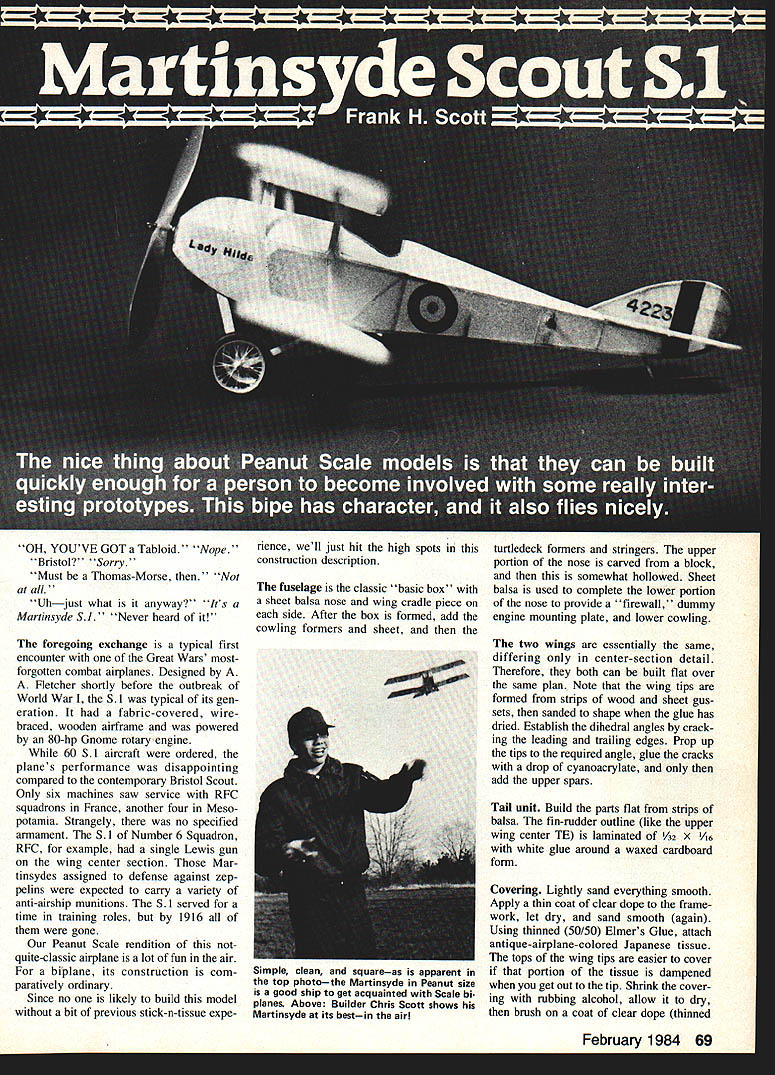
The nice thing about Peanut Scale models is that they can be built quickly enough for a person to become involved with some really interesting prototypes. This biplane has character, and it also flies nicely.
"OH, YOU'VE GOT a Tabloid." "Nope." "Bristol?" "Sorry." "Must be a Thomas‑Morse, then." "Not at all." "Uh—just what is it anyway?" "It's a Martinsyde S.1." "Never heard of it!"
The foregoing exchange is a typical first encounter with one of the Great War's most‑forgotten combat airplanes. Designed by A. A. Fletcher shortly before the outbreak of World War I, the S.1 was typical of its generation. It had a fabric‑covered, wire‑braced, wooden airframe and was powered by an 80‑hp Gnome rotary engine.
While 60 S.1 aircraft were ordered, the plane's performance was disappointing compared to the contemporary Bristol Scout. Only six machines saw service with RFC squadrons in France, and another four in Mesopotamia. Strangely, there was no specified armament. The S.1 of No. 6 Squadron, RFC, for example, had a single Lewis gun on the wing center section. Martinsydes were assigned to defense against Zeppelins and were expected to carry a variety of anti‑airship munitions. The S.1 served for a time in training roles, but by 1916 all of them were gone.
Our Peanut Scale rendition of this not‑quite‑classic airplane is a lot of fun in the air. For a biplane, its construction is comparatively ordinary. Since no one is likely to build this model without a bit of previous stick‑and‑tissue experience, we'll just hit the high spots in this construction description.
Construction
Fuselage
- The fuselage is the classic "basic box" with a sheet balsa nose and a wing‑cradle piece on each side.
- After the box is formed, add the cowl formers and sheet, then the turtledeck formers and stringers.
- The upper portion of the nose is carved from a block and then somewhat hollowed. Sheet balsa completes the lower portion of the nose to provide a firewall, dummy engine mounting plate, and lower cowling.
Wings
- The two wings are essentially the same, differing only in center‑section detail, so both can be built flat over the same plan.
- Note that the wingtips are formed from strips of wood and sheet gussets, then sanded to shape after the glue dries.
- Establish the dihedral angles by cracking the leading and trailing edges. Prop up the tips to the required angle, glue the cracks with a drop of cyanoacrylate, and only then add the upper spars.
- The center section and interplane strut attachment points require careful fitting and trimming.
Tail unit
- Build the tail parts flat from strips of balsa.
- The fin‑rudder outline (like the upper wing center trailing edge) is laminated from 1/32 x 1/16 strips with white glue around a waxed cardboard form.
Covering
- Lightly sand everything smooth.
- Apply a thin coat of clear dope to the framework, let dry, and sand smooth again.
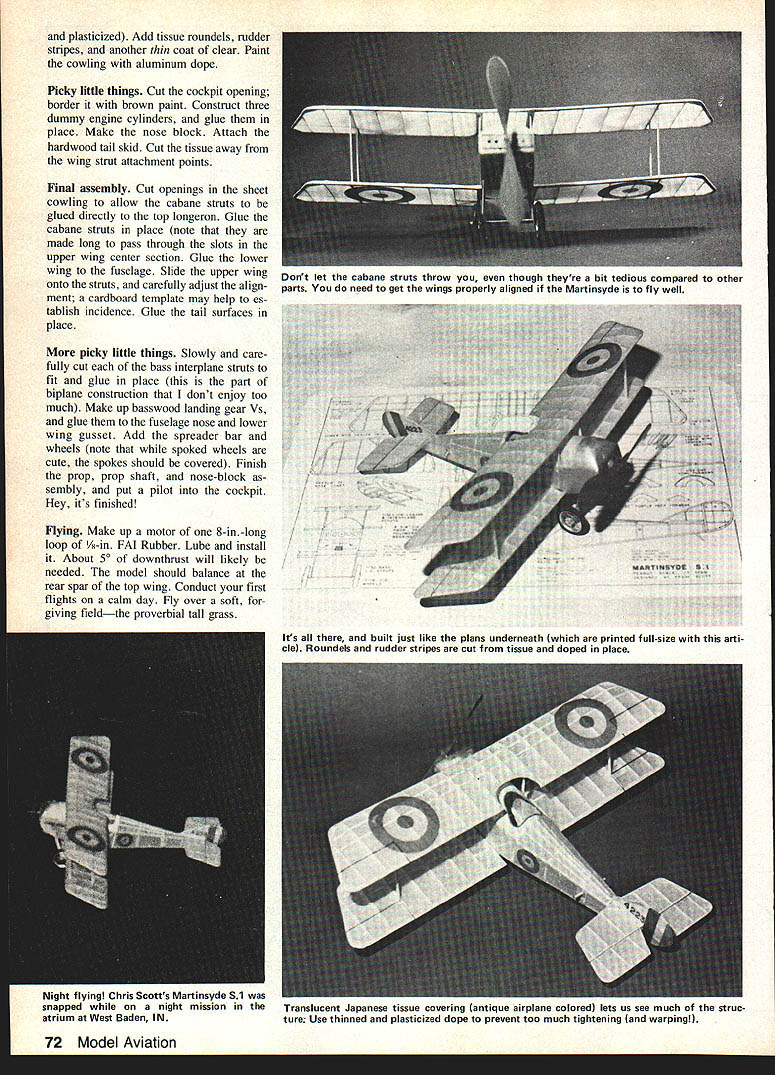
- Using thinned (50/50) Elmer's Glue, attach antique‑airplane‑colored Japanese tissue.
- The tops of the wingtips are easier to cover if that portion of the tissue is dampened when you get out to the tip.
- Shrink the covering with rubbing alcohol, allow it to dry, then brush on a coat of thinned clear dope.
- Add tissue roundels and rudder stripes, then another thin coat of clear. Paint the cowling with aluminum dope.
Plans and Dimensions / Notes
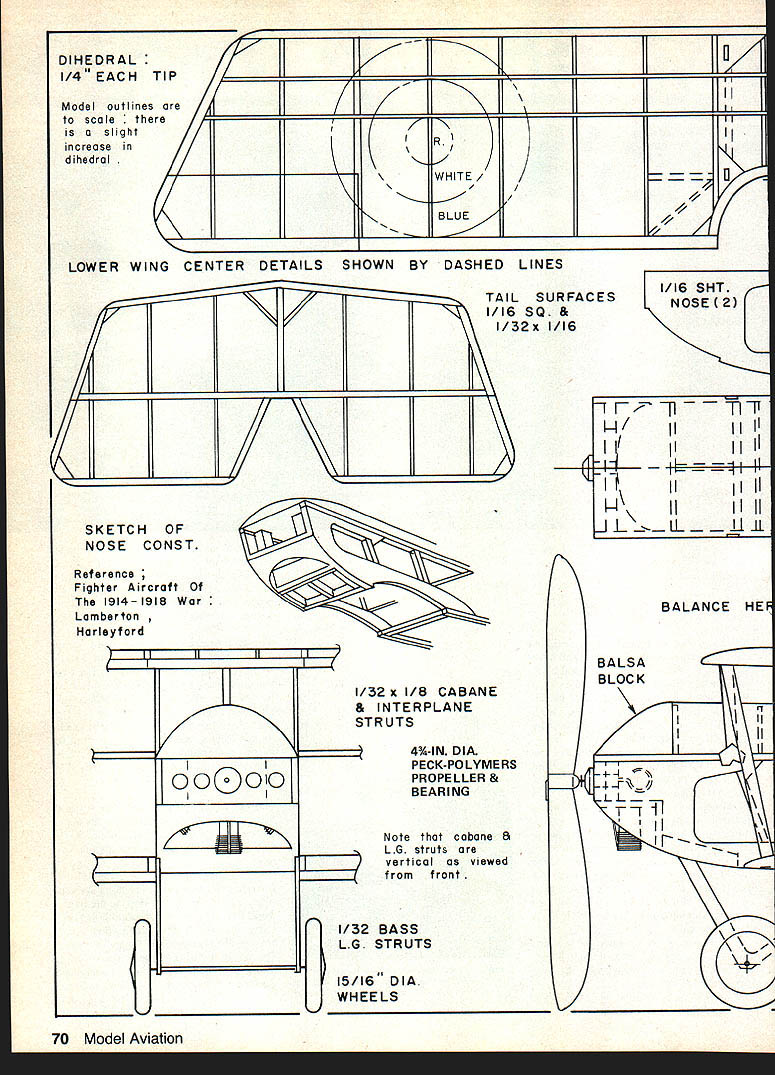
- Dihedral: 1/4" each tip (model outlines are to scale; there is a slight increase in dihedral).
- Tail surfaces: 1/16 sq. and 1/32 x 1/16.
- 1/16 sheet nose (2).
- Sketch of nose construction included in plan.
- Reference: Fighter Aircraft of the 1914–1918 War — Lamberton, Harleyford.
- 1/32 x 1/8 cabane & interplane struts.
- 4 3/4‑in. dia. Peck‑Polymers propeller & bearing.
- Note that cabane and landing‑gear struts are vertical as viewed from front.
- 1/32 bass landing‑gear struts.
- 15/16" dia. wheels.
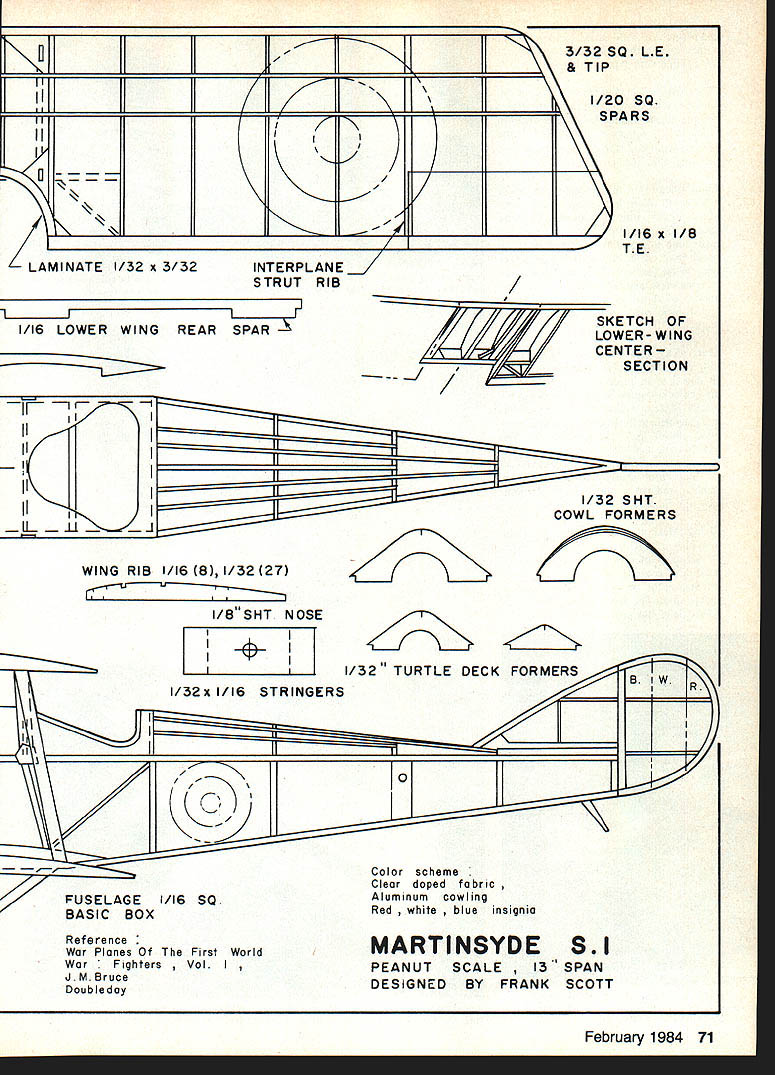
- Laminate 1/32 x 3/32 for interplane strut rib.
- 3/32 sq. leading edge & tip.
- 1/20 sq. spars.
- 1/16 x 1/8 trailing edge.
- 1/16 lower‑wing rear spar.
- Sketch of lower‑wing center section: 1/32 sheet cowl formers; wing rib 1/16 & 1/32; 1/8 sheet nose.
- Fuselage: 1/16 sq. basic box.
- Reference: War Planes of the First World War — Fighters, Vol. 1, J. M. Bruce, Doubleday.
- Martinsyde S.1 Peanut Scale: 13" span, designed by Frank Scott.
- 3/32 sq. leading edge & tip; 1/20 sq. spars; 1/16 x 1/8 trailing edge; laminate 1/32 x 3/32 interplane strut rib; 1/16 lower wing rear spar.
- Wing ribs: 1/16 (8), 1/32 (27).
- 1/32" turtledeck formers; 1/32 x 1/16 stringers.
- Balance: balsa block and balance point noted on plan.
Color scheme
- Clear‑doped fabric.
- Aluminum cowling.
- Red, white, and blue insignia.
- Add tissue roundels and rudder stripes; finish with a thin coat of clear dope. Paint the cowling with aluminum dope.
Picky little things
- Cut the cockpit opening and border it with brown paint.
- Construct three dummy engine cylinders and glue them in place.
- Make the nose block and attach the hardwood tailskid.
- Cut the tissue away from the wing strut attachment points.
Final assembly
- Cut openings in the sheet cowling to allow the cabane struts to be glued directly to the top longeron.
- Glue the cabane struts in place (they are made long to pass through the slots in the upper wing center section).
- Glue the lower wing to the fuselage.
- Slide the upper wing onto the struts and carefully adjust the alignment; a cardboard template may help to establish incidence.
- Glue the tail surfaces in place.
More picky little things
- Slowly and carefully cut each of the bass interplane struts to fit and glue in place.
- Make up basswood landing gear Vs and glue them to the fuselage nose and lower‑wing gusset.
- Add the spreader bar and wheels (note that while spoked wheels are cute, the spokes should be covered).
- Finish the prop, prop shaft, and nose‑block assembly, and put a pilot into the cockpit.
Flying
- Make up a motor of one 8‑in.‑long loop of 1/8‑in. FAI rubber. Lube and install it.
- About 5° of downthrust will likely be needed.
- The model should balance at the rear spar of the top wing.
- Conduct your first flights on a calm day. Fly over a soft, forgiving field—the proverbial tall grass.
References
- Fighter Aircraft of the 1914–1918 War — Lamberton, Harleyford.
- War Planes of the First World War — Fighters, Vol. 1, J. M. Bruce, Doubleday.
Transcribed from original scans by AI. Minor OCR errors may remain.

