
MASTERING THE IMMELMANN AND CUBAN 8
Lessons in proactive vs. reactive flying
by Dave Scott
As soon as a pilot has become proficient performing loops and rolls, the different ways that loop and roll elements can be combined are practically infinite. This article applies the timeless efficiency of the crawl-walk-run process to the Immelmann turnaround and the Cuban 8.
It is important to note that regardless of which maneuver you're practicing, adding refinements is much easier after first mastering the basic elements. Furthermore, by adding refinements individually, each receives the majority of your attention and is more quickly mastered.
Immelmann Turnaround
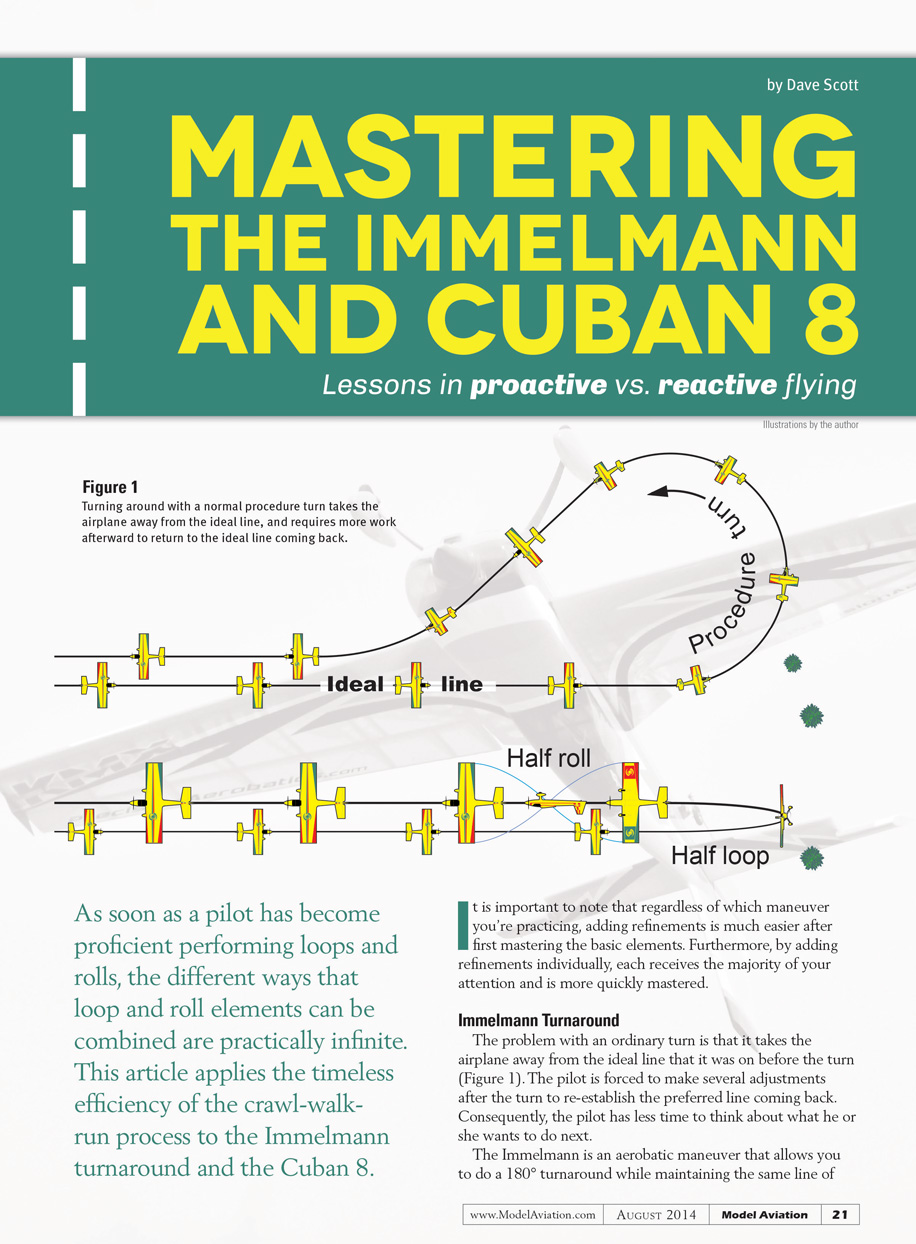
The problem with an ordinary turn is that it takes the airplane away from the ideal line that it was on before the turn. The pilot is forced to make several adjustments after the turn to re-establish the preferred line coming back. Consequently, the pilot has less time to think about what to do next.
The Immelmann is an aerobatic maneuver that allows you to do a 180° turnaround while maintaining the same line of flight coming back—albeit higher—and thereby makes flying easier.
Phase I: Sequencing Steps
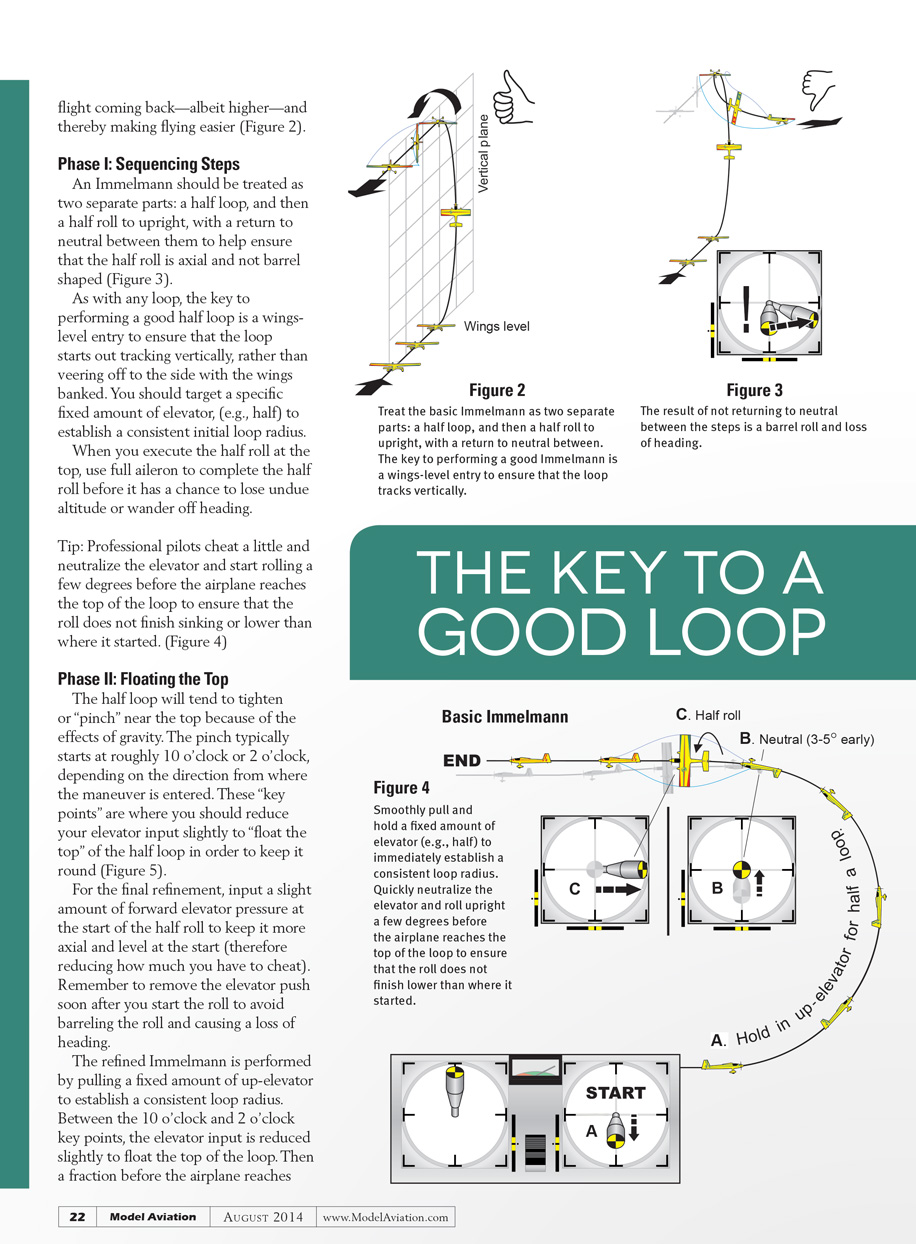
An Immelmann should be treated as two separate parts: a half loop, then a half roll to upright, with a return to neutral between them to help ensure that the half roll is axial and not barrel shaped.
As with any loop, the key to performing a good half loop is a wings-level entry to ensure the loop starts out tracking vertical rather than veering off to the side with the wings banked. Target a specific fixed amount of elevator (for example, half) to establish a consistent initial loop radius.
When you execute the half roll at the top, use full aileron to complete the half roll before it has a chance to lose undue altitude or wander off heading. Tip: professional pilots neutralize the elevator and start rolling a few degrees before the airplane reaches the top of the loop to ensure the roll does not finish lower than where it started.
Phase II: Floating the Top
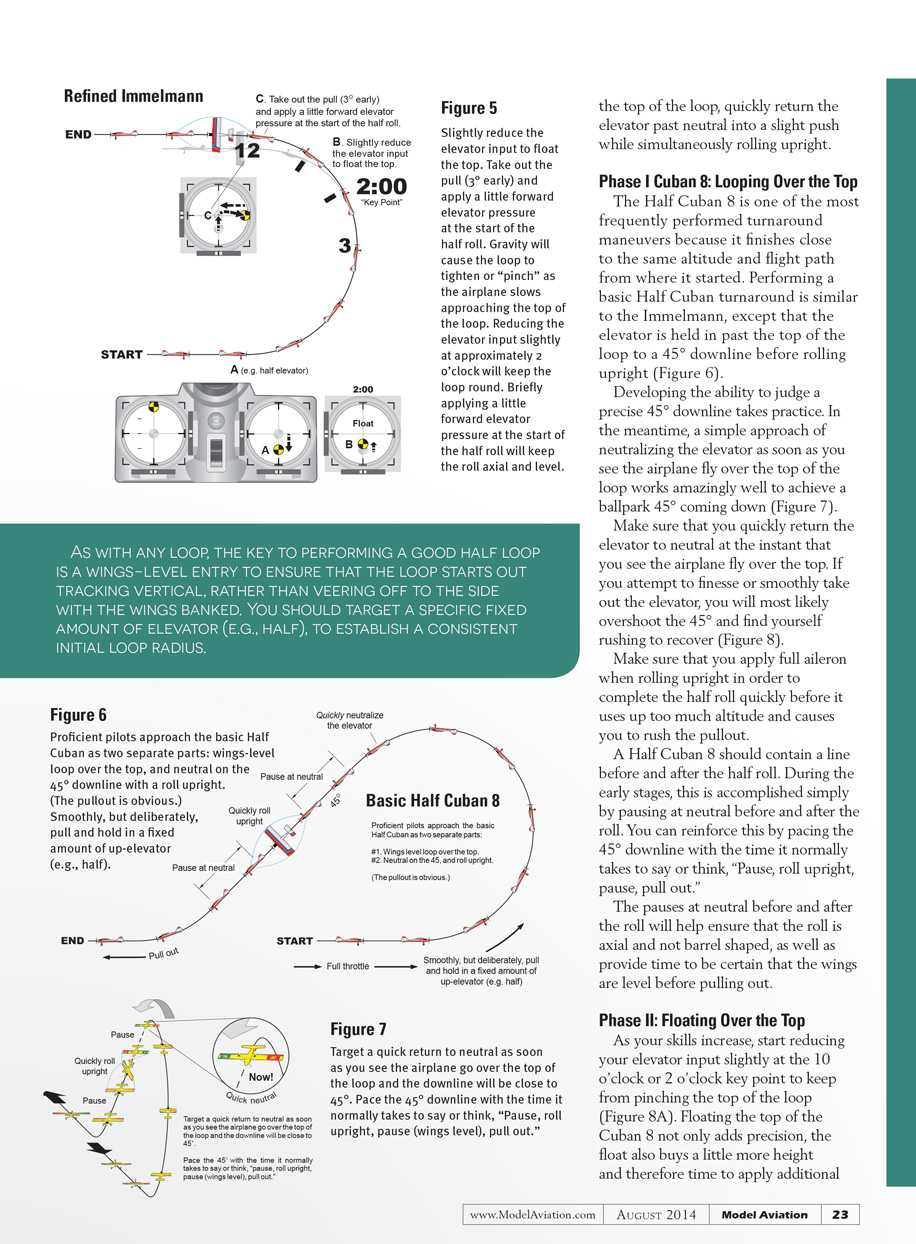
The half loop will tend to tighten or “pinch” near the top because of gravity. The pinch typically starts at roughly the 10 o’clock or 2 o’clock position, depending on the direction of entry. These key points are where you should reduce elevator input slightly to “float the top” of the half loop and keep it round.
For final refinement, apply a slight amount of forward elevator pressure at the start of the half roll to keep it more axial and level at the outset (reducing how much you have to pre-roll). Remember to remove the elevator push soon after you start the roll to avoid barreling the roll and causing a loss of heading.
Altogether, the refined Immelmann is performed by pulling a fixed amount of up-elevator to establish a consistent loop radius, reducing elevator slightly between the 10 o’clock and 2 o’clock key points to float the top, then just before the airplane reaches the top quickly return the elevator past neutral into a slight push while simultaneously rolling upright.
Half Cuban 8 (Phase I): Looping Over the Top
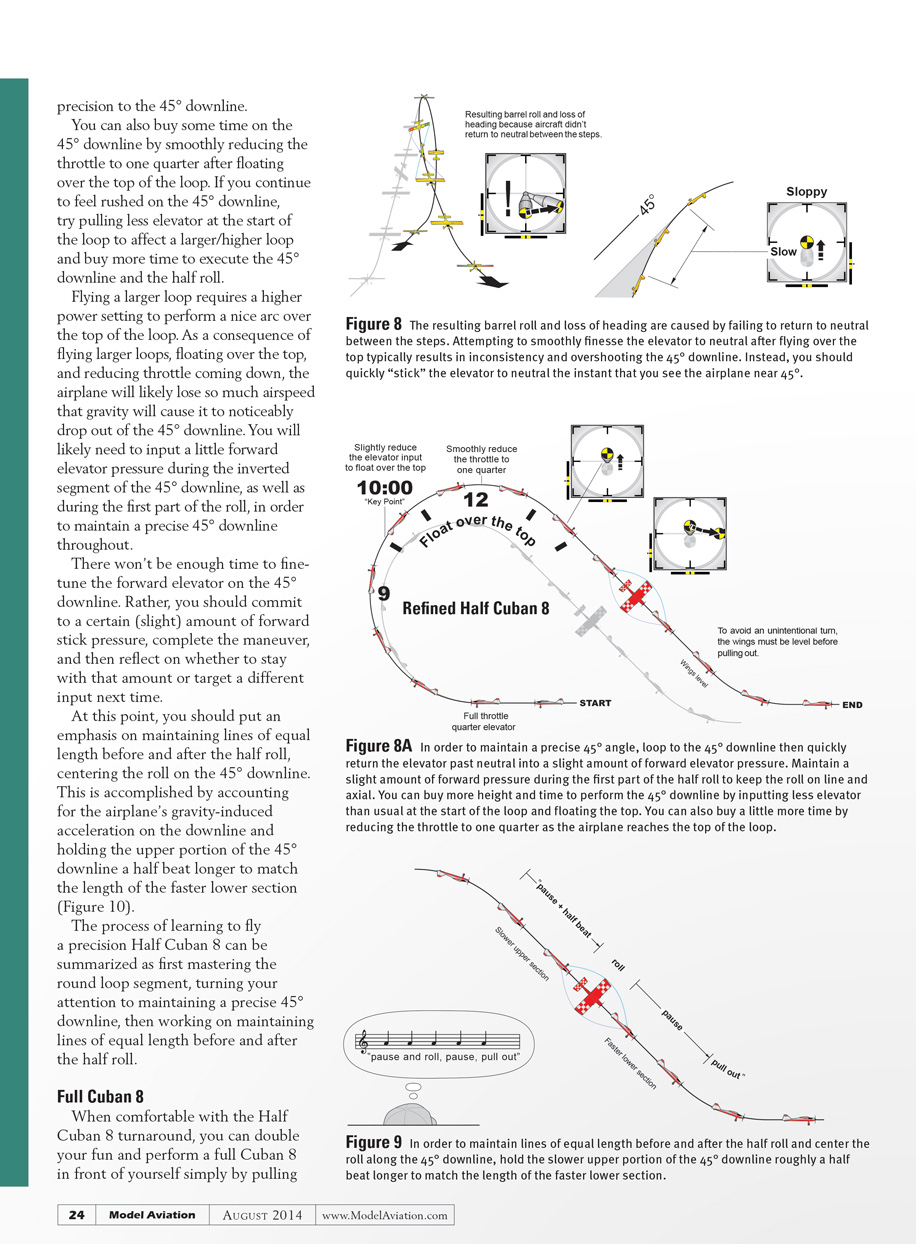
The Half Cuban 8 is one of the most frequently performed turnaround maneuvers because it finishes close to the same altitude as it started. Performing a basic Half Cuban 8 is similar to the Immelmann, except that the elevator is held in past the top of the loop to establish a 45° downline before rolling upright.
Developing the ability to judge a precise 45° downline takes practice. A simple initial approach is to neutralize the elevator as soon as you see the airplane fly over the top of the loop; this produces a reasonable 45° downline in a “ballpark” fashion.
Make sure you quickly return the elevator to neutral the instant the airplane flies over the top. If you attempt to finesse or smoothly take out the elevator, you will most likely overshoot the 45° and find yourself rushing to recover.
Apply full aileron when rolling upright to complete the half roll quickly before it uses up too much altitude and causes you to rush the pullout.
A Half Cuban 8 should contain a line before and after the half roll. During early stages, this is accomplished by pausing at neutral before and after the roll. You can reinforce this by pacing the 45° downline with the time it normally takes to think or say, “Pause, roll upright, pause, pull out.” The pauses at neutral help ensure the roll is axial rather than barrel shaped and provide time to confirm the wings are level before pulling out.
Phase II: Floating Over the Top
As your skills increase, start reducing elevator input slightly at the 10 o’clock or 2 o’clock key point to keep from pinching the top of the loop. Floating the top of the Cuban 8 adds precision and buys height and time to apply additional refinements, such as neutralizing the elevator a few degrees before the top and rolling upright, or briefly applying a small amount of forward elevator at the start of the half roll to keep it axial. Remember to remove the forward pressure quickly to avoid barreling the roll.
You can also buy time on the 45° downline by smoothly reducing the throttle to one quarter after floating over the top of the loop. If you feel rushed on the 45° downline, try pulling less elevator at the start of the loop to create a larger, higher loop and gain more time for the downline and half roll.
Flying a larger loop requires a higher power setting to perform a nice arc over the top. As a consequence of larger loops, floating over the top, and reducing throttle coming down, the airplane may lose enough airspeed that gravity causes it to drop out of the 45° downline. You will likely need to input a little forward elevator during the inverted segment of the 45° downline and during the first part of the roll to maintain a precise 45° throughout.
There won't be time to fine-tune forward elevator on the 45° downline in-flight. Commit to a slight, consistent forward stick pressure, complete the maneuver, then reflect on whether to adjust that input next time.
Emphasize maintaining lines of equal length before and after the half roll, centering the roll on the 45° downline. Account for the airplane's gravity-induced acceleration on the downline by holding the upper portion of the 45° downline a half beat longer to match the faster lower section.
The learning process for a precision Half Cuban 8 is: first master the round loop segment, then focus on maintaining a precise 45° downline, and finally work on equalizing the line lengths before and after the half roll.
Full Cuban 8
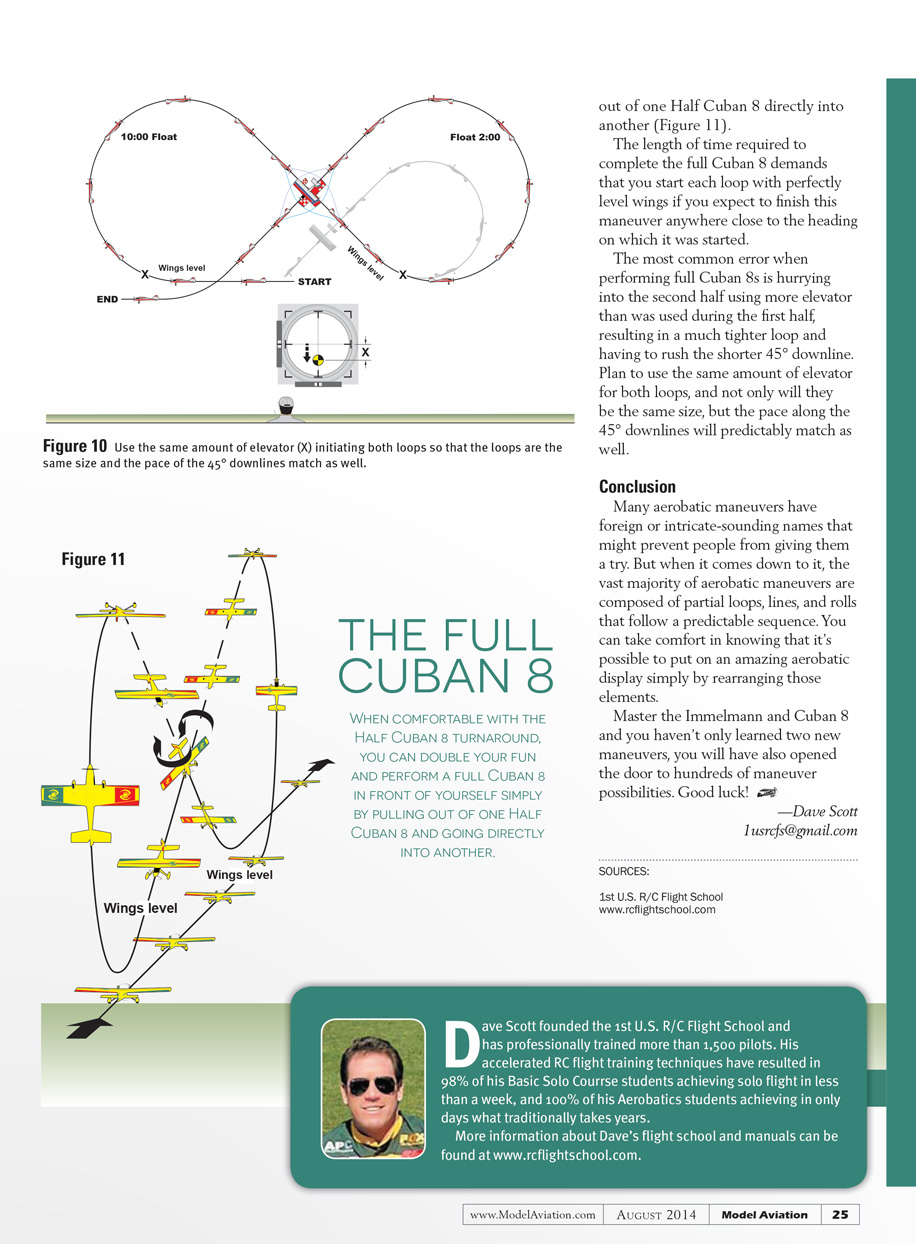
When comfortable with the Half Cuban 8 turnaround, perform a Full Cuban 8 by pulling out of one Half Cuban 8 directly into another.
The time required to complete a Full Cuban 8 demands that you start each loop with perfectly level wings if you expect to finish near the heading on which you started.
The most common error when performing Full Cuban 8s is hurrying into the second half and using more elevator than in the first half, resulting in a tighter loop and a rushed, shorter 45° downline. Use the same amount of elevator for both loops so they will be the same size and the pace along the 45° downlines will match.
Conclusion
Many aerobatic maneuvers have foreign- or intricate-sounding names that might prevent people from giving them a try. In reality, most aerobatic maneuvers are composed of partial loops, lines, and rolls that follow a predictable sequence. You can put on an impressive aerobatic display simply by rearranging those elements.
Master the Immelmann and Cuban 8 and you not only learn two new maneuvers, you open the door to hundreds of maneuver possibilities. Good luck!
— Dave Scott usrcfs@gmail.com
SOURCES:
- 1st U.S. R/C Flight School
- www.rcflightschool.com
Transcribed from original scans by AI. Minor OCR errors may remain.

