
Masters World Aerobatic Championship
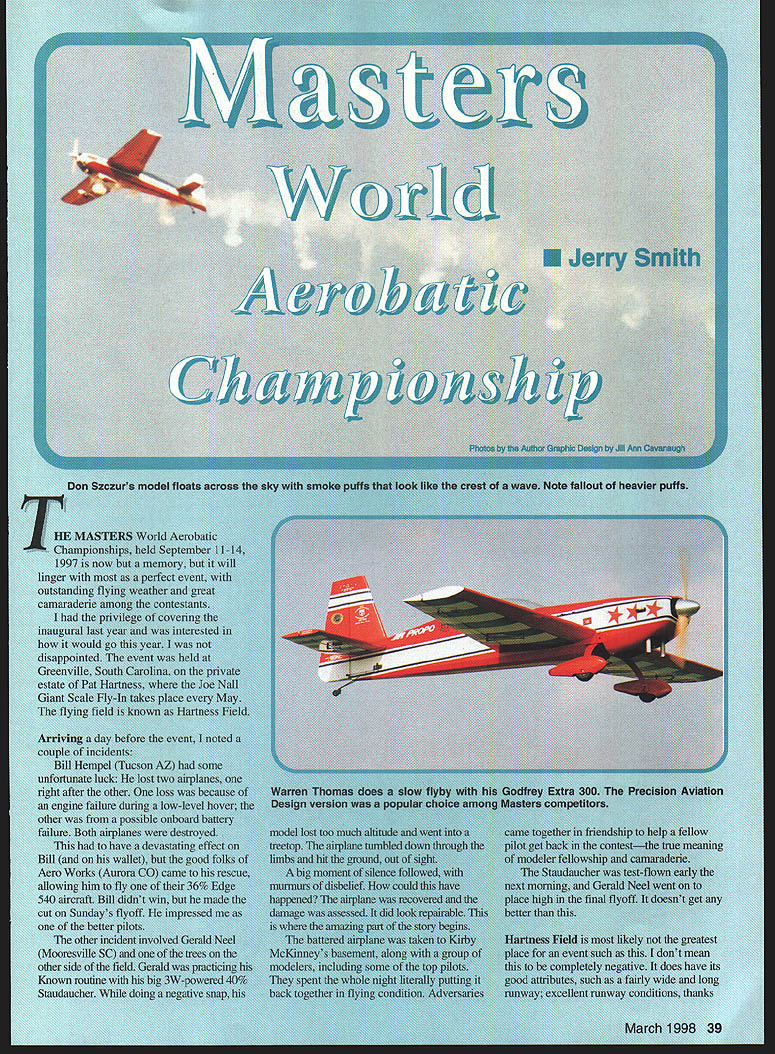
The Masters World Aerobatic Championships, held September 11–14, 1997, at Hartness Field on the private estate of Pat Hartness (Greenville, South Carolina), was a memorable event: outstanding flying weather, excellent organization, and great camaraderie among contestants.
Overview
- Dates: September 11–14, 1997
- Location: Hartness Field, Pat Hartness estate, Greenville, SC
- Format: 20 contestants; each flew a Known, Unknown, and Freestyle pattern each day for three days. The top 11 pilots advanced to the final elimination flyoff on the last day.
- Spectators required an AMA card for entry.
Notable incidents
- Bill Hempel (Tucson, AZ) lost two airplanes in separate accidents (one due to engine failure during a low hover, another likely due to onboard battery failure). Both models were destroyed. Aero Works (Aurora, CO) loaned Bill one of their 36% Edge 540 aircraft so he could continue; he made the cut for Sunday’s flyoff.
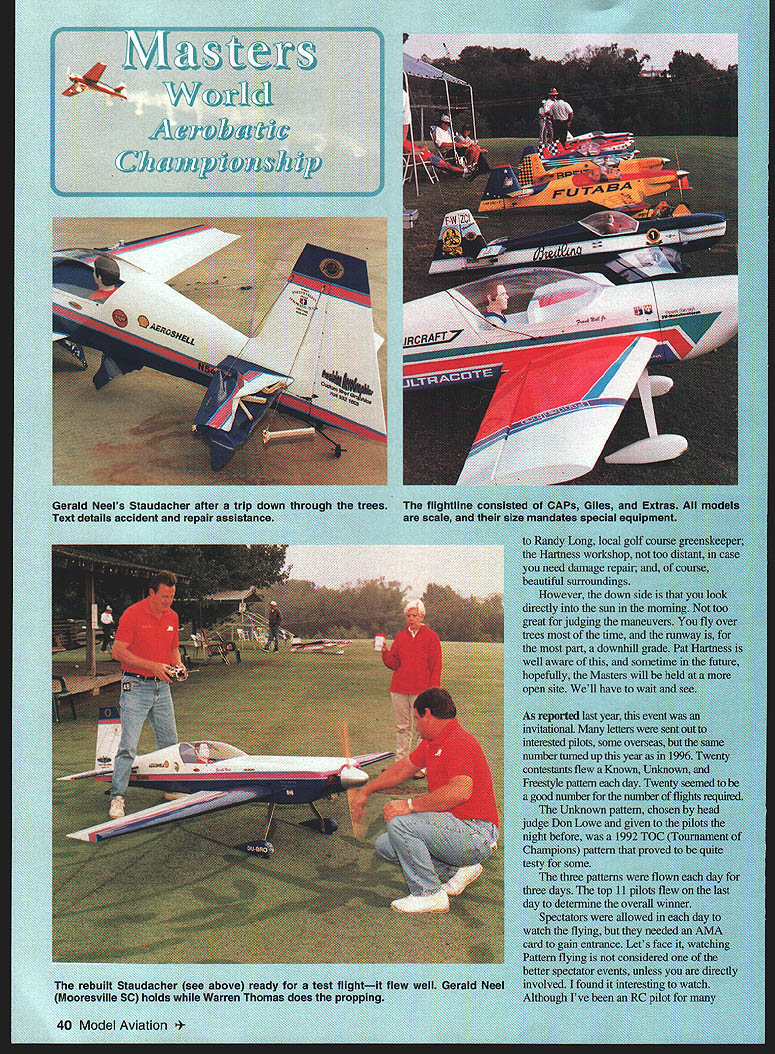
- Gerald Neel (Mooresville, SC) hit a treetop while practicing with his 40% Staudacher (3W-powered) during a negative snap. The model tumbled through the limbs and was heavily damaged. A group of modelers, led by Kirby McKinney and including several top pilots, spent the night repairing the airplane. It was test-flown early the next morning, and Gerald went on to place high in the final flyoff — a striking example of modeler fellowship and camaraderie.
Hartness Field — strengths and limitations
- Strengths:
- Fairly wide and long runway
- Excellent runway surface and groundskeeping
- Beautiful surroundings and pleasant hospitality from the Hartness gang
- Limitations:
- Morning sun is directly in the pilots’ and judges’ eyes — not ideal for judging maneuvers
- Much of the flying is over trees
- Runway has a downhill grade for most of its length
Pat Hartness is aware of these limitations; future Masters events may be held at a more open site.
Aircraft and teams
- Aircraft were large, powerful models (30%–46% scale) with high-performance engines; costs commonly range from $3,000–$5,000 per airplane.
- Many models were modified within the TOC 10% rule (based on wingspan) for improved handling (fuselage stretches, tail-area adjustments, etc.).
- Notable entries and pilots:
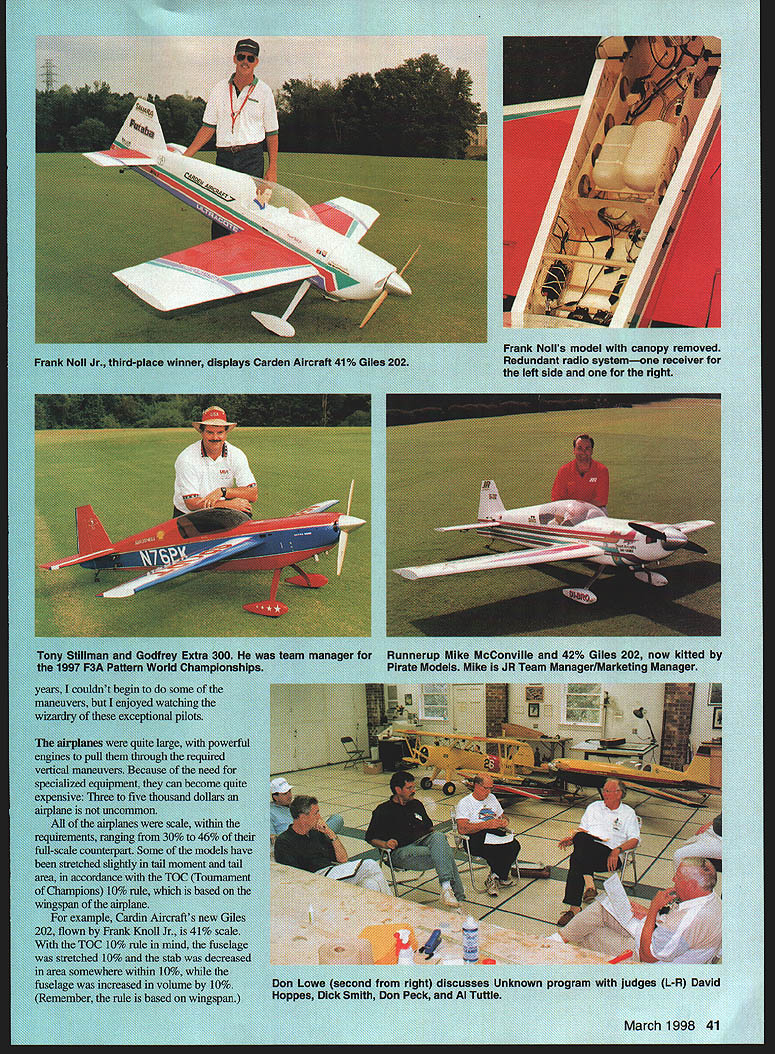
- Cardin Aircraft Giles 202 (41% scale fuselage noted as slightly stretched) — flown by Frank Knoll (listed in some notes as Frank Noll Jr.) and Gerald Candito (Precision Aviation’s new Giles 202)
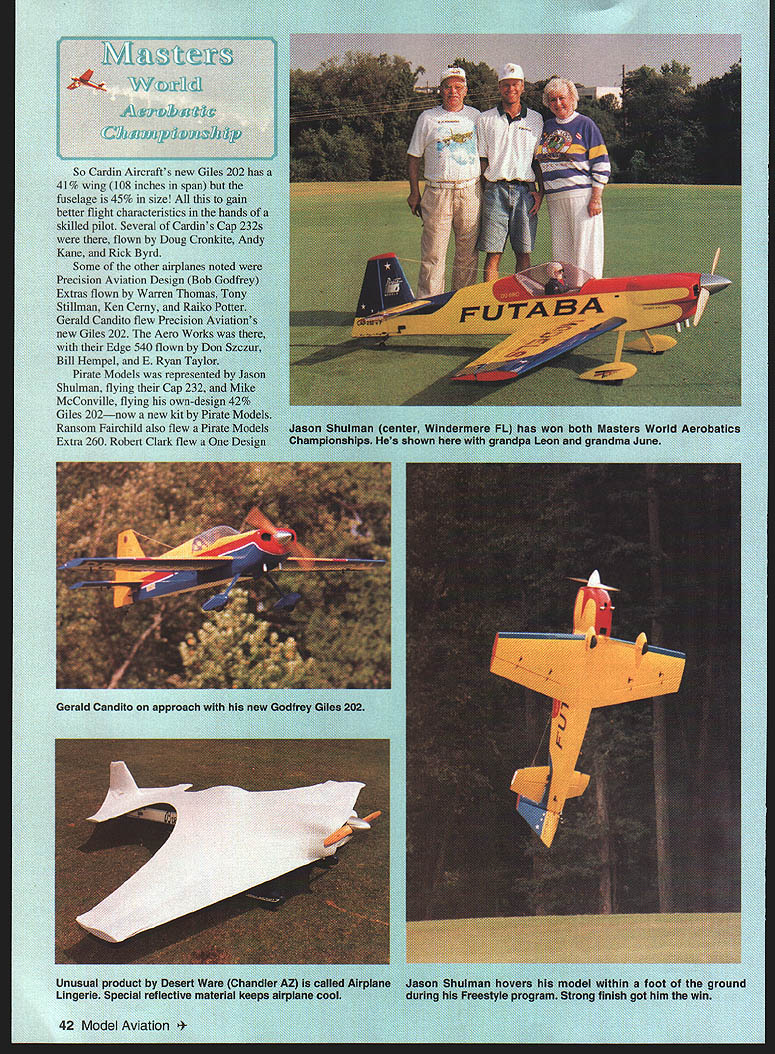
- Pirate Models Cap 232 — Jason Shulman
- Pirate Models Giles 202 (42%, new kit) — Mike McConville
- Aero Works Edge 540 — Don Szczur, Bill Hempel, E. Ryan Taylor
- Precision Aviation Design Extras — Bob Godfrey’s designs flown by Warren Thomas, Tony Stillman, Ken Cerny, Raiko Potter
- Other entries: Ransom Fairchild (Pirate Extra 260), Robert Clark (One Design), Bart Luscuskie and Bill Bishop III (Extra 300s), Dean Koger (46% Giles 200)
Scoring (brief)
- Each individual maneuver is scored 1–10 by each judge.
- The maneuver score is multiplied by a K factor (varies by maneuver complexity) to produce maneuver points.
- Maneuver points are summed for each judge to give that judge’s total for the flight.
- Judge totals are added to give the flight’s raw total points.
- The flight total is divided by the best point total in the round and multiplied by 1,000 to get a normalized score.
- The normalized score is multiplied by a weight factor to get the round score.
- Round scores are summed for the final score.
Scoring is a detailed numerical process intended to normalize and weight performances objectively.
Competition progression and results
- For the first three days Mike McConville led the competition and looked untouchable. Jason Shulman (1996 winner) had some early bad luck but improved steadily; Jason’s grandfather Leon Shulman noted, “Don’t worry about Jason — he works best under pressure.”
- Final elimination standings going into Saturday showed:
- Mike McConville
- Jason Shulman
- Gerald Neel
- Dean Koger
- Bill Hempel
- Frank Knoll
- Sunday’s flyoff changed the outcome. Jason Shulman put on a terrific Freestyle program (and a solid Known flight) and beat Mike by a few points.
- Final top three:
- Jason Shulman — 1st (received the one-and-only traveling trophy)
- Mike McConville — 2nd
- Frank Knoll — 3rd (moved up from sixth with excellent flying)
- Notable Freestyle highlight: Ransom Fairchild used two cane poles (approx. 12 inches high) with a red crepe-paper ribbon stretched between them. He made a knife-edge pass to pick up the ribbon, missed on his second pass, then on a later approach executed a knife-edge snap and picked up the ribbon with the stabilizer — a spectacular precision maneuver.
Judges, director, and organization
- Judges: Don Lowe, Al Tuttle, Dick Smith, Don Peck, Tom Miller, David Hoppes. They worked hard through four days in bright conditions and did a fine job assigning objective scores.
- Contest Director: Mike Gregory — ran a well-organized contest, handled glitches smoothly, and treated pilots first-class.
- Pilots were given caps and T-shirts; a BBQ at Pat Hartness’s backyard Saturday night was a popular social highlight.
- Awards: commemorative plaques to the top three finishers; the champion received the traveling trophy.
Future plans and qualifications
- According to Mike Gregory, 1998 qualifications are planned. The idea: invite pilots who made the cut into the elimination flyoff this year, and recruit some younger pilots (at least five) to expand participation. Watch the magazines and upcoming ads for details.
Thanks
Many thanks to Pat Hartness and the Hartness gang for their hard work and hospitality in making the event successful. It’s always a pleasure to attend events at the Hartness estate.
By Dick Smith 2416 Carina Terrace Acworth, GA 30101
Transcribed from original scans by AI. Minor OCR errors may remain.

