
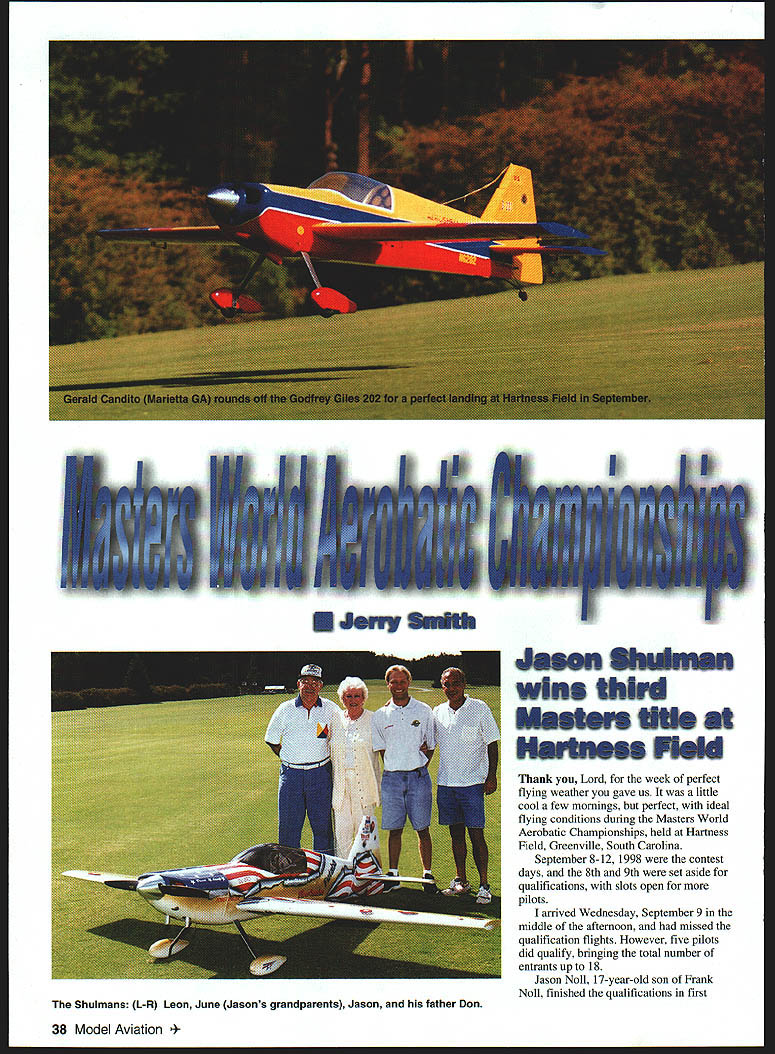
Masters World Aerobatic Championships
Overview
The Masters World Aerobatic Championships were held at Hartness Field, Greenville (Greer), South Carolina, September 8–12, 1998. Contest Director Mike Gregory ran a well-organized event with clear procedures and no confusion. Weather was ideal for the week — a few cool mornings but perfect flying conditions overall.
Schedule
- September 8–9: Qualifications (slots open for pilots)
- Thursday: Known pattern and Freestyle
- Friday: Unknown pattern and Freestyle (also elimination day)
- Saturday: Final flyoff (top 10)
I (the author) arrived Wednesday, September 9, late afternoon and missed the qualification flights; five pilots qualified that day, bringing the total entrants to 18.
Competition formats
- Known pattern: Maneuvers published well in advance so contestants can practice. Judged flight.
- Freestyle: Pilot-chosen maneuvers within a four-minute limit, often flown with smoke and choreographed to music.
- Unknown pattern: Maneuvers given on the spot with no practice time; familiar maneuvers in unfamiliar sequences increase difficulty.
Example Unknown sequences mentioned:
- Level flight, pull to vertical, two negative snap rolls, 5/8 outside loop, four-point roll, 45° downline, pull to 135° horizontal, exit upright (power-draining, demanding engine performance).
- Rolling circle: level flight, three-roll rolling circle (rolls to the outside), exit upright level flight.
Eliminations and finals
After a hard day flying two Unknown patterns and two Freestyles, the top 10 pilots were chosen for the Saturday final flyoff. Similar to prior years:
- Mike McConville and Jason Shulman were the leading contenders.
- Warren Thomas Jr. moved up from seventh in the 1997 eliminations to place high in 1998 after a year of focused practice.
- Other qualifiers included Ken Cerny, Nelson Hole, Stan Stockman, and Ryan Evans.
Three-time winner Jason Shulman was allowed to keep the traveling trophy. Past years show consistent top placements with Jason Shulman and Mike McConville typically occupying the top two, and third place rotating among Frank Noll, Warren Thomas, and Gerald Neel.
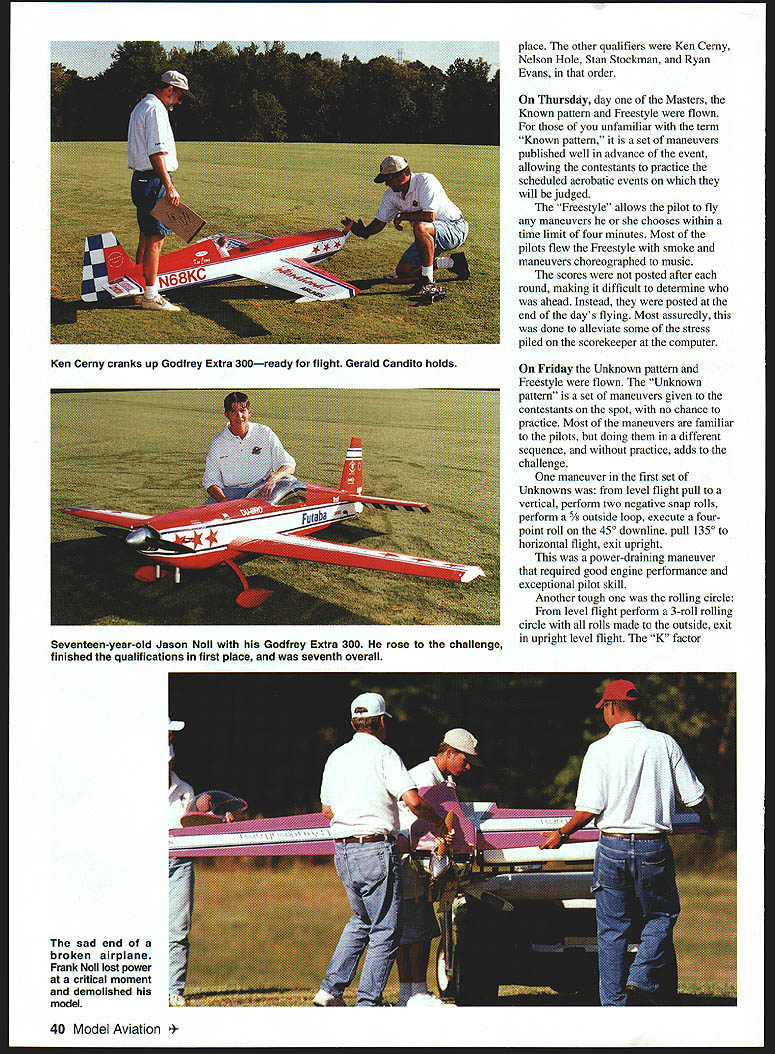
Jason Noll (age 17, son of Frank Noll) finished first in qualifications and placed well overall, ending up seventh in the final standings.
Notable pilots and aircraft
- Jason Shulman — 44% Fibercraft Giles 202
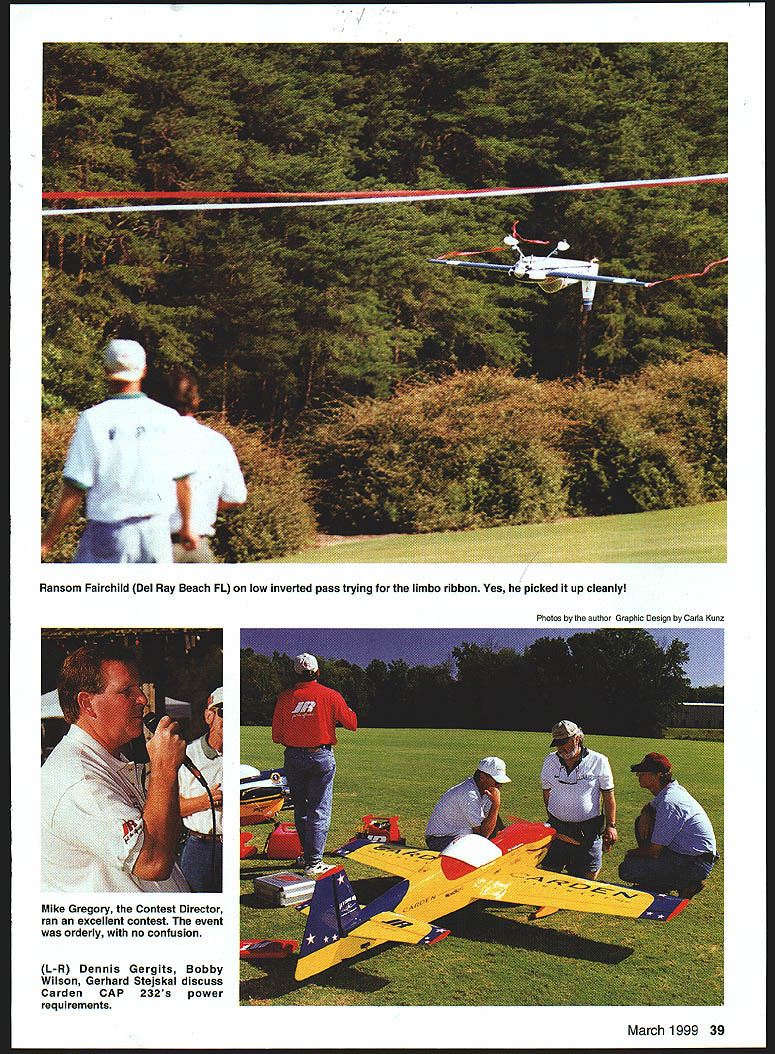
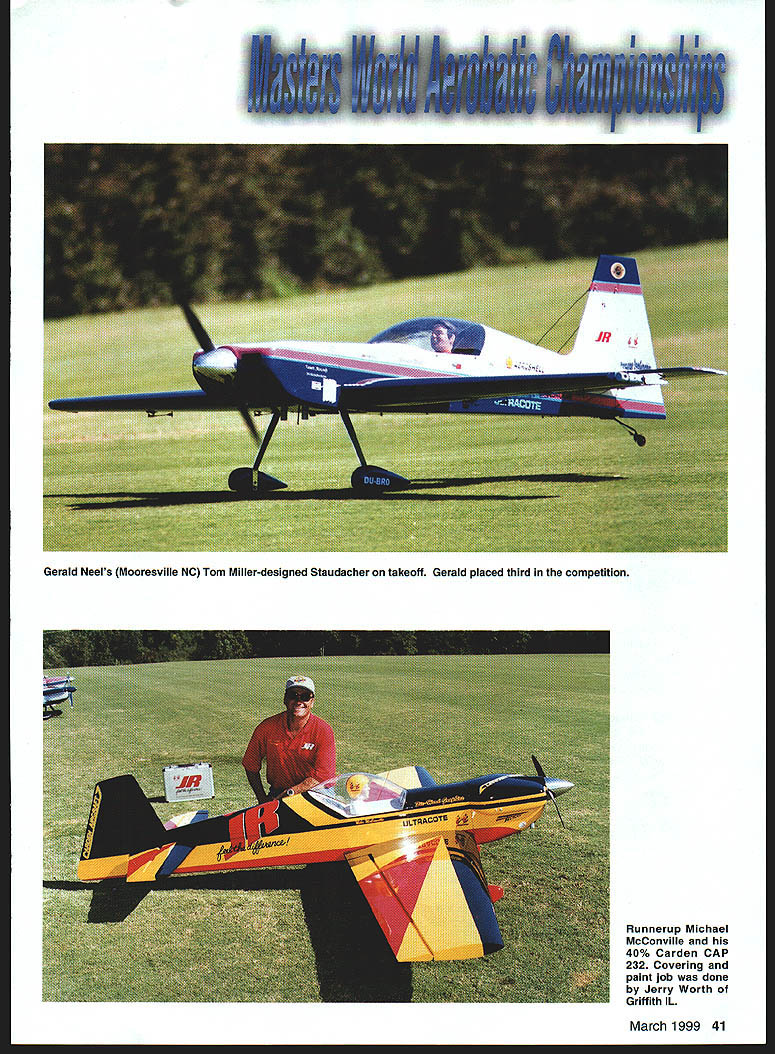
- Mike McConville — 40% Carden CAP 232
- Gerald Neel (Mooresville, NC) — Tom Miller–designed 40% Staudacher (placed among the top; will compete in the TOC in Las Vegas as the highest placing non-TOC pilot)
- Jason Noll (17) — Godfrey Extra 300 (gifted by Pat Hartness)
- Ken Cerny — 32.5% Godfrey Extra
Airframes present included Carden Aircraft Giles and CAP 232s, Precision Aviation Design Extras and Giles, Aeroworks, Pirate Models, Radio-Craft, and Tom Miller–designed Staudacher.
Equipment and gear
- Engines: 3W engines dominated; other engines included a Quadra 100, a BME 5.8 (Precision Aviation), and an N-cubed engine made and sold by Bob Ayres.
- Propellers: Menz, Bolly, and Mejzlik (Menz had a slight edge).
- Covering: MonoKote or UltraCote with painted cowls and wheel pants.
Incidents and safety concerns
- Frank Noll suffered a catastrophic power failure at a critical point in the pattern on Friday and lost his airplane.
- Earlier, Bill Hempel experienced a power failure but managed to land safely, losing valuable points.
- In 1997 Gerald Neel’s 40% Staudacher hit the top of a tree; that same Staudacher was flown this year.
- Safety/location concern: Hartness Field lies directly below the Greer airport landing pattern. Airline pilots reported seeing models near their approach path (one reported seeing a model about 100 feet above him on an 1,800-foot final). Up-line patterns for models require significant altitude to space down-line maneuvers properly, raising concerns about model maximum altitudes and potential conflicts with full-scale traffic.
- After discussion, organizers concluded the situations were not directly comparable but acknowledged the site’s geographic issues. Plans are underway to relocate the Masters (and the Joe Nall IMAC event) to a new site within the next two years.
Judges and officials
- Chief judge: Don Lowe
- Other judges: Darlene Frederick, Al Tuttle, Tom Miller, David Hoppes, Dick Smith
- Contest Director: Mike Gregory
- Announcer: Bob Saddler
The judging crew was commended for objective, attentive work despite the difficulty of repeatedly tracking maneuvers (sometimes into the sun).
Vendors, sponsors, and extras
Retailers and manufacturers present behind the flightline included:
- Cactus Aviation
- Aircraft International, Inc.
- Carden Aircraft
- Precision Aircraft Design
- Sew Busy (embroidery; caps and shirts)
Each pilot received a cap and a T-shirt and was treated to a first-class all-you-can-eat barbecue at Pat Hartness’s home. The top three pilots received commemorative plaques.
TOC director Steve Rojecki offered the highest-placing non-TOC pilot at the Masters an opportunity to compete in the TOC in Las Vegas; Gerald Neel accepted that invitation.
Closing and acknowledgments
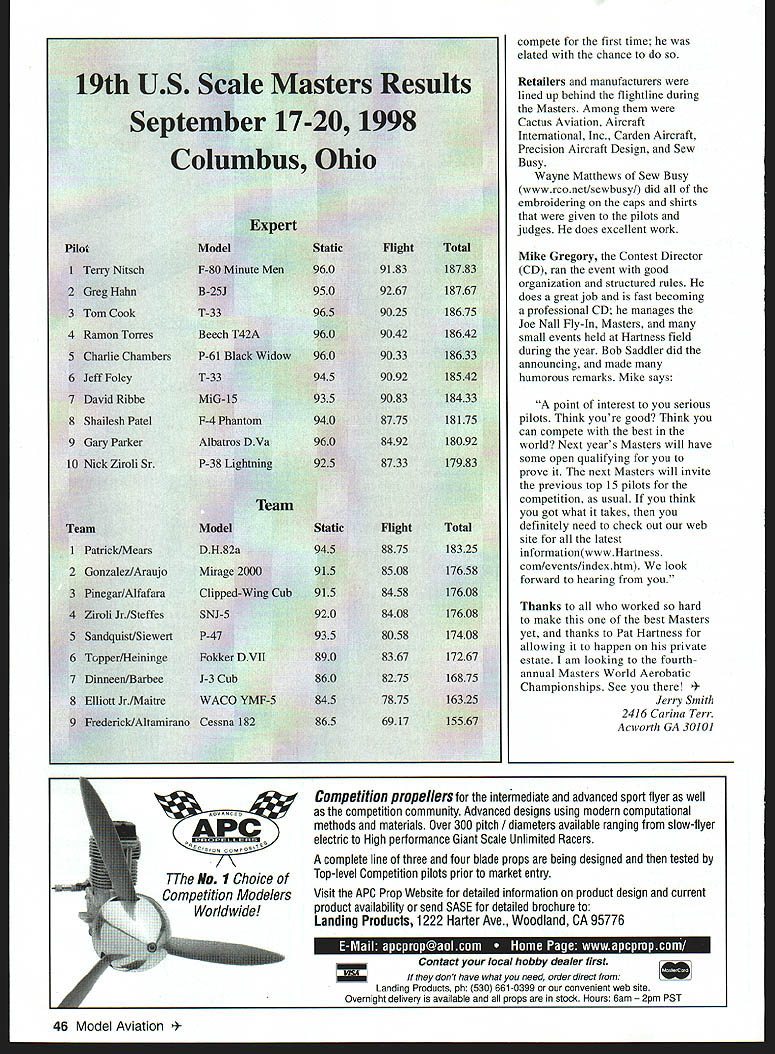
Thanks to Pat Hartness for hosting the event on his private estate and to all volunteers, officials, and vendors who helped make this one of the best Masters yet. Mike Gregory continues to develop into a professional Contest Director, managing Joe Nall, the Masters, and multiple events at Hartness Field.
I look forward to the fourth annual Masters World Aerobatic Championships. See you there!
Jerry Smith 2416 Carina Terr. Acworth, GA 30101
Transcribed from original scans by AI. Minor OCR errors may remain.

