
Maximum Splat
How every child's understanding of natural laws can give us more power with less noise. — Duane Gall
RC fliers, especially Racing and Pattern fliers, have a problem with noise. No, I'm not going to discuss in detail the fact that our problem is not so much with noise as with intolerance of our sport by nonparticipants. Nor will I say much about the mentally debilitating effects of staring at a dB meter for too long. I will simply say that by any standard, including that of the dB, the use of a muffled tuned pipe significantly improves the noise situation with no power loss.
Tuned pipes, both muffled and nonmuffled, have been around since the 1960s. The use of muffled pipes is now commonplace in RC Pattern. A muffled pipe with an appropriate header can be found to fit virtually any two-stroke engine now on the market. The modern Schnuerle-ported engine designs benefit most from the use of a pipe.
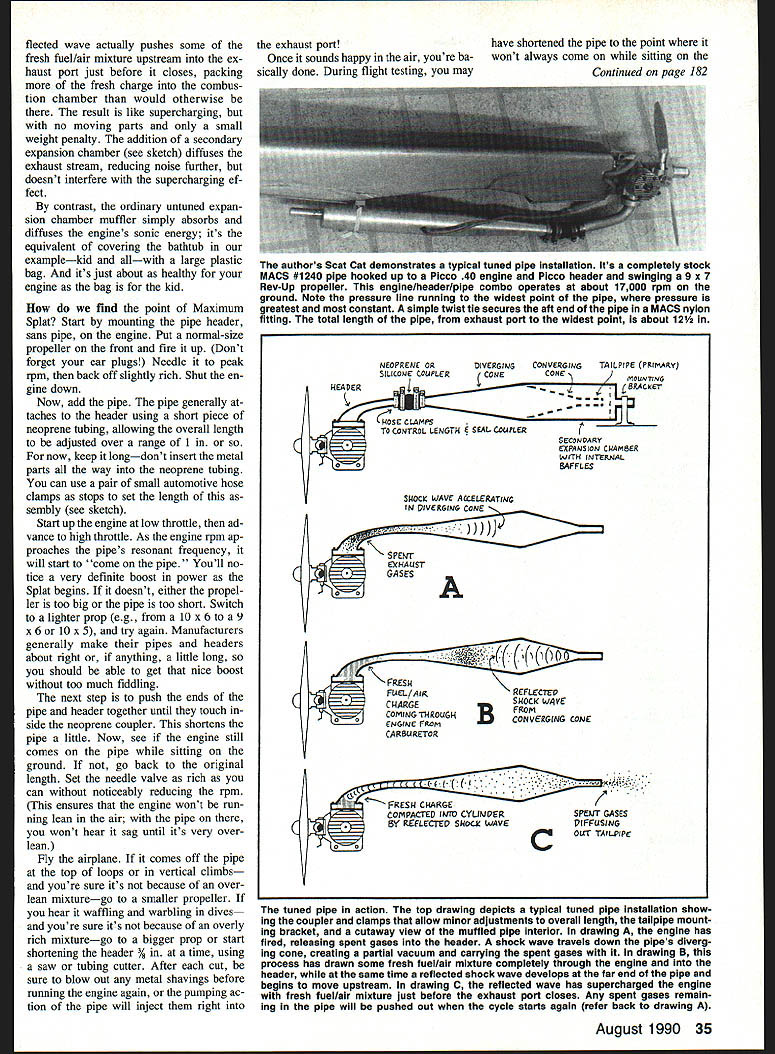
How much benefit can be expected? Experimenting on my Picco .40-powered Scat Cat racer, I measured a drop of over 11 dB simply by fitting a stock MACS #1240 muffled pipe over the open end of the header. At the same time I gained over 1,000 rpm. More significant than either of these changes, however, was the change in sound quality — the pipe changed the sound from raspy, drag-racer snarl to a pleasant, Saab turbo-style "whoosh." By contrast, the muffler that came with the engine reduced dB by only about half that much, had no noticeable effect on the rpm, and did nothing to smooth out the sound quality.
I'm convinced that most complaints about noise have nothing at all to do with dB, but rather with the quality of the sound our models make. Why else do our nonmodeler neighbors tolerate lawn mowers, motorcycles, and full-size aircraft that vastly exceed the sound levels of model aircraft? Why else are Giant Scale models so often granted an unofficial exemption from dB limits at flying fields that have such limits? Suffice it to say the use of a muffled tuned pipe gives at least as much reduction in noise as the dB meter would indicate — and probably much more — without sacrificing power. I'll now explain how you can get these benefits with little or no tinkering.
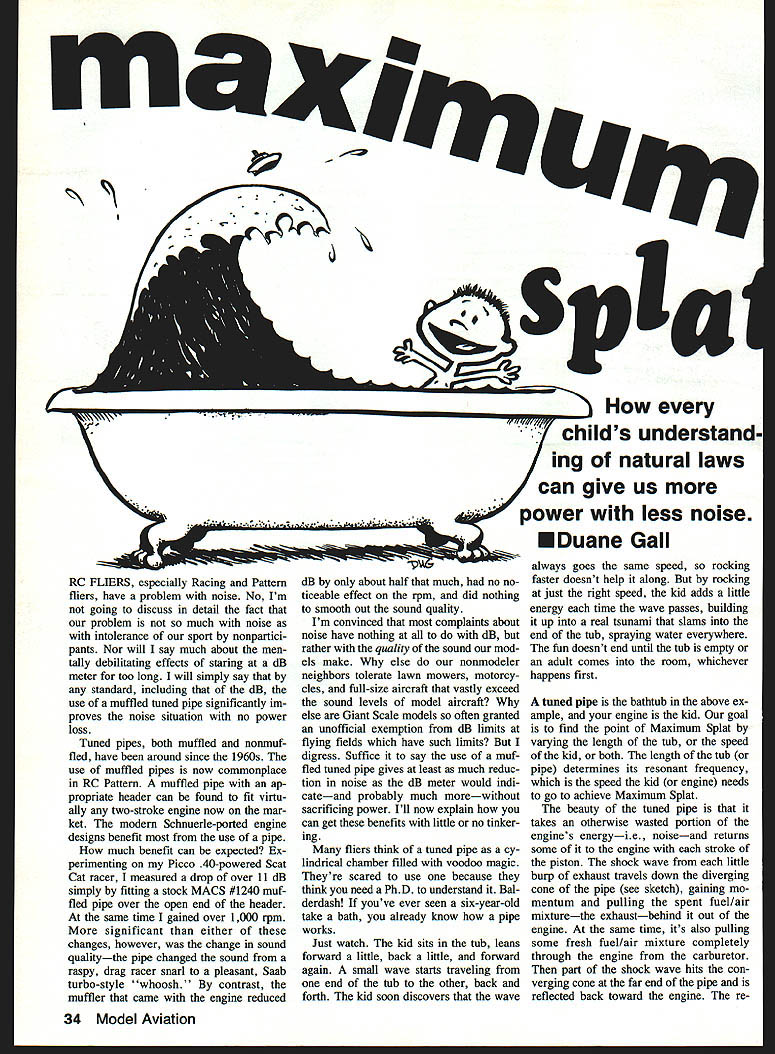
Many fliers think of a tuned pipe as a cylindrical chamber filled with voodoo magic. They're scared to use one because they think you need a Ph.D. to understand it. Balderdash! If you've ever seen a six-year-old take a bath, you already know how a pipe works.
Just watch. The kid sits in the tub, leans forward a little, back a little, and forward again. A small wave starts traveling from one end of the tub to the other, back and forth. The kid soon discovers that the wave always goes the same speed, so rocking faster doesn't help it along. But by rocking just the right speed, the kid adds a little energy each time the wave passes, building it up into a real tsunami that slams into the end of the tub, spraying water everywhere. The fun doesn't end until the tub is empty or an adult comes into the room, whichever happens first.
A tuned pipe is the bathtub in the above example, and your engine is the kid. Our goal is to find the point of Maximum Splat by varying the length of the pipe, or the speed of the kid, or both.
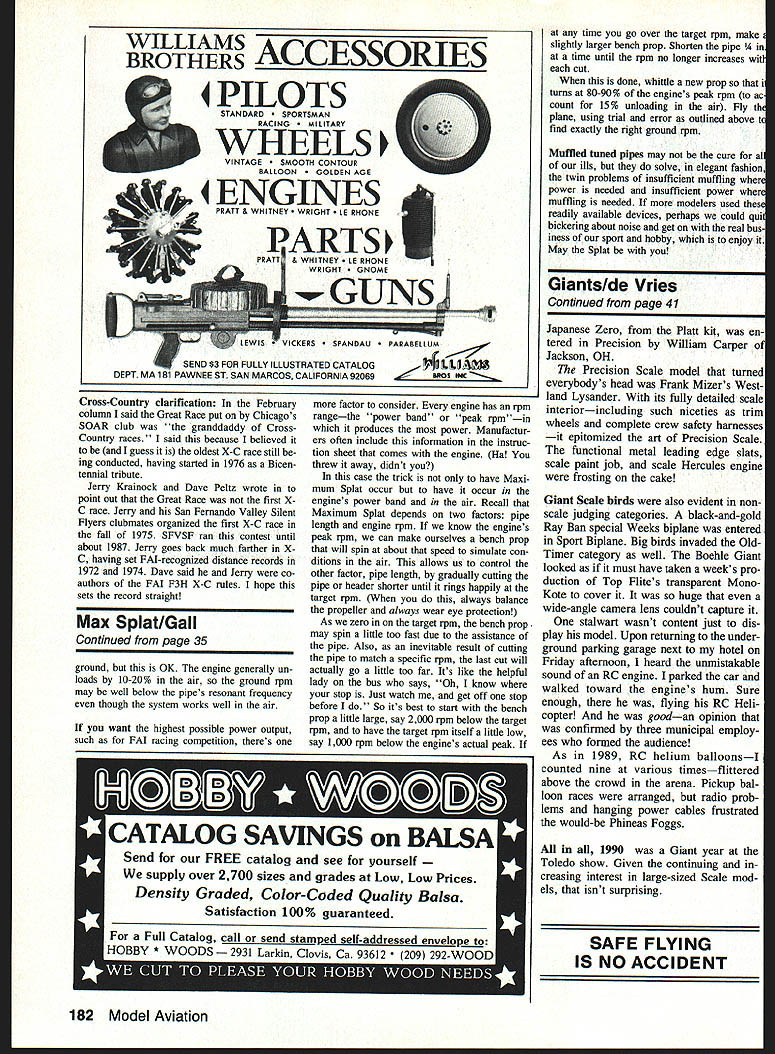
The beauty of the tuned pipe is that it takes an otherwise wasted portion of the engine's energy — i.e., noise — and returns some of it to the engine in the form of a little burp of exhaust that travels down the diverging cone of the pipe (see sketch), gaining momentum and pulling the spent fuel/air mixture — the exhaust — behind it out of the engine, while at the same time it's also pulling some fresh fuel/air mixture completely through the engine and carburetor. Part of the shock wave hits the converging cone at the far end of the pipe and is reflected back toward the engine. The reflected wave actually pushes some fresh fuel/air mixture up past the exhaust port just before it closes, packing the fresh charge into the combustion chamber that would otherwise be lost. It's like supercharging with no moving parts; the small weight penalty of adding a secondary expansion chamber diffuses the exhaust stream, reducing noise further and doesn't interfere with the supercharging effect. Contrast ordinary untuned expansion-chamber mufflers that simply absorb and diffuse the engine's sonic energy — it's the equivalent of covering the bathtub with a large plastic bag. It's just about healthy.
- Start mounting the pipe header, sans pipe, on the engine. Put a normal-size propeller on the front and fire up. Use ear protection.
- Needle to peak rpm, then back off slightly to the rich side. Shut the engine down.
- Add the pipe. The pipe generally attaches to the header using a short piece of neoprene tubing, allowing the overall length to be adjusted over a range. Don't keep it long; don't insert metal parts in the way of the neoprene tubing. You can use a pair of small automotive hose clamps as stops to set the length of the assembly (see sketch).
- Start up the engine at low throttle and advance to high throttle. As engine rpm approaches the pipe's resonant frequency, it will start to "come on the pipe." You'll notice a very definite boost in power as the Splat begins.
- If it doesn't come on the pipe, either the propeller is too big or the pipe is too short. Switch to a lighter prop (e.g., from a 10 x 6 to a 9 x 6 or 10 x 5), and try again. Manufacturers generally make their pipes and headers about right, or, if anything, a little long, so you should be able to get that boost without too much fiddling.
- The next step is to push the ends of the pipe and header together until they touch inside the neoprene coupler. This shortens the pipe a little. Now, see if the engine still comes on the pipe while sitting on the ground. If not, go back to the original length.
- Set the needle valve as rich as you can without noticeably reducing the rpm. This ensures the engine won't be running lean in the air; with the pipe on, you won't hear it sag until it's very overlean.
- Fly the airplane. If it comes off the pipe at the top of loops or in vertical climbs — and you're sure it's not because of an overlean mixture — go to a smaller propeller. If you hear it waffling and warbling in dives — and you're sure it's not because of an overly rich mixture — go to a bigger prop or start shortening the header 3/8 in. at a time, using a saw or tubing cutter. After each cut, be sure to blow out any metal shavings before running the engine again, or the pumping action of the pipe will inject them right into the exhaust port!
Once it sounds happy in the air, you're basically done. During flight testing, you may have shortened the pipe to the point where it won't always come in while sitting on the ground.
If you want the highest possible power output, such as for FAI racing competition, there's one more factor to consider. Every engine has an rpm range — the "power band" or "peak rpm" — in which it produces the most power. Manufacturers often include this information in the instruction sheet that comes with the engine. (Ha! You threw it away, didn't you?)
In this case the trick is not only to have Maximum Splat occur but to have it occur in the engine's power band in the air. Recall that Maximum Splat depends on two factors: pipe length and engine rpm. If we know the engine's peak rpm, we can make ourselves a bench prop that will spin at about that speed to simulate conditions in the air. This allows us to control the pipe or header length by gradually cutting the pipe or header shorter until it rings happily at the target rpm. (When you do this, always balance the propeller and always wear eye protection!)
As we zero in on the target rpm, the bench prop may spin a little too fast due to the assistance of the pipe. Also, as an inevitable result of cutting the pipe to match a specific rpm, the last cut will actually go a little too far. It's like the helpful lady on the bus who says, "Oh, I know where your stop is. Just watch me, and get off one stop before I do." So it's best to start with the bench prop a little large, say 2,000 rpm below the target rpm, and have the target rpm itself a little low, say 1,000 rpm below the engine's actual peak. If at any time you go over the target rpm, make a slightly larger bench prop. Shorten the pipe 1/4 in. at a time until the rpm no longer increases with each cut.
When this is done, whittle a new prop so that it turns at 80–90% of the engine's peak rpm (to account for 15% unloading in the air). Fly the plane, using trial and error as outlined above to find exactly the right ground rpm.
Muffled tuned pipes may not be the cure for all of our ills, but they do solve, in elegant fashion, the twin problems of insufficient muffling when power is needed and insufficient power when muffling is needed. If more modelers used these readily available devices, perhaps we could quit bickering about noise and get on with the real business of our sport and hobby, which is to enjoy it. May the Splat be with you!
Transcribed from original scans by AI. Minor OCR errors may remain.

