
Maxwell Bassett: First Gas Model Champion
THE OPENING YEARS of this decade mark a significant, yet almost unnoticed, milestone in the history of model aviation — the Golden Anniversary of "gas power." That is not to say that no gas models existed before 50 years ago. Indeed, one of the first gasoline-powered models on record — built by a 16-year-old named Ray Arden, who much later invented the glow plug — is said to have flown as early as 1907. However, this and the handful of other attempts at gas power by various individuals over the next 25 years somehow failed to spark the imagination of the large majority of model airplane builders. The result was that our hobby grew up virtually tied to rubber power until the early 1930s.
All good things must have a beginning, though. If the vast amount of activity involving today's highly developed, wondrously powerful "model airplane engines" can be traced back to a single event, that would have to be a "gas model" contest held some 51 years ago on May 10, 1932, near what is now the Philadelphia International Airport.
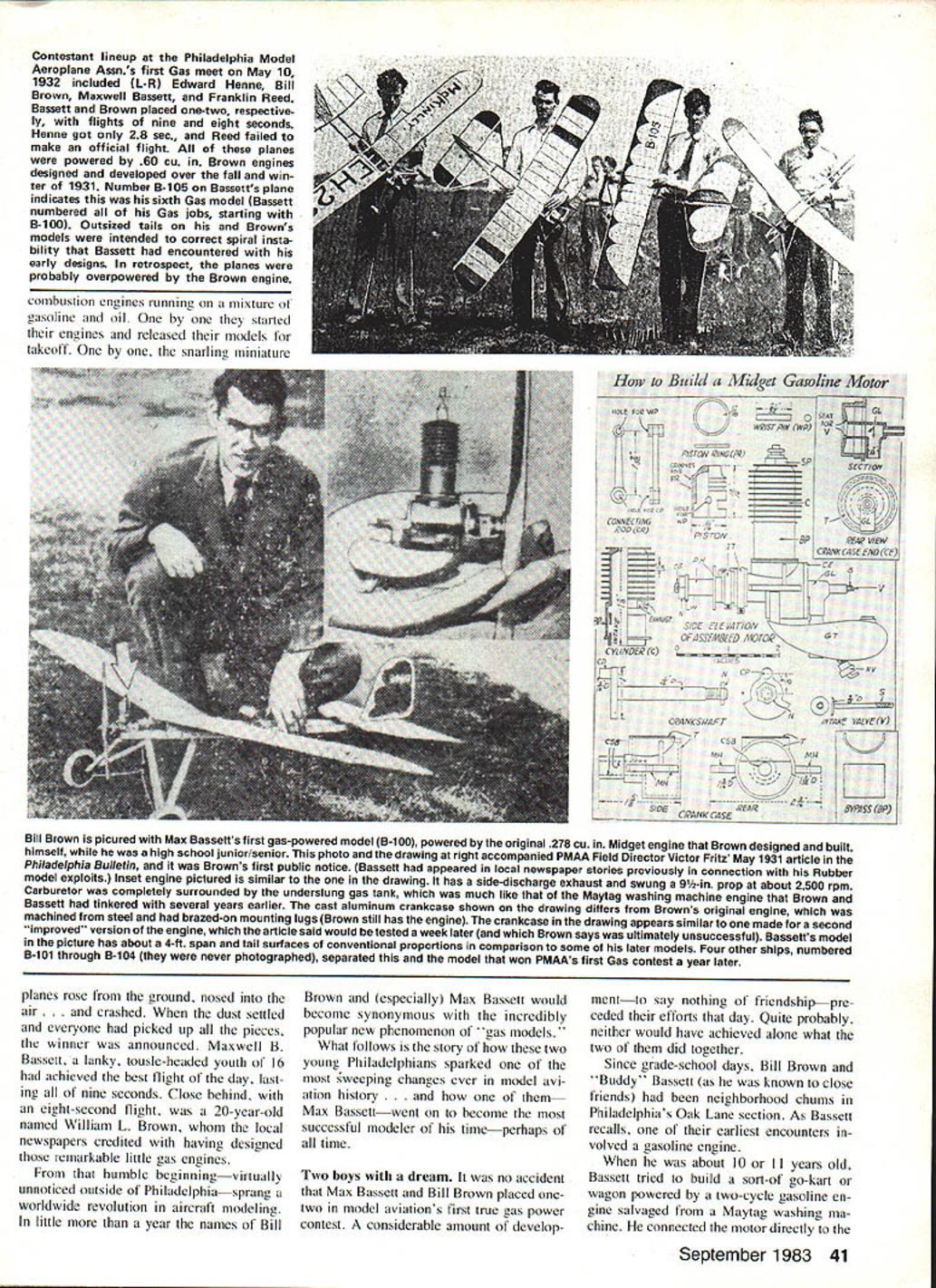
Four hopeful entrants lined up at that windy Saturday afternoon contest with their model planes — powered not by the usual twisted rubber bands, but by real internal combustion engines. Their planes rose from the ground, nosed into the air, and crashed. When the dust settled and everyone had picked up all the pieces, the winner was announced. Maxwell B. Bassett, a lanky, tousle-headed youth of 16 had achieved the best flight of the day, lasting all of nine seconds. Close behind, with an eight-second flight, was a 20-year-old named William L. Brown, whom the local newspapers credited with having designed those remarkable little gas engines.
From that humble beginning — virtually unnoticed outside of Philadelphia — sprang a worldwide revolution in aircraft modeling. In little more than a year the names of Bill Brown and (especially) Max Bassett would become synonymous with the incredibly popular new phenomenon of "gas models."
What follows is the story of how these two young Philadelphians sparked one of the most sweeping changes ever in model aviation history... and how one of them — Max Bassett — went on to become the most successful modeler of his time — perhaps of all time.
Two boys with a dream
It was no accident that Max Bassett and Bill Brown placed one-two in model aviation's first true gas power contest. A considerable amount of development — to say nothing of friendship — preceded their efforts that day. Quite probably, neither would have achieved alone what the two of them did together.
Since grade-school days, Bill Brown and "Buddy" Bassett (as he was known to close friends) had been neighborhood chums in Philadelphia's Oak Lane section. As Bassett recalls, one of their earliest encounters involved a gasoline engine.
When he was about 10 or 11 years old, Bassett tried to build a sort of go-kart or wagon powered by a two-cycle gasoline engine salvaged from a Maytag washing machine. He connected the motor directly to the wagon's drive wheels by a V-belt, and since there was no proper "clutch," he had quite a bit of trouble getting the cart to operate as intended.
Brown, who enjoyed tinkering with mechanical things, saw the problem and offered to help. Together, the boys devised a sprocket drive that allowed the engine to be disconnected from the rear wheels for starting and stopping.
It was right about this time that Charles Lindbergh made his historic transatlantic flight from New York to Paris. In its wake the whole country went aviation-crazy. Model airplane clubs sprang up in cities all over the country, and the youth of America joined them in droves. By 1929 a group of small clubs in the Philadelphia area had consolidated under the banner of the Philadelphia Model Aeroplane Association (PMAA). The PMAA was sponsored jointly by the city's Playgrounds Association, the Pennsylvania Aero Club, and the Philadelphia Bulletin, which covered news of the club's events in Saturday editions.
Both Brown and Bassett were among the many Philadelphia youngsters then building and flying rubber-powered models. By the time the two joined the PMAA, Bassett was already displaying a flair for competition, having recorded a number of wins in city-wide meets — both indoor and outdoor.
Bassett was dissatisfied with the short flights afforded by rubber power, however. At first he tried to remedy this by building a "piggyback" model — a single "pusher" canard-type model superimposed on a twin-pusher motor frame. As long as the twin-pusher motors were tightly wound, their tension held the whole assembly together. But when the twin props unwound and their rubber motor tension relaxed, the lower framework would drop away — allowing the single prop to take over and extend the model's flight.
Bassett says the idea was a success which won several contests — until the officials altered the rules to bar anything dropping off the models in flight. That was the first time, but by no means the last, that a Bassett model would bring about a change in contest rules. The inevitable result of Bassett's quest for longer flights and Brown's love of mechanical experimentation was that the two Oak Lane boys soon began to discuss the possibilities of a model plane powered by a gasoline engine.
Says Bassett: "Since there was no such engine available, we decided we'd have to build one ourselves."
Bill Brown's first engine
In September of 1930 they began work on the idea. Dividing their efforts, Brown concentrated on producing the engine in his father's home workshop which was equipped with a small lathe and a few other machine tools, while Bassett began to design and build the airframe.
Numerous obstacles stood in the way of achieving an engine that would simply run — let alone be light and powerful enough to fly a model. Brown made a dozen piston/cylinder assemblies before coming up with one that would produce decent compression.
The spark plug and ignition coil were particularly difficult problems. Recalls Bassett: "Bill's first operable spark plug was made out of a nail, a nut, and a stack of mica washers for the insulator. After a few runs it would become soaked with oil, and he'd have to make another."
The boys needed a lightweight induction-type coil to cause a spark to jump across the points of those crude early plugs. They made more than 20 coils by hand before getting one that worked. Each coil required thousands of turns of fine enameled wire interlayered with waxed paper over an iron core.
After months of experimentation, the little engine was ready at last for mounting and test-running in Bassett's plane. With an 11/16-in. bore and 1/4-in. stroke, it displaced only .278 cubic inches but weighed a hefty 14 ounces complete with coil, condenser, fuel tank, batteries, and a 9-1/2-in. prop that Bassett had carved.
The engine was balky and hard to start. Though getting such a tiny engine to run at all seemed a miraculous achievement, its performance was not exactly spectacular. With a flywheel it would turn up about 6,500 rpm; less than half that was possible with a prop.
The boys had an interesting method of measuring rpm. "We'd start the engine," says Bassett, "and take it into the house — right into the living room next to the piano. Then we'd start hitting piano keys till we found one that matched the pitch of the engine. From there it was a simple calculation to convert the frequency of the piano note to engine rpm."
In the spring of 1931, Victor R. Fritz, an industrial arts teacher at Olney High School, who was also field director of the PMAA, heard of the boys' experiments and asked to see their model. Fritz wrote most of the newspaper articles on PMAA activities. On Memorial Day of 1931 the article which he authored appeared in the Philadelphia Bulletin, complete with a photo of Brown with Bassett's airplane and construction plans for the Midget engine.
According to Bassett, Fritz's article was perhaps a bit "premature." Indeed, while it stated that the little engine "amazed" spectators at its first public demonstration, it contains no actual reference to the model's flight. Compared to the way later articles described Brown's and Bassett's activities, it's probably fair to conclude that this was only a running demonstration of the engine.
The newspaper mentioned, however, that Brown would attempt to fly an "improved" version of the engine a week later. Among those who read the story was a middle-aged man named Walter Hurleman who ran a machine shop not far from the boys' neighborhood. Hurleman had always been interested in small engines. As a younger man he had gained some experience in "hopping up" outboard motors for racing. Curious to see so tiny an engine as Brown's in operation, he drove out to the PMAA's flying field the next Saturday with his son, Walter, Jr.
According to Walter Hurleman, Jr., the demonstration he and his father witnessed consisted of "a handful of people who stood around while Brown and Bassett tried to start their engine."
As Hurleman remembers, the engine looked like "an attempt to miniaturize a washing machine motor." "They worked on it for quite a while," he says, "but never got it running long enough to fly the plane. It would only pop and pop." (The only Brown engine that looks anything like a washing machine motor was the first Midget engine. Both it and the Maytag engine Brown and Bassett tinkered with several years earlier had underslung gas tanks with the carburetor drawing right through the tank. Brown says that other engines also influenced the design of his Midget, including an outboard his father had bought for summer use at the Jersey shore, and a type of bicycle motor both he and Bassett used as youngsters.)
The Brown Junior engine
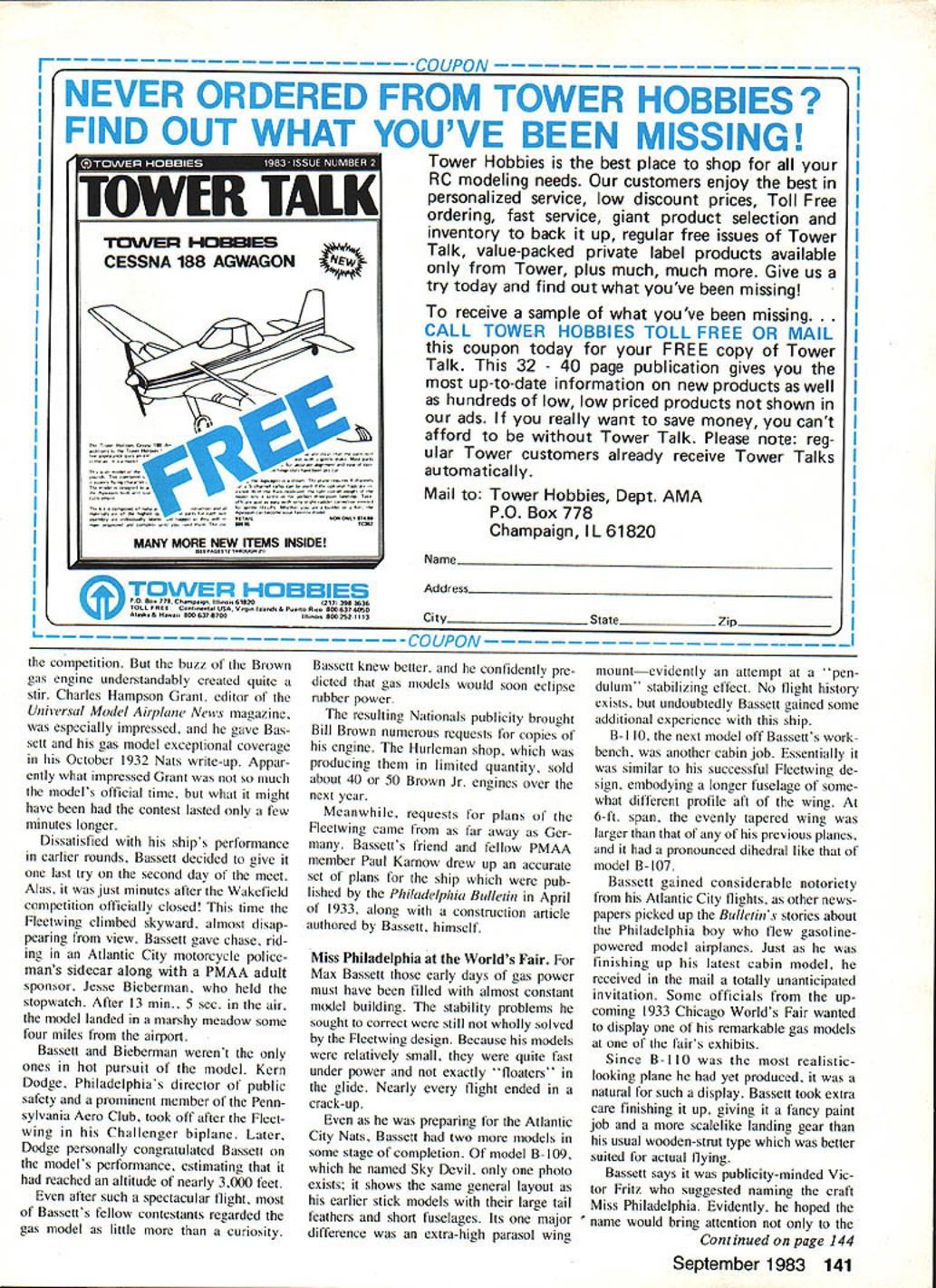
Meanwhile, Bill Brown continued to work on his engine idea from the time Victor Fritz's first article appeared in the spring of 1931. The Midget motor's reliability improved greatly when he replaced the original mica insulators in his spark plugs with real ceramic insulators obtained from the Isolantic company, a manufacturer of full-size spark plug insulators and other ceramic products in northern New Jersey. Even then, the motor's output wasn't strong enough to lift Bassett's first gas model more than a few feet off the ground.
A second engine design of slightly larger displacement was attempted — this time with the help of Brown's father, William L., Sr., who was an engineer by profession and an accomplished craftsman in his own right. Unfortunately, none of several prototypes resulting from this father/son collaboration was successful, and by late summer of 1931 Bill Brown (still a high school senior) had roughed-out on paper the configuration of yet a third engine.
This new design did away with the performance-limiting crankcase poppet valve induction of the original Midget engine. Instead it employed the lighter, simpler, more efficient "four-port" system in which admission of fresh gas/air mixture was controlled by the passage of the piston skirt over intake ports drilled in the rear of the cylinder. With a 7/8-in. bore and 1-in. stroke, it displaced .60 cu. in., establishing a standard that survives to this day. With a good ignition hookup, fresh batteries, and properly mixed fuel, it started and ran with much greater reliability and power than the original Midget ever displayed, turning a 14-in. prop at 4,000–5,000 rpm while generating up to three pounds of thrust.
Brown laboriously hand-built about eight or 10 of these engines, four of which appeared at that first PMAA gas model contest of May 10, 1932.
At about this time, Walter Hurleman contacted the Browns with an offer. Hurleman wanted young Bill Brown, who had graduated from Frankford High School in February of 1932, to work in his machine shop during the coming summer. Instead of pay (which he could ill afford in those dark Depression days), Hurleman offered Brown the facilities of his shop in which to continue developing his engine idea.
Brown must have jumped at the chance. Says he: "Walter Hurleman was a highly skilled machinist and tool-and-die maker. His was the first commercial shop I ever worked in, and I was eager to learn anything I could from the old master. In Hurleman's shop there were available machines and processes far beyond the scope of my father's home workshop. They were put to good use in refining the design of the engine and putting it into a higher level of production."
Evidently, production was precisely what Hurleman had in mind, because almost immediately he began to develop sophisticated tooling of his own to mass-produce the engine. Along the way, he added some refinements to the basic design.
All of Bill Brown's hand-built engines had employed pistons with heavy rings that leaked compression to some degree and exacted a friction penalty as they worked up and down in the cylinder. These engines also used a 1/16-in.-dia. "shear pin" to secure the propeller drive washer to the crankshaft. According to Brown, it was Walter Hurleman who originated the ringless hard-steel "lapped" piston, which produced superior compression and ran so much better than earlier engines that it became standard practice for model engine construction for a long time afterwards. This refinement and a more positive propeller hub hex drive were incorporated into the new Brown Junior engines which the Hurleman shop began turning out as early as mid-summer of 1932. The workmanship on these Hurleman-built engines was "excellent," according to Brown, who adds that their running "pleased us all very much at the time." They were rated, conservatively, at 1/5 hp — a five-fold increase over Brown's original Midget.
By this time development of the Brown Jr. engine was essentially complete. Further changes, though there were many over the years, were all aimed at easing production — not at increasing power or performance. Development of the gas-powered model, which had been left to Maxwell Bassett, was just beginning.
Bassett's first gassers
Fortunately for history, Bassett numbered his gas models in a way that aids their identification. His first, built for Brown's .278 cu. in. Midget and pictured in Victor Fritz's May 1931 newspaper article, was number B-100. This was followed by four others, numbered B-101 through B-104, which served as test beds for the engine improvements Brown was making during the summer of 1931. No photos of them have survived, but they were undoubtedly all of "stick" design for ease of repair and modification — and with wingspans of around four feet.
"What we were really trying to do," explains Bassett, "was to develop and test a gas model in secret, so that when we were ready we could go to the meets and 'clean up' against the competition, which was all rubber-powered at that time."
Once they had the Midget engine running more or less reliably in the plane, they began to test-fly the craft — right in front of Bassett's house.
"The very first takeoffs were ROGs right off of 11th Street," says Bassett. "The plane would keep turning left and would end up in the bushes." After a few such attempts, they moved their testing to a nearby vacant lot.
"Because of the tall weeds," says Bassett, "I had to hand-launch the models. This gave us more time to figure out what was going wrong. The main problem with the first flights was that they always ended up in a left-hand spiral dive. In an attempt to correct this instability, I kept enlarging the tail surfaces and increasing the wing dihedral, but we still had the spiral dive to the left."
By the time Bassett built his first contest-winning gas job, B-105, the tail had become truly outsized, as can be seen in one of the pictures. But the stability problem persisted. Accounts of its May 10, 1932 flight describe "a large loop 50 feet into the air, ending in a crash that might have been avoided had the plane gained only a few feet more altitude."
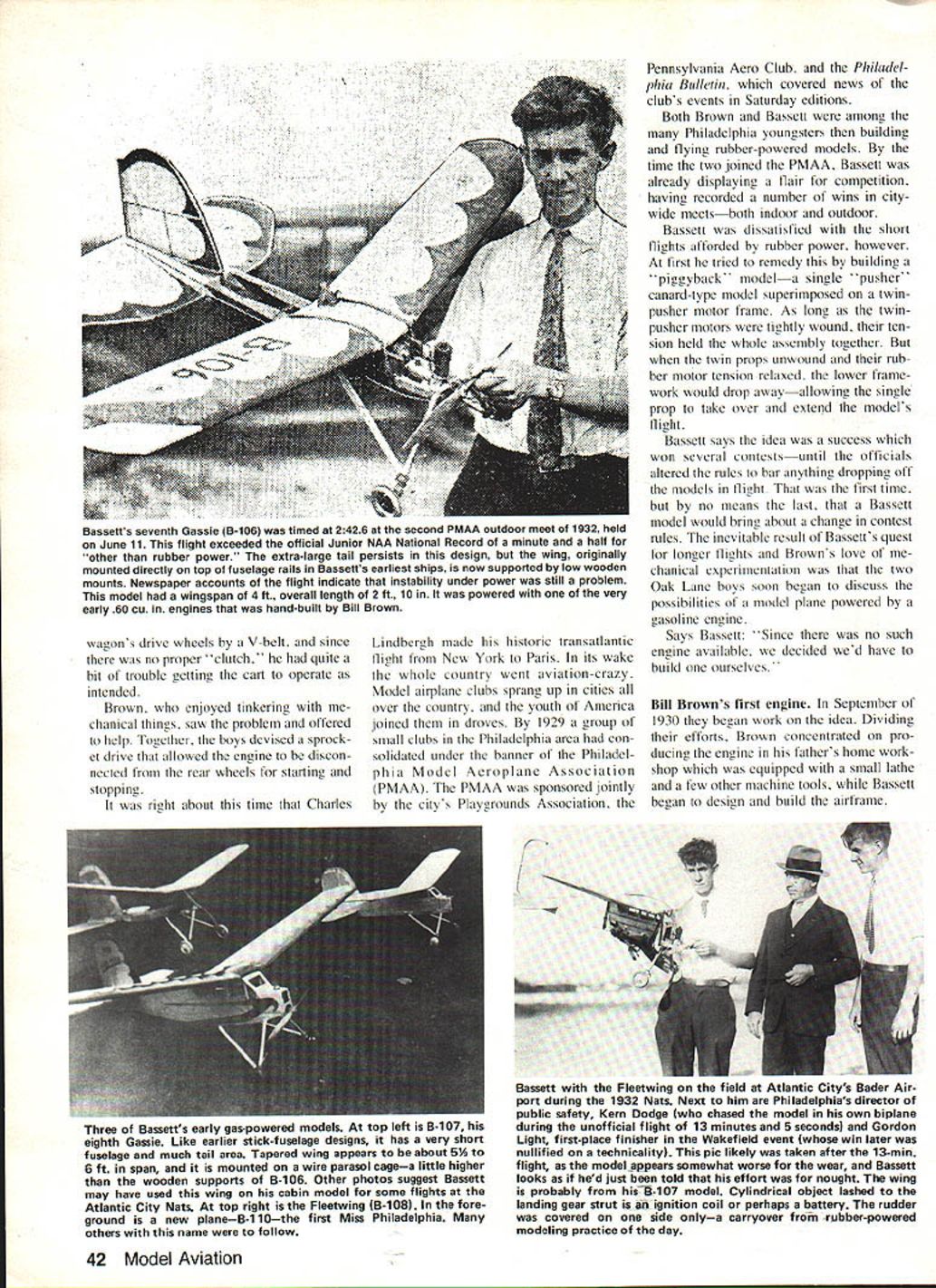
Undaunted, Bassett fielded another model — B-106 — in competition a month later. On June 11, at the second meet of the PMAA's 1932 outdoor season, this ship took off from Model Farms, the club's South Philadelphia flying field, and for two minutes 42 3/5 seconds it gyrated wildly through the air towards the Philadelphia Navy Yard. Its looping, swooping flight was the first by a gas model to exceed the then-current record of a minute and a half for "other-than-rubber" power, set a year earlier by a Louisville, KY boy's compressed-air-powered model. Bassett retrieved the plane nearly a half-mile from its launch point, and afterwards the Bulletin printed Brown as exclaiming: "That flight certainly was worth the two years' work put into that motor!"
Not one to rest on his laurels, Bassett immediately set to work on two more models. Number B-107 was another stick job, but B-108, his ninth gas model, was something new — a cabin design. Bassett gave the airplane a name as well as a number. He called it the Fleetwing.
On to Atlantic City
The 1932 National Contest was set for Atlantic City, NJ, in September. Doubtless the two boys had their sights on a major win. In testing the new airplanes, Bassett found the cabin job, powered with a Hurleman-built engine, a better flier than the stick model. Says he: "I thought I was making the Fleetwing more stable by giving it a low C.G. Actually I learned much later that I was really giving the plane more side area which countered the effect of what had become a pretty oversize tail."
Competition for the International Wakefield Cup was to be the highlight of the Atlantic City meet. The Wakefield rules stated that models had to be of "fuselage" (as opposed to stick) design, but they weren't specific as to the type of power. And so Bassett entered his gas-powered cabin job in the Wakefield event.
As it turned out, the competition was tougher than expected. According to running accounts of the two-day meet, Gordon Light of Lebanon, PA put in a truly phenomenal rubber-powered flight of 25 minutes, 53 seconds on the first day, covering a distance of eight miles from the meet site at Atlantic City's Bader Airport. This must have been disallowed for some reason, however, as the final published results credited him with only 7 min., 57 2/5 sec., good enough, nonetheless, to win the Wakefield trophy. (Later, even this win was declared invalid because of a technical irregularity in the fact that the contest had been postponed from an earlier date.)
Bassett's best official flight lasted only 2 min. and 55 sec., netting him fourth place in the competition. But the buzz of the Brown gas engine understandably created quite a stir. Charles Hampson Grant, editor of the Universal Model Airplane News magazine, was especially impressed, and he gave Bassett and his gas model exceptional coverage in his October 1932 Nats write-up. Apparently what impressed Grant was not so much the model's official time, but what it might have been had the contest lasted only a few minutes longer.
Dissatisfied with his ship's performance in earlier rounds, Bassett decided to give it one last try on the second day of the meet. Alas, it was just minutes after the Wakefield competition officially closed! This time the Fleetwing climbed skyward, almost disappearing from view. Bassett gave chase, riding in an Atlantic City motorcycle policeman's sidecar along with a PMAA adult sponsor, Jesse Bieberman, who held the stopwatch. After 13 min., 5 sec. in the air, the model landed in a marshy meadow some four miles from the airport.
Bassett and Bieberman weren't the only ones in hot pursuit of the model. Kern Dodge, Philadelphia's director of public safety and a prominent member of the Pennsylvania Aero Club, took off after the Fleetwing in his Challenger biplane. Later, Dodge personally congratulated Bassett on the model's performance, estimating that it had reached an altitude of nearly 3,000 feet.
Even after such a spectacular flight, most of Bassett's fellow contestants regarded the gas model as little more than a curiosity. Bassett knew better, and he confidently predicted that gas models would soon eclipse rubber power.
The resulting Nationals publicity brought Bill Brown numerous requests for copies of his engine. The Hurleman shop, which was producing them in limited quantity, sold about 40 or 50 Brown Jr. engines over the next year.
Meanwhile, requests for plans of the Fleetwing came from as far away as Germany. Bassett's friend and fellow PMAA member Paul Karrow drew up an accurate set of plans for the ship which were published by the Philadelphia Bulletin in April of 1933, along with a construction article authored by Bassett himself.
Miss Philadelphia at the World's Fair
For Max Bassett those early days of gas power must have been filled with almost constant model building. The stability problems he sought to correct were still not wholly solved by the Fleetwing design. Because his models were relatively small, they were quite fast under power and not exactly "floaters" in the glide. Nearly every flight ended in a crack-up.
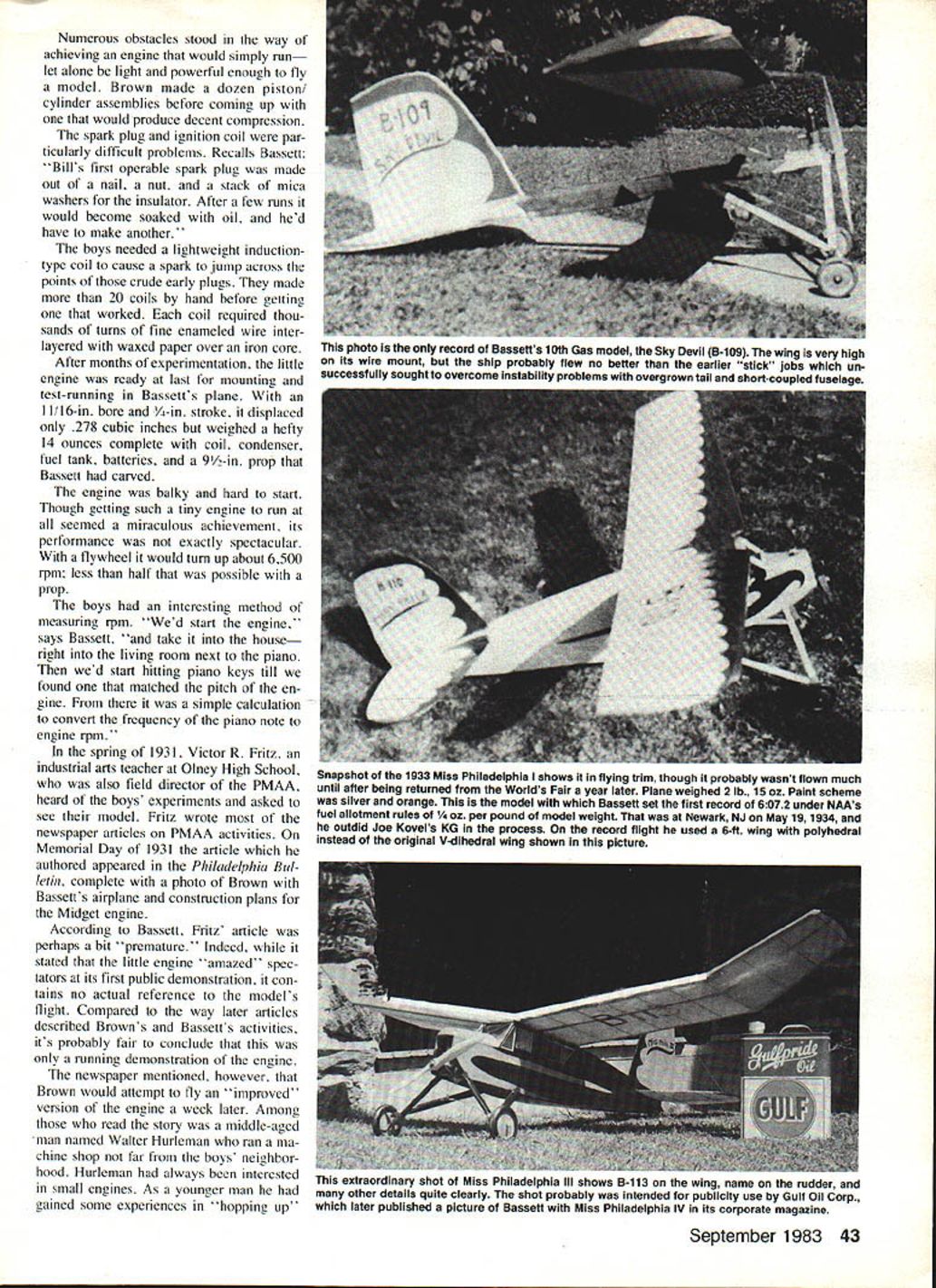
Even as he was preparing for the Atlantic City Nats, Bassett had two more models in some stage of completion. Of model B-109, which he named Sky Devil, only one photo exists; it shows the same general layout as his earlier stick models with their large tail feathers and short fuselages. Its one major difference was an extra-high parasol wing mount — evidently an attempt at a "pendulum" stabilizing effect. No flight history exists, but undoubtedly Bassett gained some additional experience with this ship.
B-110, the next model off Bassett's workbench, was another cabin job. Essentially it was similar to his successful Fleetwing design, embodying a longer fuselage of somewhat different profile aft of the wing. At 6-ft. span, the evenly tapered wing was larger than that of any of his previous planes, and it had a pronounced dihedral like that of model B-107.
Bassett gained considerable notoriety from his Atlantic City flights, as other newspapers picked up the Bulletin's stories about the Philadelphia boy who flew gasoline-powered model airplanes. Just as he was finishing up his latest cabin model, he received in the mail a totally unanticipated invitation. Some officials from the upcoming 1933 Chicago World's Fair wanted to display one of his remarkable gas models at the fair's exhibits.
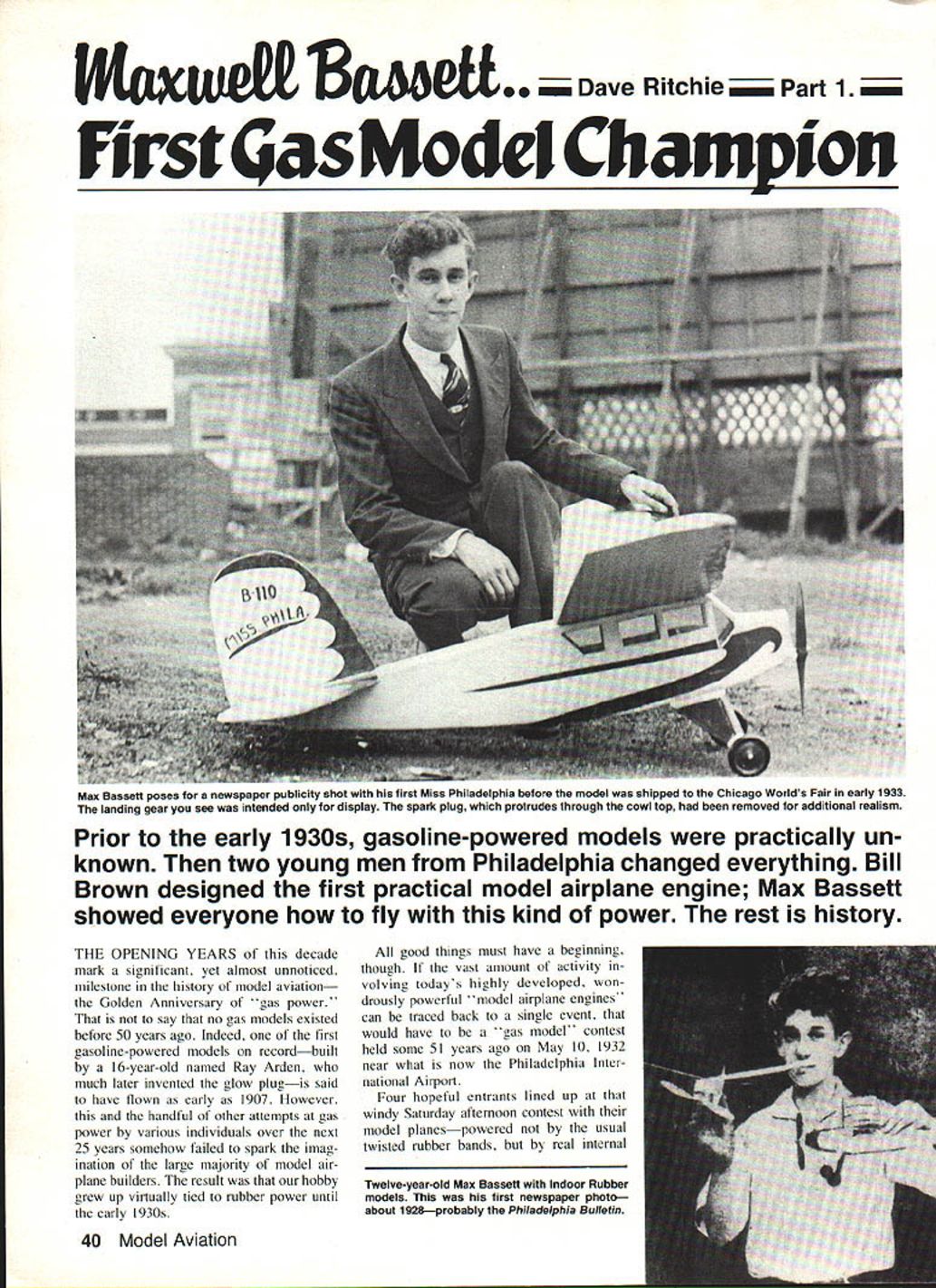
Since B-110 was the most realistic-looking plane he had yet produced, it was a natural for such a display. Bassett took extra care finishing it up, giving it a fancy paint job and a more scale-like landing gear than his usual wooden-strut type which was better suited for actual flying.
Bassett says it was publicity-minded Victor Fritz who suggested naming the craft Miss Philadelphia. Evidently, he hoped the name would bring attention not only to the city which AMA founder H.W. (John) Alden would later call "the world's most active in model airplane matters," but to the PMAA as well.
Bassett flew the new model only a time or two before shipping it off to Chicago. He would not fly it in competition until the following year. But Miss Philadelphia had already set two precedents that would become routine with Bassett. It was the first of several of his models to go on public display. It was also the first of a whole succession of tremendously successful designs to bear his hometown's name.
The last "stick" model
With Miss Philadelphia temporarily out of action, Bassett needed another ship to try to better his earlier flight times. He decided to give the stick-model concept another try. As it turned out, number B-111, or Miss Philadelphia II as he named it, was his last stick job. Generally proportioned about the same as Miss Philly I, it performed markedly better than the earlier stick models. By now Bassett had found the secret to success with gas power. By building his models larger than before, he was able to slow them down and add to their gliding capability. He also found that longer fuselages contributed much to flight stability.
By late fall of 1932, Bassett estimated he had made as many as 300 gas-powered flights. Most of his test-flying was now conducted at Wings Field, an airport north of the city. Though his best official record was the 2 min., 55 sec. scored at Atlantic City, he was achieving flights as long as 15 minutes at Wings under favorable conditions.
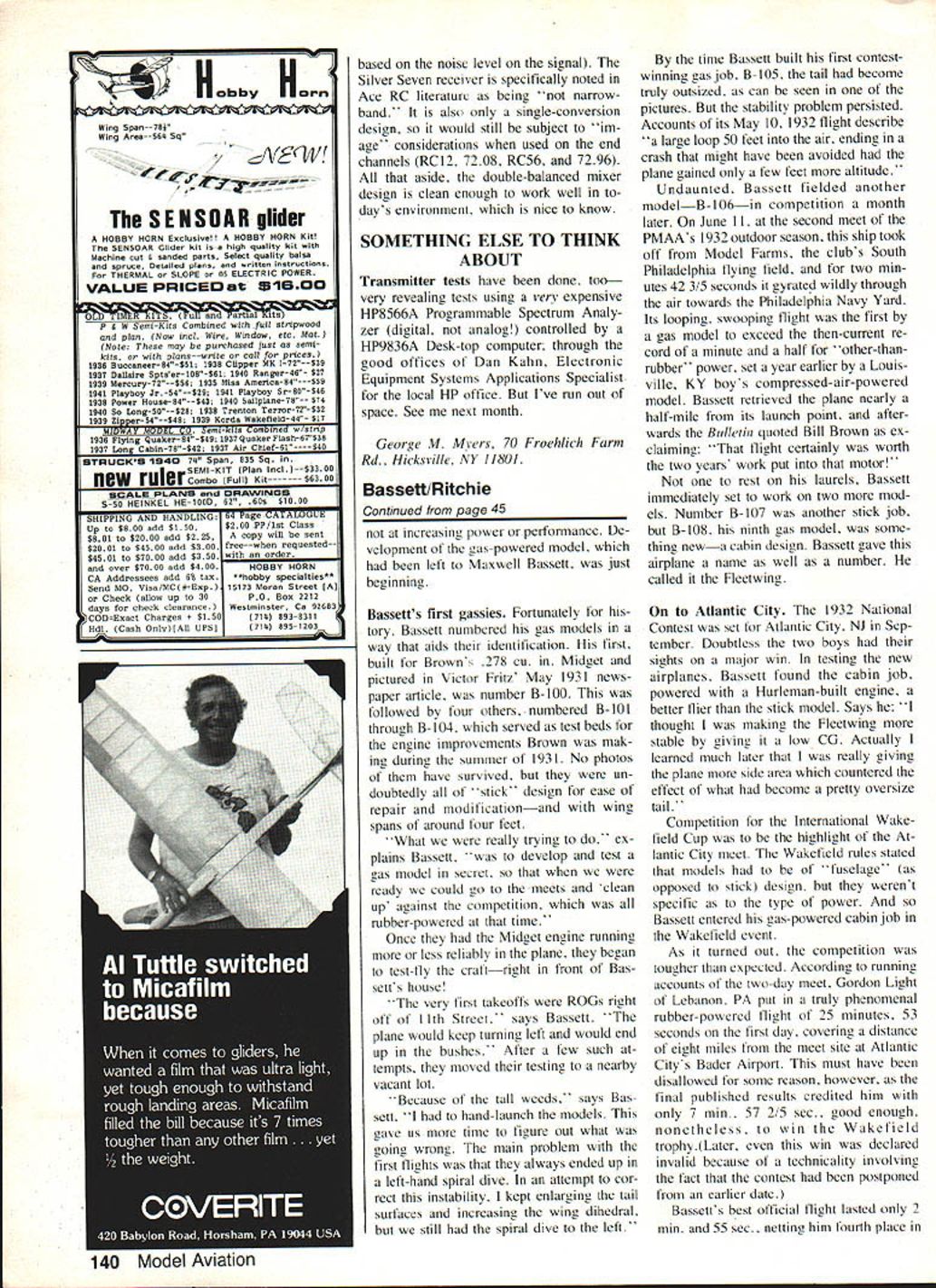
At this time, Max Bassett wasn't the only gas modeler in Philadelphia — just the most successful. His closest competitor at the PMAA's first gas model contest had been Bill Brown. But Brown was nearing the age of 21, after which he would be barred from PMAA competition (no Open class existed in those days). For this reason, and also because he was entering the College of Engineering at Penn State, Brown never again entered a gas model contest. Says he: "I had more than enough work just taking care of the engines."
PMAA members Edward Henne and Franklin Reed were Bassett's other gas-power rivals in 1932, but in competition his models always managed to stay aloft just a few seconds longer than theirs, and they soon dropped out of the picture.
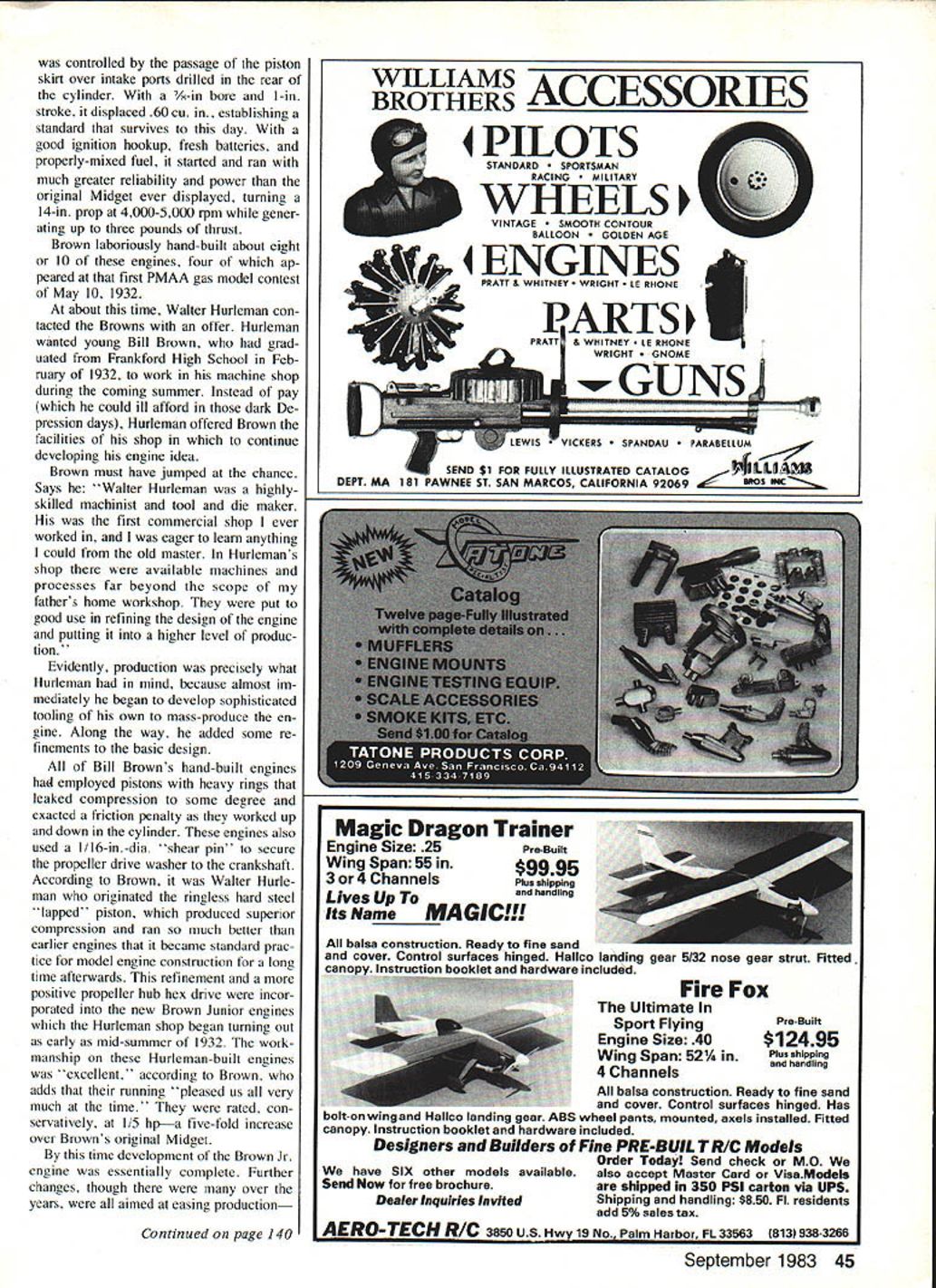
Pushing the season a bit, Victor Fritz scheduled the first PMAA gas contest of 1933 for Saturday, March 11, to give Bassett and other modelers an early chance at raising his 2 min., 42.6 sec. PMAA record set the previous June. The weather turned out to be sub-freezing and blustery. Nevertheless, Max Bassett and his father drove out to the meet site at Caster and Cottman Avenues with Miss Philly II in the back seat of their car.
Other Brown Jr.-powered entries in the meet were those of Frank Reed and Walter Hurleman, Jr., who showed up with a rather complicated pendulum-controlled model he and his father built.
After four attempts, Bassett managed to get his ship trimmed for sustained flight, and on its fifth launch, Miss Philly II sailed away to the cheers of spectators, circling to an estimated altitude of 700 feet. The model blew east about three-quarters of a mile, crossing Roosevelt Boulevard a hundred feet over the traffic below. From a vantage point atop a hill west of the boulevard, Bassett and Fritz clocked its new record time at 47 min., 37 3/5 sec., as it landed in a driveway on the other side. Returning to the contest with the model tucked under his arm, Bassett was applauded by the onlookers, including Hurleman and Reed, neither of whom obtained successful flights that day.
Total triumph at last
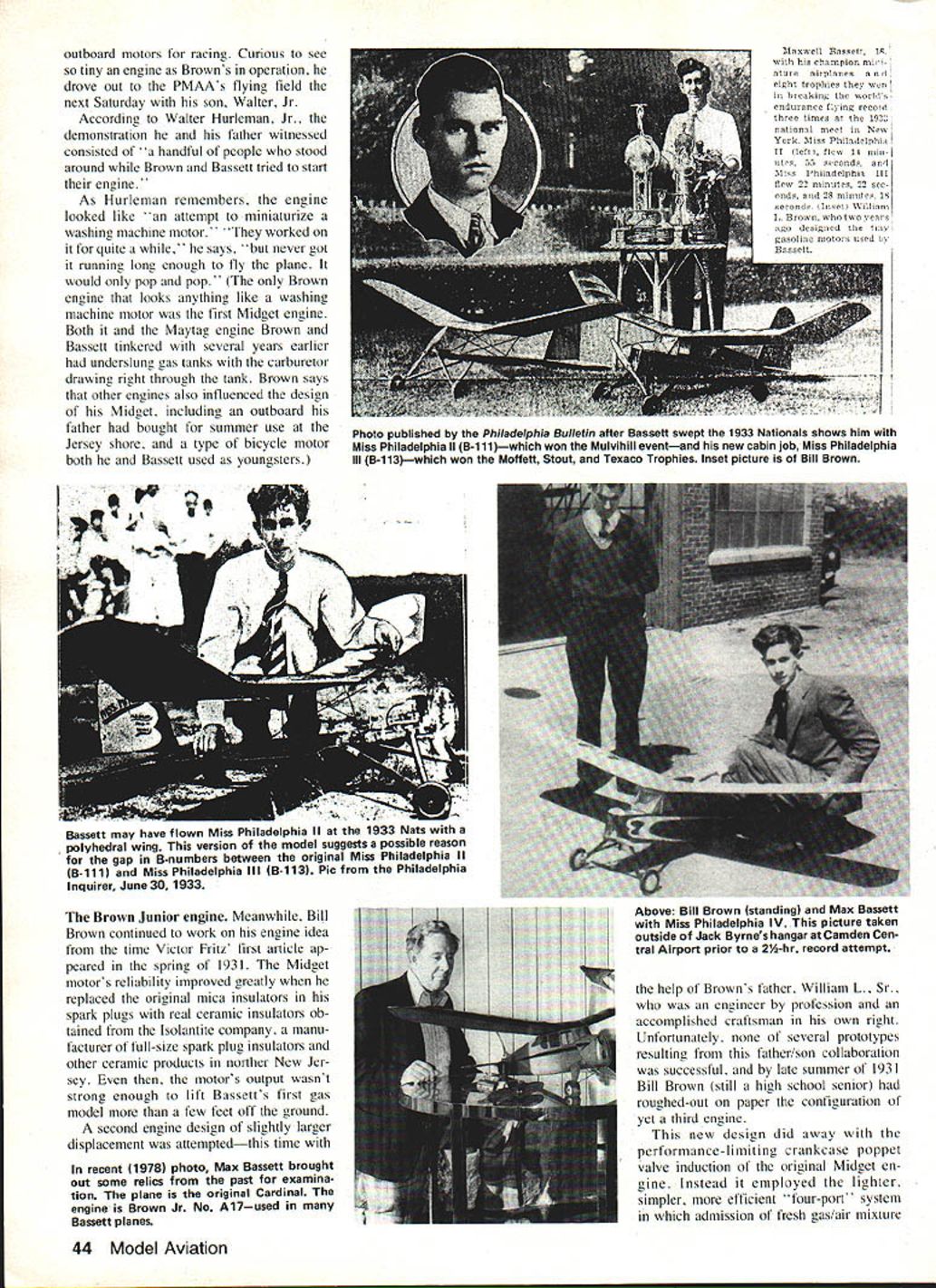
During the winter, Bassett had completed yet another new cabin model. This one he designated B-113. Continuing the tradition begun by Victor Fritz, he called it Miss Philadelphia III. The new plane was a further evolution of the original cabin design (which resembled the Curtiss Robin), having yet a longer fuselage, double-tapered aft of the wing, and fully enclosed engine with a more streamlined hood or cowl (not even the spark plug protruded, as it had on Miss Philly II). The six-foot wing of Miss Philly III was a new departure for Bassett, being his first with polyhedral (or double-dihedral), as he called it. The rudder had straight leading and trailing edges tapering to a rounded tip.
Bassett left an apparent gap in his numbering system between Miss Philly II (B-111) and Miss Philly III (B-113). As flown on March 11, 1933, Miss Philly II had a single-dihedral tapered wing and a rather rounded rudder, as shown in one of the pictures. Later pictures of this model show a rudder more like that of Miss Philly III, and some show a polyhedral wing as well. No evidence exists that Bassett ever built a separate model bearing number B-112. Evidently, he considered the polyhedral version of Miss Philly II enough of a change to warrant reserving that number from any other design.
At any rate, by the time of the 1933 Nationals, Bassett was prepared with two well-tested and trimmed gas models. Like the previous year's Nats, the competition was a two-day affair. All outdoor events were scheduled to take place at Roosevelt Field, Long Island, on Tuesday, June 27, with indoor events to follow the next day at the 258th Field Artillery Armory in the Bronx.
Fog and drizzle greeted the bulk of the 165 registered contestants as they arrived at the airport made famous only six years before by Charles Lindbergh. By 11 o'clock the sky cleared, and the meet got underway.
In contrast to the multi-faceted, week-long competitions of our day, the 1933 Nats presented contestants with only three outdoor events. The Mulvihill Trophy was for Hand-Launched Stick models. The William B. Stout Trophy, named for the designer of the Ford Trimotor transport, was for ROG Cabin (or "fuselage" models, as they were called then). In addition, a third trophy was being offered for the first time in honor of the Bureau of Aeronautics chief, Rear Admiral William A. Moffett, who had perished in the crash of the dirigible Akron only months earlier.
So as not to interfere with the flurry of rubber-powered stick-and-tissue twin pushers and light fuselage "tractor" models circling silently above the main competition area, Bassett and Bill Brown (present in his usual "mechanic" capacity) took the gas-powered Miss Phillys some distance down the main runway to prepare them for flight.
Three times that afternoon Bassett poured a measured ounce of fuel into his models' gas tanks. Three times he set his ignition and flipped the prop. Three times the buzzing Miss Phillys took off into the light southeast breeze, climbing in steady spirals to play hide-and-seek among the clouds. The display was spellbinding to all except Bassett, who immediately began his now-familiar race to keep his craft in sight.
By the close of the afternoon, the two Philadelphia youths knew they had finally accomplished their goal of three years before: Miss Philadelphia II had won the Mulvihill event with a time of 14 min., 55 sec. Her sister ship, Miss Philly III took both the Stout and Moffett Trophies with times of 22 min., 22 1/2 sec. and 28 min., 18 sec., respectively — a clean sweep.
The Mulvihill and Moffett flights scored new world records. In addition, Bassett was presented with a new perpetual trophy offered by Texaco for the longest gasoline-engine-powered flight of the National Meet.
Bassett's models weren't the only gas jobs entered in the 1933 Nats. Only the day before the contest, Brooklyn's Joe Kovel was putting the last touches on his entry, the KG-1 designed by Charlie Grant as a result of inspiration provided by Bassett's gas-powered exploits at the previous year's Nats. John Romanowsky of Jersey City, N.J. is also reported to have entered a gas model in the meet. Both, however, failed to make official flights, and aside from Bassett's marks, the rest of the outdoor times recorded were by "elastically-driven" models, as one reporter termed them.
Bassett's remarkable wins brought him considerable fame. After the meet his Miss Philly III was put on display in a downtown Philadelphia store window along with his Nats trophies. Stories of his modeling achievements appeared not only in Model Airplane News, but in American Boy and Youth World magazines, as well as in the New York Times and all the Philadelphia papers.
It also caused considerable commotion at the National Aeronautic Association (NAA) — then the sanctioning body for model competitions as well as full-scale events. In its coverage of the event, the NAA's National Aeronautic Magazine editorialized: "Because it was gasoline-powered, Bassett's ship was far and away ahead of its competitors... It was evident from the results that gasoline-engined models must be placed in a separate category from rubber-powered models. The latter do not have a fair chance when entered against gasoline-powered planes." Shortly thereafter, the NAA Contest Committee made sure that rubber and gas power would never again compete in the same events.
Philadelphia's 18-year-old model airplane champion seemed not to notice. Absorbed in exploring the limits of gas model endurance, he began construction of yet another Miss Philadelphia.
(To be continued.)
Transcribed from original scans by AI. Minor OCR errors may remain.

