
Maxwell Bassett — First Gas Model Champion
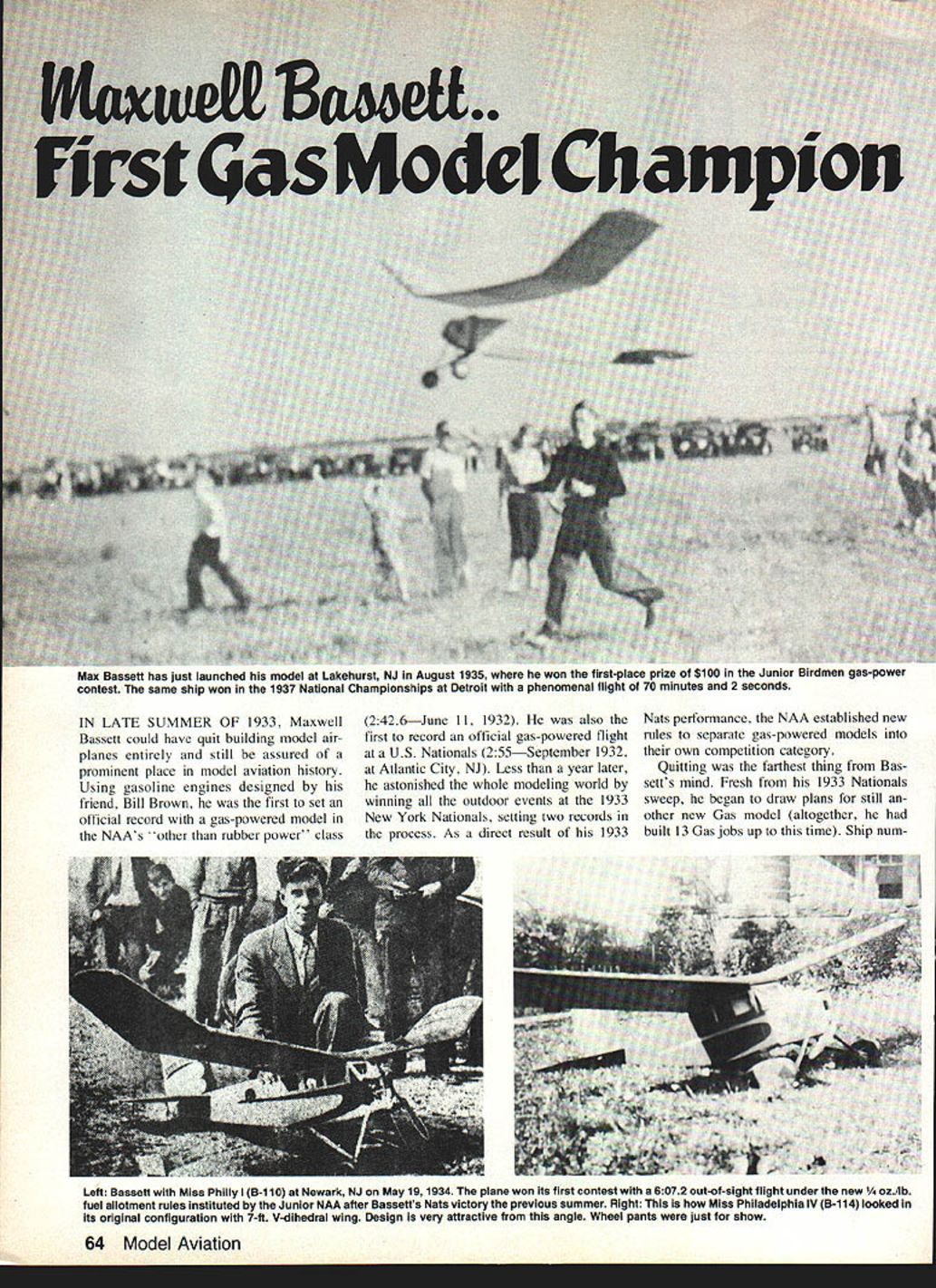
In late summer of 1933 Maxwell Bassett could have quit building model airplanes entirely and still have been assured a prominent place in model aviation history. Using gasoline engines designed by his friend Bill Brown, he was the first to set an official record with a gas-powered model in the NAA's "other than rubber power" class (2:42.6 — June 11, 1932). He also recorded the first official gas-powered flight at a U.S. Nationals (2:55 — September 1932, Atlantic City, NJ). Less than a year later he astonished the modeling world by winning the outdoor events at the 1933 New York Nationals and setting two records in the process. As a direct result of his 1933 Nats performance, the NAA established new rules to separate gas-powered models into their own competition category.
Quitting was the farthest thing from Bassett's mind. Fresh from his 1933 Nationals sweep, he began drawing plans for still another gas model. By that time he had built 13 gas jobs.
Notable early records and results:
- 2:42.6 — NAA "other than rubber power" class (June 11, 1932).
- 2:55 — first official gas-powered flight at U.S. Nationals (September 1932).
- Swept outdoor events at 1933 New York Nationals, prompting new NAA rules.
Miss Philadelphia IV — design and intent
Number B-114, Miss Philadelphia IV, resembled Bassett's Nats-winning Miss Philly II and III in most respects. Differences included:
- A rounded rudder and a fuselage nearly identical to the Moffett Trophy winner.
- Originally a V-dihedral wing, 7 ft span (later changed).
- A neat pair of detachable wheel pants intended for display only.
- A 15 oz auxiliary gas tank installed to augment the standard 2½ oz tank that came with the Brown Jr. engine.
Bassett initially envisioned launching the model from flatland — prairie country where it could be tracked cross-country by automobile. Victor Fritz, fearing an endurance attempt might carry the model out of the Philadelphia area, instead proposed launching from a local airport and following it by full-size airplane. Fritz arranged with the operator of Camden (NJ) Central Airport and hoped to make a trial before Christmas 1933, but harsh winter weather forced repeated postponements until the following spring.
The Brown Jr. engine and Junior Motors Corporation
For his entry at Newark Bassett used a Model B Brown Jr. engine. Unlike earlier A-model Brown engines, the Model B was manufactured by Junior Motors Corporation, formed by Bill Brown and financial backer Edward Roberts after parting ways with Walter Hurleman late in 1933. In contrast to Hurleman's low-volume shop, Junior Motors would later mass-produce some 50,000 engines before World War II. Edward Roberts would also become the third president of the not-yet-formed Academy of Model Aeronautics.
Newark — Eastern States Outdoor Championships (May 19, 1934)
On May 19, 1934, the PMAA sent a large contingent to the Eastern States Outdoor Championships at Newark, NJ. Although the meet was still predominantly rubber-powered, the "gas bug" was catching on and Bassett entered the new NAA gas model category with his original Miss Philadelphia, recently returned from the World's Fair and untried in competition.
Competition at Newark included Joe Kovel (Bassett's 1933 Nats rival), Alfred Huber, Martin Fay and others from the Newark area. Early in the meet Kovel got his KG-1 off but it stalled after a 4 minute, 35 second flight that might have lasted longer if properly trimmed. Bassett bettered the mark, launching Miss Philadelphia into a thermal that carried her out of sight for 6 minutes, 7 seconds, winning the event despite new NAA gas rules limiting Miss Philly's fuel supply to 1/2 oz.
Searching the neighborhood for where the model had been last seen, Bassett and his father eventually found the slightly damaged Miss Philly in the possession of a youngster and paid two dollars for its return, nine days after Newark.
Camden endurance attempt — May 28, 1934
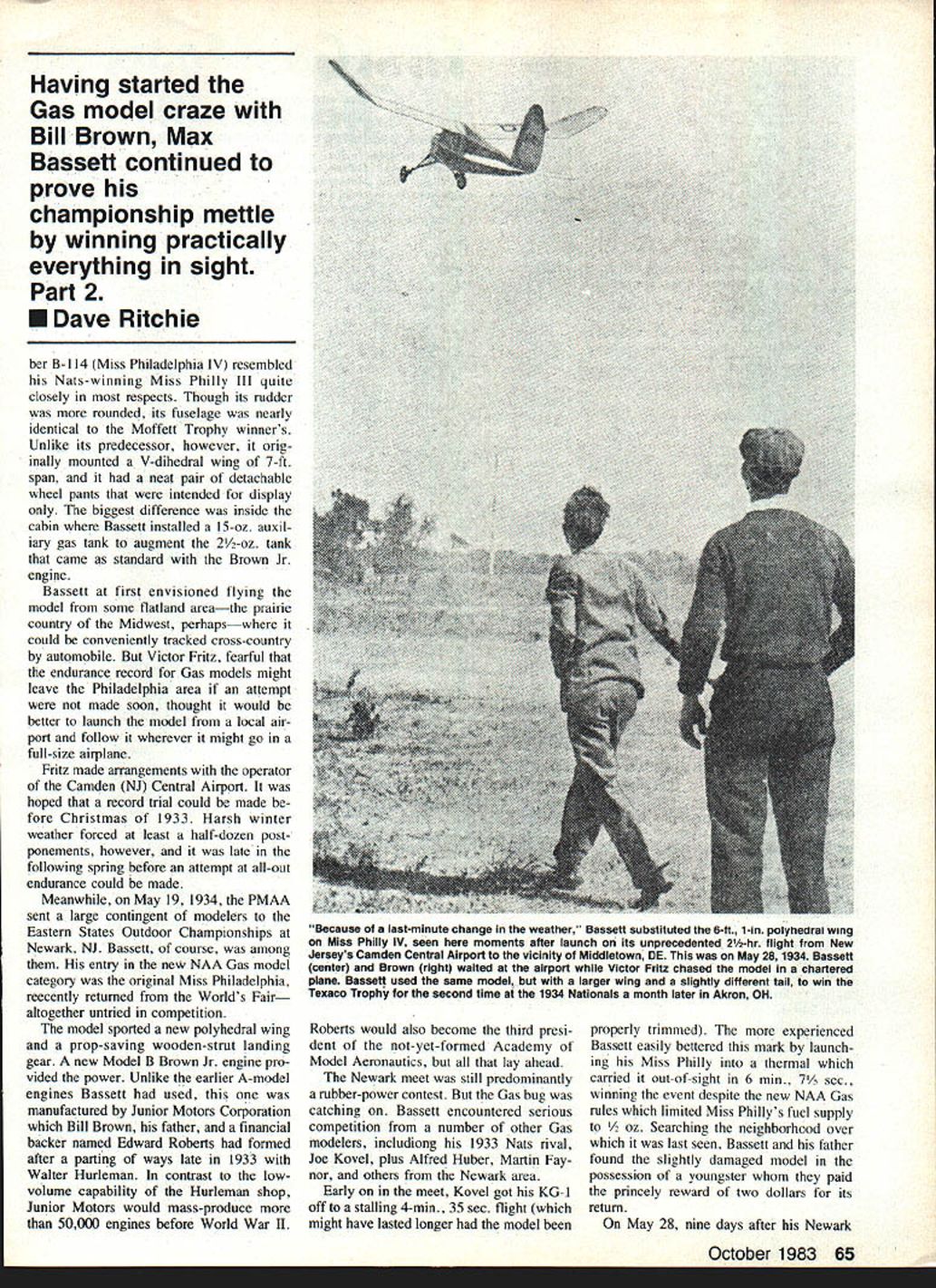
On May 28, 1934, nine days after Newark, Bassett readied Miss Philadelphia IV for its oft-postponed endurance attempt from Camden Airport. Among the onlookers were C. Townsend Ludington (founder of what became Eastern Airlines), Bassett's parents, friends from the PMAA, and Bill Brown. Victor Fritz and charter pilot Jack Byrne prepared to follow the model in Byrne's open-cockpit Fairchild Parasol, with Fritz filming on 16mm.
Two attempts the previous day had failed (one in a spiral dive due to trim error; the other curtailed by engine failure). This time everything clicked. With Bill Brown holding the plane while Bassett set the mixture and spark, Bassett sprinted and launched the model into the wind. Miss Philly IV climbed in slow steady circles with 17 oz of gas aboard.
Byrne and Fritz kept the Fairchild above the miniature plane as it circled away southwesterly: from Camden to Gloucester, across the Delaware River to South Philadelphia, over Chester, PA, then eastward back to Gibbstown, NJ, south over Salem, NJ, and westward across Delaware Bay. The engine ran out of gas shortly after crossing into Delaware state, at about 8,000 ft altitude. Byrne later recalled the glide: "I would never have believed it if I hadn't seen it myself. That little plane glided 10 miles!"
Two hours, 35 minutes, and 39½ seconds after launch, Victor Fritz stopped his stopwatch as Miss Philadelphia IV nosed over in a cow pasture near Armstrong's Corner in Delaware, just south of Middletown and four miles from the Maryland line. Byrne landed in an adjoining field and retrieved the model. The flight had traversed a straight-line distance of 54 miles from its launch point; Fritz optimistically estimated a circling path of some 180 miles.
After refueling at a nearby airport, Byrne and Fritz returned to Camden, touching down just before dark with the model poking out of the Fairchild's front cockpit. Bassett recalled, "That was the longest four hours I'd ever spent in my life."
Recognition and NAA ruling
The unprecedented feat was hailed locally and nationally. The Philadelphia Bulletin called it a new endurance record. The PMAA presented Bassett and Brown with Achievement Awards. PMAA director Charles H. English declared: "These boys ... have shown that model planes cannot be classed as mere playthings." Reginald Cleveland of the New York Times noted the accomplishment, and Popular Science, Reader's Digest and Time Magazine also reported the story — Time comparing 19-year-old Bassett to aviation heroes Frank Hawks and Roscoe Turner.
Ironically, the NAA refused to recognize the flight under its 1934 rules (which had been precipitated by Bassett's 1933 Nats sweep). Gas models were allotted 1/2 oz of fuel per pound of airplane weight — up to a maximum of 1 3/4 oz liquid. Miss Philly IV's 17 oz fuel load far exceeded that limit, so the 2½-hour flight did not make the official record books. Not getting the official record mattered little: Bassett was indisputably the nation's foremost gas model builder and the gas-model boom accelerated. Junior Motors Corp. was deluged with orders and produced about a thousand Brown Jr. engines in its first year.
Wing changes, Franklin Institute display, and the Akron Nationals
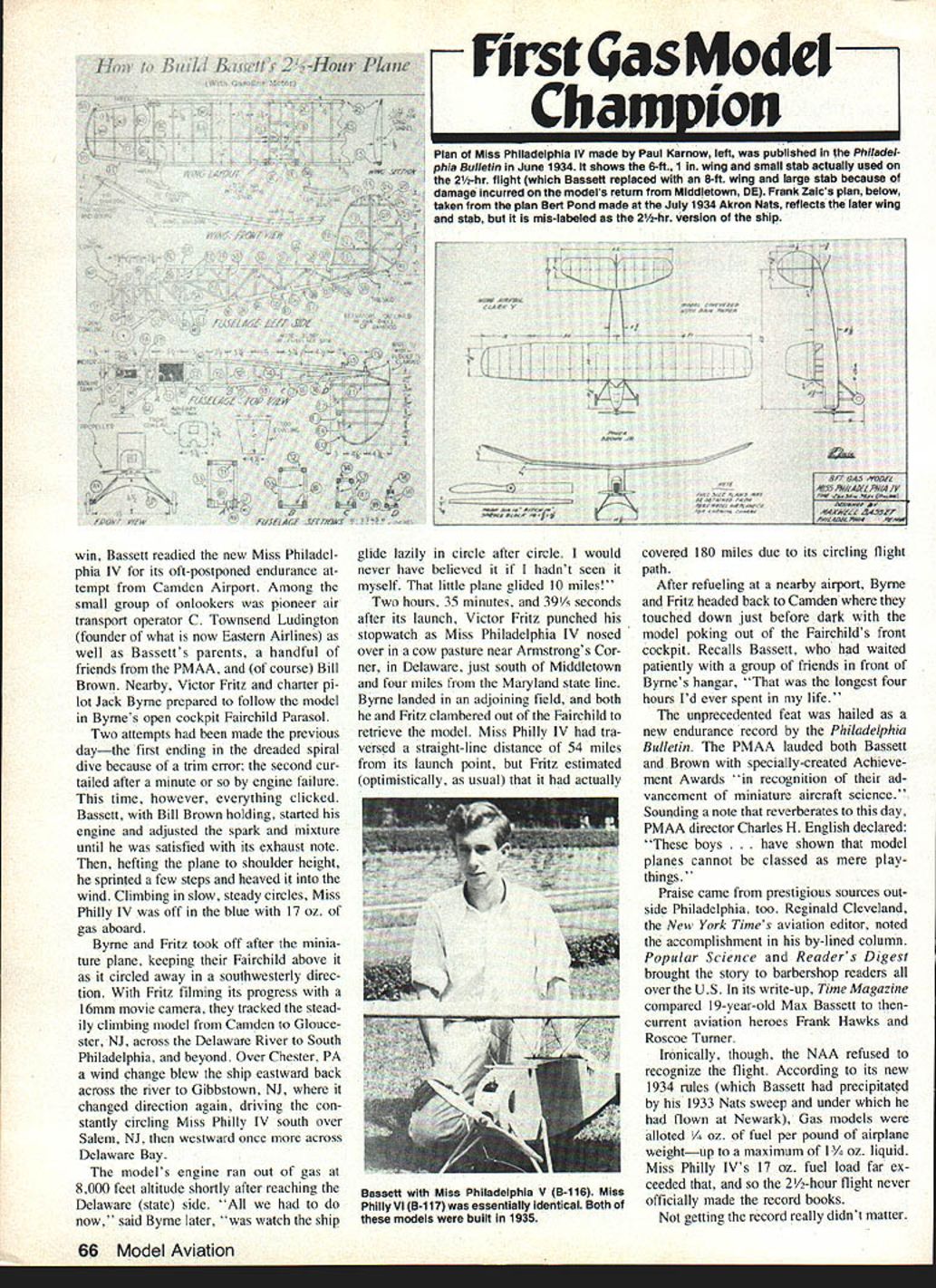
Miss Philly IV had originally been designed with a 7 ft V-dihedral wing, but for the 2½-hour flight Bassett substituted a polyhedral wing of 6 ft 1 in span similar to Miss Philly III. Paul Karnow made an accurate plan of the ship in this configuration that was published in the Philadelphia Bulletin and in Victor Fritz's PMAA handbook How to Build Model Airplanes (1934 and later editions).
During the return to Camden the model's wing and tail assembly were damaged by the Fairchild's slipstream. Bassett built another polyhedral wing — this time with an 8 ft span — as well as a larger elevator and slightly different rudder. With the new wing and tail, Miss Philly IV went on 10 days' temporary display at Philadelphia's Franklin Institute museum before being sent to Akron, OH for the 1934 Nationals.
Exactly one month after the endurance flight, Bassett prepared Miss Philly IV for action at Akron Municipal Airport. In the shadow of the giant Goodyear Air Dock, over 2,000 spectators gathered for the seventh National Model Airplane Championships. Modelers came from Los Angeles, Boston and Chicago with gas-powered entries.
At Akron, Bassett again faced stiff competition. Emmanuel Radoff of Newark and Robert Long of Reading had flown Brown-powered ships for nearly 2 minutes and over 3½ minutes respectively. Joe Kovel's KG-1 stalled on takeoff and managed only a brief flight. Bassett launched Miss Philly IV into a thermal that carried her out of sight for 21 minutes, 57 seconds, landing in a briar patch off Akron–Canton Road about four miles from the airport. He retrieved the model with the two timers who had kept it in sight.
Returning to the field, Bassett logged his time and was congratulated by officials and contestants. The Texaco Trophy (the major prize for gas modelers under 21) was his to keep for the second year running. Wiley Post, present to give the Nationals banquet keynote, examined the model and praised its design and workmanship. Philadelphia newspapers celebrated the result and noted that the first five placers in the Texaco event flew engines designed by William L. Brown.
On the night of the Nats banquet, hobby shop owner Bert Pond measured Bassett's Texaco-winning plane and produced a detailed plan of Miss Philly IV (though it was mislabeled as the 2½-hour version). That plan was later referenced in Frank Zaic's early Year Books and sold through Pond's shop. Copies of that plan were available through Pond's hobby shop in Longmeadow, MA. Magazine plans of the ship did not appear until 1937, and some were inaccurate.
On his return to Philadelphia, Bassett retired Miss Philly IV to the Franklin Institute for temporary display in the museum's Hall of Aviation, hanging near Amelia Earhart's Lockheed Vega. (The Vega was later moved to the Smithsonian; Miss Philadelphia IV has since been lost.)
The last Miss Philly and later competition
Having graduated in June on a music scholarship from Penn Charter High School — a skilled violinist and varsity tennis player — Bassett prepared to enter the University of Pennsylvania as an engineering student. Academic commitments gradually reduced his time for model building, though he still competed occasionally.
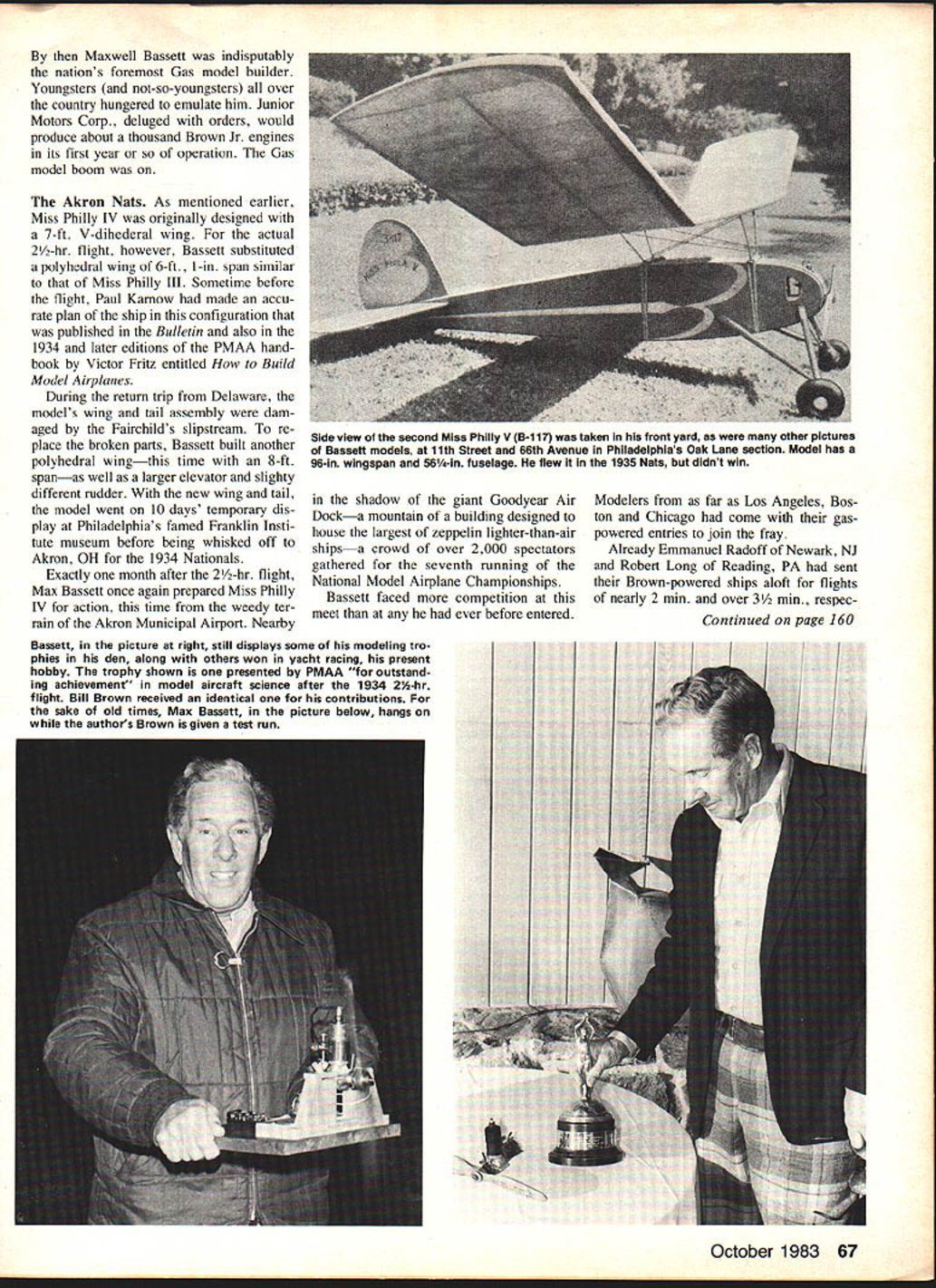
In 1935 he competed in three meets. At a glider meet in Paoli, PA, he flew the two-year-old Miss Philadelphia II stick model to a narrow win in an event limited to a 1/4 oz fuel allotment. For the Nationals in St. Louis he hurriedly designed and built a new ship (B-116) named Miss Philadelphia V. Bassett considered two versions of Miss Philadelphia IV (the 6 ft-span endurance version and the 8 ft-span Texaco Trophy winner) as separate designs and thus reserved B-115 for the 8 ft version, explaining the numbering gap before B-116.
Miss Philadelphia V combined elements of his stick and cabin designs: a built-up box-section fuselage with considerable flat side area, a wire parasol wing mount, a two-panel constant-chord wing with a flat center section and upturned outer quarter panels (tip dihedral), and tail surfaces of constant chord and fairly deep section. Bassett used wooden strut landing gear with a pair of M&M air wheels and powered the ship with an original A-model Brown Junior.
He built two identical ships for St. Louis (B-116 and B-117) with slightly different paint and numbers.
Nationals disappointment and brief "retirement"
The June 1935 Nationals were a disappointment. Plagued by engine trouble, Bassett missed the chance to win the Texaco Trophy for a third time (winning it permanently if he had earned three victories). Leo Weiss won with a highly streamlined all-balsa twin-tailed model and a record of 64 minutes, 12 seconds. Bruno Marchi took second with 41 minutes, 55 seconds. Bassett managed third with 36 minutes, 49 seconds; his engine ran for only about 1½ minutes on the contest flight. Whether engine age, an unlucky day, or other causes were to blame is unclear, but the setback was significant for a modeler who had seldom failed to top his field since 1932. Apparently discouraged, Bassett announced at St. Louis that this would be his last contest.
Later that summer the Junior Birdmen of America offered a $100 top prize at a contest at the Lakehurst (NJ) Naval Air Station. The prize persuaded Bassett to return to competition. On August 28, 1935 he entered his twin ships (now called Miss Philly V and VI) in the Junior Birdmen Gas Model Classic. A crowd of about 1,000 watched the models fly out of sight (O.O.S.); Miss Philly VI was credited with the contest-winning time of 17 minutes, 48 seconds. Two weeks later Bassett received a $100 check from Lawrence Shaw, national director of the Junior Birdmen. Second place paid $50 and third $25.
The contest may have been a net loss financially: Bassett valued his models at about $75 apiece. Fortunately, a few days later Navy blimp crews spotted the pair in scrub pine several miles from the air station and he recovered them undamaged.
To be continued.
Transcribed from original scans by AI. Minor OCR errors may remain.

