
Maxwell Bassett: First Gas Model Champion
The latter years of Maxwell Bassett's modeling career brought diminished activity, but not diminished competitiveness. This chapter of the Bassett story also reveals what became of him after his retirement from the hobby and includes some interesting information about Bill Brown's early engines.
The peak years: 1934–1935
The years 1934 and 1935 were mostly successful for Maxwell Bassett in Gas model flying. Having helped start the Gas model revolution with Bill Brown in 1932 and 1933, he won the first NAA‑sanctioned Gas model competition at Newark, NJ in spring 1934 and retained the Texaco Trophy at the 1934 Akron Nationals. He launched Miss Philadelphia IV on an amazing 54‑mile cross‑country duration flight of more than 2½ hours — a feat not recognized by the NAA as an official record but one that brought him national prominence in newsreels and publications such as Time, Reader’s Digest, Popular Science, and The New York Times.
He failed to win the Texaco Trophy a third time at the 1935 St. Louis Nationals, but later that year he took first place — and a $100 cash prize — at the Junior Birdmen Gas Model Classic at Lakehurst, NJ. Despite continued success, Bassett’s modeling activity began to diminish slightly in 1935 — a trend that continued into 1936. No new planes emerged from his workshop over the winter, and in 1936 he missed the Nationals in Detroit because of a last‑minute accident.
1936: Diminished activity and notable wins
On February 22, 1936, Bassett joined Bill Brown and Victor Fritz on a Philadelphia radio program from the Franklin Institute’s lecture hall, recounting their pioneering Gas model efforts. Brown quoted the number of engines manufactured to date at 1,300.
Bassett’s first contest of 1936 was on May 9 at Hadley Field, New Brunswick, NJ, where Charlie Grant’s International Gas Model Airplane Association sponsored its first all‑Gas meet. Contest rules specified 1/6 oz. of fuel per pound of airplane weight — one‑fourth the usual NAA allotment. Miss Philadelphia VI carried only 5/16 oz., enough for a 3‑minute engine run. The model caught a thermal and stayed in sight for 24 minutes, 18 seconds — a “remarkable” flight, decisively beating the next mark by more than 2½ times.
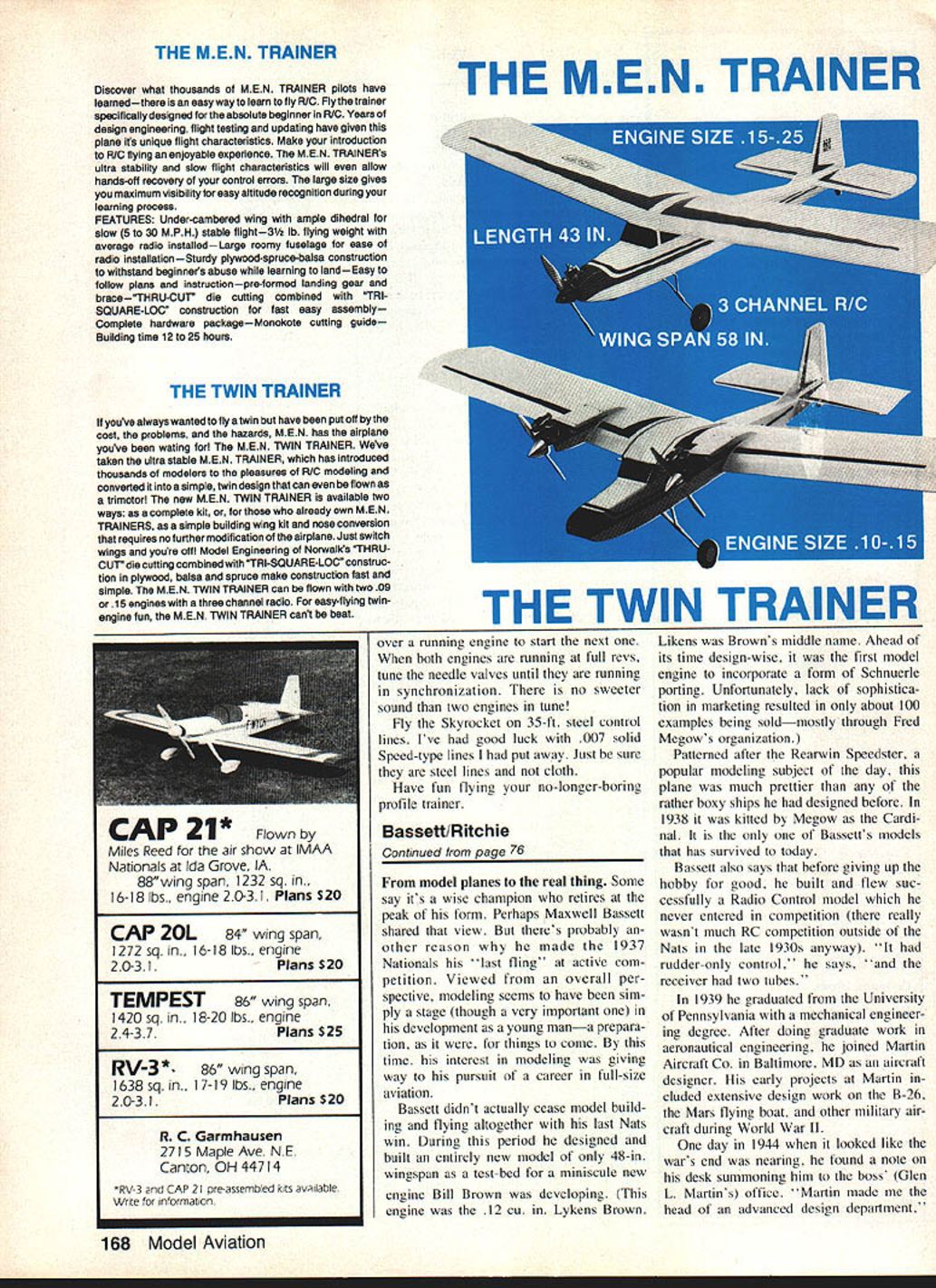
Bassett followed the ship by car for 10 miles but reached its landing place minutes after someone with Pennsylvania plates was seen carrying it away. He reported the theft to state police, who recovered the model. At the meet he received the gold‑bronze IGMAA Trophy and a Forster .99 engine, presented by George Forster.
Bassett flew in two more 1936 contests at Hadley Field. On October 3, at a meet sponsored by Ben Shereshaw’s Kresge Aero Club, he placed third in the weight‑lifting event (payload required: 25% of net weight). The IGMAA fall contest on October 31 was more rewarding: he won first overall in duration with 16:46.4 and first in consistency with a three‑flight total of 23:45.8. Second place in consistency was won by Philadelphia’s Ed Manulkin, who later founded Sterling Models.
1937: Kits, publications, and the final Nationals
In 1937 the Scientific Model Airplane Company of Newark, NJ kitted two Bassett designs. Scientific’s Miss Philadelphia V & VI kit sold for $9.95 (less engine) and included nearly everything needed: air wheels, prop, bamboo, paper covering, Bassett trademark cement, yellow‑blue dope, hardware, and battery hookup wire. Deluxe kits could be ordered with engines: Brown B ($29), Ohlsson‑Miniature ($27), or Baby Cyclone ($26). Another Bassett design for Scientific, the Streamliner, was a 6‑ft‑span ship resembling Miss Philadelphia III and IV; its kit sold for $4.95 (less engine and wheels).
Bassett also wrote construction articles for versions of Miss Philadelphia IV that appeared in Air Trails and Flying Aces that year, sometimes with plans that were imperfect. His ability to sell similar articles to competing magazines reflected his popularity.
During 1937 Bassett competed only once: the National Meet in Detroit on July 10, his last contest. He mounted a new Baby Cyclone engine (.36 cu. in.) in his two‑year‑old Miss Philadelphia V, abandoning the Brown Jr. the Brown engine that had served him well. The Baby Cyclone was more fuel‑efficient but less powerful — a trait favored by fuel‑allotment rules.
Carl Goldberg attended the 1937 Nats with a stunning Gas entry, the Valkyrie: a huge, streamlined ship with a 10‑ft. elliptical wing made from a complex trussed‑rib structure. Many considered it the finest Gas model on the field; by comparison Miss Philadelphia V looked outdated. Looks did not win the contest: Bassett sent Miss Philadelphia V aloft for an astounding 70:02 flight in the Open class that ended O.O.S. (out of sight) over Windsor, Canada. Goldberg could not match it, losing the Valkyrie on a second‑place flight 17 minutes short of Bassett’s time. Bassett recovered his lost model after the contest.
Bassett’s 70:02 was the best time in the Open class and the best of the entire contest, nearly doubling the existing Open record of 36:52 set the previous Nats by Mike Roll. Charlie Grant wrote, “Everybody wonders how he does it.”
That single flight won Bassett more prizes than any event he had ever entered. Prizes included:
- the Gar Wood Trophy, presented by Jimmy Doolittle
- the Baby Cyclone prize of $150 cash
- Scientific’s $50 prize for winning with a model in their kit line (even though it was the prototype)
- $12.72 for the 67 points earned in the Du Pont Company’s Gas model competition
From models to full‑scale aviation
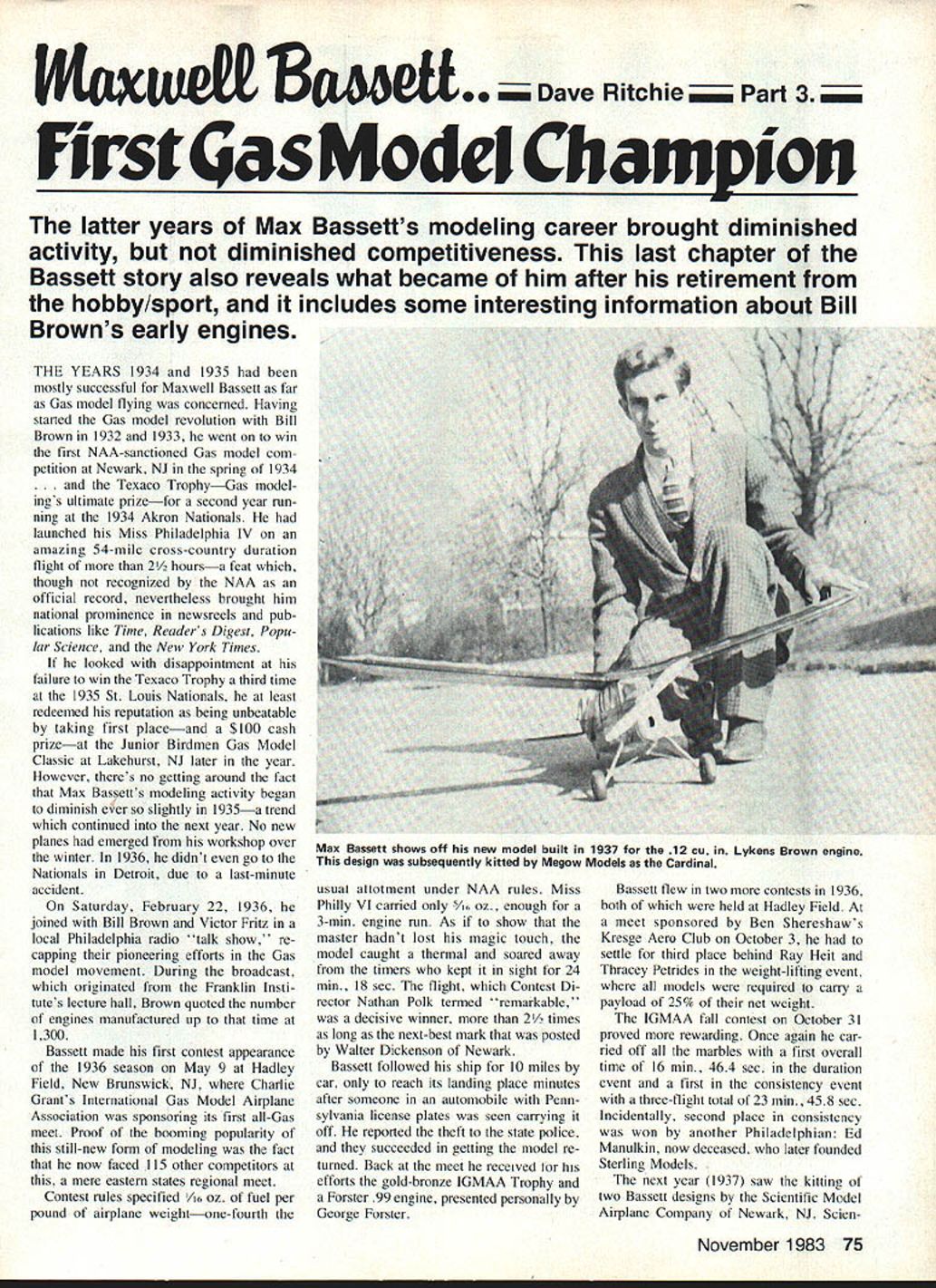
Bassett’s retirement from active competition may have been partly voluntary; modeling had been a stage in his development toward a career in full‑size aviation. He did not cease building and flying entirely immediately after 1937. He designed and built a 48‑in. span model as a testbed for a minuscule engine Bill Brown was developing: the .12 cu. in. Lykens Brown (Lykens was Brown’s middle name). Ahead of its time, the Brown .12 incorporated an early form of Schnuerle porting. Poor marketing limited sales to about 100 examples, mostly through Fred Megow’s organization.
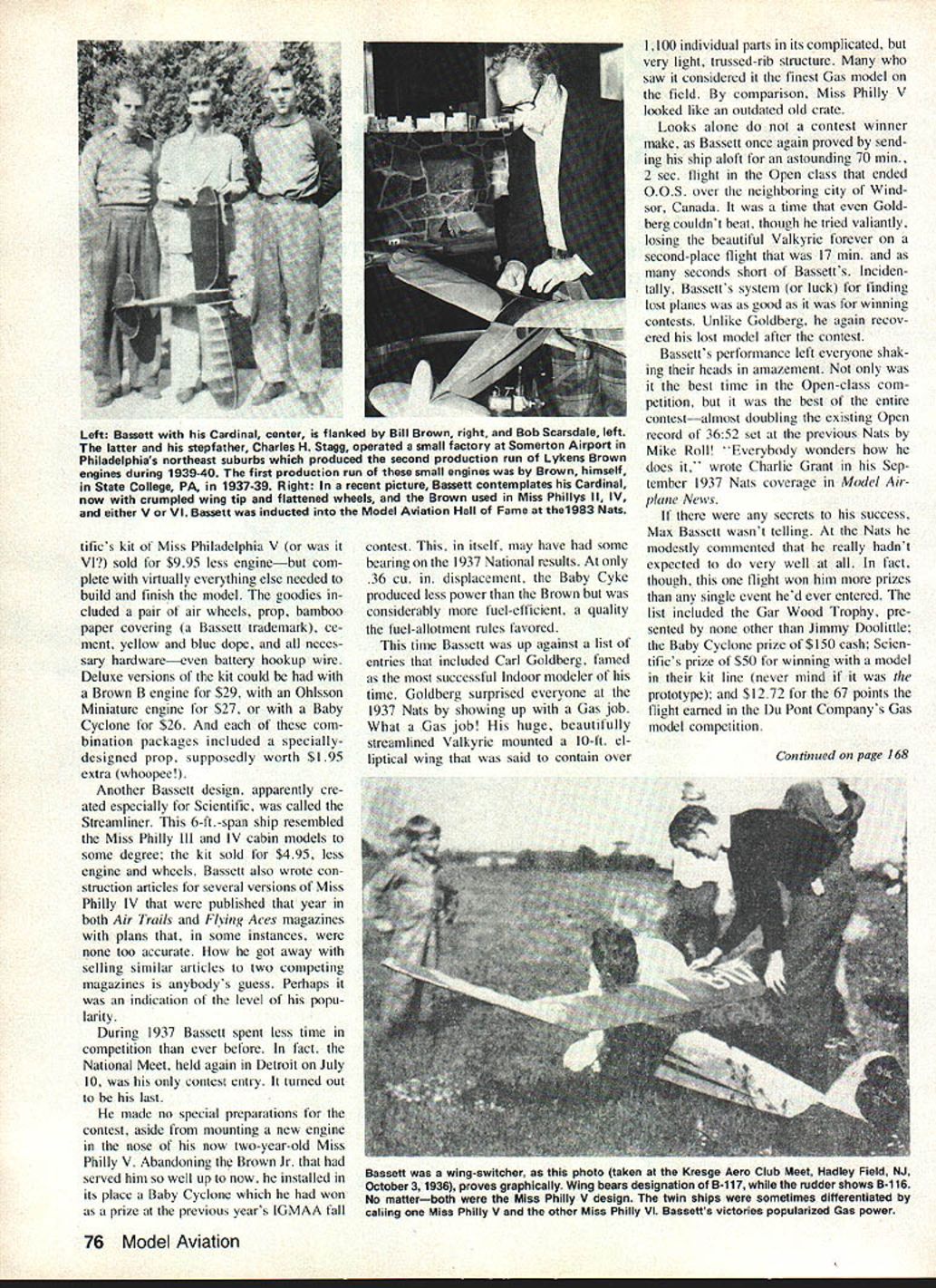
Patterned after the Rearwin Speedster, the 48‑in. plane was more graceful than Bassett’s earlier boxy designs. In 1938 Megow kitted it as the Cardinal; it is the only one of Bassett’s models known to survive today.
Bassett also built and flew a radio‑control model before quitting the hobby. It had rudder‑only control and a receiver with two tubes.
In 1939 he graduated from the University of Pennsylvania with a mechanical engineering degree. After graduate work in aeronautical engineering, he joined Martin Aircraft Co. in Baltimore as an aircraft designer. His early projects included design work on the B‑26, the Mars flying boat, and other military aircraft during World War II.
In 1944 Glenn L. Martin summoned Bassett and made him head of an advanced design department. For about a year he was the sole member charged with designing a projected postwar airline transport. The result was the twin‑engine Martin 202, introduced in 1946 — quite possibly the last major aircraft designed by a single person. After that first year his department grew to more than 100 people, but the basic 202 design was his alone.
Later career, hobbies, and legacy
Bassett continued at Martin through the 1950s. Early in that decade he led a design team that evolved the B‑57D, a high‑altitude reconnaissance version of the Canberra bomber that served as a precursor to the U‑2. The project was a rapid redesign using off‑the‑shelf components: longer wingspan, different engines, and substantial transformation such that mostly the cockpit section remained from the original aircraft.
In the mid to late 1950s Bassett became involved with the Titan missile project. He later shifted toward electronics and management. Around 1961 he joined General Precision Equipment Corp., an avionics firm, holding various management positions until leaving in 1970. Since then he has worked in management consulting on high‑technology projects (lasers and similar equipment) and on reviving financially troubled companies.
For recreation he took up sailing on Chesapeake Bay. He campaigns an all‑aluminum Sparkman & Stephens ocean‑going yacht in major Atlantic races; a glass‑encased model of the yacht greets visitors to his Connecticut home.
Although Bassett’s retirement from modeling was nearly complete (few in the hobby knew of his doings or whereabouts since 1937), he kept in occasional touch with old friends such as Bill Brown, Charlie Grant, and Nat Polk. His memorabilia collection includes his trophies, the prototype Megow Cardinal, one of his original Brown Jr. engines (serial number A17), and the 16mm black‑and‑white film Victor Fritz shot of Miss Philadelphia IV’s 2½‑hour flight from Camden, NJ to Middletown, DE.
Bassett still enjoys talking about airplanes. “No question about it,” he says, “I do miss the aviation business.” He tends to categorize people as either “dreamers” or “doers” and does not dwell on the past. He remains busy turning around companies, overseeing new‑technology development, or competing in yacht races.
Would he ever return to modeling? “It would be fun,” he admits, “but I just don’t see how I’d find the time to build one again.”
That is probably good for the rest of us. In a contest, who would stand a chance against a competitor like Maxwell Bassett?
Transcribed from original scans by AI. Minor OCR errors may remain.

