
Me 163 Komet
by George Leu
This story started during World War II, somewhere over Germany in late August 1944. At an altitude approaching 20,000 feet, a Boeing B-17 in formation with approximately 700 other aircraft was heading into the heart of Germany for a bombing mission. At the controls, 23-year-old pilot Joe Beshar focused on keeping his B-17 in place with the others.
The mission’s smoothness ended quickly when Joe noticed two fast, swept-wing aircraft attacking the formation ahead of him. They dove through the group of B-17s with cannons blazing, damaging a number of airplanes, and flew out of sight in an instant.
Joe unknowingly witnessed the beginning of the Jet Age in fighter aircraft and the ramifications of speed to an attacking aircraft. The image of those airplanes would never leave his memory; they were Messerschmitt Me 163 Komets.
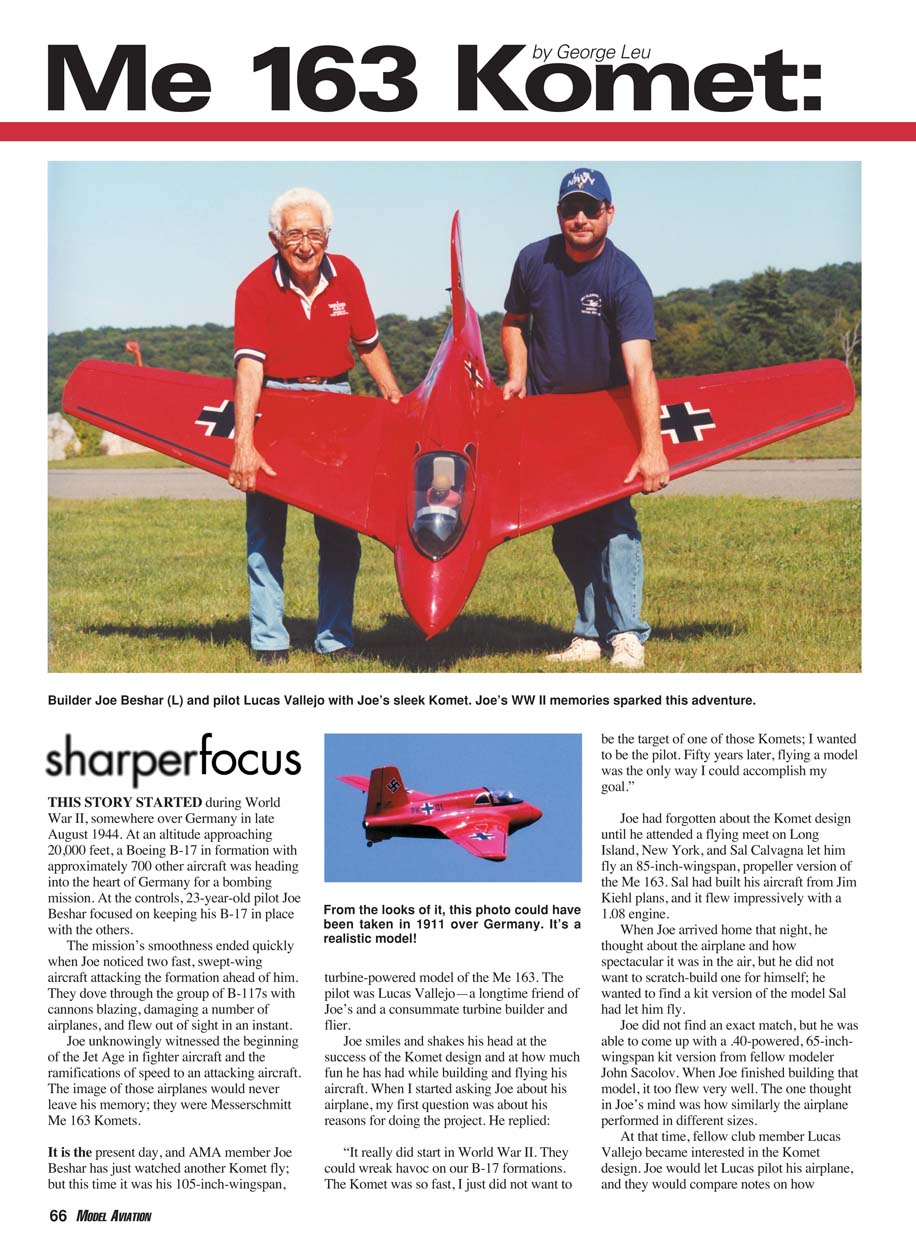
It is the present day, and AMA member Joe Beshar has just watched another Komet fly; but this time it was his 105-inch-wingspan, turbine-powered model of the Me 163. The pilot was Lucas Vallejo—a longtime friend of Joe’s and a consummate turbine builder and flier.
Joe smiles and shakes his head at the success of the Komet design and at how much fun he has had while building and flying his aircraft. When I started asking Joe about his airplane, my first question was about his reasons for doing the project. He replied:
"It really did start in World War II. They could wreak havoc on our B-17 formations. The Komet was so fast, I just did not want to be the target of one of those Komets; I wanted to be the pilot. Fifty years later, flying a model was the only way I could accomplish my goal."
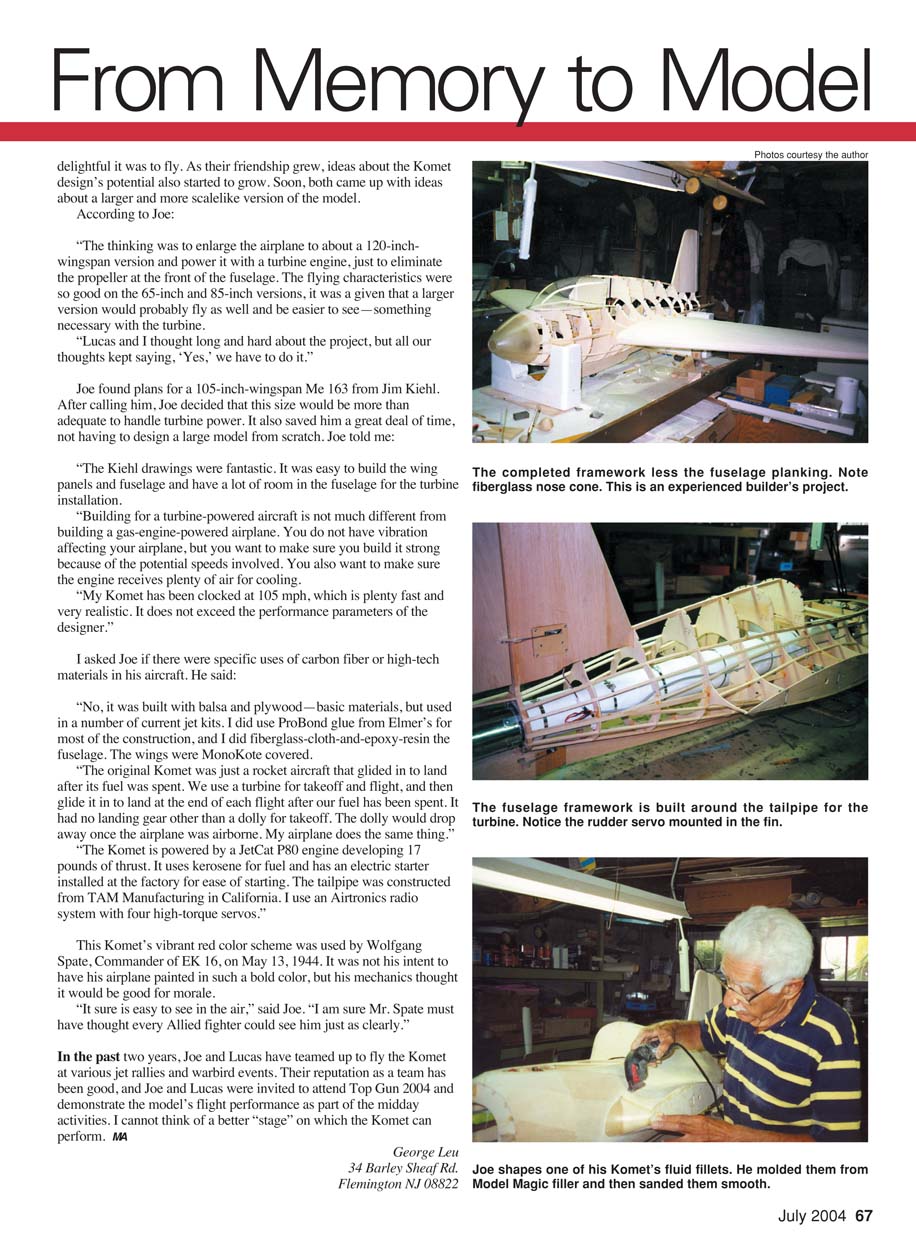
Joe had forgotten about the Komet design until he attended a flying meet on Long Island, New York, and Sal Calvagna let him fly an 85-inch-wingspan, propeller version of the Me 163. Sal had built his aircraft from Jim Kiehl plans, and it flew impressively with a .108 engine.
When Joe arrived home that night, he thought about the airplane and how spectacular it was in the air, but he did not want to scratch-build one for himself; he wanted to find a kit version of the model Sal had let him fly.
Joe did not find an exact match, but he was able to come up with a .40-powered, 65-inch-wingspan kit version from fellow modeler John Sacolov. When Joe finished building that model, it too flew very well. The one thought in Joe’s mind was how similarly the airplane performed in different sizes.
At that time, fellow club member Lucas Vallejo became interested in the Komet design. Joe would let Lucas pilot his airplane, and they would compare notes on how delightful it was to fly. As their friendship grew, ideas about the Komet design’s potential also started to grow. Soon, both came up with ideas about a larger and more scale-like version of the model. According to Joe:
"The thinking was to enlarge the airplane to about a 120-inch-wingspan version and power it with a turbine engine, just to eliminate the propeller at the front of the fuselage. The flying characteristics were so good on the 65-inch and 85-inch versions, it was a given that a larger version would probably fly as well and be easier to see—something necessary with the turbine.
"Lucas and I thought long and hard about the project, but all our thoughts kept saying, 'Yes, we have to do it.'"
Joe found plans for a 105-inch-wingspan Me 163 from Jim Kiehl. After calling him, Joe decided that this size would be more than adequate to handle turbine power. It also saved him a great deal of time, not having to design a large model from scratch.
"The Kiehl drawings were fantastic. It was easy to build the wing panels and fuselage and have a lot of room in the fuselage for the turbine installation."
"Building for a turbine-powered aircraft is not much different from building a gas-engine-powered airplane. You do not have vibration affecting your airplane, but you want to make sure you build it strong because of the potential speeds involved. You also want to make sure the engine receives plenty of air for cooling.
"My Komet has been clocked at 105 mph, which is plenty fast and very realistic. It does not exceed the performance parameters of the designer."
I asked Joe if there were specific uses of carbon fiber or high-tech materials in his aircraft. He said:
"No, it was built with balsa and plywood—basic materials, but used in a number of current jet kits. I did use ProBond glue from Elmer's for most of the construction, and I did fiberglass-cloth-and-epoxy-resin the fuselage. The wings were MonoKote covered.
"The original Komet was just a rocket aircraft that glided in to land after its fuel was spent. We use a turbine for takeoff and flight, and then glide it in to land at the end of each flight after our fuel has been spent. It had no landing gear other than a dolly for takeoff. The dolly would drop away once the airplane was airborne. My airplane does the same thing."
"The Komet is powered by a JetCat P80 engine developing 17 pounds of thrust. It uses kerosene for fuel and has an electric starter installed at the factory for ease of starting. The tailpipe was constructed by TAM Manufacturing in California. I use an Airtronics radio system with four high-torque servos."
This Komet's vibrant red color scheme was used by Wolfgang Späte, commander of EK 16, on May 13, 1944. It was not his intent to have his airplane painted in such a bold color, but his mechanics thought it would be good for morale.
"It sure is easy to see in the air," said Joe. "I am sure Mr. Späte must have thought every Allied fighter could see him just as clearly."
In the past two years, Joe and Lucas have teamed up to fly the Komet at various jet rallies and warbird events. Their reputation as a team has been good, and Joe and Lucas were invited to attend Top Gun 2004 and demonstrate the model's flight performance as part of the midday activities. I cannot think of a better "stage" on which the Komet can perform.
MA
George Leu 34 Barley Sheaf Rd. Flemington NJ 08822
Specifications (model)
- Wingspan: 105 inches
- Powerplant: JetCat P80 turbine
- Thrust: 17 lb
- Fuel: Kerosene
- Construction: Balsa and plywood; fiberglass-cloth-and-epoxy fuselage; MonoKote-covered wings
- Adhesive: ProBond (Elmer's)
- Radio: Airtronics
- Servos: Four high-torque servos
- Tailpipe: TAM Manufacturing (California)
- Recorded speed: 105 mph
Transcribed from original scans by AI. Minor OCR errors may remain.

