
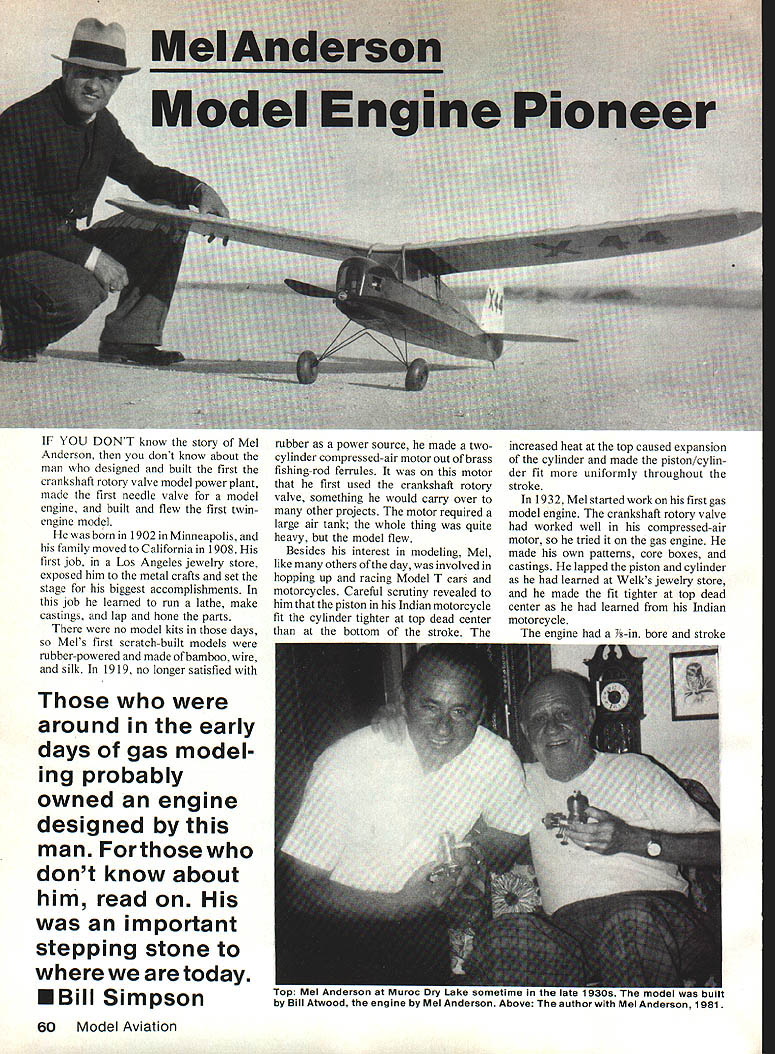
Mel Anderson: Model Engine Pioneer
If you don't know the story of Mel Anderson, then you don't know about the man who designed and built the first crankshaft rotary-valve model power plant, made the first needle valve for a model engine, and built and flew the first twin-engine model.
Early life and introduction to metalwork
Mel Anderson was born in 1902 in Minneapolis; his family moved to California in 1908. His first job, in a Los Angeles jewelry store, exposed him to metal crafts and set the stage for his later accomplishments. There he learned to run a lathe, make castings, and lap and hone parts.
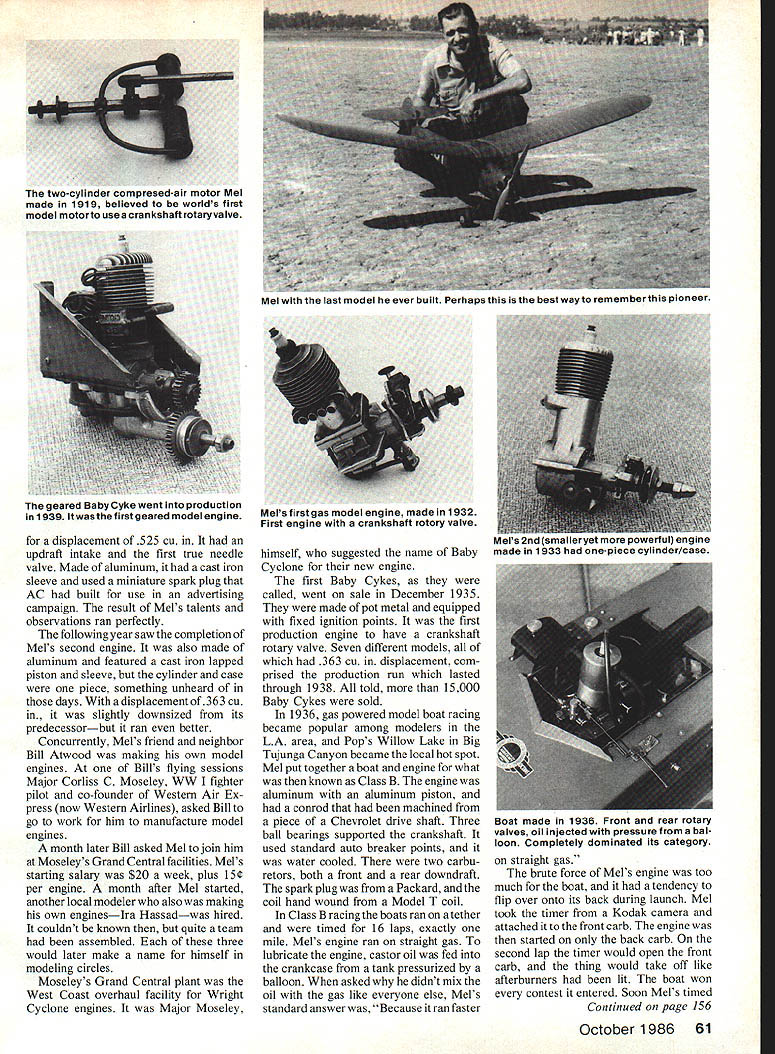
There were no model kits in those days, so Mel's first scratch-built models were rubber-powered and made of bamboo, wire, and silk. In 1919, dissatisfied with rubber power, he made a two-cylinder compressed-air motor out of brass fishing-rod ferrules. On this motor he first used a crankshaft rotary valve, a feature he carried into many later projects. The motor required a large air tank; the whole assembly was quite heavy, but the model flew.
Besides modeling, Mel was involved in modifying and racing Model T cars and motorcycles. Observing his Indian motorcycle, he noticed the piston fit the cylinder tighter at top dead center than at bottom dead center because of heat-induced expansion. He used that insight in later engine designs.
First gas engines and innovations
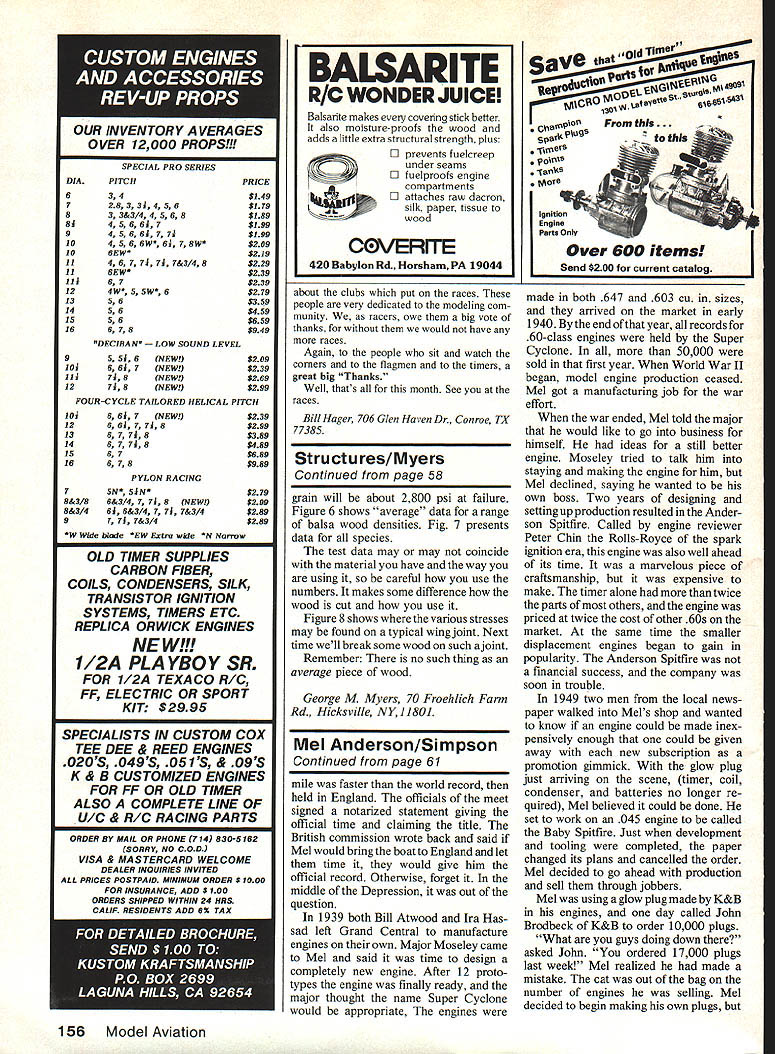
In 1932 Mel began work on his first gas model engine. Having found success with the crankshaft rotary valve on his compressed-air motor, he used it on the gas engine as well. He made his own patterns, core boxes, and castings; he lapped the piston and cylinder and deliberately made the fit tighter at top dead center. The engine had a 7/8-in. bore and stroke (displacement .525 cu. in.), an updraft intake, and featured the first true needle valve. It was made of aluminum with a cast-iron sleeve and used a miniature spark plug. The engine ran perfectly.
The following year he completed a second engine, also aluminum with a cast-iron lapped piston sleeve and cylinder case piece — an uncommon practice at the time. Its displacement was .363 cu. in., slightly smaller than its predecessor, but it ran even better.
Notable early innovations:
- Crankshaft rotary valve applied to model engines
- First true needle valve for model engines
- Precision lapping and tuned piston/cylinder fit for performance
Grand Central, Baby Cyclone, and the team
Mel's friend and neighbor Bill Atwood was also making model engines. Bill's flying sessions attracted the attention of Major Corliss C. Moseley, WWI fighter pilot and co-founder of Western Air Express, who asked Bill to work for him to manufacture model engines. Bill soon asked Mel to join. Moseley's Grand Central facilities were a West Coast overhaul plant for Wright Cyclone engines. Mel's starting salary was $20 a week plus $1.50 per engine. Shortly after Mel started, Ira Hassad, another local modeler, was hired. This team would later gain renown in modeling circles.
Major Moseley suggested the name "Baby Cyclone" for the new engine. The first Baby Cykes went on sale in December 1935. They were made of pot metal and equipped with fixed ignition points — the first production engines to have a crankshaft rotary valve. Seven different models (displacements ranging from .363 to .525 cu. in.) comprised the production run, which lasted through 1938. It is said some 15,000 Baby Cykes were sold.
Model boat racing and the Class B engine
By 1936, gas-powered model boat racing became popular among Los Angeles-area modelers. Ponds such as Willow Lake and Big Tujunga Canyon were local hot spots. Mel built what became known as his Class B engine: aluminum with an aluminum piston, a conrod machined from a Chevrolet drive shaft piece, and three ball bearings supporting the crankshaft. He used standard auto breaker points, water cooling, two downdraft carburetors (front and rear), a Packard spark plug, and a hand-wound coil.
Class B boats ran tethered and were timed for 16 laps (exactly one mile). Mel's engine ran on straight gasoline; castor oil was fed to the crankcase from a tank pressurized by a balloon for lubrication. When asked why he didn't premix oil with the gas like others, Mel's standard answer was, "Because it ran faster."
The brute force of Mel's engine sometimes flipped the boat during launch. He rigged a timer tied to a Kodak camera and attached it to the front carburetor: the engine started on the rear carb, and on the second lap the timer opened the front carb and the boat would accelerate dramatically. The boat won contest after contest and at one point recorded a timed mile faster than the world record then held in England. British officials said they would recognize the record if Mel brought the boat to England for official timing; during the Depression that was not feasible.
Super Cyclone, wartime, and the Anderson Spitfire
In 1939 Bill Atwood and Ira Hassad left Grand Central to manufacture engines on their own. Major Moseley asked Mel to design a completely new engine. After 12 prototypes the engine was ready, and Moseley suggested the name Super Cyclone. Engines were made in both .647 and .603 cu. in. sizes and arrived on the market in early 1940. By the end of that year, the Super Cyclone held all .60-class records and reportedly more than 50,000 were sold that first year. When World War II began, model engine production ceased and Mel took a manufacturing job contributing to the war effort.
After the war, Mel wanted to go into business for himself. After two years of design and setup, he produced the Anderson Spitfire. Engine reviewer Peter Chin called it the "Rolls-Royce of the spark-ignition era." The Spitfire was advanced and exquisitely made, but expensive to produce. Its timer alone had more than twice the parts of most competitors, and its head and intake were costly to manufacture. At the same time, smaller-displacement engines were growing in popularity, and the Spitfire was not a financial success. The company soon encountered trouble.
Baby Spitfire, glow plugs, and growth
In 1949 two men from a local newspaper asked Mel if an inexpensive engine could be made that might be given away with a subscription. With the glow plug's arrival (eliminating timer, coil, condenser, and batteries), Mel believed it could be done. He developed an .045 engine called the Baby Spitfire. The newspaper canceled the order after tooling was completed, but Mel decided to proceed and sell the engines through jobbers.
Mel had been using a K&B glow plug and once called John Brodbeck of K&B to order 1,000 plugs, only to discover he had already ordered 17,000 the previous week — the cat was out of the bag on production volume. Mel then attempted to have his own plugs produced by an outside firm. The first batch of 10,000 was defective (they ran down and would not hold heat) because the manufacturer used a cheaper alloy; Mel returned them and had the plugs properly made.
He expanded production of components and accessories to support the engines. Anderson Manufacturing moved to a larger plant in Anaheim and later to Santa Ana. Production continued into the early 1950s, and a variety of .045/.049 designs followed, including the Spitz, Royal Spitfire, and Royal Baby Spitfire. By 1950 K&B was on the market with their own .049; over half a million Baby Spitfires were sold.
Decline of the company and later career
By 1953 the market for 1/2 A engines was saturated and Mel Anderson Manufacturing developed internal problems. A fuel facility investment of $30,000 (a large sum at the time) never turned a profit. Competition from lower-cost foreign-made engines also took its toll. By the mid-1950s Mel had sold the company.
Mel went to work at Henry Engineering, where he designed the 100-series Veco .19, .29, and .35 engines. He eventually had a falling out with Gil Henry and left to work as a tool engineer for a firm making gyro components for aerospace. He remained there until his retirement in 1970.
Legacy and honors
In 1981 Mel Anderson was inducted into the Model Aviation Hall of Fame, modeling's highest honor. Modeling experienced a great loss with his death on June 9, 1986. His designs and workmanship helped make possible the reliable, powerful model engines enjoyed by hobbyists and manufacturers today. He influenced countless hobbyists and engineers and left a lasting legacy in model engine design.
Transcribed from original scans by AI. Minor OCR errors may remain.

