
Micro-Flying
Dave Robelen
Route 4, Box 369, Farmville, VA 23901 E-mail: aplusfarm@hovac.com
Hello, friends. This has been a busy cycle with a great deal of good information. The Toledo show and indoor flying at the Bowling Green facility will be covered by special features, no doubt, but a couple of highlights caught my eye that I want to share. A tip for those who are considering attending in the future: Saturday is a bit of a zoo! If you can make one of the other days, the chances of seeing more will be much better.
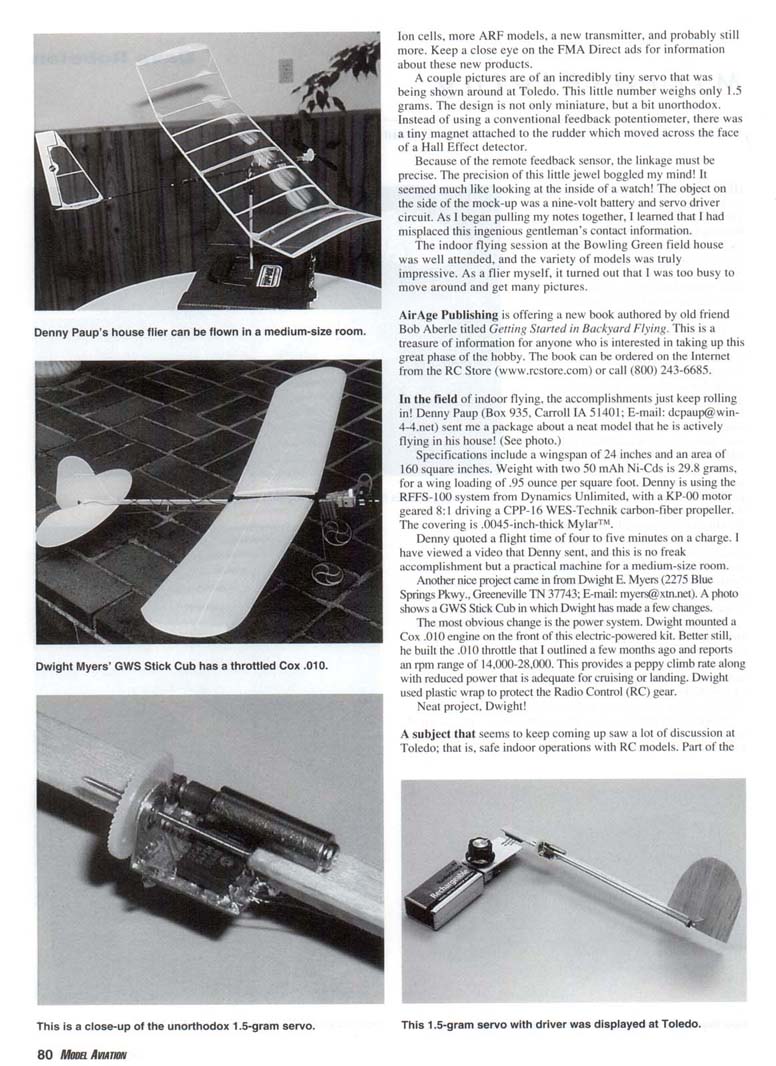
The number of manufacturers showing new products in the micro/indoor category was limited, but the goodies were fascinating. DJ Aerotech (www.djaerotech.com) has several new groups of models to add to its popular Roadkill Series. A photo shows Don Stackhouse holding the new Jenny. There were also airliners, World War I fighters, and additional World War II models.
Don is the "D" of DJ Aerotech, and he is a really bright fellow. Don and his partner Joe Hahn did a great job of demonstrating these models at the Bowling Green indoor facility Saturday night.
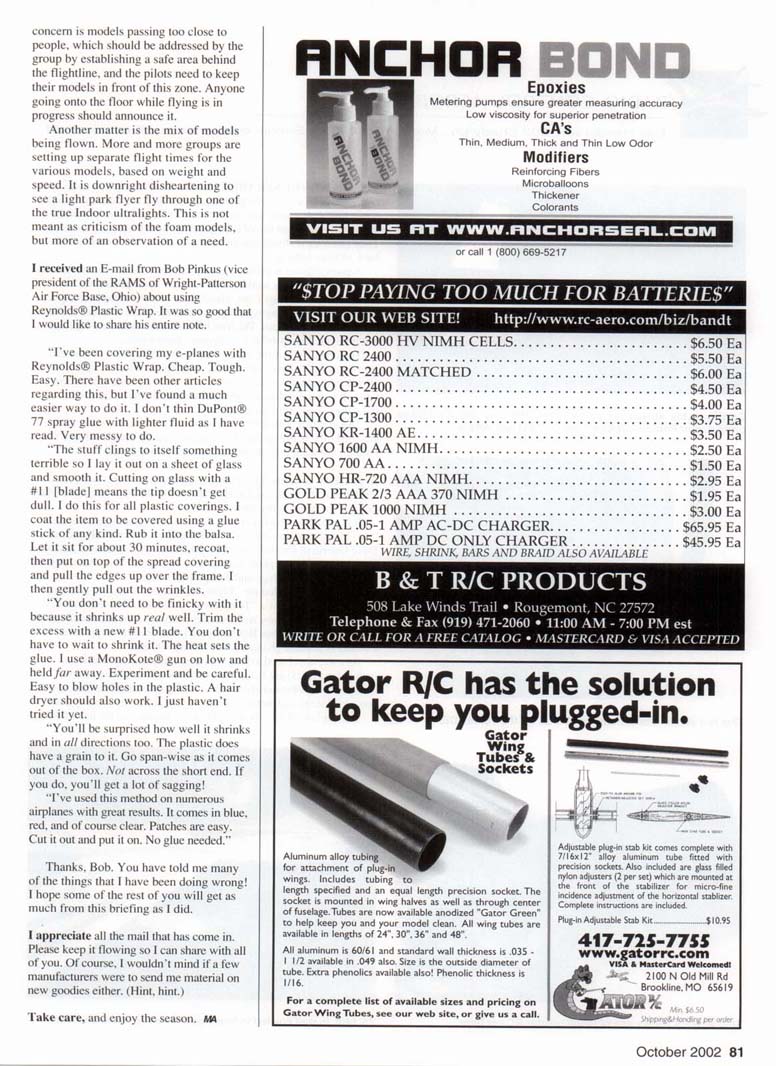
In one photo is a new micro receiver/ESC (Electronic Speed Control) combo unit from Sky Hooks and Rigging. This unit is designed to operate from a single lithium-ion (Li‑Ion) cell, is narrow-band, will detect and adapt to the transmitter (positive or negative shift), has good range, and is extremely light. A number of these were in use at the indoor flying session with apparent good results.
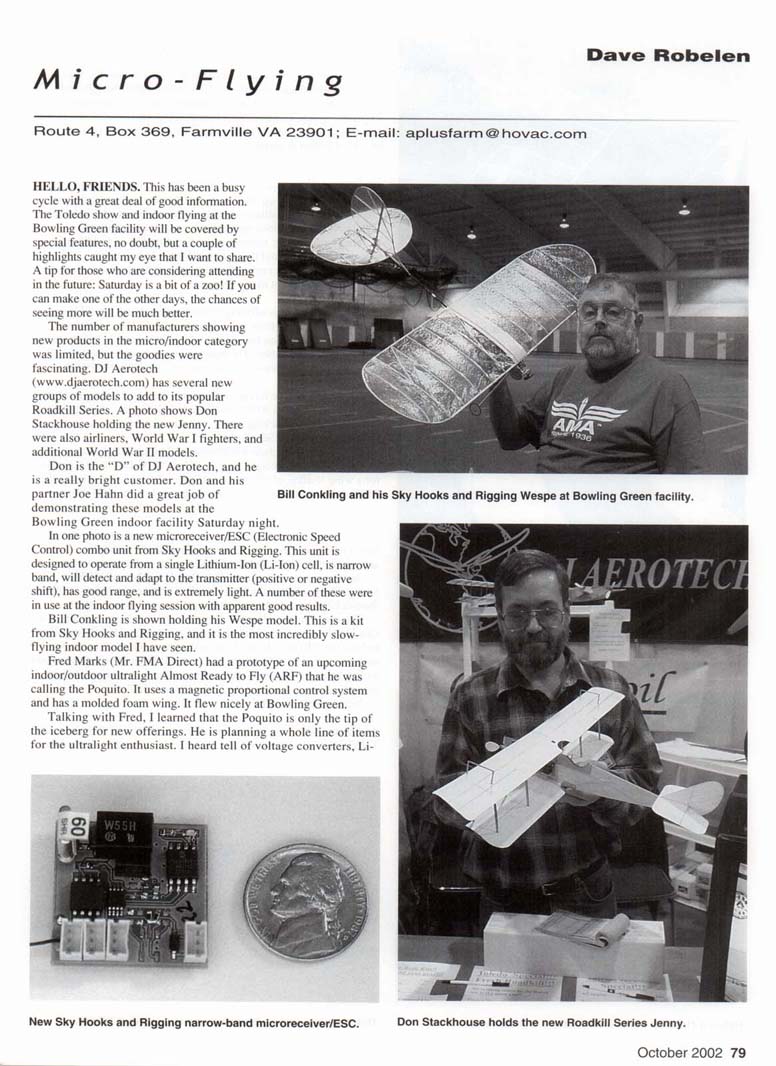
Bill Conkling is shown holding his Wespe model. This is a kit from Sky Hooks and Rigging, and it is the most incredibly slow-flying indoor model I have seen.
Fred Marks (Mr. FMA Direct) had a prototype of an upcoming indoor/outdoor ultralight Almost Ready to Fly (ARF) that he was calling the Poquito. It uses a magnetic proportional control system and has a molded-foam wing. It flew nicely at Bowling Green.
Talking with Fred, I learned that the Poquito is only the tip of the iceberg for new offerings. He is planning a whole line of items for the ultralight enthusiast. I heard tell of:
- voltage converters
- Li‑Ion cells
- more ARF models
- a new transmitter
- and probably still more
Keep a close eye on the FMA Direct ads for information about these new products.
A couple of pictures are of an incredibly tiny servo that was being shown around at Toledo. This little number weighs only 1.5 grams. The design is not only miniature, but a bit unorthodox. Instead of using a conventional feedback potentiometer, there was a tiny magnet attached to the rudder which moved across the face of a Hall-effect detector. Because of the remote feedback sensor, the linkage must be precise. The precision of this little jewel boggled my mind! It seemed much like looking at the inside of a watch. The object on the side of the mock-up was a nine-volt battery and servo driver circuit. As I began pulling my notes together, I learned that I had misplaced this ingenious gentleman's contact information.
The indoor flying session at the Bowling Green field house was well attended, and the variety of models was truly impressive. As a flier myself, it turned out that I was too busy to move around and get many pictures. AirAge Publishing is offering a new book authored by old friend Bob Aberle titled Getting Started in Backyard Flying. This is a treasure of information for anyone interested in taking up this great phase of the hobby. The book can be ordered on the Internet from the RC Store (www.rcstore.com) or by calling (800) 243-6685.
Notable indoor projects
Denny Paup (Box 935, Carroll, IA 51401; E-mail: dcpaup@win-4-4.net) sent me a package about a neat model that he is actively flying in his house. Specifications include:
- Wingspan: 24 inches
- Area: 160 square inches
- Weight (with two 50 mAh Ni‑Cd cells): 29.8 grams
- Wing loading: 0.95 ounce per square foot
Denny is using the RFFS-100 system from Dynamics Unlimited, with a KP-00 motor geared 8:1 driving a CPP-16 WES‑Technik carbon-fiber propeller. The covering is 0.0045-inch-thick Mylar™.
Denny quoted a flight time of four to five minutes on a charge. I have viewed a video that Denny sent, and this is no freak accomplishment but a practical machine for a medium-size room.
Another nice project came in from Dwight E. Myers (2275 Blue Springs Pkwy., Greeneville, TN 37743; E-mail: myers@xpn.net). A photo shows a GWS Stick Cub in which Dwight has made a few changes.
The most obvious change is the power system. Dwight mounted a Cox .010 engine on the front of this electric-powered kit. Better still, he built the .010 throttle that I outlined a few months ago and reports an rpm range of 14,000–28,000. This provides a peppy climb rate along with reduced power that is adequate for cruising or landing. Dwight used plastic wrap to protect the radio-control (RC) gear.
Neat project, Dwight!
Safety and operations
A subject that seems to keep coming up saw a lot of discussion at Toledo: safe indoor operations with RC models. Part of the concern is models passing too close to people, which should be addressed by the group by establishing a safe area behind the flight line; pilots need to keep their models in front of this zone. Anyone going onto the floor while flying is in progress should announce it.
Another matter is the mix of models being flown. More and more groups are setting up separate flight times for the various models, based on weight and speed. It is downright disheartening to see a light park flyer fly through one of the true indoor ultralights. This is not meant as criticism of the foam models, but more of an observation of a need.
Covering tip from Bob Pinkus
I received an e-mail from Bob Pinkus (vice president of the RAMS of Wright-Patterson Air Force Base, Ohio) about using Reynolds® Plastic Wrap. It was so good that I would like to share his entire note:
"I've been covering my e-planes with Reynolds® Plastic Wrap. Cheap. Tough. Easy. There have been other articles regarding this, but I've found a much easier way to do it. I don't thin DuPont® 77 spray glue with lighter fluid as I have read. Very messy to do.
"The stuff clings to itself something terrible so I lay it out on a sheet of glass and smooth it. Cutting on glass with a #11 blade means the tip doesn't get dull. I do this for all plastic coverings. I coat the item to be covered using a glue stick of any kind. Rub it into the balsa. Let it sit for about 30 minutes, recoat, then put on top of the spread covering and pull the edges up over the frame. I then gently pull out the wrinkles.
"You don't need to be finicky with it because it shrinks up real well. Trim the excess with a new #11 blade. You don't have to wait to shrink it. The heat sets the glue. I use a MonoKote gun on low and hold far away. Experiment and be careful. Easy to blow holes in the plastic. A hair dryer should also work. I just haven't tried it yet.
"You'll be surprised how well it shrinks and in all directions too. The plastic does have a grain to it. Go span-wise as it comes out of the box. Not across the short end. If you do, you'll get a lot of sagging!
"I've used this method on numerous airplanes with great results. It comes in blue, red, and of course clear. Patches are easy. Cut it out and put it on. No glue needed."
Thanks, Bob. You have told me many of the things that I have been doing wrong! I hope some of the rest of you will get as much from this briefing as I did.
I appreciate all the mail that has come in. Please keep it flowing so I can share with all of you. Of course, I wouldn't mind if a few manufacturers were to send me material on new goodies either. (Hint, hint.)
Take care, and enjoy the season.
MA
Transcribed from original scans by AI. Minor OCR errors may remain.

