
GREETINGS FROM Central Virginia
This month I have several items of interest to write about, including new products and a new competition.
I have applied for a sanction to hold the "Radio Control (RC) Indoor Nationals" at the Lakehurst dirigible hangar at Lakehurst Naval Air Station in Lakehurst, New Jersey. The paperwork is still "in the mill" as of this writing, but there is little reason to anticipate problems. The proposed dates are June 21–22, 2003 (the third weekend in June).
It is very important that all models flown in the Lakehurst facility have a weight limit of 10 ounces gross; this applies to all events.
Events at Lakehurst
The proposed events include Scale, aerobatics, pylon racing, duration (endurance), cargo, and possibly others. The various event rules are still being finalized, but some basic items have been established.
Scale
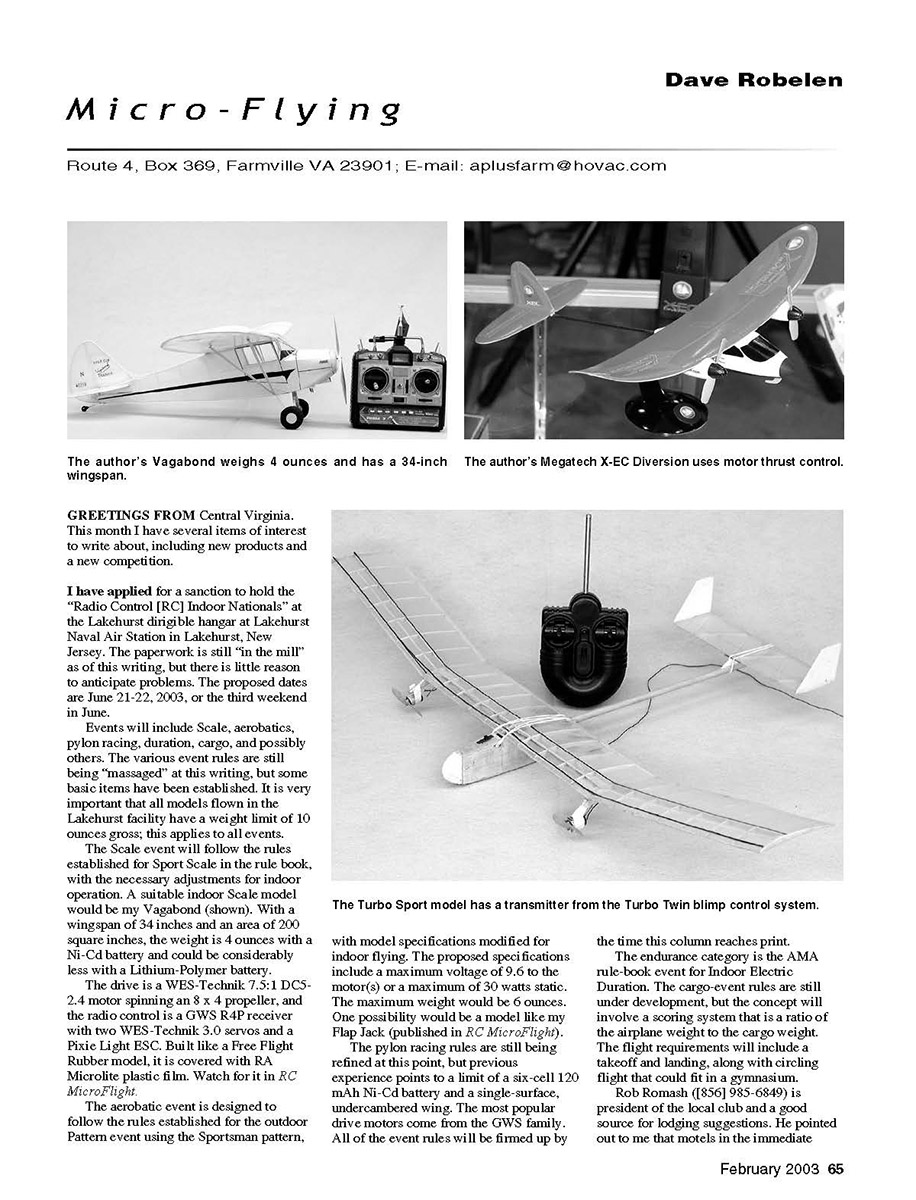
The Scale event will follow the rules established for Sport Scale in the rule book, with the necessary adjustments for indoor operation. A suitable indoor Scale model would be my Vagabond (shown). With a wingspan of 34 inches and an area of 200 square inches, the weight is 4 ounces with a Ni-Cd battery and could be considerably less with a Lithium-Polymer battery. The drive is a WES-Technik 7.5:1 DC5-2.4 motor spinning an 8 x 4 propeller, and the radio control is a GWS R4P receiver with two WES-Technik 3.0 servos and a Pixie Light ESC. Built like a Free Flight rubber model, it is covered with RA Microlite plastic film. Watch for it in RC MicroFlight.
Aerobatics
The aerobatic event is designed to follow the rules established for the outdoor Pattern event using the Sportsman pattern, with model specifications modified for indoor flying. The proposed specifications include a maximum voltage of 9.6 V to the motor(s) or a maximum of 30 watts static. The maximum weight would be 6 ounces. One possibility would be a model like my Flap Jack (published in RC MicroFlight).
Pylon Racing
The pylon racing rules are still being refined, but previous experience points to a limit of a six-cell 120 mAh Ni-Cd battery and a single-surface, undercambered wing. The most popular drive motors come from the GWS family. All event rules will be firmed up by the time this column reaches print.
Endurance (Duration)
The endurance category will follow the AMA rule-book event for Indoor Electric Duration.
Cargo
The cargo-event rules are still under development, but the concept will involve a scoring system that is a ratio of the airplane weight to the cargo weight. Flight requirements will include a takeoff and landing, along with circling flight that could fit in a gymnasium.
Rob Romash — president of the local club and a good source for lodging suggestions — can be reached at (856) 985-6849. He pointed out that motels in the immediate neighborhood of Lakehurst will have higher rates because of their proximity to a resort area; selecting lodging a few miles inland could result in substantial savings.
A variety of vendors carry suitable kits and supplies. The following list is by no means complete but includes firms with which I have had dealings:
- Sky Hooks and Rigging (kits, supplies), (905) 257-2101, Web site: www.microrc.com
- Todd's Models (kits, supplies), (425) 888-8580 (5 p.m.–8 p.m. Monday–Thursday Pacific), Web site: www.toddsmodels.com
- David Lewis (kits, supplies), (407) 856-6245, Web site: www.homefly.com
- Sig Manufacturing (indoor Scale kits)
My apologies to all those I have left out. For additional sources, check the vendor links at www.rcmicroflight.com. Put this date on your calendar, and bring some models looking for a good time.
Ultra-Micro 1.5-gram Servo
Since I last wrote about the new ultra-micro 1.5-gram servo, I have had an opportunity to work with one of the preproduction samples. The source of these little gems is Dave Burley, 1801 N.W. Johnson Rd., Portland, OR 97231; Tel.: (503) 621-6928. I installed the unit in my Punkin II model. A close-up of this little jewel can be seen in the cabin and the tail-mounted sensor.
As of this writing, I have flown with this servo controlling the rudder in my little biplane with a large throw, and it continues to be at least as smooth as any servo employing conventional feedback. The feedback on the Burley unit involves a tiny magnet mounted on the control surface moving next to a Hall-effect sensor. With no physical contact, this feedback system should really shine in the lifespan department.
Operating on 4.8 volts, the servo has an impressive force and speed. It compares favorably with other linear servos on the market. It is likely that John Worth (of Cloud 9 Micro RC) will be the jobber for these units. If you are looking for the smallest motor-driven servo, this one could meet your needs.
Turbo Twin and the Turbo Sport
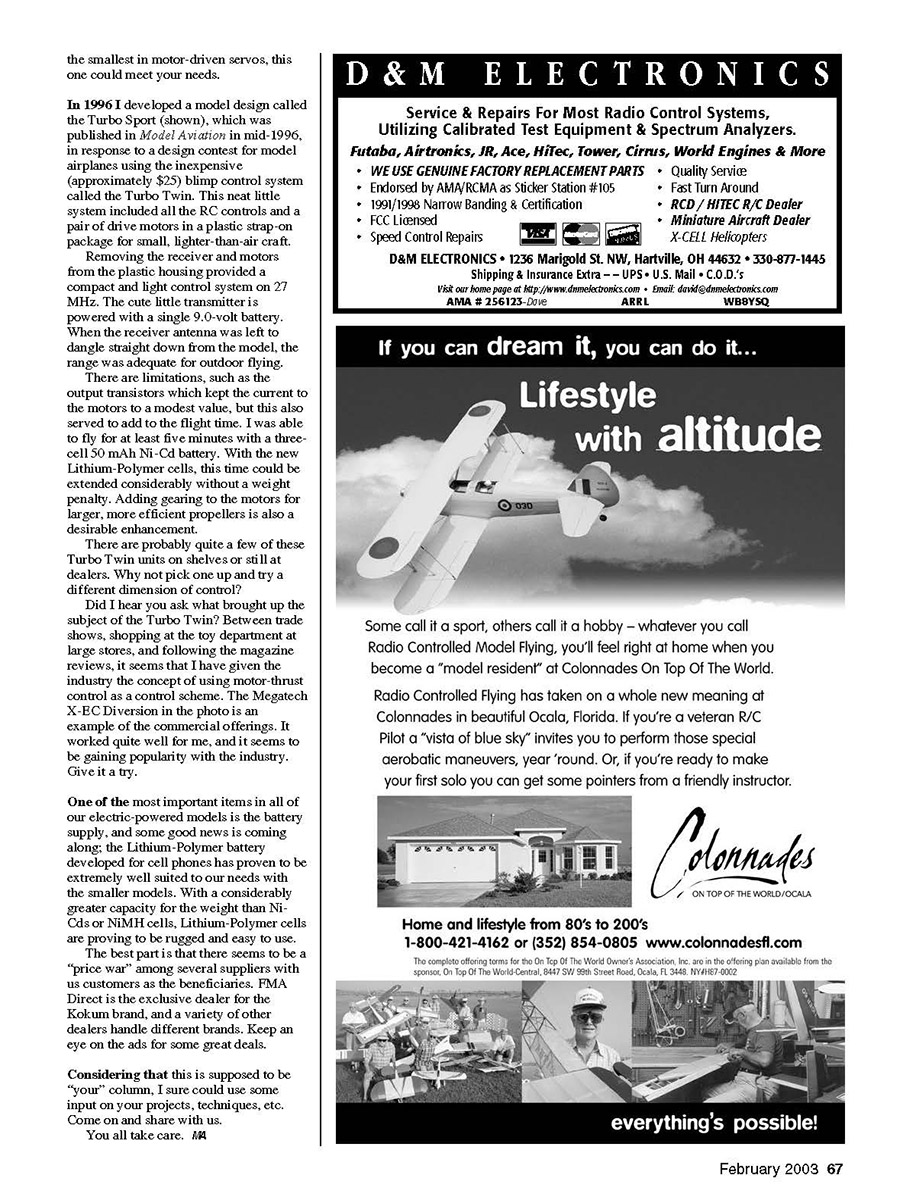
In 1996 I developed a model design called the Turbo Sport (shown), which was published in Model Aviation in mid-1996. It was a response to a design contest for model airplanes using the inexpensive (approximately $25) blimp control system called the Turbo Twin. This neat little system included all the RC controls and a pair of drive motors in a plastic strap-on package for small, lighter-than-air craft.
Removing the receiver and motors from the plastic housing provided a compact and light control system on 27 MHz. The cute little transmitter is powered with a single 9‑volt battery. When the receiver antenna was left to dangle straight down from the model, the range was adequate for outdoor flying.
There are limitations, such as the output transistors which kept the current to the motors modest, but this also added to flight time. I was able to fly for at least five minutes with a three-cell 50 mAh Ni-Cd battery. With the new Lithium-Polymer cells, this time could be extended considerably without a weight penalty. Adding gearing to the motors for larger, more efficient propellers is also a desirable enhancement.
There are probably quite a few Turbo Twin units on shelves or still at dealers. Why not pick one up and try a different dimension of control?
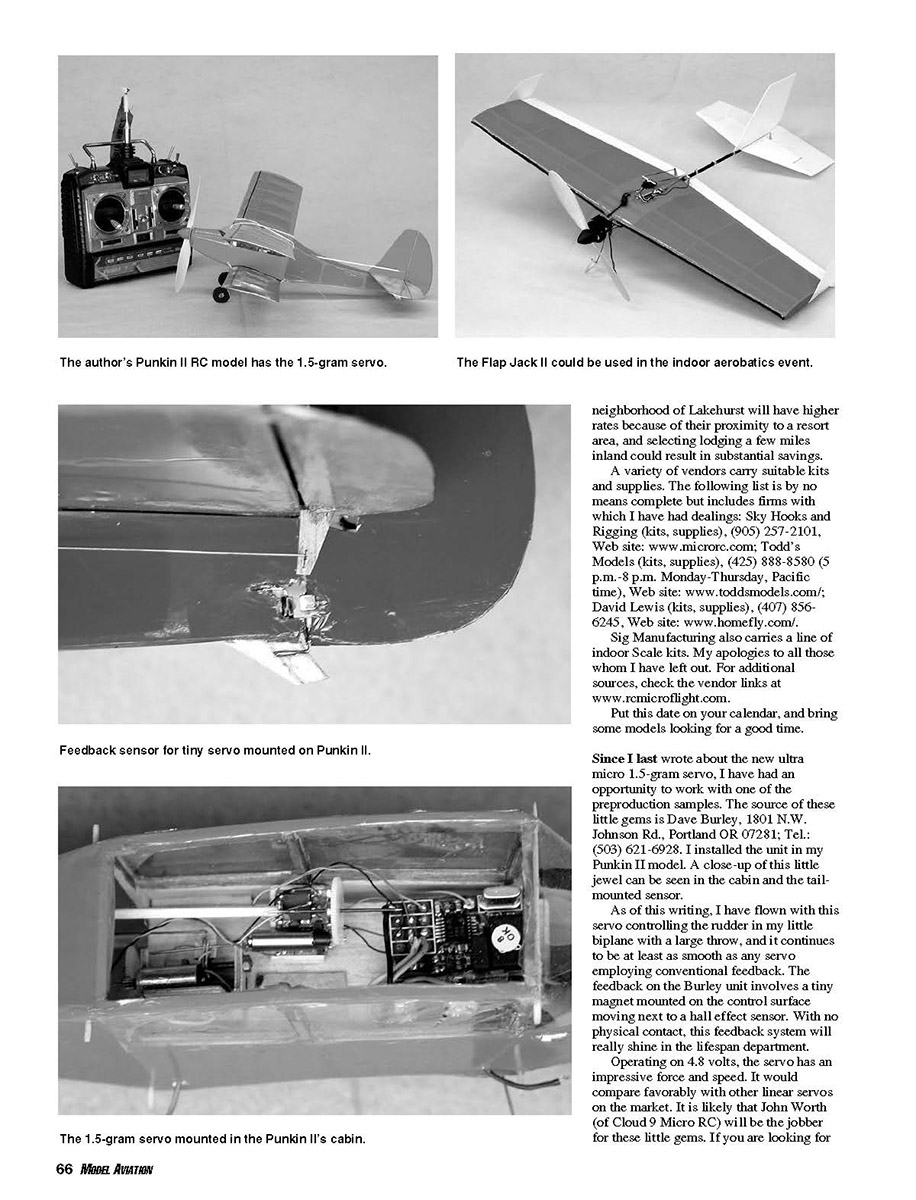
Did I hear you ask what brought up the subject of the Turbo Twin? Between trade shows, shopping at toy departments, and following magazine reviews, it seems that I have given the industry the concept of using motor-thrust control as a control scheme. The Megatech X-EC Diversion in the photo is an example of the commercial offerings. It worked quite well for me and seems to be gaining popularity. Give it a try.
Lithium-Polymer Batteries
One of the most important items in our electric-powered models is the battery supply, and some good news is coming along: the Lithium-Polymer battery developed for cell phones has proven extremely well suited to our needs with smaller models. With considerably greater capacity for the weight than Ni-Cd or NiMH cells, Lithium-Polymer cells are proving to be rugged and easy to use. The best part is that there seems to be a "price war" among several suppliers with us customers as the beneficiaries. FMA Direct is the exclusive dealer for the Kokam brand, and a variety of other dealers handle different brands. Keep an eye on the ads for some great deals.
Call for Input
Considering that this is supposed to be "your" column, I could use some input on your projects, techniques, etc. Come on and share with us.
You all take care.
/MR
Transcribed from original scans by AI. Minor OCR errors may remain.

