

Micro-Flying
Dave Robelen
Route 4, Box 369, Farmville VA 23901 E-mail: aplusfarm@hovac.com
Greetings from microland and indoor RC land
As I write this, we have just gotten our power back following Hurricane Isabel. Trying to function in this modern world without electricity is a bummer. I never realized what a luxury a hot shower could be!
There are many trees down on our property, but most are in irrelevant locations and will become firewood. For those who suffered losses in this storm, I offer my condolences.
NIRAC championships — June 4–6, 2004
I want to bring you up to date on the next National Indoor Remote-controlled Aircraft Council (NIRAC) championships. The event will be June 4–6, 2004, at the Oakland Yard Athletics dome in Waterford, Michigan. There is detailed information on the NIRAC Web site at www.nirac.org.
Six events and periods of open flying are planned. Some of the events will require custom models for best results. Arrangements are being made to provide plans for at least one design for each of these events. Below are event details and examples of suitable aircraft.
Old-Timer Climb-and-Glide
The Old-Timer Climb-and-Glide is intended to re-create the glamour of those early free-flight designs. Rules summary:
- Any free-flight design, rubber or gas, published or kitted prior to 1943 is eligible.
- Maximum wingspan: 42 inches.
- Minimum weight: 5 ounces.
- Maximum motor size: equivalent to a 180 class.
- Battery: up to 7.4 volts (two Li-Poly cells or six Ni-Cd cells).
- Models must take off from the floor; 30 seconds are allowed for climb, then the propeller must stop and the glide begins.
- Score: total time combining climb and glide.
Many excellent designs are available in plan or kit form. I chose to build a replica of Miss America. Construction is classic stick-and-tissue, but any material may be used. The rules allow the airfoil to be changed while keeping the basic shape of the model. I chose an undercambered section for the wing and a flat-bottom foil for the stabilizer. The drive is a GWS IPS DXA (Lite Stick) with a 9 x 7 prop and two 340 mAh Kokam Li-Poly cells. Equipment is a GWS R4P receiver with two lightened Hitec HS-50 servos. An unexpected benefit is that this is a superb model for lazy evening cruising. Watch for a construction article in an AirAge publication.
Start by looking at the line available from A.A. Lidberg Model Plan Service: 1030 E. Baseline, Suite 105-1074, Tempe AZ 85283; Tel.: (480) 839-8154; Web: www.aalmps.com
Indoor Pylon Racing
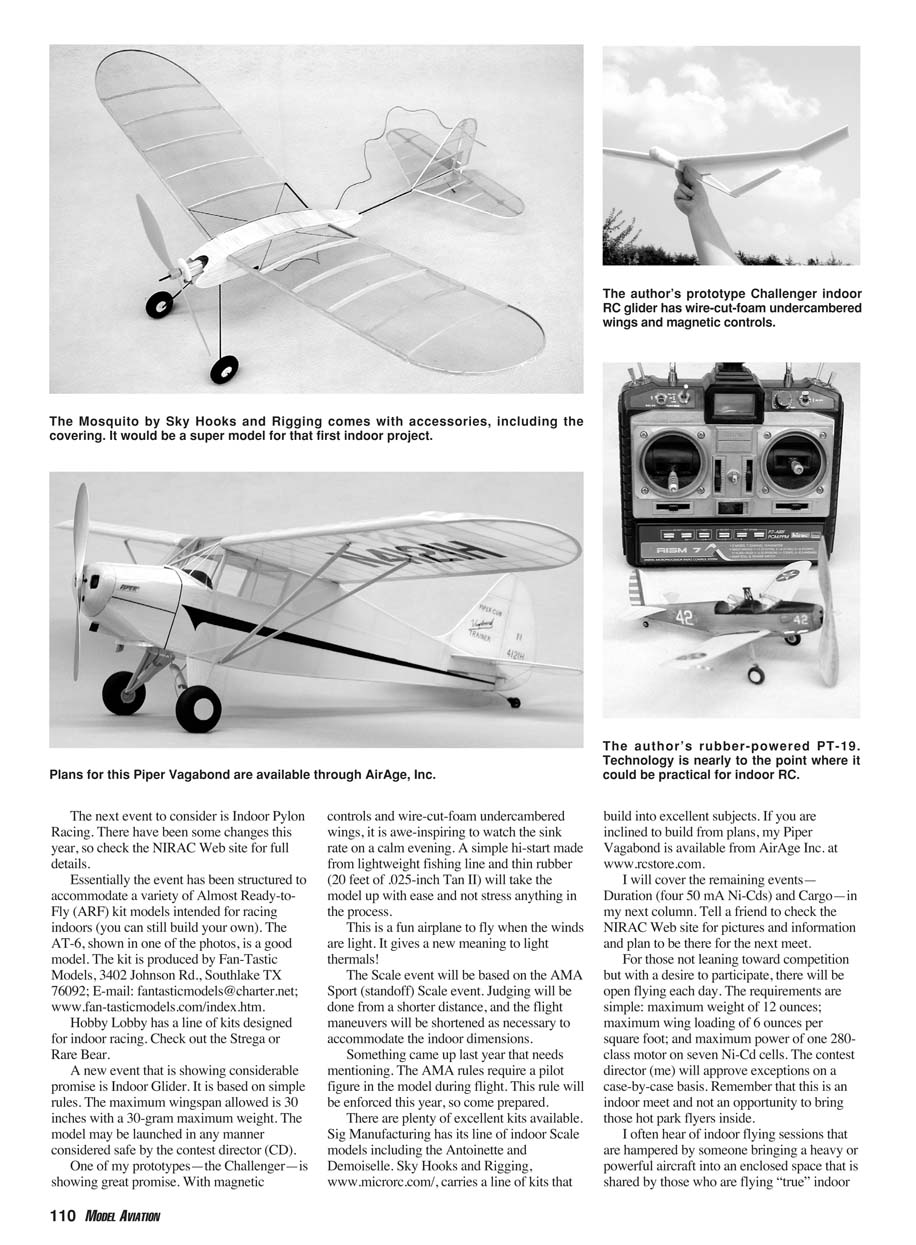
There have been some changes this year, so check the NIRAC Web site for full details. The event has been structured to accommodate a variety of Almost Ready-to-Fly (ARF) kit models intended for indoor racing (you can still build your own). The AT-6 is a good model; the kit is produced by Fan-Tastic Models: 3402 Johnson Rd., Southlake TX 76092; E-mail: fantasticmodels@charter.net; Web: www.fan-tasticmodels.com/index.htm. Hobby Lobby has a line of kits designed for indoor racing — check out the Strega or Rare Bear.
Indoor Glider
A new event showing considerable promise. Rules summary:
- Maximum wingspan: 30 inches.
- Maximum weight: 30 grams.
- Model may be launched in any manner considered safe by the contest director (CD).
One of my prototypes — the Challenger — is showing great promise. With magnetic controls and wire-cut-foam undercambered wings, it is awe-inspiring to watch the sink rate on a calm evening. A simple hi-start made from lightweight fishing line and thin rubber (20 feet of .025-inch Tan II) will take the model up with ease and not stress anything in the process. This is a fun airplane to fly when the winds are light — it gives a new meaning to light thermals!
Scale
The Scale event will be based on the AMA Sport (standoff) Scale event. Judging will be done from a shorter distance, and flight maneuvers will be shortened as necessary to accommodate indoor dimensions.
Note: The AMA rules require a pilot figure in the model during flight. This rule will be enforced this year, so come prepared.
Plenty of excellent kits are available. SIG Manufacturing has indoor Scale models including the Antoinette and Demoiselle. Sky Hooks and Rigging (www.microrec.com) carries kits that build into excellent subjects. If you prefer plans, my Piper Vagabond is available from AirAge Inc. at www.rstore.com.
Remaining events
I will cover the remaining events — Duration (four 50 mA Ni-Cds) and Cargo — in my next column. Tell a friend to check the NIRAC Web site for pictures and information and plan to be there for the next meet.
Open flying
For those not leaning toward competition but wanting to participate, there will be open flying each day. Requirements:
- Maximum weight: 12 ounces.
- Maximum wing loading: 6 ounces per square foot.
- Maximum power: one 280-class motor or seven Ni-Cd cells.
The contest director (CD) will approve exceptions on a case-by-case basis. Remember this is an indoor meet — not an opportunity to bring hot park flyers inside.
I often hear of indoor flying sessions hampered by someone bringing a heavy or powerful aircraft into an enclosed space shared by those flying "true" indoor models. If you are planning to attend an open-flying session, use common sense and good manners. If your model would fly outdoors in 10 mph winds, leave it at home. Light models can be damaged, safety is compromised, and many people fail to enjoy a session they had looked forward to. Please be considerate and keep the outdoor models outside before legislation makes it a requirement.
New products and kits
A couple of new products have come through my shop:
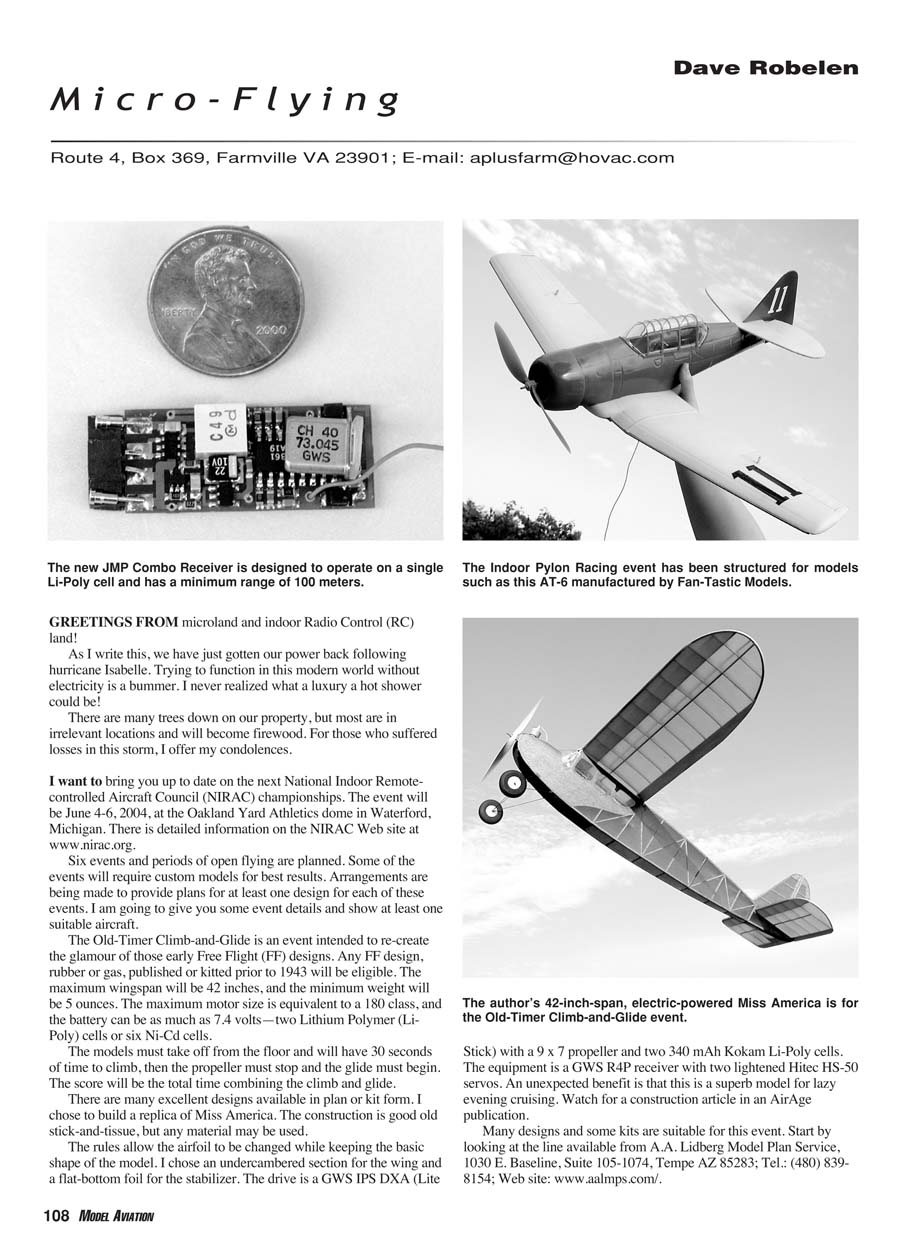
- JMP Combo Receiver (France): Designed to operate on a single Li-Poly cell and has a minimum range of 100 meters. Outputs are designed to drive magnetic actuators; the electronic speed control is rated 1.5 amps continuous with a 2.5 amp peak. It is narrow band with 10 kHz selectivity. Available with bare solder pads or connector sockets to make it interchangeable with the popular RFFS-100 unit. In my tests this receiver resists interference well, even from adjacent-channel transmitters. Others report smooth operation while flying next to as many as five transmitters on other channels. Available from Bob Selman Designs: 9054 Gum Rd., Carthage MO 64836; Tel.: (417) 358-9521 (between 6 p.m. and 9 p.m. CST); Web: http://users.joplin.com/~bselman.
- Sky Hooks and Rigging Mosquito: A new indoor model available as a deluxe kit with laser-cut balsa of suitable density and a custom drive complete with prop. Accessories (machined-foam wheels, etc.) are included, and Reynolds Wrap covering is supplied. If you have balsa-building experience, this is a great first indoor project. The drive operates from a single Li-Poly cell, and Sky Hooks and Rigging has a narrow-band receiver that will work at this low voltage. Most of my family has flown mine and enjoyed it.
Tiny rubber-powered inspiration
I'm including this for inspiration and ideas: my little rubber-powered FF PT-19 with an 8-inch wingspan. With available equipment, we are nearly at the point of making a model this small a practical RC project. Bob Selman carries a line of tiny equipment made by Nick Leichty that should be small enough, and there are pager motors available that could do the job. The final touch is a suitable battery, and there is word of some tiny Li-Poly cells becoming available. Henry Pasquet of Missouri is flying models that weigh only a couple grams with magnetic actuators.
How about one of you "watchmaker" types stepping up and getting it all together? I will save you some space if you come up with a solution.
Over and out. MA
Transcribed from original scans by AI. Minor OCR errors may remain.

