
Micro-Flying
Dave Robelen
Route 4, Box 369, Farmville VA 23901 E-mail: aplusfarm@hovac.com
GREETINGS, fans of micro models. Assuming you get this when I anticipate you will, let me wish you a happy holiday season. Of course, I hope you find your cherished new micro product under the tree.
NIRAC Championships 2005
The officers of the National Indoor Remote-controlled Aircraft Council (NIRAC) are working hard to make the arrangements for the 2005 championships. At this point, I anticipate that the contest will be in the fall and will likely be held in a golf-dome type of building on the East Coast. For updated information, check the NIRAC Web site at www.nirac.org.
It appears that the events will be the same as in 2004, with minor adjustments in a couple of the categories. In general, models that were used in 2004 will be suitable for the 2005 event. All efforts are being made to ensure that contestants get the maximum amount of flying time possible.
For those who attend the championships, you can help yourself enormously by having the entries tested and ready to compete without last-minute work. Stay tuned and be ready to make reservations!
Old Timer Climb and Glide
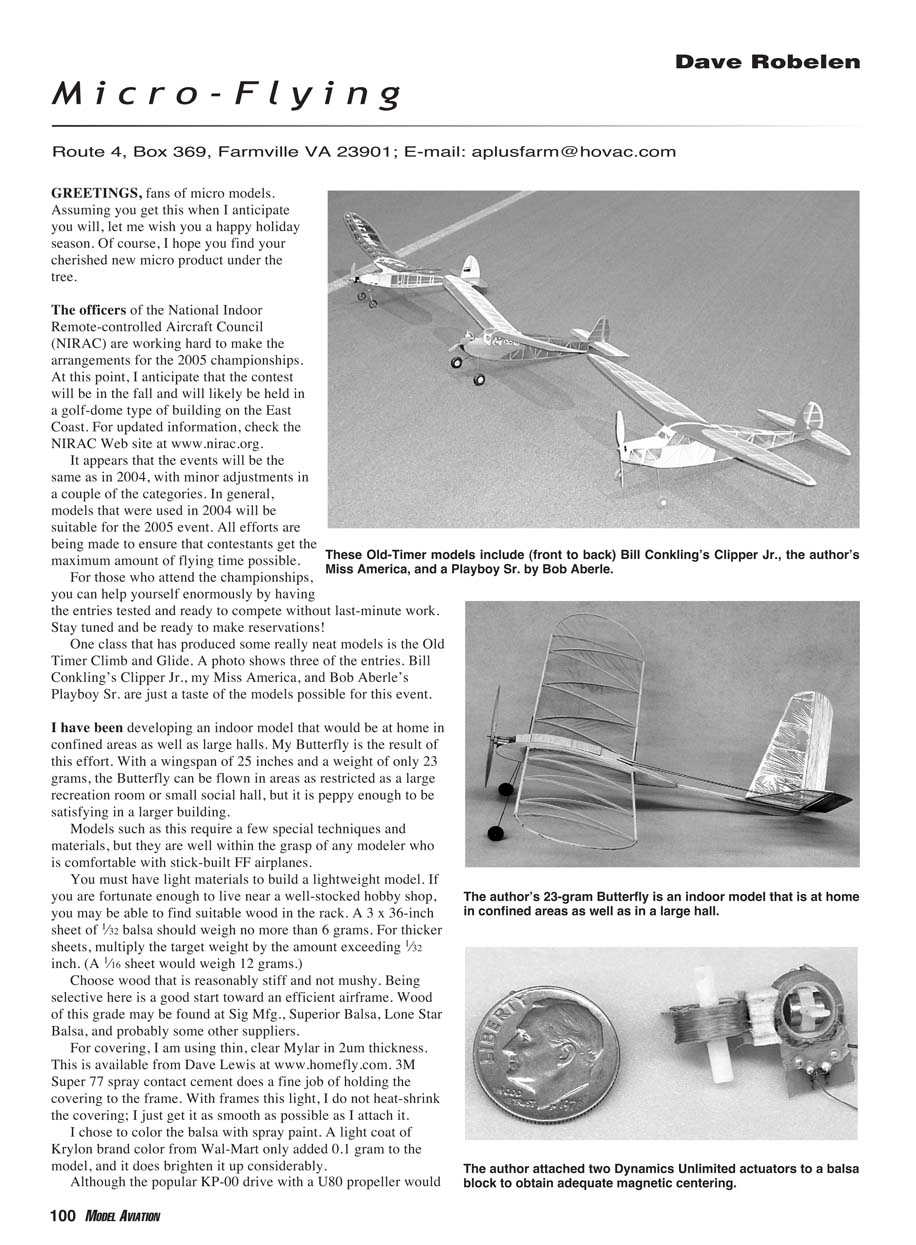
One class that has produced some really neat models is the Old Timer Climb and Glide. A photo shows three of the entries. Bill Conkling’s Clipper Jr., my Miss America, and Bob Aberle’s Playboy Sr. are just a taste of the models possible for this event.
The Butterfly
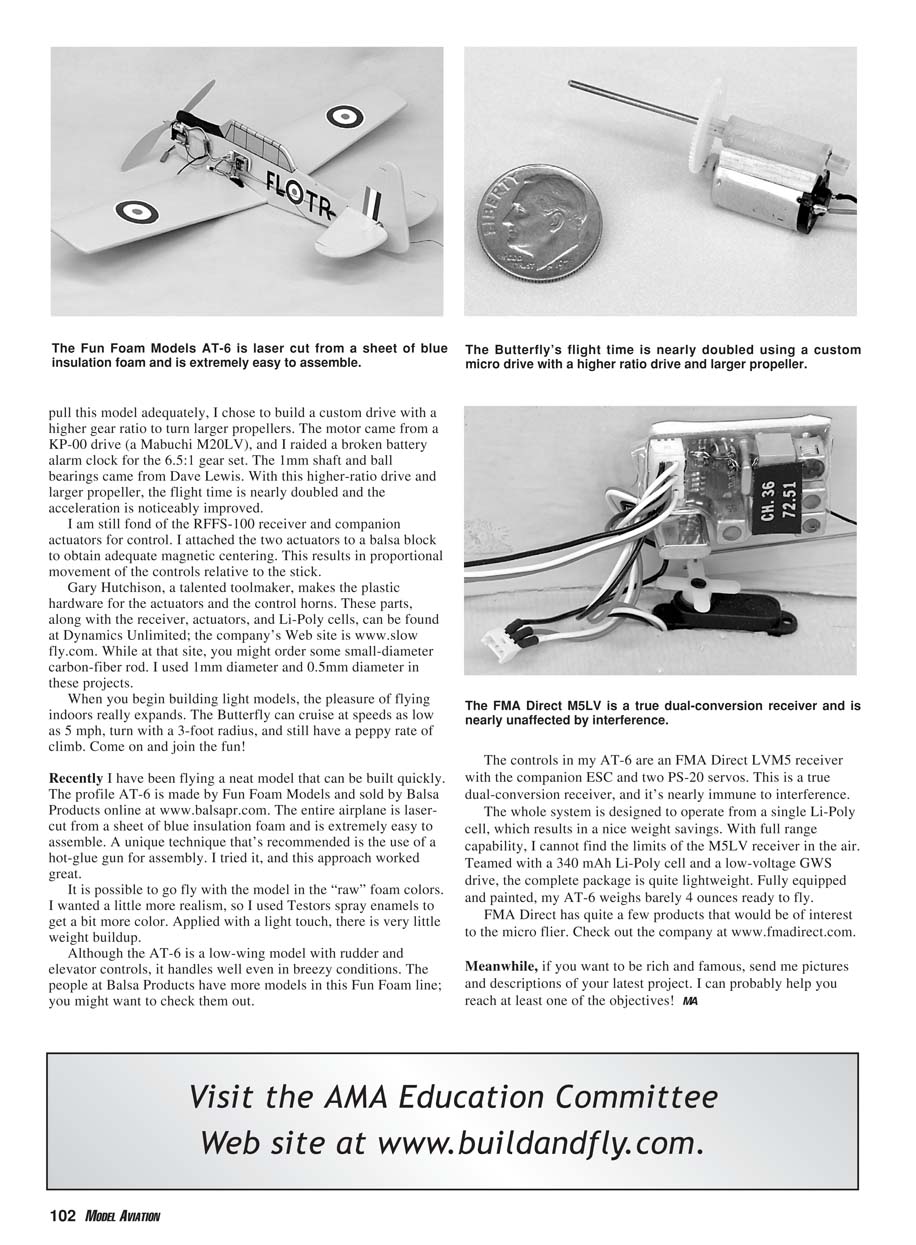
I have been developing an indoor model that would be at home in confined areas as well as large halls. My Butterfly is the result of this effort. With a wingspan of 25 inches and a weight of only 23 grams, the Butterfly can be flown in areas as restricted as a large recreation room or small social hall, but it is peppy enough to be satisfying in a larger building.
Models such as this require a few special techniques and materials, but they are well within the grasp of any modeler who is comfortable with stick-built free-flight airplanes.
Materials and construction
You must have light materials to build a lightweight model. If you are fortunate enough to live near a well-stocked hobby shop, you may be able to find suitable wood in the rack.
- A 3 x 36-inch sheet of 1/32-inch balsa should weigh no more than 6 grams.
- For thicker sheets, multiply the target weight by the amount exceeding 1/32 inch (for example, a 1/16-inch sheet would weigh about 12 grams).
- Choose wood that is reasonably stiff and not mushy. Being selective here is a good start toward an efficient airframe.
Wood of this grade may be found from:
- SIG Mfg.
- Superior Balsa
- Lone Star Balsa
For covering, I am using thin, clear Mylar in 2 µm thickness. This is available from Dave Lewis at www.homefly.com. 3M Super 77 spray contact cement does a fine job of holding the covering to the frame. With frames this light, I do not heat-shrink the covering; I just get it as smooth as possible as I attach it.
I chose to color the balsa with spray paint. A light coat of Krylon brand color from Wal-Mart only added 0.1 gram to the model, and it does brighten it up considerably.
Drive and power
Although the popular KP-00 drive with a U80 propeller would pull this model adequately, I chose to build a custom drive with a higher gear ratio to turn larger propellers. The motor came from a KP-00 drive (a Mabuchi M20LV), and I raided a broken battery alarm clock for the 6.5:1 gear set. The 1 mm shaft and ball bearings came from Dave Lewis. With this higher-ratio drive and larger propeller, the flight time is nearly doubled and the acceleration is noticeably improved.
Radio and controls
I am still fond of the RFFS-100 receiver and companion actuators for control. I attached the two actuators to a balsa block to obtain adequate magnetic centering. This results in proportional movement of the controls relative to the stick.
Gary Hutchison, a talented toolmaker, makes the plastic hardware for the actuators and the control horns. These parts, along with the receiver, actuators, and Li-Poly cells, can be found at Dynamics Unlimited; the company's Web site is www.slowfly.com. While at that site, you might order some small-diameter carbon-fiber rod. I used 1 mm diameter and 0.5 mm diameter in these projects.
When you begin building light models, the pleasure of flying indoors really expands. The Butterfly can cruise at speeds as low as 5 mph, turn with a 3-foot radius, and still have a peppy rate of climb. Come on and join the fun!
Fun Foam AT-6
Recently I have been flying a neat model that can be built quickly. The profile AT-6 is made by Fun Foam Models and sold by Balsa Products online at www.balsaproducts.com. The entire airplane is laser-cut from a sheet of blue insulation foam and is extremely easy to assemble. A unique technique that's recommended is the use of a hot-glue gun for assembly. I tried it, and this approach worked great.
It is possible to go fly with the model in the "raw" foam colors. I wanted a little more realism, so I used Testors spray enamels to get a bit more color. Applied with a light touch, there is very little weight buildup.
Although the AT-6 is a low-wing model with rudder and elevator controls, it handles well even in breezy conditions. The people at Balsa Products have more models in this Fun Foam line; you might want to check them out.
AT-6 equipment
The controls in my AT-6 are an FMA Direct M5LV receiver with the companion ESC and two PS-20 servos. This is a true dual-conversion receiver, and it's nearly immune to interference.
The whole system is designed to operate from a single Li-Poly cell, which results in a nice weight savings. With full range capability, I cannot find the limits of the M5LV receiver in the air. Teamed with a 340 mAh Li-Poly cell and a low-voltage GWS drive, the complete package is quite lightweight. Fully equipped and painted, my AT-6 weighs barely 4 ounces ready to fly.
FMA Direct has quite a few products that would be of interest to the micro flier. Check out the company at www.fmadirect.com.
Suppliers and resources
- NIRAC: www.nirac.org
- Dave Lewis / Homefly: www.homefly.com
- Dynamics Unlimited / SlowFly: www.slowfly.com
- FMA Direct: www.fmadirect.com
- Balsa Products: www.balsaproducts.com
- Wood suppliers: SIG Mfg., Superior Balsa, Lone Star Balsa
Closing
Meanwhile, if you want to be rich and famous, send me pictures and descriptions of your latest project. I can probably help you reach at least one of the objectives! MA
Transcribed from original scans by AI. Minor OCR errors may remain.

