
Heavy-metal warbirds: an indoor reality
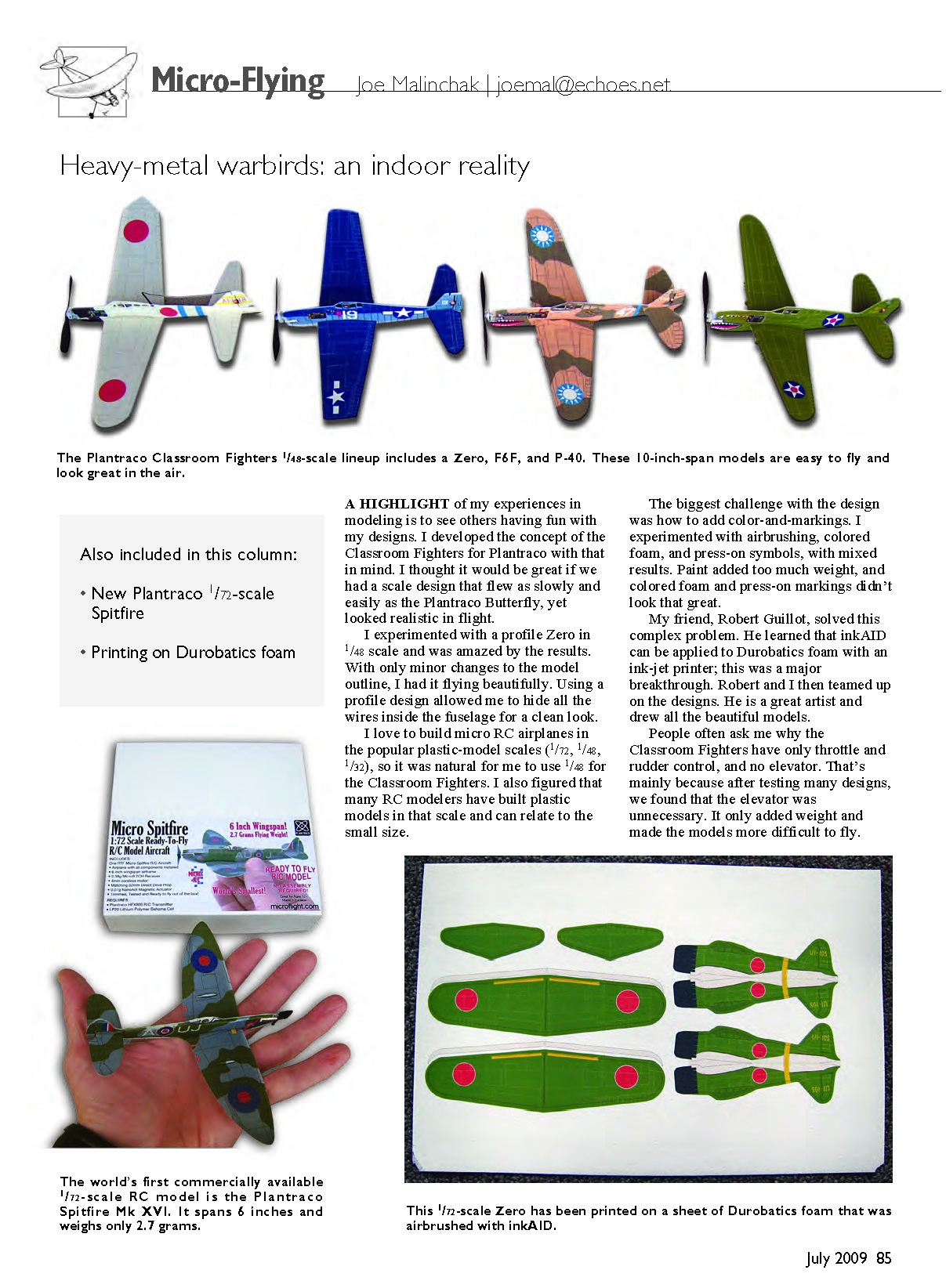
A highlight of my modeling experience is seeing others have fun with my designs. I developed the concept of the Classroom Fighters for Plantraco with that in mind. I wanted a scale design that flew as slowly and easily as the Plantraco Butterfly yet looked realistic in flight.
I experimented with a profile Zero in 1/48 scale and was amazed by the results. With only minor changes to the model outline, it flew beautifully. The profile design allowed me to hide all the wires inside the fuselage for a clean look.
I enjoy building micro RC airplanes in popular plastic-model scales (1/72, 1/48, 1/32), so it was natural to use 1/48 for the Classroom Fighters. Many RC modelers have built plastic models in that scale and can relate to the small size.
People often ask why the Classroom Fighters have only throttle and rudder control, with no elevator. After testing many designs, we found that the elevator was unnecessary — it only added weight and made the models more difficult to fly. The two-channel airplanes are nonetheless fun to fly and teach basic aerodynamic lessons: add power to climb, reduce power to descend. This "control-performance concept" is a basic instrument-flying principle. It can be challenging and rewarding to maintain a constant attitude and fly neat low passes just a few feet off the ground.
The main focus of the Classroom Fighter design was pure, easy flying fun. The models can be flown indoors or outdoors when the wind is calm. My favorite time to fly is just before dark on a nice summer evening.
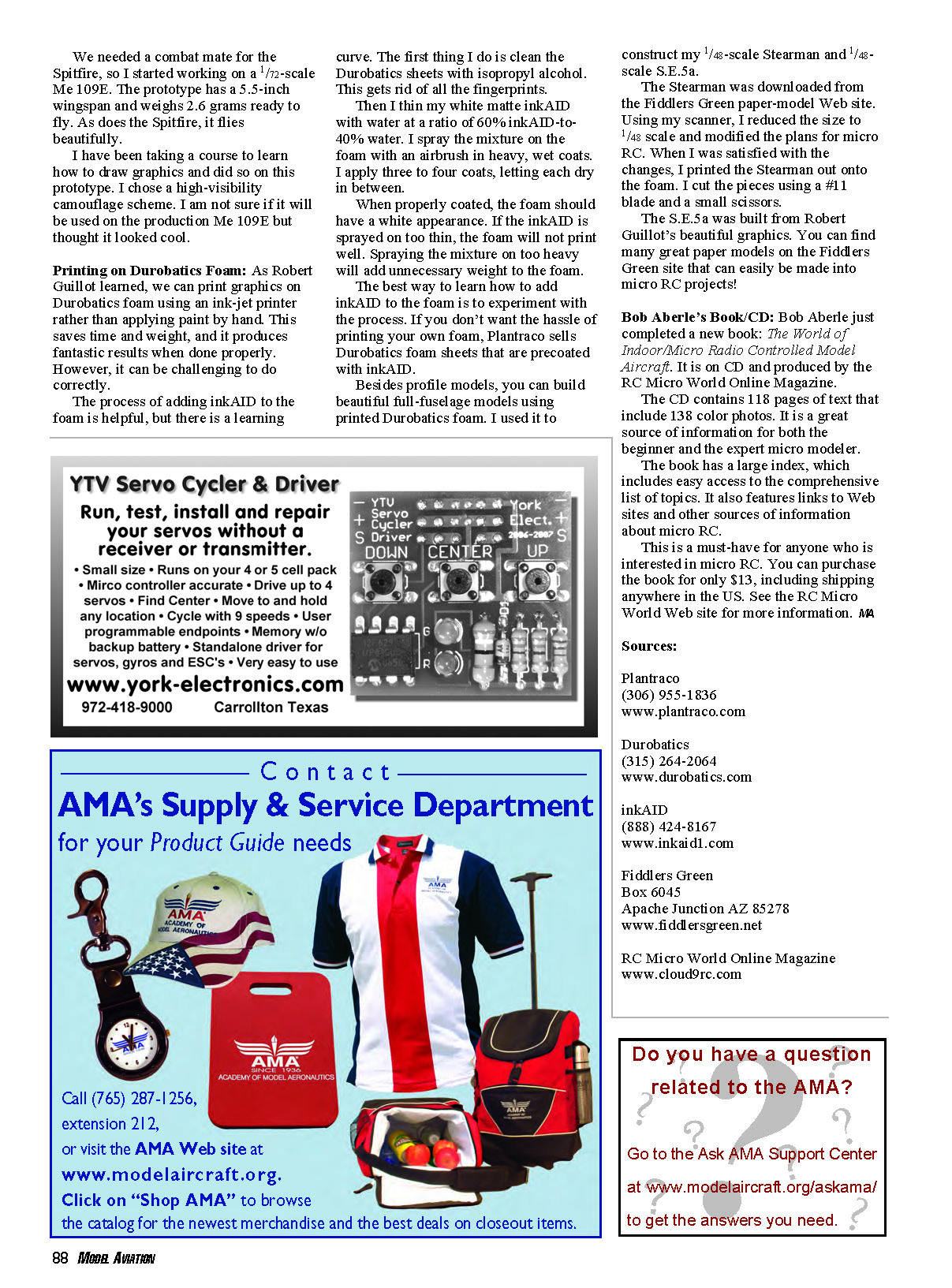
The biggest challenge with the design was adding color and markings. I experimented with airbrushing, colored foam, and press-on symbols, with mixed results. Paint added too much weight, and colored foam and press-on markings didn't look great.
My friend Robert Guillot solved this problem. He discovered that inkAID can be applied to Durobatics foam and then printed on with an ink-jet printer — a major breakthrough. Robert and I teamed up: he is a great artist and drew all the beautiful model graphics.
New Plantraco Spitfire
With the success of the Classroom Fighters, I decided to scale the models down to 1/72 to see how they'd fly. I built an F6F using a 13-ohm, 4mm motor and the 32mm propeller used on the Micro Butterfly. The F6F flew very well, so I immediately built a 1/72 Zero to test — it flew even better.
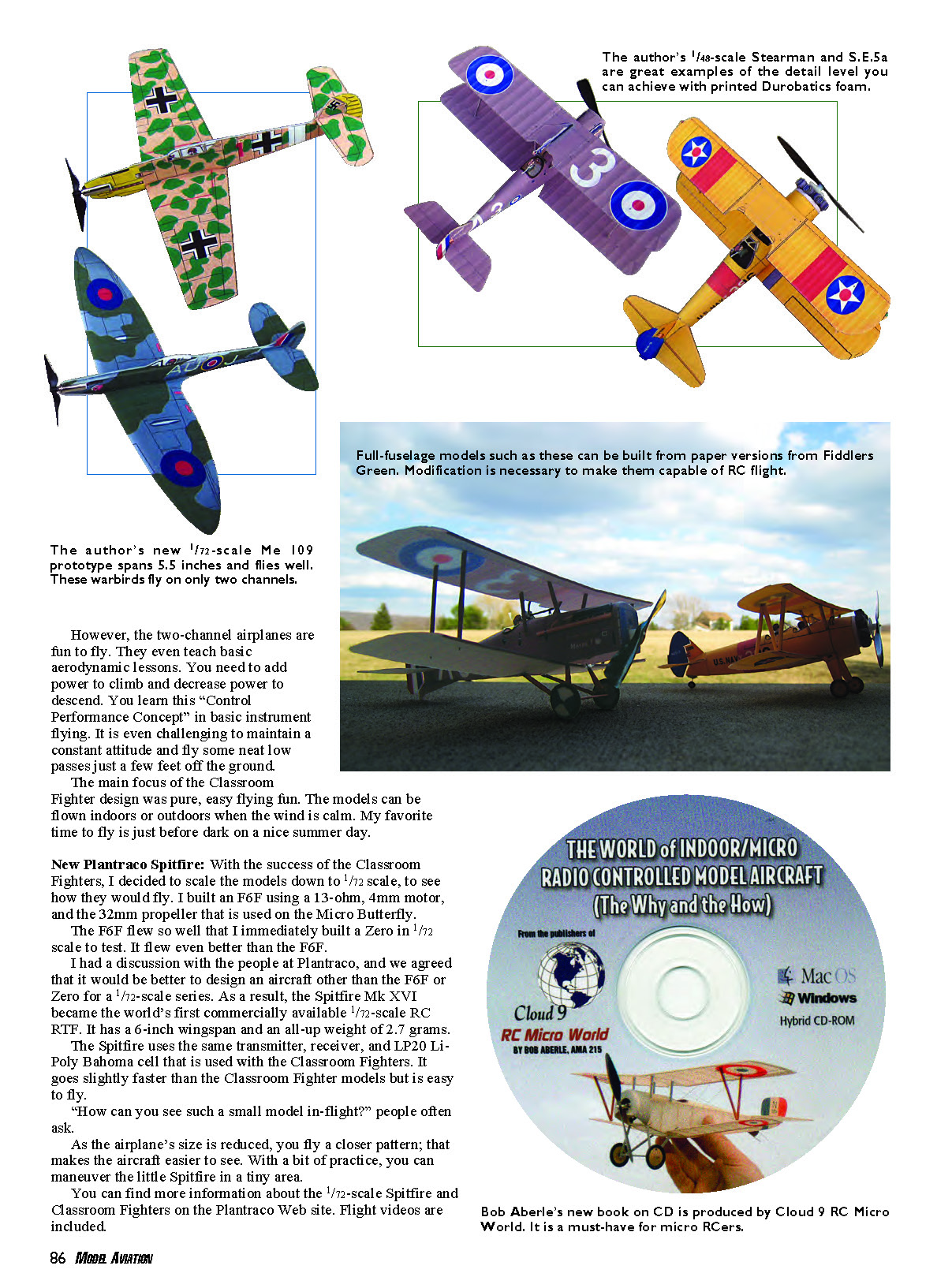
After discussions with the people at Plantraco, we agreed to design an aircraft other than the F6F or Zero for a 1/72 series. The Spitfire Mk XVI became the world's first commercially available 1/72-scale RC RTF. It has a 6-inch wingspan and an all-up weight of 2.7 grams.
The Spitfire uses the same transmitter, receiver, and LP20 Li-Poly battery cell as the Classroom Fighters. It goes slightly faster than the Classroom Fighter models but remains easy to fly.
"How can you see such a small model in flight?" people often ask. As the airplane's size is reduced, you fly a closer pattern, which makes the aircraft easier to see. With a bit of practice, you can maneuver the little Spitfire in a very small area. You can find more information and flight videos for the 1/72 Spitfire and Classroom Fighters on the Plantraco website.
We needed a combat mate for the Spitfire, so I started working on a 1/72 Me 109E. The prototype has a 5.5-inch wingspan and weighs 2.6 grams ready-to-fly. Like the Spitfire, it flies beautifully. I have been taking a graphics course and designed the prototype with a high-visibility camouflage scheme. I am not sure if that scheme will be used on the production Me 109E, but I thought it looked cool.
Printing on Durobatics Foam
As Robert Guillot discovered, you can print graphics on Durobatics foam using an ink-jet printer instead of applying paint by hand. This saves time and weight and produces fantastic results when done properly, though it can be challenging.
The process begins by cleaning the Durobatics sheets with isopropyl alcohol to remove fingerprints. Then thin white matte inkAID with water at a ratio of about 60% inkAID to 40% water. Spray the mixture on the foam with an airbrush in heavy, wet coats — apply three to four coats, letting each dry in between.
When properly coated, the foam should have a white appearance. If the inkAID is sprayed on too thin, the foam will not print well; sprayed on too heavy, it adds unnecessary weight. The best way to learn is to experiment. If you don't want to print your own foam, Plantraco sells Durobatics sheets precoated with inkAID.
Besides profile models, you can build full-fuselage models using printed Durobatics foam. I used it to construct a 1/48 Stearman and a 1/48 S.E.5a. The Stearman plan was downloaded from the Fiddlers Green paper-model website, reduced to 1/48 with my scanner, and modified for micro RC. After printing onto the foam, I cut the pieces using a #11 blade and small scissors. The S.E.5a was built from Robert Guillot's graphics. There are many great paper models on the Fiddlers Green site that can be adapted into micro RC projects.
Bob Aberle's Book/CD
Bob Aberle has completed a new book: The World of Indoor/Micro Radio Controlled Model Aircraft. It is available on CD and produced by the RC Micro World Online Magazine.
The CD contains 118 pages of text and 138 color photos. It is a great source of information for both beginner and expert micro modelers. The book includes a large index, links to websites, and other micro RC resources.
This is a must-have for anyone interested in micro RC. You can purchase the CD for $13, including shipping within the US. See the RC Micro World website for more information.
Sources
- Plantraco (306) 955-1836 www.plantraco.com
- Durobatics (315) 264-2064 www.durobatics.com
- inkAID (888) 424-8167 www.inkaid1.com
- Fiddlers Green, Box 6045, Apache Junction, AZ 85278 www.fiddlersgreen.net
- RC Micro World Online Magazine www.cloud9rc.com
Transcribed from original scans by AI. Minor OCR errors may remain.

